A sin of commission?
It took a court order from the Tribunal Electoral del Poder Judicial de la Federación, for the Secretaría de Gobernacíon to FINALLY admit that after having broken the very simple law in this country that says ministers of religion cannot proselytize for or against any particular political party, the Archdiocese of Mexico City (and its spokesman, Msgr. Hugo Valdemar) for flagrantly doing exactly that… specifically telling the faithful not to vote for the PRD.
The law is very clear on this, and the penalties aren’t a gray area in the law. The Secretaría de Gobernacíon normally would just pull the registration for the offending cleric and his congregation, which wouldn’t be all that great shakes if we were talking about the Second Independent Church of the Holy Spaghetti-monster of Fulanotitlan, Sonora… but we are talking about the Metropolitan Cathedral here, and the Cardinal-Primate of a country with (at least on paper) something around 80 million Catholics.
And, a federal executive from a Catholic party. So… the law be damned, while admitting there was a crime, the Sec. de Gob. has set up a “commission” to consider what actions to take.
While there are those who might find it delightful to simply force the Cathedral to close, realistically, I’m not sure what all can be done. At least on paper, the Catholic Church doesn’t have all that much in the way of assets in this country, the Cathedral and most art works in churches being government property (since 1854). Ironically, while intended to limit the power of the Church, it has worked recently to keep them from being held accountable in civil actions.
Profit centers for the churches (like schools) are separate organizations. Still, I imagine that — like it or not — Msgr. Valdmar should look forward to a transfer to some less visible post, and the Cardinal may have to take up a second collection to pay a nominal fine. And eat some crow. Otherwise, I don’t think anything is going to happen.
Illuminating comparison
So, how many U.S. Representatives and Senators does it take to change a lightbulb? I can’t believe (actually, I can) that light bulbs are a political issue in the United States. Rather than deal with something like their aggressive wars against other countries (and the trillions of dollars its cost them), unemployment, anemic stimulus packages, their out of control narcotics habit, or even the federal debt, the U.S. Congress would much rather spend their time fussing about light bulbs.
Do people in the U.S. have nothing better to do than come up with philosophical rationales for not changing their lightbulbs? From what I can tell, the anti-lightbulb lobby — mostly Republicans, but I guess they can be called “Dim-ocrats” — oppose more energy efficient lightbulb standareds on the theory that it limits consumer choice. Or, having already passed a bill changing the light-bulb standards back during the Bush administration, the Congress just needs to find something to distract itself from more serious business.
Or is it a question of cost… while all that nonsense was going on north of the border, here in Mexico, where it’s estimated that a quarter of electrical use is for lighting... the government just went out an bought 22.9 million lightbulbs, which it will trade for the old incandescent bulbs, though you have to screw them in yourselves.

Wheels of justice, turning ever so slowly
With a slew of constitutional changes that strengthen human rights guarantees, the Supreme Court was FINALLY a able to rule that human rights violations by the military must be heard in regular civilian courts. The court decision was 9 to 3, the three dissenting ministers being Salvador Aguirre, Jorge Mario Pardo y Luis María Aguila. Minister Aguirre, is considered the most “conservative” of the court ministers (“minister” being the proper title for a Mexican judge. He is the only one of the 11 member court whose background is in politics, rather than in the courts or as a legal scholar, having been active in his native Jalisco in the more clerical circles of PAN. The other two ministers are both recent Calderon appointees.
On the other hand, justice reforms have stalled in Baja California, where only three percent of trials are being held under the new “oral argument” system. What is particularly troubling is the decision by state procurador Rommel Moreno Manjares, to NOT hold oral trials for organized crime cases. What bothers me is that this brings to mind the “special tribunals” the United States wants to use for alleged “terrorists”, which is defended by the odd logic that if they were treated as common criminal cases, there is a possibility that the person on trial might not be found guilty. Which isn’t justice, but prejudice seeking a legalistic cover.
Not that I’m unbiased towards gangsters, mind you. But by claiming one cannot use normal (or, in this case, reformed) legal procedures towards the worst suspected criminals, is to admit the justice system is incapable of imparting justice, or that justice can only be applied selectively.
Moreno may want to consider the history of Sicily in the 1970s and 80s, when organized crime was much worse than here in Mexico (and much more violent than anything we’ve experienced here) but the court system did manage to hold normal trials… it meant building bomb-proof courthouses, and judges and investigative magistrates were murdered along the way, but the Sicilians got to see and hear the criminals that they had been fearing for centuries as just the pathetic, loser crooks that they were… if the Sicilians learned anything, it was that protecting human rights and following procedures does not mean special rights for crooks… but equal rights for all, and that includes the human right to be tossed in the slammer for the rest of your life when you violate everyone else’s rights… something much better to know than just some “monster” has been taken away and…oh… at some point… something might or might not happen in some court… somewhere… somehow.
First, they came for the beer, and I said nothing…
Yup, somebody went there.
Mazatlan, Sinaloa- The president of the Partido Revolucionario Institucional (PRI) in Mazatlan, Maribel Chollet Moran said that her party stands in opposition to everything done by the new (PAN) municipal administration.
Mazatlan said did not want a Hitler, to repress all that with which you disagree.
This referring to the supposed repressive attitudes to exercise in the municipality mayor Alejandro Higuera.
At a press conference held this morning at a restaurant of the port, Chollet Moran said the offensive launched against the current administration drinkers on the boardwalk and other parts of the city, is just a smokescreen to divert attention major problems facing the municipality, as the issue of insecurity.
I t’ll be instructive to see how His Honor takes next week`s Marcha para diversidad, and the several planned after-parade events, including a well-publicized one on a public beach.
Either he`s gonna do something stupid (like with Carnaval, when he wouldn’t let GLBT groups distribute condoms provided by the Federal Secretaría de Salud) which would, it seems, force PRI to … er… come out of the closet on GLBT rights, or he’ll have to justify himself to the more reactionary wing of PAN, while trying to maintain the theoretical alliance he has with PRD.
See, not everything in Sinaloa has to do with narcos.
Neither here nor there
Facundo Cabral, the Argentine poet and musician who survived childhood abandonment, his wife and daughter’s death in an airplane accident, cancer, blindness, and political exile, all the while singing of hope for a better world, was murdered yesterday morning in Guatemala City.
Though Cabral was not overtly political, Argentina’s dictators, on the presumption that anything that makes you think had to be dangerous, forced the poet to flee into exile in 1976. Until 1983 he lived in Mexico, which he considered his second home.
Cabral was probably not the target of the killers. He was riding in a car driven by his promoter, a Nicaraguan who owns clubs throughout Central America and Colombia. So, naturally, the Los Angeles Times tosses in a reference to Mexican “cartels” in writing about the senseless murder of a man best known for singing “I’m from neither here nor there”
[youtube+”http://youtu.be/5Hq7CkVL4jo”%5DLos ricos también insultan
The matriarch of the clan, having managed to marry into an ambitious family, and strategic violence successfully built up the family business into a huge and profitable enterprise. Of the two daughters, the elder, who is heir to the family marries the hot stud … who turns out to be something of a cad. The stud, with the connivance of his father-in-law (who wants control of the family fortune himself) decide elder daughter is a bit too neurotic to run the business, so the stud and dad fight for control, as the younger daughter marries the nice non-entity who stands to inherit a rival firm. Then dies.
On the rebound, the younger daughter ends up marrying the nice non-entity’s brother. Although it seems to be working out, and younger daughter soon has a daughter of her own, it looks like the non-entity’s brother, like the hot stud, also has a wandering eye. Though some very tricky legal manouvering, he manages to not just divorce the younger daughter, but to disinherit their own daughter.
Now it gets even kinkier. Caddish stud and neurotic first daughter have a son, who inherits the business and has a son of his own. Meanwhile, disinherited daughter of the second daughter, as the rival family enterprise is growing rapidly, has been jerked around as her father works his way through a string of babes… and turning his business over to his son… who isn’t at all the man his dad was, and besides, isn’t at all healthy. So, disinherited daughter of the second daughter… has to be called in, and the business is put into her hands. Which she tries to merge with the original family enterprise, marrying her cousin, son of the stud.
Which pisses off the rival company board, but there’s not much they can do about it, although …. there is another daughter by the brother of the nice non-entitity that everyone seems to have forgotten about (oh… she’s been around, doing her own plotting, too). Who, after getting control of the rival company sets out to get her revenge on her brother-in-law, grandson of the stud and the neurotic elder daughter. She goes so far as to pay thugs to steal from the brother-in-law’s business, so he sends out his boys to mess her up, but they screw it up, and…
… that’s why we English-language writers diss the Mexicans!
In trying to work on a book I’m tentatively calling “Mexico Reflected in a Jaundiced Eye” — about the 400 or so years of English-language writers who came, who saw, who dissed.
I wonder if even those who were “colonials” or the heirs to the colonials (like William S. Burroughs and Jack Keroauc) aren’t also the heirs of the language itself, and if the language isn’t more a prisoner of history than we think.
Spain, and the Spanish language itself, is in many ways, what it is, and Mexico is what it is, due to that larger-than-life devious matriarch, Isabella of Castille. She

Isabella -- "it's good to be queen, better to be king"
wasn’t raised to take over the family business, i.e. the Kingdom of Castille and Leon, but, when her step-brother died in 1474, Isabella — just like your run of the mill telenovela matriarch — wasn’t above violence and chincanery when it came to gaining control of the concern. With troops from her husband, Ferdinand of Aragon (a not particularly important kingdom as those things go, more a client state of France than anything else), put down rival claimants to her right to rule as King of Castille (and she did style herself “King”).
Considering she’d been raised to do girly-girl princess things, mastering the foreign languages medieval kings were expected to know (Latin and French, for starters) and learning the law would have

Mr. Isabella
been enough, but good telenovela matriarchs have to be ruthless and ambitious, something Isabella discovered she had a real taste for. Ferdinand had been groomed as a military leader, and was probably better than some, but Isabella — who had to learn to wield a sword, and the fine arts of village pillaging and head-chopping in her twenties — was said to be the better general… and an even better quartermaster. How she fit into her suit of armor when she was pregnant has always been a mystery, but somehow she did.
At any rate, Isabella made Castille into the pre-eminent Iberian power, finally in 1492 capturing the last Moorish kingdom, Granada. Having made Castille the
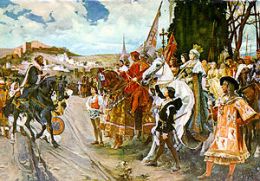
Merger and Aquisition: Surrender of Granada 1492
Walmart of Iberian kingdoms, Isabella decided to consolidate her holdings. Although Aragon, remained a separate country (and legally could not be ruled by a woman), it was more or less a subsidiary enterprise, with Ferdinand as CEO and COO in Castille, while Isabella worked on crushing any possible competition to Castillian rule, and — like WalMart or Starbucks — standardizing the operation company-wide.
Tossing out the Jews, and restricting the rights of the Moors was easy enough, but Isabella faced an unexpected problem that same year, when Christopher Colombus bumbled into a whole new market opportunity. Castille, Inc. was getting very rich off Pillagers-R-Us, aka, the Conquest of the Americas, the business of which would be conducted in Castillian. Along with everything else going on in 1492, Isabella decided her hilly-billy dialect of the Arabic and German influenced Latin spoken around Madrid was the language of her dominion.
Despite maternity armor, and probably better pre-natal care than most people at the time, the infant mortality rate in the fifteenth century was pretty appalling. Only two of her daughters survived her, Juana and Catarina.

Yeah, he looks like a dork but this is what passed for a stud in 1500. Philip and Juana
Juana, having been married off to Philip the Handsome of Burgundy (another of those small kingdoms eventually to be the merged into a conglomerate, in this case, France). the caddish stud who wrested control of Castille, Inc. away from Juana (mostly by convincing everyone she was nuts… which seems to have been true). Philip basically changed the name of the expanded enterprise to Spain, and father a child, Carlos, before his horn-dog ways caught up with him, and he died at the age of 28 mostly of exhaustion. Carlos I of Spain, who was also Charles V of the Holy Roman Empire, never would spend much time in Iberia (he didn’t like it much), but would have a son of his own, Philip II.

Catalina (Catherine of Aragon)
Although the new world was an extremely profitable acquisition, Isabella was always looking out for possible merger opportunities. Remember, Isabella was a whiz when it came to military logistics, and recognized that with her new world possessions, she needed to beef up her naval operations. She’d married off her eldest daughter, Maria, to the King of Portugal, but Maria died young, along with her son (who would have become king of Castille and Portugal), but — good manager that she way — Isabella had a back-up daughter, having married off Caterina to Prince Arthur, heir to the up and coming naval power, England. This was business. Arthur and Catarina were both still in diapers when they became engaged. The two weren’t married until they were 15, but Arthur was in very poor health and while they did manage to have a honeymoon of sorts, the kid died. On to Plan C… Catarina (known in England as Catherine of Aragon) .. not providing an heir to a joint Anglo-Castillian throne… married Arthur’s younger brother, Henry, right after he became King Henry VIII of England.
… stay tuned for the next episode of
Los ricos también insultan
“Along comes Mary… the blonde (naturally) femme-fatale”… and the return of Philip II”
State of Mexico 2011, Mexico 2012: que será será
Unlike Aguachile, I don’t see anything outrageous about a daily hiring a failed politico as a columnist. Rosario Robles, the former PRD party chair and interim governor of the Federal District between Cuauhtemoc Cardenas and Andres Manuel Lopez Obrador, is remembered mostly for being spectacularly less than successful in both jobs — and for her involvement in the messy “video-gate scandal, meant to discredit the Lopez Obrador, who kept saying it was a plot orchestrated by Carlos Salinas… which — as it turned out — was true.
Robles is hardly the first hack politico, nor the first disgraced politician ever hired by the media as a “pundit” … neither intellectual depth nor any particular skill as a prognosticator being a job requirement… though perhaps the creeping USAnization (if I can coin a word) of Mexican media, replacing “public intellectuals” — the historians, philosophers, novelists and academics who wrote trenchant columns on politics and public affairs — with failed politicians and (in the U.S.) washed up sportscasters, might be a cause for alarm.
But I don’t think Rosario Robles as a political commentator is nearly as interesting to Aguachile as the chance to return to one of his favorite topics of late:
Now, Robles argues in her column that a PAN-PRD alliance in Mexico State would have been useless, as the parties together were still beat by more than 30 points. This ignores completely two important points: An early demonstration of unity by PRD-PAN and a credible candidate might have created a very different dynamic and polarized the election. In turn, this might very well have elevated the turnout, which was the lowest in decades. It was exactly the much higher turnout, undoubtedly generated by voters actually believing the opposition candidate stood a chance and thus bothered to show up, which nailed the PRD-PAN triumphs in Oaxaca, Puebla, and Sinaloa last year.
Preferring to write on culture and history, I haven’t commented much (at least here) on these recent state elections, and I don’t think I’ve said anything about the supposedly watershed state of Mexico elections held last Sunday. For those who haven’t followed Mexican news, the PRI swept the elections, winning all municipalities, and the governor’s office. The only surprise was, that despite hopeful predictions by both PRD and PAN, the PRI did better than expected, winning about 63 percent of the vote, the PRD about 21 percent and PAN pulling in only a miserable 12.5 percent.
Robles is right that the two losing parties wouldn’t have even come close to PRI’s margin, but it doesn’t follow that a coalition of the two would have turned out more voters. I don’t see much point in engaging in “what ifs”, so while it is true that “An early demonstration of unity by PRD-PAN and a credible candidate might have created a very different dynamic,” that would have depended on there being a credible unity candidate available that wouldn’t have turned off as many true believers in either PAN or PRD as it brought to the polls, and that PRI voters would have stayed home, or switched votes. And, there wasn’t any such mythical candidate, and the PRI did a better job of turning out their voters.
Voter turn-out was only 45 percent, and might have been lower if there was a compromise left-right candidate. While weather was a factor (Ecatepec was flooded), it’s also true that people are just turned off by conventional politics. Younger voters are just refusing to vote (although the PRI received 71 percent of the youth vote in this election, I’m not seeing any figures on what percentage of younger voters turned out… the abstention among the young might be much higher than 45 percent).
Mexico Perspective, quoting columnist (or pundit?) Leo Zuckermann, writes on the relative popularity of the candidates that “name recognition” had a lot to do with this election:
[Governor-elect Eruvial] Ávila, unlike his two major counterparts, has been intimately involved in Mexico state politics in recent years, serving twice as mayor of Ecatepec, the nation’s largest municipality (Mexico City is not considered to be more akin to a state than a municipality). His old-guard counterparts, Felipe Bravo Mena of the National Action Party and Alejandro Encinas of the Democratic Revolution Party, both previously lost governorship bids in 1993, and since have been mainly involved in activities outside the state. While Encinas did well in the debates, he was not an attractive candidate, and Bravo Mena even less so.
Again, I have to wonder where the two opposition parties (of very different governing philosophies) would have found a candidate. And, more importantly, whether just winning the election is always worthwhile. Aguachile harks back, regularly, to the PAN-PRD successes in Oaxaca, Puebla and Sinaloa. In Oaxaca, there was a well-known coalition candidate for governor, but he was not from either of the two main opposition parties, but from Convergencia, and it was an all-party anti-PRI coalition in a state where even the national PRI found the sitting governor an embarrasment. In Puebla, the national party also found the sitting governor a problem, and here in Sinaloa, the coaliton candidate for governor was PRI until the last possible moment, then switched to PAN to run on the coalition ticket. He is widely viewed as just a change in PRI faction within the statehouse, and as bringing in his own cronies, putting in a “PRIAN” clique that has frozen out the PRD from any meaningful input into state policy. In Mazatlan, the PAN-PRD presidente municipal has started off his term by alienating youth, gays and tourism operators. And beer drinkers (enforcing new “blue laws”) which are hardly the kinds of actions dear to the heart of the average PRD voter… or the youth vote.
Mexico Perspective brings up one other point:
Zuckermann also said Ávila won on the coattails of current Gov. Enrique Peña Nieto, whose heavy spending on public works projects and other actions have kept him popular — so popular that he is the odds-on candidate to win the presidency next year.
At least the “odds-on” candidate by the pundocracy, and for all I know, they may be right. Peña Nieto may have an edge with the U.S. government, if they — as I expect they might — feel that a “free market” Salinas-protege is as much in their interest as a Calderonista who will continue the increasingly pointless “drug war”. In that case, and one really believes the State of Mexico election was a valid harbinger of the July 2012 election, then the PRD should run its own candidates, and avoid a PAN coalition. PAN will do very badly, and PRD would be a minority party in any case, so it is better off in a leftist coalition. It has more in common with smaller parties like PT and Convergencia, and in the Chamber and Senate can form a more effective opposition than it could as a left-right coalition which would have to compromise with PAN on economic and social issues (or take them off the table altogether) if it were to have any impact at all.
And, we’re forgetting the abstentions and voto nulo people, not to mention those potential voters that are off the radar right now… groups like MORENA (Lopez Obrador’s movement) don’t seem to show interest in the main parties, and may be waiting to see if it’s worth voting at all. Or, other things may happen.
It’s somewhat ridiculous to try to predict the election trends when contested presidential elections have only really been around since 1988 (where there was massive fraud), 1994 (when the PRI candidate was assassinated, and the replacement candidate likely won fair and square), 2000 (also likely having been wonbfairly, though not-so-covert assistance from the U.S. Republican Party played a role in the winner’s election) and 2006, still seen by nearly half the electorate as having been fraudulent.
Mexico has never had a normal presidential election, and there’s no reason to think this one will be either. And, if it were, it would be abnormal.
Seizing drugs… “UP” to a point
EL PASO — A border security program to X-ray every train rolling into the US has prompted as much as $400 million in fines against US railroads, which are held responsible for bales of marijuana, bundles of cocaine, and anything else criminals cram into the boxcars as they roll through Mexico.
Union Pacific, the largest rail shipper on the US-Mexico border and the largest recipient of fines, refuses to pay more than $388 million in fines, up from $37.5 million three years ago when the screening began. In federal litigation the railroad argues that it is being punished for something it cannot control: criminals stashing illegal drugs in railcars in Mexico.
…
… The federal government recently signed a partial settlement with the railroad, releasing 10 seized railcars in exchange for $40,000, and agreed to return to negotiations with the railroad, according to court records.
When I was in Alpine, Texas, I supported my writing habit in large part by working as a chauffeur for Union Pacific crews, picking them up often in sight of the Mexican border, and occasionally at the Sierra Blanca siding, where the Border Patrol inspects cargo coming across the border. That doesn’t make me an expert on railroads (or anything else, really) but when two guys (and that’s the entire crew on a train… a brakeman and an engineer) have to “tie down” a train a half-mile or longer in the middle of an isolated rural siding and that train may sit for days, only to be moved in the middle of the night, it’s pretty easy to see how contraband gets aboard… and that’s not even talking about what’s in the cargo, or what goes on in the rail-yards (I once saw a boxcar on a siding that some jokers had repainted as belonging to the “Sinaloa Growers Association,” with a big marijuana leaf logo). There probably is no good way to completely guard against illicit cargo on a train… or a truck… or private automobiles for that matter.
 The U.P., which has always had excellent lawyers (going back to the 1850s, when the Alton and Sagamon Railroad Company — a part of which was later folded into U.P — hired a litigator named Abraham Lincoln). The railroad — which has invested about 80 million dollars in better security and training — claims it is doing the best it can. And, the fines are a little ridiculous — from Trains: THE magazine of railroading:
Under a 1930 law requiring an accurate manifest of everything on board a train, the U.S. Department of Justice fines UP $500 per ounce of marijuana and $1,000 per ounce of heroin or cocaine that reaches the United States on UP trains. These fines now exceed $388 million.
One comment you read from railroaders is that it’s the Mexican’s job to secure against contraband, and it’s a good point… but seeing that Union Pacific is a quarter owner of Ferrocarril Mexicano, it wouldn’t let them off the hook, and  ould raise two much more interesting question. If the investment in protecting against contraband is considered sufficient in the United States, how much would Union Pacific kick in to prevent contraband (especially weapons) from crossing into Mexico? And — given that U.P. has paid some fines (basically admitting the government has a right to take action against the railroad) — how much of an investment, and in what kinds of security measures would be considered due diligence in Mexico?
And, if the Union Pacific wins, how much do other transporters need to invest to prove they are guiltless when it comes to cross-border illegal trafficking? How much are we — on both sides of the border — willing to pay for extra freight costs. For that matter, if an ounce of marijuana is held to be worth 500 dollars in damages in the United States, what price should be put on an AK-47 or MR-15 that kills a person here?
Arbeit Mach Frei
The Major League All Stars game… scheduled for Phoenix’s Chase Field next Tuesday is supposed to highlight professional baseball’s finest… although, being in Arizona, since the passage of the “Show us your papers” law, aka SB 1070, that could be a problem:
… 27 percent of MLB players are Latino, compared to 16 percent of the general population. Since its passage, SB 1070 has been condemned by civil right groups because they say it would lead to racial discrimination against Hispanics by police, who under the law are required to request identification from anyone that they have a “reasonable suspicion” is an undocumented immigrant. A federal judge has issued a preliminary injunction blocking this part of the law from going into effect.
but leave it to Sheriff Joe Arapaio to attempt to turn it into a showcase of Arizona justice at its most —I donno —Belsen-Bergenish Fuckedupish stone-cold friggin’ nazi-level insane!
The Arizona Republic reports a group of inmates from the sheriff’s holding area for suspected illegal immigrants will be on the chain gang with drunken driving offenders. All will be chained together and decked out in their striped jail uniforms.
Arpaio says it’s his way of sending a message about the perils of drunken driving.
So, if this is about the “perils of drunk driving,” what are the “suspected illegal aliens” doing on the chain gang? And, will those baseball players (assuming they show up, or the fans who are suspected of having a good tan) get the message that breathing while brown in Arizona is also perilous?

Veracruz… where the buffalo roam?
Cuatzacoalcos, Veracruz cattle-man José Facundo Montalvo Burgos is encouraging his fellow breeders to think about changing their ways slightly, and letting the water buffalo roam southern Veracruz.
An advantage of buffalo is that the same animal can provide both milk and meat, although, as with cattle, farmers usually specialize in one or the other. In India, buffalo provide 30 million tons of milk annually, and — although there are breeds of buffalo bred especially for meat production — your run of the mill average buffalo has less fat and bone than your average steer, and a leaner meat.
 And, if milk and meat aren’t plenty from one animal, or if you feel attached to old Flossie, she can be put to work as a draft animal. Try getting a Holstein to pull a plow. And, on top of that, buffalo are not particular picky eaters.
The big advantage is these guys are called “water buffalo” in English for a reason… they love swamps, and southern Veracruz is swampland… an ideal environment for what in Mexico is known as búfalo de la India.

And… I suppose there is a way to get real Buffalo Wings from them, too.
Sources:
All About The Buffalo ( Indian Dairy Industry)
Jornada
Also, check out:
Water Buffalo Recipes (Broughton Farms, U.K.)
U.S. Citizens at extreme risk!
… maybe not of execution … not in Mexico anyway, which is relatively civilized (and doesn’t have a death penalty), but any of us who are U.S. citizens, and travel abroad, or live abroad, are in imminent danger of having our rights violated, in the event we are arrested or detained for any reason… “thanks” to Rick Perry and the State of Texas.
At least some Texans get it. From the San Antonio Express-News:
Unless Gov. Rick Perry grants a last-minute reprieve, the state of Texas will put Humberto Leal to death today in Huntsville. Leal may well be guilty of the gruesome murder of a 16-year-old girl in San Antonio in 1994. That’s not the most contentious issue of his case.
What is being contended is U.S. compliance with its obligations under the Vienna Convention on Consular Relations. The U.S. Senate ratified the treaty in 1969, which requires nations to notify consular officials if a foreign national “is arrested or committed to prison or to custody pending trial or is detained in any other manner.”
Leal is a Mexican citizen. Yet officials in the Texas criminal justice system never informed him of his right to contact Mexican consular officials, nor did they inform those officials that a Mexican national was in their custody on a murder charge.
The notification might not have made any difference in the outcome of Leal’s trial. But proceeding with his execution without following the Vienna protocol will have dangerous consequences for Americans who live, work or travel abroad.
“If we do not comply with our obligations under the Vienna Convention,” John B. Bellinger III, who was the U.S. government’s senior international lawyer in the administration of President George W. Bush, told the New York Times, “we put at risk Americans, including Texans, who travel and may be arrested overseas.”
If this case sounds familiar, it should. In 2008, the Bush administration argued at the U.S. Supreme Court in favor of a retrial for Texas convict Jose Medellin, a Mexican national convicted of murdering two Houston girls. The court ruled that only Congress could require states to comply with the Vienna protocol by passing a federal law.
In the absence of such a law, Perry refused to halt Medellin’s execution. Three years later, there’s still no law.
While there’s no reason to believe Perry will act differently in the case of Leal, there are once again compelling reasons why he should. The bigger issue is that Congress must act.
Last month, U.S. Sen. Patrick Leahy, D-Vt., introduced the Consular Notification Compliance Act. That’s too late to be of any consequence in the Leal case.
But if Congress does pass the measure, it would finally help ensure U.S. compliance with the Vienna Convention. That, in turn, would strengthen the legal protections of Americans citizens who are detained or charged with crimes in other countries.
One thing Calderón did right…
… and he should get credit for: making a convincing case for the need to take climate change seriously — a much better job than the leaders of some other North American Free Trade Association countries (two I could name).
From Mexico Today, “a joint public and private sector initiative designed to help promote Mexico as a global business partner and tourist destination.”


 mexfiles.net