21 de mayo de 1911 – 21 de mayo 2011

The Treaty of Ciudad Juarez was signed 21 May 1911, under which Porfirio Diaz and Secretario de Hacienda (Secretary of the Treasury) Jose Limantour to both resign, making Foreign Secretary Francisco Leon de la Barra the interim president until new elections can be called. In recognition of the 10oth anniversary of the Treaty of Ciudad Juarez, the city has been officially designated “Heroic”. peaking at the ceremony surrounding Ciudad Juarez’ new official status (a not-unusual civic designation, although usually an honor awarded to cities that resisted foreign intervention, as in “Thrice-Heroic Veracruz” where an attempted French landing by French marines was beaten back by the Mexican army under General Santa Ana in 1838 and civilian and military resistance to the two U.S. landings of 1846 and 1914).
Of course, the 1911 Treaty was only the first act, of the first act of a major social revolution (de la Barra did everything possible to set up the Madero administration for failure, and — when it did (with a healthy assist from U.S. Ambassador Henry Lane Wilson) led to a violent social revolution, the mother of all anti-imperialist uprisings of the last century, and the Mexican people attempting to gain control over their natural resources and export economy.
Under the terms of the Treaty, the irregular forces seeking to overthrow the Diaz government were incorporated into the Federal Army. According to Felipe Calderon, the “lesson” of the Treaty of Juarez is that the various political parties … and the “irregular political forces” of people like Javier Sicilia … should be incorporated into his “war on drugs” that allow for more foreign control over at least one natural resource and an important part of our export economy.
With assurances that a disorganized state cannot deal with organized crime, Felipe Calderon called for Mexicans to leave behind recriminations and “absurd accusations” and unite to curb insecurity.
As he and Chihuahua Governor Cesar Duarte led festivities marking the historic 100th anniversary of the Treaty of Ciudad Juarez, which was signed on 21 May 1911 marking the triumph of the Revolution and the exile of the dictator Porfirio Diaz, The PAN politician was clamoring for unity without dissent.
“We must work more and more coordinated way, as we’re doing today, and with increasing effort in the State of Chihuahua, because you can not deal with the crime without considering the strength of organized crime, and you can not face the organized crime with a disorganized state. I know that together we can overcome any challenge, “he said.
A critique of reporting on Mexico
A journalist doesn’t have to live like an impoverished local. But the less local life you experience the less you can do your job, and this is what readers need to understand. The average person anywhere in the world goes to work and comes back home. He knows little about people outside his social class, ethnic group, neighborhood, or city. As a journalist you are making judgments on an entire country and interpreting it for others, but you don’t know the country because you don’t really live in it. You spend twenty hours a day in seclusion from the country. You have no basis for judgment because to you Iraq is out there, the red zone, and the pace of filing can make this even harder.
U.S. journalist and reporter, Nir Rosen in “A Critique of Reporting on the Middle East” (Jadaliyya, “an independent ezine produced by Arab Studies Institute)
I am thankful to the Agonist, for its link to Rosen’s essay, since a journal for Arab affairs nerds is not my normal reading: narrow specialization in our own field being an industrial ailment to which scholars and journalists (even self-defined ones) are particularly prone.
The essay is well worth reading, whatever our specialty. What Rosen writes about about U.S. (and “western”) journalists in the middle-east applies as well to any of us writing about countries not our own, even when the reporter is someone like Rosen, a bona fide scholar of the particular corner of the planet he happens to write about, and where he lives, and who can make a living from his writing, with paychecks from heavy hitters like Rolling Stone and the New York Times.
Too often consumers of mainstream media are victims of a fraud. You think you can trust the articles you read, why wouldn’t you, you think you can sift through the ideological bias and just get the facts. But you don’t know the ingredients that go into the product you buy. It is important to understand how knowledge about current events in the Middle East is produced before relying on it. Even when there are no apparent ideological biases such as those one often sees when it comes to reporting about Israel, there are fundamental problems at the epistemological and methodological level. These create distortions and falsehoods and justify the narrative of those with power.
According to the French intellectual and scholar Francois Burgat, there are two main types of intellectuals tasked with explaining the “other” to Westerners. He and Bourdieu describe the “negative intellectual” who aligns his beliefs and priorities with those of the state and centers his perspective on serving the interest of power and gaining proximity to it. And secondly, there is what Burgat terms as “the façade intellectual,” whose role in society is to confirm to Western audiences their already-held notions, beliefs, preconceptions, and racisms regarding the “other.” Journalists writing for the mainstream media, as well as their local interlocutors, often fall into both categories.
While I have carped for years that Latin America receives much less attention from the media than it deserves, and sometimes am happy enough to see Latin American news in the mainstream media, even when it is less than as detailed as I would like, it seems that Rosen’s “Critique” applies equally well to this part of the world. We fully expect ideological biases when the subject is, say, Cuba or Venezuela (knowing for certain anything in the Wall Street Journal or Miami Herald will be uniformly negative), it isn’t so easy when the subject is, for example, Mexico.
This isn’t to say that there aren’t good journalists (mainstream and otherwise) who aren’t doing a good job in Mexico, or elsewhere in Latin America, but that they operate under the same limitations as any journalist in any “outside” culture.
The ideological biases are perhaps more subtle (no one “explains” Mexico by crude half-baked notions of Roman Catholicism, the way Arabs are “explained” in terms of a shallow sense of Islam, for example) but the ideological biases certainly exist. I’ve heard more than one good reporter complain privately or publicly that even if they want to write about something else, they have to bring in the “drug war”. … or whatever the euphemism is today. Ganchoblog — Patrick being one of those who sometimes is a mainstream journalist and has to make a living — has complained about this, as have other journalists (off and on the record), proposing the “Crowbar Award” for those reporters who somehow manage to slip in mention of narcotics smuggling into any news item about Mexico.
Rosen mentions something similar, writing, “I once asked my editor at the New York Times Magazine if I could write about a subject outside the Muslim world. He said even if I was fluent in Spanish and an expert on Latin America I wouldn’t be published if it wasn’t about jihad.” Had he been sent to Mexico, undoubtedly, he would have been expected to write on supposed jihadist activity in this part of the world (don’t laugh… even National Public Radio found it necessary to report on length on a “latino” Islamic convert suspected of terrorist activities, as a worrisome trend).
Countering “jihad” is the justification for U.S. belligerence in the Middle East, therefore, to support the ideology, “jihad” is the focus of U.S. media attention. Similarly, U.S. intervention in Mexico is justified for now on the premise that it is designed to counter narcotics smuggling making it ideologically unwise to focus attention on the very good reasons the narcotics industry exists (like the damage done to Mexican agriculture by NAFTA).
When I first moved here, every mention of a Mexico City neighborhood that wasn’t one where the mainstream media types lived (or, rather, where the official sources lived) was described as the “teeming slums”. I half-seriously suggested that “teeming slum of” was the name of most colonias in Mexico City . I hadn’t heard of Francois Burgat, but his terms make perfect sense. “Teeming slums” was short-hand for “desperately poor” (and, by extension “not our kind” — “façade intellectualism” meant to explain the popularity of, at that time, the “leftist firebrand,” Andres Manuel Lopez Obrador. It was left to the “negative intellectuals” to explain (as they did ad naseum in the mainstrem press) that “populism” was an ideological danger equaled only by “jihad terrorists”.
The problem is that the reading public is cheated. Both the “terrorism” we read about in the mainstream press in connection with the Middle East, and populism of the Latin American variety are reactions to the imposition of policies based on social and political biases not shared by the people (among whom the journalists really have no connection).
Certainly, those of us foreigners who fancy ourselves ” local interlocutors” share many of the same traits as the mainstream journalists. While a few of us have come close to living as “impoverished locals”, the reality is we are conscious of that impoverishment (and write about it in foreign languages) as an experience of the “others” — as poverty tourists.
More than a few who comment from (and on) Mexico manage to live secluded from their neighbors and from those outside their own social class. We are always tempted to make generalizations about the country and its cultures (if we remember there are many cultures, and many different classes in the country) based on very little direct knowledge of anything outside our own narrow experience.
Not expecting any ties to the power elites here, I hope to at least have avoided falling into the trap of becoming a “negative intellectual” and my own biases (unapologetically admitted and openly expressed) have seldom aligned with the “official” biases expressed in the mass media, and hopefully saving me from working as a “façade intellectual”.
Of course, this is not, and never will be a “mainstream media” site. Or all that influential. Not that it was ever intended to be either mainstream or influential (though I’m pleasantly surprised it has some minor influence). It’s more important to me — and more important for those who care about Mexican events — that more focus be put on “the ingredients that go into the product you buy.”
That product is largely the creation of both negative and façade intellectuals of the past, which just happens to the subject of a book I’ve been putting off, and need to put my time into. At the end of this month, I’ll be on indefinite “sabbatical”, posting Mex Files only occasionally.
Greater love hath no woman…
I am not going to be the first or the last woman who decides to get a divorce, but I am the only woman to get a divorce for her country.
Guatemala’s future ex-first lady, and potential future President, Sandra Torres, after the constitutional courts turned down attempts by conservative lawyers to nullify her divorce from President Álvaro Colom.
The Guatemalan Constitution precludes the president’s spouse (and close relatives) from running as their successor, but nothing is said about ex-spouses. Politics makes for strange bed-fellows, and vice-versa (whatever that might happen to be).
There is probably a good reason for this legal restriction, though I admit I don’t know enough about Guatemalan history to even guess what it might be. While other than Argentina, where Christine Fernandez de Kirchner succeeded her husband Nestor Kirchner (and Isobel Martinez de Peron was Vice-President under Juan Peron and succeeded to the Presidency when Peron died in 1974), I can’t think of any other examples in the Americas, although a number of wives have succeeded their husbands in lesser offices — as state governors or legislators in the United States, Mexico and elsewhere in the Americas.
Sex, money, power: ask a Mexican?
(Sorry, all — my keyboard is STILL possessed by demons, and is under some gringo voodoo curse that won’t let me type accent marks)
Since 1945, the International Monetary Fund has seen its role as “oversee[ing] the global financial system by following the macroeconomic policies of its member countries institutional lender”. In other words, using money and power to satisfy the urges and desires of those with power and status in the world economy, even at the expense of the health, safety and dignity of those who are on the receiving end. Sort of metaphorically what its managing director, Dominque Strauss-Kahn, is now sitting in a New York City jail is accused of doing to a hotel maid, supposedly an immigrant from one of countries whose institutional lenders are “overseen” (or is it overpowered?) by the IMF.
Strauss-Kahn is only the latest in a string of IMF Managing Directors brought low by his own (mis)behavior on the low-down, the organizations board is having to find a new leader, one that it is hoped, might keep the organization out of the crime pages and in the financial pages of the international press. In some ways, the IMF is like the Roman Catholic Church. Not in having been beset with scandals involving sexual abuse, but in that it is largely a European institution of international scope, with the decision making directorate heavily weighted in favor of those who designed the mechanism for making the rules and chosing their leader. The Church, to its credit, has been sort of evening out the College of Cardinals over the last several years, appointing more Americans, Africans and Asians to balance out the plethora of Italians who ran the Vatican for the last millenia, while voting rights in the IMF executive board are weighted based on the economic value of the board member’s country in the exisiting neo-liberal system.
And, like with the election of the Pope, when selecting a Managing Director, those who are openly seen by the public at large as lobbying for the top job are often rejected by those who actually make the decision in their own conclave.
But, the IMF has to share its pretentions of controlling the economic way and the truth with the Word Bank. Keeping the world powers happy, the head of the World Bank is usually from the United States, and the IMF from Europe.
The media wisdom is that the next IMF managing director will be another European, although there is speculation that the IMF board will look for an “outsider” — by birth, not by adherence to orthodoxy that is.
Geman Chancellor Angela Merkel has been “demanding” that the IMF executive remain in European hands, basically to defend the Euro, but — as Thorsten Benner argues in Der Spiegel —
A tight grip on the top IMF post weakens Europe because it damages Europe’s credibility at a time of significant and rapid global power shifts. And without credibility, Europe will find it more difficult to encourage rising powers to play a constructive role in international institutions. Newcomers to the power stage have in the past hidden behind the argument that they have not been allowed to wield influence — an argument that allowed them to cover up a lack of political will or courage to face tough international issues. That argument would evaporate if Europe were to relinquish its privileges.
Benner also writes:
The excuse for the tight European grasp on the top IMF slot is the ongoing euro crisis. But while Merkel may not immediately grasp the paradox of this argument, countries like Mexico and Brazil certainly do. During the Latin American and Asian financial crises, Europeans certainly didn’t make the case that the IMF should be led by someone from the affected regions.
Although Benner, like so many, when thinking of medium sized economic powers, focus on the historically expansionist minded Brazil (which spent the first century of independence mostly trying to grab chunks of its neihbor’s territories) as opposed to Mexico (which spent its first century fending off territorial chunk-grabbers), no Brazilians in particular have surfaced as possible IMF managing directors- Two Mexicans have.
The talk about former president Ernesto Zedillo — who basically oversaw the legitimization of the neo-liberal social and political changes (and economic disasters) imposed by the IMF on Mexico — is mostly in the Mexican press (and seems based on speculation by some Harvard professor) and University of Chicago educated former IMF Executive Director Augustin Carstens Carstens.
Carstens, who after his IMF stint served as Treasury Secretary in the Calderon administration won plaudits for, of all things, borrowing wazoos of money from the IMF — 72 billion dollars to be exact. It was, of course, due in large part to the fact that Mexicans don’t follow the U.S. and European financial ideas on a personal level (people buy a house to live in… with cash… not as a speculative investment, nor do they use credit cards all that much and people are only dragged into the banks kicking and screaming), and because the very anti-neo-liberal ides of putting in strict banking regulations still made sense during the last banking crisis (under Zedillo’s administration) that Mexico has a relatively healthy economic situation (as far as the IMF is concerned, never mind how individual Mexicans were doing) while Euopeans and those in the U.S. were facing economic melt-down (on a personal and institutional level).
Bottom line — Mexico didn’t need the credit, but by upping their credit limit, they cushioned the rich countries economies, and put off the eventual day of reconing with the inevitable clash between limited resources and unlimited money. Which makes Carstens a big man in the international financial system.
Of course, he’d be a big man anywhere. There’s no way around it. He’s fat. He’s really, really, really fat.
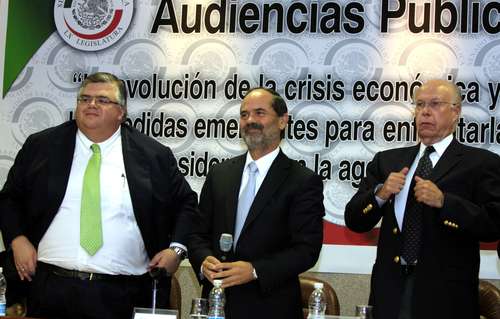
Um, three guesses which one is Carstens
The guy looks like the Michelin Man. Which, given that Michelin is a French company, might at least give some satisfaction to those who want to keep a European (and French) face at the top of the heap. More importantly, can you see anybody having sex with the guy? I suppose — given the temption (that I gave into at the beginning of this post) to make atrocious metaphors out of the sexual predation of previous IMF managing directors and the wretched of the earth, we could say he’s capable of crushing any resistance by African maids… but really… the maids of the world’s luxury hotels at least have a fair chance to outrun the guy, as he looks for his… uh, I guess that’s enough out of me.
Economic directions
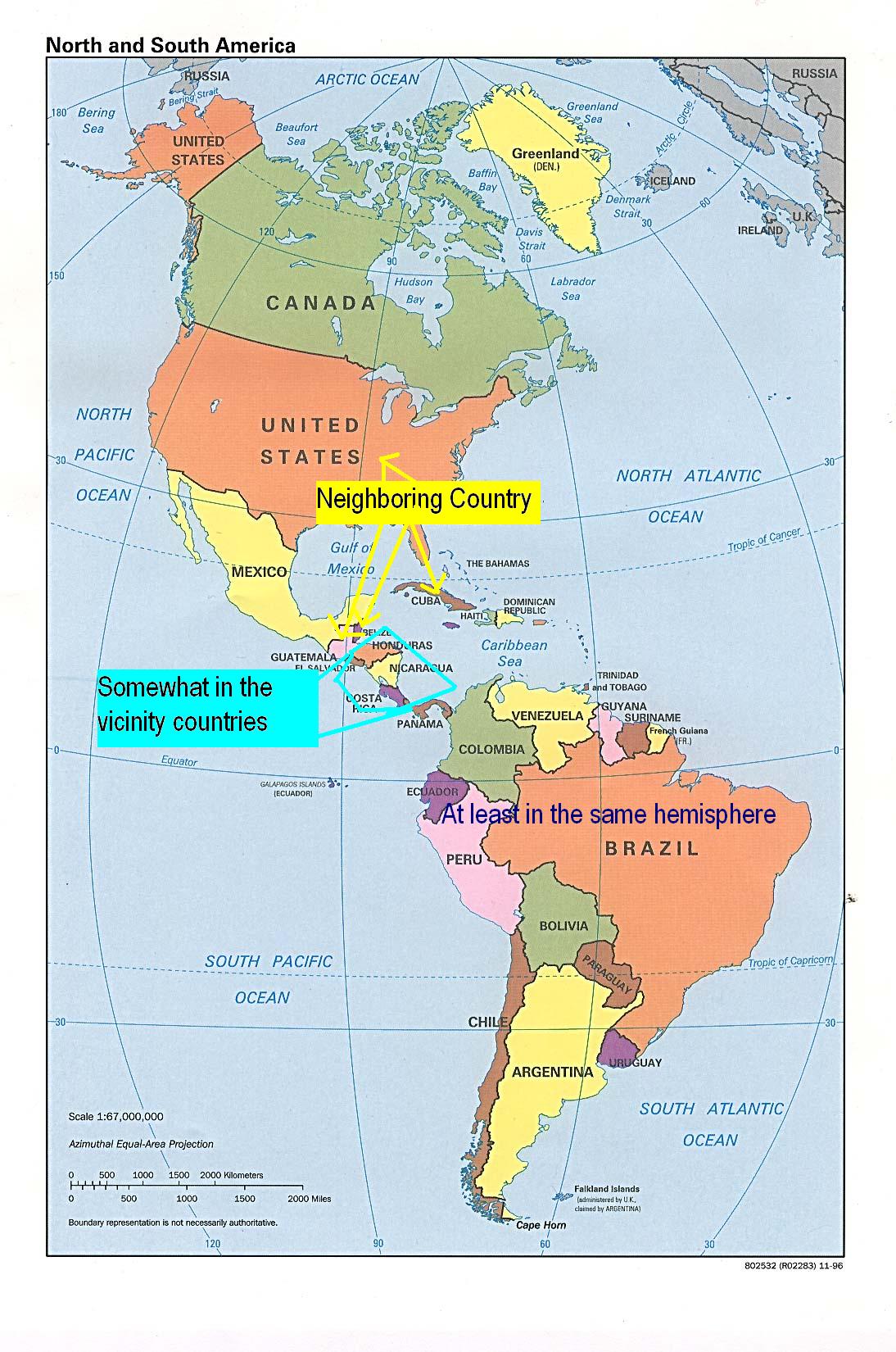
Investors are piling into Mexican bonds as a record gain in the peso keeps price increases near a five-year low and bolsters dollar-based returns on local assets. Neighboring Brazil and Peru are seeking to stem advances in their currencies while struggling to keep inflation below their targets.
(Peso’s Advance Has Foreigners Piling Into Fixed-Rate Bonds: Mexico Credit, Bloomberg 17 May 2011).
Perhaps “neighboring” means something special in bond markets, or at Bloomberg, but for those of us uninitiated in the arcana of this field, the word usually means something a little closer than within the same hemisphere.
Sustainable cities… or strategic hamlets?
I’m having some very odd computer problems (a virus perhaps?) so if the formatting is off, and there’s a lack of accent marks where there should be, there’s not much I can do about it, and am muddling through.
There have been several articles around the left end of the blogosphere (Latin American division) about the Chiapas “Rural Cities Initiative”. Jeff Conant in Upside Down World explains:
In 2009, the state launched and began widely publicizing its Climate Change Action Programme (CCAPCH). The plan includes vast biofuel plantations, forest carbon offset projects, and a statewide “productive conversion” initiative to convert subsistance farmers into producers of African palm, Jatropha, and export-oriented crops such as roses, fruits, and coffee.
The plan also includes a program called the Sustainable Rural Cities initiative; under this plan, the state is developing between six and twenty-five prefabricated population centers designed, according to the state’s publicity, to “promote regional development, combat the dispersion and marginalization of local peoples, and play a significant role in making efforts [to develop infrastructure and provide basic services] cost-efficient.”
Conant goes on to quote Chiapas Governor Juan Sabines as stating that the goals of this project are “to mitigate poverty, to mitigate the risk of people facing climate-related disasters, and to reduce the threat of global warming. It is based in the Millenium Development Goals of the United Nations, which in Chiapas are obligatory.”
The complaints — everything from a stumplifyingly dull design (as planned communities tend to be, especially those built not for the rich but for the poor), the high cost of utilities and problems with transportation — are the things you’d expect in any planned community. However, given that the project is designed both to “free up” land for large-scale development (industrial farming) and to set aside land for biosphere protection* there are some more sinister connotations put on the projects, fostered — as all controversies are in Mexico — by historical reference. From Sustainable Rural Cities, a Nightmare Comes True in Chiapas :
“Rural cities were not invented by the state and federal government of this administration, but have a very long history, going back, for example, to the colonization of Latin America. At that time they were not called ‘rural cities’ but were known as ‘reducciones’, with the aim of making control of the population easier and more efficient in order to collect taxes (tribute), to use the people as labour for mines, plantations (most frequently sugar cane), for the construction of cities for the Spanish, and, of course, for political and military control. It is also true that then, as now, they argued that there would be benefits for the population directly affected, that by concentrating a population they can be provided with access to basic services of potable water, education, health, etc..”
The first of the Sustainable Rural Cities was Nuevo Juan de Grijalva, which was hastily built, to replace the old Juan de Gijalva, wiped out in a mudslide triggered by a dam failure. I saw it (and still do) as somewhat admirable in that the Mexican government was able to provide shelter and services to the affected population after a disaster in record time, espcially compared to the cock-up following the hurricanes in Lousiana and surrounding states. Being built overnight (for all practical purposes), one expects it to be somewhat raw, and expects that the place will develop its “personality” only with time. One thinks of colonias that spring up (or suburban communities) that have a certain sameness to them originally, but as people express their own ideas (painting their houses, adding shops in their front rooms, etc.), cobbling together a transit system, etc. these places eventually take on an existence as a viable community.
HOWEVER… that’s assuming Nuevo Juan de Grijalva was an unplanned planned community, and wasn’t just built out of some pre-existing concept, but was rushed into execution after the dam-burst. That is, as Naomi Klein would have it, the “shock doctrine” in practice. There’s good evidence of this (again from “A Nightmare Come True…“):
…in 2008 the presidents of Colombia, Mexico and other Central American countries signed the trade agreement Plan Mesoamerica (a new version of the Plan Puebla Panama). The purpose of this plan is to create an infrastructure and trade corridor that connects Southern Mexico to Colombia, and this area is intended to serve big capital. On the other hand, the political and economic plan of the World Bank, outlined in their report entitled ‘New Economic Geography’, suggests that economic integration is the fundamental way to bring development to all corners of the world. This report emphasizes population density as a key factor for the economic development of any country.
The construction of Santiago El Pinar, the second SRC, clearly unveils another facet of the project: that of a counterinsurgency strategy devised by the Chiapas government against the Zapatista Army of National Liberation (EZLN). Located very close to the Zapatista autonomous municipalities of San Juan de la Libertad and San Andrés Sakamch’en, the ‘city’ breaks down the traditional ways of life, and forces people to enter the capitalist mode of production of small businesses oriented towards the external market…
What makes me sit up and notice these new communities is that one sees the same sort of developments in the other two “conservative” countries in the “Plan Mesoamerica” community: Honduras and Colombia. Adrian Pine (Quotha) translates one organization’s scathing denunciation of Honduras’ “Charter Cities” program thus:
The principle of Charter Cities is cased in the idea of wanting to create an “ideal” model society in the context of a state of crisis, imposing a political and economic regime that privileges the investment of transnational corporations in an isolated region of the base country to promote an image of well-being for its preselected inhabitants but meanwhile the profits are sent back to the original country of the transnational in what is in essence a simple expropriation of the base country’s land and workforce.
It is important to highlight that charter cities deepen the social divide in a collapsed country; that the sovereignty of a country that boasts of its independence is exposed as a farce when it loses power over the “model” region and the economic development of the charter city is not replicated in the host country.
In Colombia, since at least 2003, scholars have been noting that the U.S. sponsored “Plan Colombia” called for forcibly moving rural communities into consolidated villages, similar to the “Strategic Hamlets” of the Vietnam War. In Colombia, at the time (and up to the present), the “war on drugs” has been sinonomous in the minds of at least some in Colombia (and, alas in 2003 that included the ruling administration) with a war on leftists, labor unions, rural discontent and anyone and anything opposing the regime in power.
In all these examples, what you basically see is an attempt to remove rural people to clear the way for large-scale corporate businesses: mining and industrial farming for the most part. What the Colombian example shows us, however, is that the “war on drugs” can be used to further the call for consolidating rural communities as well as anything.
I don’t quite sign off on Klein’s “Shock Doctrine” in that I think any regime of any political and economic stripe will use disaster (and sometimes foment disaster) to impose ideological programs. And I’m not a great one for buying conspiracies. With that in mind, I was taken with Lynn Brezosky’s report for the San Antonio Express-News from San Fernando, Tamalipas. While better-known for mass murder and control by gangsters, it’s also an extremely important economic region:
… sorghum makes this region, about 85 miles south of the border, Mexico’s grain basket, he said, supplying breweries with barley and feed for the nation’s farms and ranches.
It’s a land of workers who have bounced back from hurricanes and prolonged droughts, 113-degree summer days and sudden winter freezes. Its Gulf of Mexico bay teems with shrimp and trout, its ground is rich with natural gas, and its coast is being eyed for what Requena envisions as the world’s largest wind farm.
But it’s also home to a key highway linking the port cities of Veracuz and Tampico to the border cities of Reynosa, opposite McAllen, and Matamoros, across from Brownsville.
The state claims to be unable to secure the rural areas… and is suggesting people move into more populated areas. For their own good?
* A minor thing, but one complaint is that rural settlers are being moved out of protected biosphere areas. While the argument made is that this is to benefit “carbon credit” sales, balancing the needs for wilderness protection and agricultural settlement has often led to states buying out, or discontinuing services to populations within the protected boundaries. In itself, it is neither undemocratic, nor particularly sinister.
Chug-chug-chug-chug! Whoooo-woooo!
CHEPE, the Ferrocarril Chihuahua al Pacific was — and still is — one of the engineering marvels of the world, requiring 36 bridges and 86 tunnels to traverse the route frome Chihuahua to Topolobampo, crossing the six canyons collectively known as Barranca del Cobre, and having elevations ranging from sea level to 2400 meters along its 673 Km of track.
First proposed in 1848, it took some time to get the project off the ground… a U.S. invasion, a civil war and a French invasion having delayed matters some. In 1880, U.S. socialists — who were interested in founding a utopian community in the Sierra Madres, managed to get a concession for a railway, which — like their dreams of agrarian communes — never amounted to anything. In 1900, the Kansas City, Mexico and Orient Railway began construction.
KCMOR had successfully built a railway from Wichita to Alpine, Texas (the northern end of the Sierra Madres), but was unprepared for the technical challeges of a railway across the much more rugged terrain they faced. That, and the Mexican Revolution, the Great Depression and nationalization of the rail system pushed the task back a while.
Finally completed in June 1961, it is now owned by the successor company to the original KCMOR (FerroMex, which in turn is owned by Kansas City Southern). A bumpy 113 years in the making, and 50 years next month of smooth gliding through some of the most rugged scenery on the planet.
Just what we need?
President Felipe Calderon says Mexican people are “suffering” because of the violence and need a visit from Pope Benedict XV to lift their spirits.
(Guadalajara Reporter, 6-May-2011)
And Jesus says Mexicans are suffering because they had bad governments not because they yearned for a visit from the pope.
Of course, that’s Jesus Zambrano of the PRD.
The previous Pope was extremely popular here at one time, or at least appeared to be, although on his last visit, he had to compete with a appearance by Brittany Spears. As a matter, of fact, the first MexFiles post (nine years ago last Sunday) was on that very topic.
And, all that was before revelations of the late Pontiff’s relations with Marcial Maciel, another once popular cleric whose reputation has plummeted in Mexico of late.
While he is unlikely to be compared with his predecessor, should he take FeCal up on the offer, Benedict might find himself about as popular as another pop culture figure from Central Europe:

Hey, school board! Leave them kids alone!
“Over 100 police officers… includ[ing] riot police, a SWAT team, a helicopter squad, a K-9 unit, several blockades and heightened security screens for those allowed to enter…”
Terrorism? Nah… but the Tuscon Unified School District board is apparently terrified of students making scary demands… like receiving an education.
April was the cruelest month
Inca Kola News — being for investor types — usually has some chart of the day dealing with commodities prices or consumption or costs or import/export data. Yesterday’s chart came from Milenio, showing the latest “butcher’s bill” resulting from the administration’s investment in a narcotics export and firearms import business plan that hasn’t been performing as expected.

Most saavy investors (and most sane people) understand that when a plan isn’t working, you get a new plan… or at the very least, you don’t keep doing the same thing and expecting different results.
The Calderón Administration’s response to calls for a new paradigm in countering violence in this country is to make reference to the U.S. War on Iraq, which as I recall, was meant to find a guy named Osama bin Ladin, who was somewhere else.
Doesn’t make sense to me either.
Attack of the hacks
If you happen to get an email from David Bodwell, my book editor (who is not responsible for the many, many errors on this site… which are all mine), claiming he was kidnapped in London, it’s just hackers who got ahold of one of his email address books.
Thanks for your concern, but as it is, his wife practically has to hog-time him and strap him to the roof of the car just to get him to go to Guadalajara. And some of his writers at times would be willing to pay British kidnappers to keep him for a while.
And, it gave me one of my sillier ideas for a post.
Lidia Gueiler Tejada, DEP
Latin American politics has always been a full-body contact sport, no where more so than Bolivia. One of the toughest, and best, players was Lidia Gueiler, the first woman head of state in the Americas who did not inherit her position from her father or husband. She died Monday at the age of 89.
Gueiler, from one of the provincial “white” families that have traditionally ruled Bolivia, joined the MNR in 1948. MNR, the National Revolutionary Movement, modeled on the Mexican PRI, sought to replace the oligarchical and miliary governments that had run Bolivia (with the exception of the radical caudillo Manuel Belzu) since independence.
In 1948, this was a purely “honorary” post, women not having full political rights until the MNR Revolution of 1952, when Gueiler first went to congress, representing her native Cochabamba. As with the Mexican PRI, the Bolivian MNR, attempting to be simultaneously a revolutionary party and to hold the support of the elites and traditional power brokers, had huge internal contradictions. Unlike the PRI in its glory-days of the 1950s, the MNR was a little less successful at keeping internal squabbles behind closed doors. Gueiler was implicated in an attempt by one party faction to assassinate President Paz Estenssoro in 1953. How involved she was in the plot is something I don’t know, but she was — in the Latin American political tradition — enough of a danger, but a possibly useful future ally, to be “exiled” to a diplomatic post. Having served her three-year “sentence” in East Germany, she returned to Congress in 1956.
In 1964, despite moves in the second Paz Esternnoro administration towards a more conservative, “middle-of-the-road” government, military officers — unhappy with the subordinate role they held under MNR governments — staged a putsch, and another twenty years of government from the barracks.
Gueiler went into exile for the second time, joining the left-wing PRIN (Revolutionary Party of the Nationalist Left). Returning in 1979 to a destabilized Bolivia, Gueiler was again elected President of the Chamber of Deputies, from the Revolutionary Left Front (FRI) on an MNR coalition ticket headed by her one-time enemy Paz Estenssoro, who had led the MNR into a partnership with the military governments. While Gueiler was elected to her post, no one, it appeared, had won the presidency. Congress couldn’t decide between the leftist Hernán Siles (who received the most votes, but not more than 50 percent, as Bolivian law required) and Paz Estenssoro… and for called new elections. Which were again inconclusive. As a compromise, Congress — being the ones who made this decision — elected the Senate President, Walter Guevara as an internal president, with a mandate to oversee new elections the next year.
Guevara, a compromise — and, as one of the MNR politios who served under the military dictatorships — compromised — head of state quickly lost support from both the left and the right. The inevitable military coup followed … BUT…
This time, the people fought back, and fought hard. The first of November coup led to massive street fighting and the would-be President Alberto Natuch’s pathetic surrender to democracy, his only demand being that Guevara not return to the Presidency.

Assuming the Presidency, 1979 (photo: "Lydia: una mujar en la historía")
Guevara returned only to resign, and … constitutionally, next in line for the difficult task of interim president was Lidia Gueiler. As only the second woman to hold executive office in the Americas (the first being the woefully unprepared and politically incompetent Isobel Martinez de Peron) Gueiler should have been perhaps better noticed in the world press, but was basically ignored as she took on the impossible task of both attempting to rein in the military and create conditions for a democratic, legitimate government. In the latter, she was well on her way to success, the scheduled 1980 elections looking to be surprisingly fair. She was purging the military, and — with no good choice for chief of staff, reluctantly appointed her cousin, Luís Mesa García Tejada.
On top of her other challenges, Bolivia was under immense pressure from the United States to simultaneously control cocaine trafficking (largely controlled by the military) AND, avoid a leftist popular administration that might actually carry out its promises to keep more of the money made from the mining industry in Bolivian hands.
When it became clear that the left would sweep the scheduled elections, Mesa García — backed by the cocaine-dealing officers and internationally wanted Nazi war criminal, Klaus Barbie (who the Bolivians found nearly impossible to extradite given his close ties to the military) — overthrew his cousin’s government.
Again exiled, and later serving in diplomatic posts (this time West Germany, and later Colombia and Venezuela), Gueiler did what she could to work for a return to democracy. One of the very few Bolivian politicians of her era with clean hands, her support for Evo Morales’ election was important in assuring those who did not have the imagination or faith in their countrymen to otherwise trust an indigenous populist from a non-traditional political background.
In addition to her continuing activity in Bolivian feminist and human rights causes, she was one of the first Latin American politicians to call for an end to the U.S. sponsored “war on drugs”.

Lydia Gueiler Tejada (28 de agosto de 1921 — 9 de mayo de 2011)
(Photo, background information: Opinion Bolivia, )


 mexfiles.net