The Canaries in an Empire
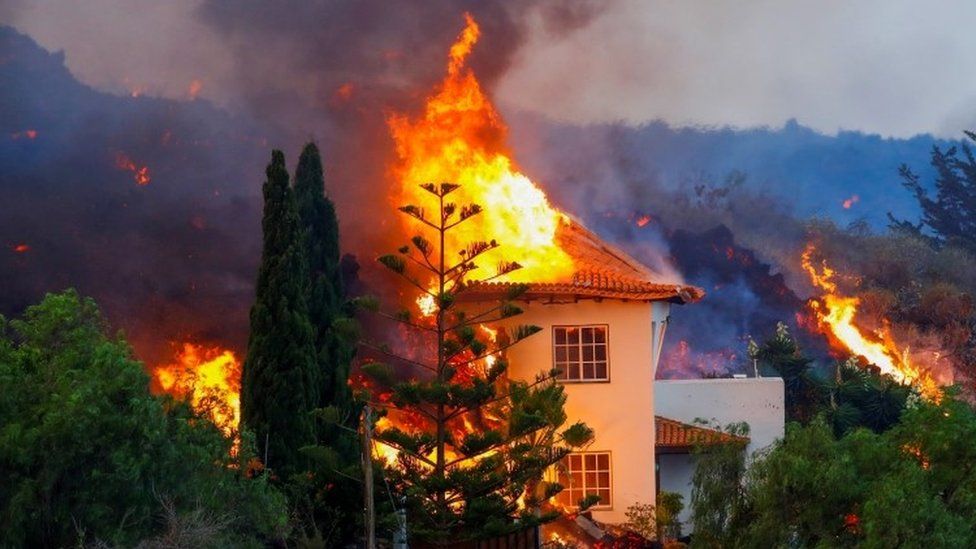
An opinion piece by in today’s Jornada by Raúl Zibechi on the La Palma volcano eruption and it’s effects on both the local economy and on the woes of “tropical paradises” in general (too damn many tourists with too much money) brought to mind Alan Taylor’s 2001 “American Colonies”. Taylor looked at the creation of the United States not just as the story of the English colonies moving westward, but of all the colonial policies of all the imperial powers that once held territory in what is now the United States (including the United States itself in Hawai’i). What Zibechi’s column had to do with Taylor (and United States history) was his somewhat passing reference to the difference between British and Spanish colonialism, based on the two countries first “overseas” colonies. Ireland for the English, the Canaries for Spain.
Both nations, in their drive to dominate and exploit their possessions turned to cultural and physical genocide, there was a distinction WITH a difference. The English, especially in the north, sought to replace the indigenous Irish… the pioneering “settler state”. The Spanish did erradicate the native Canarians (the Guanches) more by accident and ineptitude than design.
Where the Irish had immunity to the usual Euroasian diseases, the Guances had no such protection. As it is, given all we know about the native Guanches is that they were extremely big people by the standards of the time, the Spanish were at a loss, and geniunely bothered by the massive and rapid decline in the Guanche population. After all, they’d hoped to make slaves (another route to quick extinction of a population) or at least productive workers out of the natives. Preferably Catholic (at least, sorta Catholic).
The “conquest” of the Canaries, came about a century before the conquest of Mexico, which came about 400 centuries before there was anything like a decent understanding of germs and how they spread. While it doesn’t exactly let the Conquistors off the hook for setting off the American holocaust (reducing the native population of the Americas by up to 90% over the next century). but it was deliberate, as was — a century and a half later — the English realized infected clothing and blankets could be a useful tool in solving their “native problem”. Native massacres (that is, massacres OF natives) were less common, and less acceptable by the Spaniards than by the English, and the later United States, that not only accepted, but encouraged, them.
The English sought to replace the local population with their own expendibles (in the Americas, the less desiderable religious minorities and criminals) while just enough elites to command and control. The Spanish only sent out those needed for administrative tasks, although individuals in both Empires would emigrate hoping to better their economic condition, or to escape their past.
It might be tempting to imagine an alternative history in which there weren’t empires, but it would be fruitless, and foolish to assume the cultures in places like the Canaries, or Ireland, or the Americas would not have changed over the centuries, even if left alone. They weren’t. When it came to imposing themselves on the Americas, the English did a much more thorough job of wiping out the original cultures, whereas in Latin America, as much for demographic reasons as anything, the cultures of the “mother country” have been assimilated by the native population.
Decriminalized abortion
For now, lifted directly from Latin America Daily Briefing. My comments later on.
Mexican court decriminalizes abortion
Mexico’s Supreme Court decriminalized abortion yesterday, in a landmark ruling that struck down a Coahuila state law that imposed up to three years of prison for women who underwent illegal abortions or those who aided them. The ruling, which determined that criminalization of abortion unconstitutional, is binding on other states. Under Mexican law, a supreme court ruling supported by at least eight justices supersedes state laws. Yesterday’s ruling was unanimously supported by 10 justices. (Animal Político)
The decision does not automatically make abortion legal across Mexico, experts said, but it does set a binding precedent for judges across the country, reports the New York Times. Abortion is legal in four of Mexico’s 32 federal entities — Oaxaca, Veracruz, Hidalgo and Mexico City.
“Today is a watershed in the history of the rights of women and pregnant people, above all the most vulnerable,” Chief Justice Arturo Zaldívar said. “The unjust criminalization of women ends with one stroke. Never again a woman in prison for exercising her rights.”
President Andrés Manuel López Obrador did not immediately comment yesterday. He has had a conflictive relationship with women’s rights activists since taking office.
The decision reflects the growing power of Mexico’s feminist movement, and will impact the womens rights agenda in Latin America, reports the Washington Post. Victories in one country often catalyze activist efforts in others, as occurred with Argentina’s abortion legalization campaign, which succeeded in December of last year. In Mexico, as in the rest of the region, activists have linked demands for abortion legalization with protests against gender-based violence.
“Mexico’s decision represents a turning point that Latin America and the Caribbean are making in recognizing women’s rights to abortion as a matter of fundamental rights and reproductive rights,” said Brazilian women’s rights activist Debora Diniz who presented an abortion case that Brazil’s Supreme Court is set to rule on soon. (Wall Street Journal)
Which side (of the border) are you on?
Jornada’s David Brooks with some compare/contrast for the US Labor Day.
Today, the unionization rate in the United States is among the lowest of the OECD [Organization for Economic Cooperation and Development] countries, even lower than that of Mexico. Furthermore, the United States has fewer legally protected labor rights than Mexico (for example, there are no regulations here to defend non-union workers from being laid off, no health insurance, vacations, and other benefits), and in fact there is no protection of the right to freely associated, or to negotiate collective contracts. Some 20 percent of persons involved in union organizing efforts are fired by companies – there are thousands each year – while reprisals of all kinds continue against those who dare to promote unions in this country. Under the law, millions of farm laborers, domestic workers and others have no protected right to unionize. The fight for civil rights in this country has always been intertwined with a fight for workers’ rights.
Much has been said about the labor reform in Mexico and the need to ensure its implementation and compliance with its regulations and labor rights, including monitoring by the United States. But it is just as urgent that Mexico and other countries provide support to advance the fight for labor rights in the United States starting this Labor Day. Solidarity is a two-way street.

Plus ça change
US intervention, whether by a coup in Mexico in February 1913, or chasing Osama bin-Ladin around Afganistan in 2001, it never works out as intended.

Captain iuikpa castille*
Hollywood, with a few notable exceptions (Warner Brothers’ 1939 “Juarez”), has normally turned to cliches and romanticism when the setting is Mexico. Especially “Olde Mexico”. The 1947 “Captain From Castille” would have been just another Tryone Power swashbuckling adventure story… sword play and… being “olde Mexico”… an evil Inquisitor, a Señorita (Jean Peters) to be saved from a fate worth than death (and to be won by Tryone in the end) and … surprisingly.. an unusual bit of historial accuracy you wouldn’t expect… But only thanks to an uncredited actress in a key role.
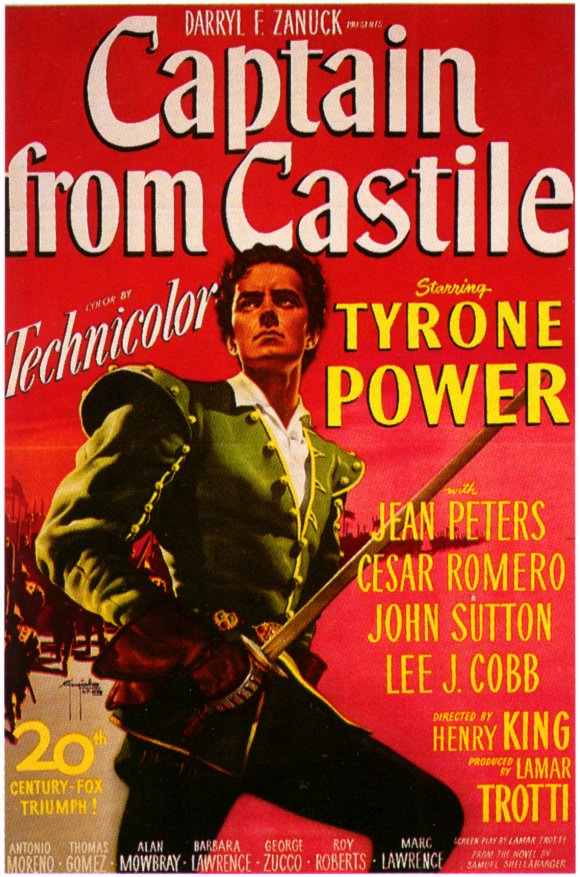
Shellabarger’s novel, and the script based on the novel, is based on Bernal Diaz de Castilo’s Historia verdadera de la conquista de la Nueva España written by the Conquistador about 50 years after the Conquest, no doubt a bit … shall we say… enhanced …over the long intervening years, and Diaz’ own sense of self-importance, mixed in with a romance and … for a villian… an agent of the Inquisition, doing what cliche Inquisitors do best (at least popular culture inquistors, not the inquistors about whom recent historians have discovered were not at all what we imagine). But… Hollywood being Hollywood… when the legend becomes the story… film the legend. Accuracy be damned. While there was a few “hispanics” in the cast playing hispanic characters (Cesar Romero as Hernan Cortés), one of the few Mexicans playing the part of a Meixcan… Stella Inda as Doña Marina… la Malache… Malintzin… who wouldn’t even be listed in the creidts at the flim’s end (although the real Doña Marina probably deserves the credit… or blame… for the eventual success of the Conquest) is credited with giving the film an unusual veneer of historical accuracy.
From the time she was first cast, Inda fought for accuracy. The costume meant for Doña Marina was something more suitable to a far east swashbuckler than one set in 1520s Mexico. Aztec women certainly didn’t wear silky sarongs. And, looking over the script, Inda noticed something that her gringo employers boviously had never given a thought to. While, in an American film for American audiences, it was natural that the “Spaniards” spoke in English, it made no sense that the “Aztecs” spoke Spanish. Surprisingly, when Inda brought her concerns to director Henry King, he agreed to her suggested changes.
One wonders if King or Inda knew what they’d just let themselves in for. Inda drew up designs for a more authentic huipal for her Doña Marina to wear, but neither she, nor any of the actors with roles as “Aztecs” spoke authentic Nahautl. King hired anthopologist Daniel Rubín de la Borbolla to translate the lines spoken by “Indians” into Nahautl, and brought in the noted linguist R. H. Barlow to not just teach the actors their lines, but to stay on the set and… if they misprounced a word in Nahautl, to insure King would re-shoot the scene. Barlow was no mere academic, at various points in his life being the literary executor of horror writer H.P. Lovecraft and later a mentor to Beat novelist William S. Burroughs during his stint in Mexico.

Amazingly, Inda herself didn’t know a word of Nahautl when she made her suggestions, although she felt compelled to learn it. Nor did the Canadian actor playing an Aztec, Jay Silverheels, know Nahautl. Although, it has to be said, unlike his role as Tonto in the 1949-55 television series “The Lone Ranger”, at least the Mohawk actor for once got to speak a real indigenous language on screen.
Inda would have a long, but not distinguished career (including a role in the worst horror film ever made, “Curse of the Aztec Mummy”) in Mexican films, but never was in another Hollywood film. Still, it was thanks to her that at least one “Olde Mexico” film out of any number of Hollywood films, had an unsual degree of historial accuracy and was probably the only major release film with significant dialoge in an indigenous American language.
* I don’t speak Nahautl, but I know where to find an English-Nahuatl on-line translator!
Sources:
Paramo, Pedro, “El capitán de Castilla” Cuando Hollywood denunció al racismo mexicano, Praxis, 7 Ago 2021
Mexico gunning for the guns
Zedrick Raziel in Animal Politico (my translation, with several structural changes):
In order to contain the illegal arms trafficking, the Secretary of Foreign Relations (SRE) has filed a civil suit in a United States Court against private companies that manufacture firearms. The lawsuit was filed today in the United States District Court for the District of Massachusetts against the manufacturers Smith & Wesson Brands Inc .; Barrett Firearms Manufacturing Inc .; Beretta USA Corp .; Beretta Holding S.P.A .; Century International Arms Inc .; Colt’s Manufacturing Company LLC; Glock Inc .; Glock Ges M.B.H .; Sturm, Ruger & Co. Inc .; Witmer Public Safety Group Inc., and D / B / A Interstate Arms.
The suit is filed in Boston for strategic and legal reasons. The arms manufacurers targeted by the suit are all headquartered in the state of Massachusetts, and 9 out of the 11 judges on the Boston District Court lean “liberal”, suggesting a favorable hearing for the Mexican argument.
The Mexican authorities point out that arms production in the United States, and the illegal traffic to Mexico, is directly related to the increase in violence in the country, since the weapons end up in the hands of drug cartels and criminal groups. Furthermore, the Mexicans argue that not only do the manufactures know that their distributors are involved in the illegal firearms trade, but are complicit in it, offering weapns specifically aimed (sorry!) at the criminal market. In short, they are suing the manufacturers for criminal negligence.
While no specific monetary compensation is being sought, with any amount to be determined at trial, the intention is to force the companies to compensate Mexico for their co-responsibility in the problem of violence.
THe suit seeks to force the companies to develop and implement reasonable, verifiable standards to monitor and, where appropriate, discipline their distributors, because — as Foreign Secretary Ebrard said in announcing the suit — “… are conscious of the fact that their products are trafficked and used in illicit activities against the civilian population and authorities of Mexico.”
He added, “But not only that, they are developing different models for drug traffickers, used by drug trafficking, they are made for that purpose, and offered in different arrangements. (We also demand) that they incorporate security mechanisms in their weapons so that we can prevent them from being used by unauthorized persons, or linked to crime. That they pay for studies, programs, media campaigns and other events focused on preventing illicit arms trafficking. That the companies immediately cease the negligent practices that cause harm and death in Mexico ”.
By filing a civil suit against manufacturers, Foreign Minister Marcelo Ebrard explained that the issue is being taken out of diplomatic channels, avoiding conflict with the United States goverment, and a diplomatic conflict between the two countries, accusing not the US government or any officials, but rather individuals who happen to be in the United States.
“Dark Victory”… the consulta
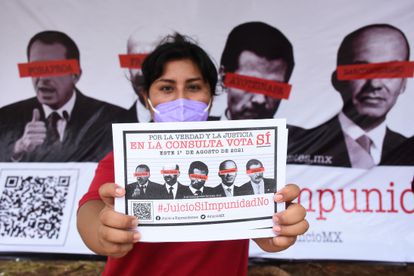
Sunday’s “consulta”… even with its confused wording that only opened the POSSIBILITY of maybe, possibly, digging into the darker secrets of the past 30 years…. passed overwhelmingly (by close to 95%) but… as mentioned yesterday, the turnout was dismally low, 7% of the electorate, when at least a 40% turnout was required for the consulta to be bindig on the legislature.
That was by design, writes Jornada’s Enrique Galván Ochoa. Under legislation passed during the Peña Nieto administration (and Peña Nieto being one of the primary targets of this consulta), to even send a question to the voters requires either support of the President and a third of Congress, or a petition signed by two percent of registered voters (which, in Mexico, is basically every citizen over 18)… meaning gathering signatures from around two millio people. And, even then, the actual mechanics of the consulta are in the hands of the (politically appointed) Elections Commission, which sets the rules for the consulta, which has be voted on by at least 40% of those voters.
And.. just to confuse things futher, the wording of the consulta had to be parsed by the Surpreme Court.
And, obviously, while passing, the threshhold for turning the proposal into reality was nowhere near being met. Who was responsible, and who benefits?
If you ask AMLO, or his backers, the answer is the Elections Commission (INE, for its initials in Spanish). INE complained they didn’t have the money for a “get out the vote” campaign (although they had plenty to pay their own salaries) and there are legitimate questions about how the mechanics of voting were handled. There were limited polling sites, sites were changed without warning, and locations were badly defined (the corner of X and Y street), even if one had the resources to navigate the confusing website set up to “assist” would be voters. (Jornada). Ironically, the President himself could not vote, being on the road Sunday, and no arrangements having been made (as they are in normal elections) for either absentee voters, or for voters unable to visit their assigned polling stations.
But, as Denise Dresser argued in Americas Quarterly last Wednesday, a botched cosulta played into AMLO’s hands… freeing him from having to dig too deeply into the sins of his predecesors, or those of his allegedly favored military supports. Dresser is well-known to loathe the present administration, and her spin stikes Mexfiles as nonsensical. Still, it’s worth noting that no one really expected the consulta would reach that 40% threshhold, despite optimistic statements by its supporters.
Which may not matter. Although Vicente Fox and the 2018 PAN candidate Ricardo Anaya both crowed that the consulta just proved there was no real support for questioning the politics of the past, a claim echoed by the three (formerly) “mainstream” parties (PRI, PAN, PRD), along with Francisco Manetto in El País, and Viri Reos in the Spanish-language edition of the New York Times. Both Manetto and Reos go further, arguing the consulta was a referendum … not on the politics and politicians of the past… but on the present government, and on AMLO’s own tenure. In essence, the two argue that by abstaining, the 93 percent of voters who did not turn out were rejecting the very notion of the people being asked to make decisions that the legislature could make for them. In other words, the people were supposedly voting (or rathat un-voting) against popular sovereignty.
STILL… given the overwhelming support the “focus group” gave to the concept of investigating the past, there is every reason to assume the ruling Morena party will go ahead in some form. Perhaps not in a formal judicial hearing, but “truth commissions”, Senate hearings, and investigations of the Fiscal General (who, in theory, is independent of the Executive) are not out of the question.
And, AMLO and his supporters have more ammunition than ever to push for changes in INE.
¡SI!… or maybe not.
The question asked on today’s “Consulta Popular” was simple, or rather could have been. The actual wording (in my translation) was:
Do you agree or disagree that pertinent actions should be carried out, in accordance with the constitutional and legal system, to undertake a process of clarification of the political decisions made in the past years by political actors aimed at guaranteeing justice and the rights of potential victims?
A mealy mouthed way (to satisfy some of the backers of those “political actors” of “the past years” to not say what is meant… should the crooks who ran this country over the last thirty years be frog-marched down Reforma and sent to the slammer?
At last count, the vote was somewhere between 90 and 97 percent in favor. HOWEVER… under the complicated regulations that had to be worked out to even allow a public referendum of this kind, at least 40% of the elctorate needs to actually vote. With most Television networks and the “mainstream” media opting to mention the consulra as little as possible (Mexfile’s TV news comes from Azteca, which I don’t think mentioned the upcoming consulta in any of its regular 6 to 8 PM newscasts).
Last numbers seen (from about an hour ago: 8:40 Mexico City time) had less than 8 percent voter turnout.
DRAT!
WTF is happening in Cuba?
I hope to post more later today (and early tomorrow) on recent events here in Mexico, but in the meantime, this is the best explanation of what has been happening in Cuba I’ve seen in the English-language media:
No more A-Biden this nonsense…
With the ridiculous US “Cuban blockade” now in it’s 67th year, and Cuba still there… though having a hard time of late between an oil shortage and the pandemic, sometimes the grown-up countries have to step in.
Earlier today, the Mexican “multipurpose” Arm Libertador Bal-02 sailed from Veracruz to Havana loaded with medical supplies and basic food items. Also yesterday, the tanker José María Morelos II left port with 100,000 barrels of oil to provide fuel for Cuban hospitals.
Ironically enough, considering how much money, men, and effort the US has invested in keeping Cuban isolated, tomorrow’s relief ship … the amphibious warship Arm Papaloapan A-411 was originally the US navy’s Newport from 1992 to 2001.

So, whatcha gonna do, Señor Biden?
Not so bad company

Had they been alive today (and had they been alive at the time), Simon Bolivar’s parents might have been mighily concerned about the company their 16 year old son was keeping up there in Mexico City on his long layover headed for Madrid where he was expected to finish his education (and, incidentally, find a Spanish wife… the latter being a condition in his mother’s will if he was to inherit the family property).
While Bolivar was well-known in his own time for his … uh… amorous adventures… it also has to be said that, unlike other leaders of his era, he always took women, especially intelligent women, seriously. One wonders if, during his stay in Mexico City (at what is now the corner of Uruguay and (of course) Simon Bolivar, it wasn’t La Guera Rodriguez (aka, María Ignacia Rodríguez de Velasco de Osorio Barba y Bello Pereyra) who first introduced him not only to the charms of the female anatomy, but to the value of their brains, as well.
La Guera lived across the street from the house where Bolivar was staying. Married off at the age of 14, La Guera was already notorious for her affairs with the rich and famous (including, it is said, the Viceroy) by the time she was 21, when young Simon caught her eye. While a sexy adult may have been what first attracted Simon (and a pretty boy, what caught La Guera’s eye), it can’t be said that he didn’t learn more than a few positions from her… after managing to dispose of her pesky husband (even after she shot him, it was only when she theatened to prosecute him for sodomy that she was able to attain a divorce in 1802), she would become a leader in the independence movement (organzing an underground network of society ladies to smuggle arms, publish anti-Spanish newspapers, run a spy network… and find time to pose for a statue of the Virgin Mary!), later serving as adviser to a later paramour, Agustin Iturbide.
Simon, in his later career of Liberador, would have no problem with women officers in his armies (including a few generalas), and his must trusted political adviser would be his Peruvian companion, Manuela Saenz.
While it’s doubtful young Simon learned, or did anything that might have shocked his conventional parents (who anyway had both died by the time he was 12), or Hipollita — his “milk mother” (nursemaid) whom he always referred to as both his true mother and true father (and whom he emacipated as soon as he reached the age of majority, providing her a comfortable home and pension the rest of her life… and she outlived Simon by five years), but WHAT HE LEARNED!
That neighbor was the thirty year old Alexander von Humboldt. Humboldt’s sexual preferences were hardly a secret, even then… to the end of his very long life (he lived to be 90) … surrounding himself with good-looking, young, and intelligent men. And, what was Humboldt seducing young Simon with? Why the surprising data proving the Americas did not need Spain, that Spain was a drag on development in the Americas… and besides, there was this radical theory called “Democracy” and “Republicanism” being tried out north of the border that looked very, very promising. Oh, and if Simon got the chance, yes, you could get across the Andes mountains.
So there you have it… money and looks and the luck of birth can only get you so far. Better yet to keep disreputable company.
Since you asked… or will
Yes, the Supreme Court of Justice DID rule (in an 8 to 1 decision) that the laws preventing the use of marijuana for recreational purposes was unconstitutional, but that does ot mean “smoke ’em if you got ’em”.
Hot off the presses (ok, off the internet, and translated) from EFE:
With the prohibition on using marijuana lifted by the Supreme Court, Mexicans who request a permit will be able to consume legally,with certain restrictions. These measures will remain in force from the publicatin of the ruling in the DOF (the Official Gazette of the Federation) UNTIL Congress legislates on the matter. Madame Justice Norma Lucía Piña, detailed the scope of what was endorsed in the court.
 Permission to grow and consume marijuana in Mexico: Permits must be processed by COFEPRIS (The Federal Commision for Sanitary Risk Protection), a department within the Ministery of Health. “With the general declaration of unconstitutionality of regulations against use and possessin, the legal obstacle is removed for the Ministry of Health, through a competent body [i.e., COFEPRIS] to authorize in the future activities related to the self-consumption of cannabis and THC (tetrahydrocannabinol) for recreational purposes, respecting the fundamental right to the free development of the personality recognized by Article 1 of the Constitution, “said Piña.
The permits may only be requested by adults, for the purpose of acquiring, planting, cultivating, harvesting, preparating, possessing and transportating marijuana.
Limitations on cannabis use in Mexico
Piña added that among the limitations are that adults do not consume marijuana in front of minors or in public spaces, that they do not drive or do dangerous activities under the influence of said drug.
“It is not authorized, in any case, to import, trade or supply” marijuana,, For now, there is no recreational cannabis market in Mexico .
(no, I haven’t been indulging… I still haven’t figured out the $%&/(“!! editing function in the “new and (not in any way) improved” WordPress editor)


 mexfiles.net