“Nothing happens in Mexico…
… until it happens,” or so the always quotable Porfirio Díaz is supposed to have said.
And, when SOMETHING happens — the Supreme Court affirming the rights of the Federal District to marry same-gender couples (and for those couples to adopt children) for example– the results aren’t always predictable.
Oh, you expect a few (quite a few) people will consider the whole idea “aberrant” … I’m referring not so much to same-gender marriage as to concepts like the separation of powers and democracy and rule of law, of course. But what I didn’t expect was that the only real conservative action ha been to attempt to delay the inevitable and to save face.
José Ángel Córdova, the Calderón Administration’s ultra-conservative Secretary of Health is willing to “have a dialog” on necessary changes to Social Security regulations (Social Security here includes not just retirement and disability payments, but workers’ compensation programs, the national health care system and some housing and mortgage programs) to cover benefits for same-gender couples.
“Dialog” is simply a way of holding off on implementing changes. After all, the whole point of being a conservative is to delay change until you figure out how to do it and leave yourself in power.
I expect (although I might be surprised again) that the foot-dragging will be about coverage for same-gender “free unions”. Coahuila beat the Federal District to the punch in legitimizing same-gender relationships when that state’s legislature eliminated the opposite gender requirements for “free unions” in 2008. What was intriguing was that the bill was pushed by PRI, and opposed by PAN and the Greens.
Now, in Sinaloa, the PRD is in a coalition with PAN, but is pushing a same-gender marriage bill. Again, it’s an attempt to delay, but PAN is willing to give legal recognition to same-gender relationships, as long as they aren’t called “marriage.” PRI, having to oppose whatever PAN proposes (and hoping to split the right-left opposition coalition) … it’s just possible that Sinaloa may surprise us and pass a same-gender marriage bill with only nominal opposition.
I think it would be great. Mazatlán has beaches and hotels too, I know, right now the tourists are being scared off by our reputation as a haven for gangsters and geezers… (giving the impression one will die here either of multiple gunshot woulds, or terminal boredom)… we’d have to improve the night-life, but it’s do-able.
Puerto Vallarta has been tapping into the lucrative gay tourist market for too long. We might be able to make a marketing campaign out of the fact that PV is in Jalisco, whose state capital is Guadalajara — as in His Eminence, Juan “You want a faggot raising a kid?” Sandoval Iñiguez. And he’s one of the more rational conservatives in that state.
Honduras Tonight
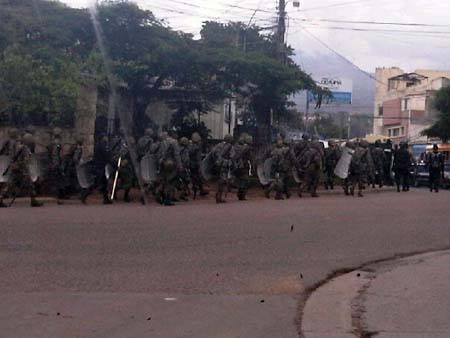
Adrienne Pine posted this earlier today, as police attacked a teacher’s demonstration at the National Pedagogical University. Dr. Pine posted at 16:00 (GMT -4): striking teachers are being violently ousted by military with teargas (L.1500 per canister). 1500 Lempira is about 80 US Dollars, or about 10 percent of the gross national income per capita.
Meanwhile, from the Diocese of Copan, where Hermano Juancito reports regularly that the spirit is willing, we learn why the flesh is weak:
… the Gracias parish asked me about how he could get vegetable seeds since there were nine severely malnourished children in his village.
Monday one of the coordinators of the maternal and infant health project shared that severe malnutrition in Honduras is at about 38%, which is one of the highest in Latin America.
… the situation of a country with about ten families with most of the power while the majority have little share of the resources.
 “La Gringa’s Blogacito” — which was all over the place claiming to be an expert on the political and economic situation in Honduras, and telling us the coup was not a coup — meanwhile, writes about ice cream makers (starting at 3.75 percent of gross national income per capita [not including shipping and handling] on up) . The big issue in Honduras in Gringa-landia is whether to include eggs in your Mocha Gelato…
Let them eat ice cream?
Legends of the fall
Diego Valle-Jones — our favorite statistician — crunches the numbers from Ciudad Juarez and discovers that — prior to the U.S. proxy war on drugs:
- The homicide rate in Ciudad Juarez was not different from other border cities.
- The homicide rate for women, while certainly higher than average for Mexico, was lower than in other large urban areas and not significantly different from other border cities.
- Ciudad Juarez is not poor or particularly unequal as measured by its gini coefficients relative to other Mexican municipalities.
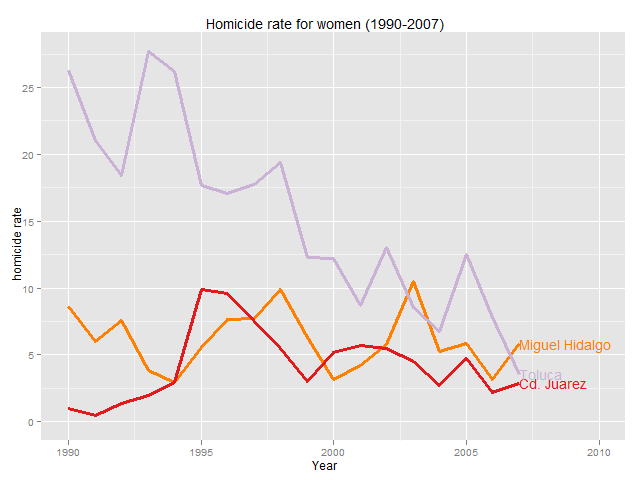
While Valle-Jones ties the increase in homicides during the 1990s to the intramural mayhem among gangsters that followed Rafael Aguilar Guajardo death in 1993, he finds one statistically measurable difference between women in Juarez and other communities there are more single mothers in Juarez. It’s not anything easily measurable, but I would add that Juarez, as a “gateway”, not just for narcotics going north, but for social trends in the United States coming south — as well as a “frontier town” — would also be the kind of community where you would have more violent deaths. The 1990s was when young Mexicans started living more on their own, and when foreign businesses began taking advantage of relocation to the Mexican side of the border, opening up opportunities for young adults to live independently. And, as any actuary will tell you, young adults on their own are the most likely victims of homicide.
In a sense, Felipe Calderón is correct when he says (as quoted by Valle-Jones):
The deterioration of values and evidently the expression of violent criminality in Mexico, was not a phenomenon that appeared suddenly, or that occurred fortuitously in our country; it was the fruit of a very long process, that today is showing, precisely, this grave result for the country, but it wasn’t something that happened suddenly.
He’s right that social values changed… but of course, he’s trying to deflect criticism from those that notice homicide rates have increased all along the border (and in the narcotics production regions) simultaneously with his tenure in office.
A factor — and one intuited, but not statistically provable (not by me, certainly) — in the perception of more criminality in Juarez than elsewhere is that Juarez is more likely to subjected to “instant analysis” by fly-over journalists. Ojinaga went through a period of violence in the 1980s, but — given the long history of smuggling in the Big Bend region, other than the somewhat “nota roja” type of Mexican border bandit writing of Terrence Poppa’s re-released 1990 “Drug Lord”, journalists weren’t going to pay attention to the place.
Besides, have you ever stayed in an Ojinaga motel? There isn’t much in Presidio Texas to attract major media types (except maybe the National Geographic… people go to the Big Bend for birdwatching or wilderness experience or to do art or to play cowboy– not to write hard-hitting crime and economic pieces… one reason I like the area).
Tijuana is always described as “not the real Mexico” (much to the annoyance of the Tijuanense, who are real Mexicans) — or at least recognized as atypical and “too Americanized”, whatever that means. Murder rates there have skyrocketed during the Calderón Administration, is less reported, perhaps because Tijuana is perceived as simply the “wrong side of the tracks” of southern California, rather than as a foreign city.
While El Paso isn’t as posh as San Diego when it comes to access to U.S. amenities, for a reporter doing a “Mexico story”, Juarez was ideal: a major Mexican city which allows the reporter to see “the real Mexico” without having to go through the complicated process of becoming a “foreign correspondent.” At least in pre-internet days, covering Juarez also meant a U.S. writer didn’t have to go more than a few hours without access to English-language media.
Valle-Jones writes that one reason for the focus on Juarez femicides was “The anti-globalization movement latched onto the killings to show the evils of free trade since they increased around the time NAFTA came into effect.” Undoubtedly true, but a less noticed factor is that the borderlands were experiencing rapid growth on both sides of the line. The old borderlands culture was changing. Porfirio Díaz supposedly said “between us and them… the desert!”, but in the 1990s, both the Mexican and U.S. sides of the border were undergoing rapid growth, and cultural changes that exacerbated the always under-the-surface “Anglo-Mexicano” cultural rift. Michoacan and Michigan suddenly found themselves facing each other in El Paso, and — with Michigan factories moving to Juarez, what happened in Juarez mattered to people in Grand Rapids.
There was no “conspiracy”, but the tendency was to report negatively on Mexico. Throwing in the recent “drug war” which came just as the U.S. was undergoing a periodic outbreak of xenophobia, AND an economic slide that makes it tempting to write “we aren’t as bad off as they are” news AND its a natural. And, as always, U.S. media people buy into the same stereotypes of Mexico and Mexicans that have floated around the United States since the 1840s.
That the same (U.S. funded proxy “war on drugs”) had been going on in Colombia, and had (and has) similarly appalling violence has not been widely reported … simply because reporters would actually have to go to Colombia (and learn Spanish) … and — out of sight, out of mind. The spates of violence, followed by militarization, which creates “stability” but does nothing to meet social needs (nor does it substantially lower narcotics exports) in Colombia were reported mostly by relying on official sources. The only difference is that with Mexico, the “drug war” is more visible to U.S. media consumers and unofficial sources are more available to U.S., including English-language on-line writers.
A teachable moment
It is well known, to Catholics and non-Catholics alike, that there are homosexuals who wear cassocks, and that celibacy is just a system to maintain control of the Church’s economic wealth. So we ask them to cease with the attacks that only foment hatred and discrimination.
Red Nacional Católica de Jóvenes por el Derecho a Decidir (National Conference of Young Catholic for Choice)
OUCH!
Not that Cardinal Sadoval Íñguez is going to cease with the attacks on Marcelo Ebrard nor is Mexico City’s Jefe de Gobierno about to back down. Ebrard is planning to file a denunciacíon today for “daño moral” — specifically because the Cardinal claimed Ebrard “maiceado” the ministers of the Supreme Court (who ruled in the Federal District’s favor, much to the chagrin of His Eminence, over the right of the legally married same-gender couples to adopt children under the same guidelines as those used for opposite gender married couples). Get the palmonitas ready… it’s going to be quite a show.
I admit it, I’d never heard the word “maiceado” before (and those of you non-native Spanish speakers who have, raise your hands), and it’s not in my McGraw-Hill Diccionario del Argot (2001) or on the Diccionario de la Jerga website, nor in my 21st edition of the DRAE. From the online version of 22nd edition of the DRAE, I was able to piece together that it means “well-fed” …. “fat and happy”… (and, in Nicaragua, “drunk”), but the sense is getting one’s nose in at the trough… “bribed”.
Which is the basis of the “daño moral” — basically damages, not necessarily monetary (like to one’s reputation) caused by a third party to a dispute. Which sent me to a long, long learned article by Alicia Elena Pérez Duarte y Noroña in the Boletín Mexicano de Derecho Comparado, Nueva Serie Año XVIII, Número 53 Mayo-Agosto (1985), pp. 625-638.
All very interesting and educational, but I’m on deadline to finish an article (with footnotes and end papers) on the Mexican-American War of 1846-48 and there’s another book editing project under way. I don’t expect to update any posts for the rest of the week, so tune in to Aguachile and Gancho for politics, Maggie’s Madness and Malcolm Beith for mahem, From Xico for analysis and Burro Hall for snark.
Back in a couple days.
A tale of a fateful trip
… That started from this tropic port
… aboard a naval ship.
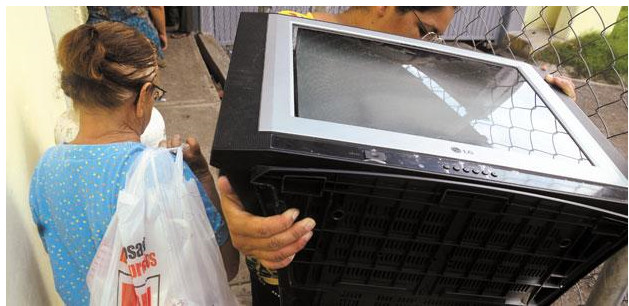
With no warning, and no explanation other than a need to relieve prison crowding, 116 male and five female convicts considered a danger to the public, were relocated from the Federal Social Readaption Center in Mazatlán to the Islas Marias “campamentos”. The convicts’ families, many of whom moved to Mazatlán to be near their incarcerated family member (or, in some cases, to live with him or her), are also relocating to the penal colonies off the Nayarit coast.
The main island, Maria Madre, presently has seven “campamentos” where there are presently 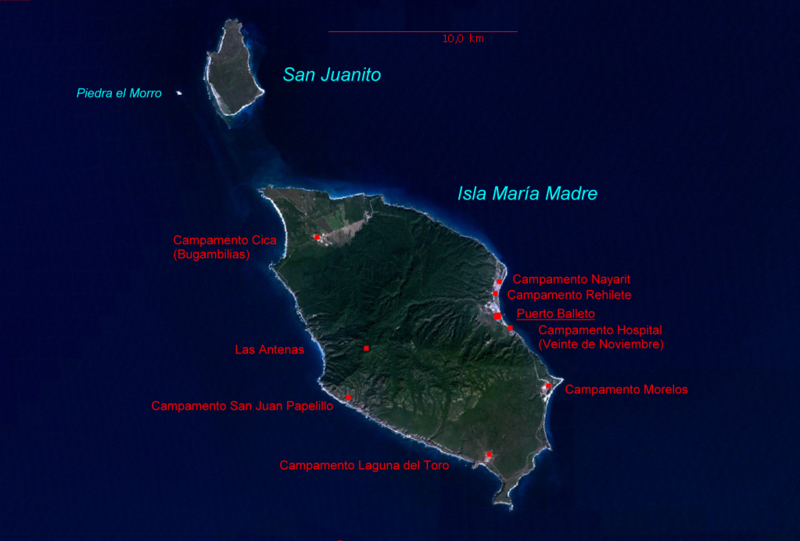 about 700 convicts living with their families. There were plans to close the convict settlements (mostly because the maintenance costs for an island facility, as well as providing social services and schooling for convict families was prohibitively expensive) and turn the Islands (only Maria Madre is inhabited) into a wildlife sanctuary. Instead, the Federal Government is looking to dramatically increase the number of convicts housed on the Maria Madre, adding several campamentos as well as two full penitentiaries (one a maximum security facility) and bring the present convict population up from its average seven hundred to 11,000, not including family members, guards, naval personnel (the Islands are under naval administration), nurses, doctors, teachers, social workers and others.
1.5 billion (thousand million) pesos was invested in new construction on Maria Madre in 2009, 2.3 billion this year and it is estimated that another 200 million will be spent in 2011 on the project. By contrast, the cost of building a maximum security mainland prison is only about 660 million pesos. The whole idea of penal colonies is kind of retro, but we have a conservative government at present. At least they haven’t done something really insane like privatize the prisons, unlike a failed state of note (which, however, doesn’t have any islands).
I don’t know if there are motor-cars on Maria Madre, but there are lights, and it’s not quite as primitive as can be. And I’m pretty sure the families aren’t forced to watch dubbed Gilligan’s Island reruns — THAT would be cruel and unusual punishment!
Clausewitz and Calderón
War is the continuation of politics by other means.
Carl Philipp Gottlieb von Clausewitz, Prussian military theorist (1780-1831)
I have said before “there is no war in Mexico” and stand by that remark. Which does not mean we do not have politics, the continuation of which means more violence and socially destructive acts.
Consider first this recent graphic from the Los Angeles Times:

Measured by U.S. parameters — and, as both “sides” in what passes for a “War on Drugs” in Mexico are financed and armed by the United States for the benefit of conflicting U.S. interests — the “official” side (the no-drugs guys) are losing. The U.S. financed anti-drug people are “ceding territory” to the U.S. financed drug people. And other than cocaine (which only passes through Mexico and can’t grow, and never has been grown, here), narcotics imports have been (forgive the pun) shooting up since the Calderón Administration decided to make controlling the cartels a priority.
I have been saying since the beginning that this was never really about Mexican narcotics in Mexico, so much as a way to get the United States to pay for a militarization that would legitimize the Calderón Administration. Raymundo Riva Palacio, while not dealing with the U.S. side of the equation, has delved into the rationale for militarization, and the “drug war”:
()
Calderon will be defined as the president who decided for no apparent reason to launch a fight against insecurity, which grew into a war against drug cartels, and provoked nation-wide violence on a scale not seen in nearly a century. The question is whether in the final assessment, he will be seen as a hero or a reckless adventurer.
Heading into the final stretch of his presidency, Calderón, seeks not so much an alternative to the security theme, as a security theme that will bolster his party’s chances of holding onto power in 2012. Over the last two weeks, he has managed to pull the other parties and social forces into the same boat. The security meme has been reinvigorated by his address on criminality …
The president is desperate for anything, and is open to a possible redesign of the stategy … (something he rejected for months, implicitly seeking to build consensus for his fight). But, as has been the case since the beginning of this stuggle, no reason for changing the strategy is given, or, for that matter, for the war itself.
The war on drugs has been very public, yet, the real source of the war has been kept secret. The spark was a discussion between then President-elect Calderón and Michoacán Governor, Lazaro Cárdenas, who was begging for help with the drug problem in his state. Cárdenas – in this instance – agreed to partner with Calderón – having been rebuffed several times President Vicente Fox.
Dozens of Michoacan municipalities were under the control of the various cartels: the Gulf cartel, Sinaloa, Valencia, and Gulf cartels; la Familia Michoacana and Ignacio Coronel’s gang. In Michoacán, they grew marijuana, acted as the port of entry for methamphetamine precursors and were the location of the major mega-laboratories that produced synthetic drugs. Drug traffickers were meeting a payroll for police officers, politicians, businessmen and journalists, and Michoacan was a kind of laboratory for the creation of a narco-state. In diagnosing his problem, he laid the groundwork for making security the Administration’s priority.
Calderon had initially thought of building support for his government on two foundations: infrastructure development and dismantling monopolies, particularly in the television sector. The first remains part of the administration’s goals, but the second was quickly dropped. First, given Calderòn’s lack of legitimacy, he needed the television network owners on his side. His field commander in that battle, Juan Camilo Mouriño, rescued Televisa and dropped the anti-monopoly push when presidential candidate Andres Manuel Lopez Obrador, published documents alleging corruption by Mouriño and his family in their dealings with Pemex.
Security, however, presented a short route to legitimacy that did not depend on voters, and became the centerpiece of Calderón’s discourses, of his propaganda and of all political communication. But since embarking on this course, violence has increased by more than 50 percent in 12 municipalities, but extending to 800, just over a third of the country. Deciding to break the cartels and the balance between them and government, which kept a status quo under which violence did not spread, the evidence is that the territorial control of drug traffickers continued to grow. In Michoacan and Tamaulipas, the first two states where there were joint operations in December 2006, more than 120 municipalities are fully are controlled by criminals.
Statistically, no country has arrested more narcotics traffickers, nor seized more weapons, cash, property and drugs than Mexico. The government’s massive information campaign saturated the airwaves with disinformation, the President being unable to give a narrative to his crusade. The results are negative: the government held in contempt as it tries to build consensus and explain why 20,000 and more are dead…
The vulnerability sensed by media after the kidnapping of Televisa and TV Milenio journalists, with the added ingredient of opportunistic politicians, give the president the chance he never had before — … an opportunity to relaunch his presidency and make this war the cornerstone of his administration. Again.
But saying so isn’t enough. Calderón has to be more persuasive, with convincing ideas, clear concepts and concrete definitions, if his legacy is to be judged on the merits of the action and the results. Otherwise, this will be the presidency that launched a civil war that got out of hand…
Rivas Palacio was not writing in some lefty rag, but in the 16 August 2010 El Financiero. My translation is from a reprint of the original in Cultura de Legalidad (OMCIM, “Observatorio y Monitoreo Ciudadano de Medios”), a “mainstream media ” monitoring group connected with the ultra-establishment, conservative Jesuit-run Universidad IberoAmericana.
I am seeing more and more “establishment” — and rightist — figures rejecting the “drug war” meme, just as it is being relaunched as an “all party crusade”. How “all party” it really is is difficult to gauge. As Gancho points out, there are alternatives, but as presented by the establishment, they are non-starters.
The continuation of the “war by other means” may mean stepping outside conventional politics.
Iguana go home and sleep it off
Jornada doesn’t usually do drunk driving arrest reports, unless…
Mexico City police officers rescued a green iguana – an endangered species — from a van whose driver had been arrested for failing a breathalyzer test.

Next time, maybe he should take a cab
The Ministry of Public Security of the Federal District (SSPDF for its initials in Spanish) reported that the lizard was discovered at a checkpoint set up during the “Drive Without Alcohol” program at the intersection of Paseo de la Reforma and Eje 2 Norte, Colonia Morelos, in Cuauhtemoc Delegation.
The driver of the Ford Windstar van, whose breath had “an obvious ethyl alcohol odor”, registered 0.58 milligrams of alcohol per liter of blood, far exceeding the permitted limit of 0.40. The driver was sent to El Torito [the Federal District drunk tank] to serve his mandatory detention.
When the officers were preparing to do the tow the truck, they found inside the green iguana, about 50 centimeters in length, the legal ownership of which, the driver could not prove.
Officers from the Animal Rescue Brigade dispatched to the scene determined the reptile was in good health, although stressed out from traveling in the van.
The SSPDF said that the iguana will be turned over to the Secretariat of Environment and Natural Resources (SEMARNAT), and sent to its facilities located in the municipality of Los Reyes La Paz, in the state of Mexico.
Es un complot… internacional! (and an update)
Juan Sandoval Iñiguez has no doubt that the Mexican Supreme Court was suborned by “international organizations” in not finding some rationale — any rationale — to throw out the new same-gender marriage laws in the Federal District.
Same gender marriage, and adoption by same-gender couples is “an aberetion supported by the high economic powers”… and furthermore… “the whole package of changes, not just from the PRD and the left in Mexico, are proposals from the great capitalists,” according to Señor Sandoval
It might be pointed out, sotto voce, that Señor Sandoval is Su Señoria Sandoval, the Cardinal of Guadalajara, representing a wealthy international organization that has been known to try to influence Mexican law from time to time … like from 1521 onwards.
Aguachile has more on what the Cardinal said, none of it very nice, using words that basically translate as “faggot” and “dyke” and claiming the justices were bribed.
The Supremes themselves weighed in today.
At the opening of the court session, Minister Sergio Valls Hernandéz — who had been charged with writing the briefs on the two same-gender marriage cases — asked for a vote of censure against the Cardinal as a personal matter. Minister-President (Chief Justice) Guillermo Ortiz Mayagoitia, who voted against upholding the rights of same gender couples both to marriage and to adoptions, said the Cardinal had impugned the honor of every one of the justices, and said any justice who felt the same, was free to vote for censure. Before voting 9-2 to uphold the rights of same gender couples to equality in adoption procedings with opposite gender couples, the court took another vote.
Remains to be seen
Via Latin American Herald Tribune:
 The remains of 14 of the most important heroes of Mexico’s struggle for independence from Spain were transferred on Sunday from Chapultepec Castle in Mexico City, where they had been subjected to anthropological studies and preservation procedures, to the National Palace, also in the capital, where they will be on public display for 11 months.
The transfer was made on Sunday morning when a contingent of carriages and mounted squadrons of soldiers dressed in ceremonial uniforms took charge of the remains, which had been placed in gilded glass or wooden urns.
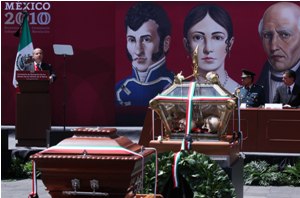 The procession followed the emblematic Paseo de la Reforma avenue to the National Palace, located on one side of the huge central square known as the Zocalo, where thousands of people threw flowers and shouted “Viva Mexico!”
The remains included those of Miguel Hidalgo y Costilla, Ignacio Allende, Juan Aldama, Mariano Jimenez, Jose Maria Morelos y Pavon, Vicente Guerrero, Leona Vicario, Mariano Matamoros, Guadalupe Victoria, Andres Quintana Roo, Nicolas Bravo, Javier Mina, Victor Rosales and Pedro Moreno…
Christopher Hitchens recently wrote about another “bicentennial exhumation”, that of Simon Bolivar. Given the British tendency to describe anything done in Latin America (or anywhere Roman Catholicism was a vital culture after 1600) in terms meant to suggest something perverse, and — since the only purpose in writing about the exhumation was to launch an ad hominum diatribe against Venezuelan President Hugo Chavez (to the point of stupidity, the author mistaking a quote from Pablo Neruda’s “Canto a Bolivar” for a prayer to Simon Bolivar) — his use of “political necrophilia” might be dismissed along with the rest of the hit piece. Still, there is some validity in the term.
The veneration of relics after all, is what prompted Luther to post his 95 thesis on the wall of the Wittenburg Castle church in 1517, and it has been the source of anti-Catholic snark every since. I suppose to a polemicist like Hitchens, describing veneration in a term normally used for sexual desire (and a perverse one at that) is natural. But, had Hitchens been writing about the Mexican heroes, I doubt he’d have used the same phrasing.
 I agree, the idea of looking at bones has limited appeal, but people have been doing that here (and in Mexico, saving the bones of honored enemies as well) for a very long time before Hugo Chavez was thought of. As I’ve pointed out before, the physicality of death does not shame us, nor is it denied. In Latin America, the reality of decay and dissolution is accepted, and the fact that any relics exist is something to be cherished. I don’t read anything into Chavez (who, after all, was the son of Catholic religious teachers and uses explicitly “Catholic” imagery and language in his speeches) overseeing Simon Bolivar’s exhumation — nor of Venezuelan television broadcasting images of Bolivar’s skeleton, any more than I do that of out-of-the-closet Catholic Felipe Calderón undertaking this mass exhumation and exhibition of less intact remains.
Es un complot?
I’ve had people misdirected to Mex Files before, but WTF is this? I’m not sure how a post on the U.S. re-definition of “drug war” and the labor practices of Canadian owned mining companies gets described as something about Chapo Guzman, grenades, and FBI agents (rogue or otherwise), let alone “the Bohemian Grove” — I know who Chapo Guzmán is, and have an idea what grenades and the FBI do, but the Bohemian Grove was one of those things I might have vaguely heard of, but had no clue what it was all about. So, I looked it up.

Apparently, one of the wackier of the wacky conspiracy theories out there involves “Bohemian Grove,” a private club in northern California, with is either a boy scout camp for wealthy Californians, or some super-duper secret hideaway for the “iluminati” who super-duperly secretly control the world… through (depending on one’s preferred flavor of craziness) the machinations (or secret control of)… take your pick… the Jesuits, the Masons, the Bildenburg financial conference, the Tri-lateral Commission, the Jews, the Bolsheveks, the Queen of England (in her super-super-duperest role as head of the international heroin and white slavery cartel) or lizard-people from the core of Planet Earth: the über-lizard being the Queen of England, naturally. Or some combination thereof. Mexicans love conspiracy theories, but even this one is, shall we say, a bit hard to swallow.
Of course, denying I’d written on what these guys said I wrote about is just proof that I’m in the conspiracy too. See you at the Bohemian Grove.
Sin maíz no hay país
And, thanks to Mexico Cooks! , we are now clear on the concept.

These (still) young girls won’t let me be…
One thing I notice about the “expat” advice columns and message boards is that the “rentistas” dominate the conversation. That’s fine, since most of the people who use those sites ARE rentistas, but those of us who are not living on a foreign income can’t always follow their financial advice. For us working or dependent resident aliens, we’re not trying to figure out how to stretch our foreign income, or the best way to transfer assets … we’re trying to figure out what to insure we are still eating after a certain age.
Most of the rentistas I know are smart, active, involved people: like the Boy Scouts they’re trustworthy, loyal and helpful (excluding a couple of perverts I knew who were –er — boy scouts). Still, advice on, say, filling out claims for Canadian medical insurance is only of limited use to me… not being Canadian … and Dr. Simi being my physician of record.
The rentistas are fortunate in that they can give logical advice because … well, they moved here for a logical reason: like it was economically possible to do so and they wanted to. And did. Those of us who did not come for logical reasons — to pursue a spouse, or an experience or … just washed up here and decided we were home, have our own set of concerns. And our own network for the schemes and dreams on which we hope to survive.
A friend of mine who is about the same age I am, and also has to consider what to do financially if we happen to live a “normal” live span and I have been corresponding recently. Living, as she does, in one of the tonier gringo ghettos, she noticed an opportunity for long-range financial security that I don’t have here … one based on the theories of big game hunting and the relative profusion of well-heeled widows in her community.
Despite certain obvious liabilities for such an undertaking (although I’m a believer in the theory that one should “trophy your handicaps” — and I’m not sure my personal vision of Hell being a long, interminably dull cocktail party is necessarily a handicap — an aversion to meaningless socialization may be an asset in some situations), I’m quite flattered to be considered a likely candidate to succeed at such an undertaking.
However, when I mentioned this to another woman, also in our somewhat exclusive club of the deserving under-invested, the upshot was a sizable contribution to the Mex Files. From with I conclude either “N” is right, and I’m a natural for big game hunting, or “M” sees some long-term growth potential in what I’m doing now.
Ni modo. I’m extremely flattered either way, and flattery will get you anything. Including, by way of a thank-you, this analysis of the whole plan presented with the same grace and good humor by two other unforgettable ladies.


 mexfiles.net