Weekend special: Love in the time of influenza
On target, if a little… uh… hammy:
Reviewing the on-going environmental and financial disaster that is the lead mining operation, Doe Run, Inca Kola News opines:
Any self-respecting country would have long expropiated and nationalized Doe Run Peru (DRP), kicked out the liars, thieves and environmental masters of disaster headed up by US Billionaire Ira Rennert and got the plant cleaned up, opened again and running to world safety standards. But not Peru.
Which got me thinking about The B.P. Blob. It might be a radical, but rational step to expropriate and nationalize B.P., kick out the liars, thieves and environmental masters of disaster headed up by British billionaire Tony Hayward and get the oil spill cleaned up… to world safety standards maybe should, but won’t happen. Not the United States.
Certainly, the disaster in the Gulf of Mexico is a larger, potentially much more catastrophic threat not just to the United States and its environmental and economic survival, but to several nations (including Cuba and Mexico), but — of course — no one is going to talk about expropriation.
But, why not? What Otto wrote was kicking around in the back of my head while I watched, without a lot of interest, the U.S. news shows. I happened to watch, without much interest, the substitute presenter for MSNBC’s Rachel Maddow Friday night. The lead story was about a loonie Senatorial candidate — a doctrine “Libertarian” (or, in Latin American terms, a neo-liberal of the General Pinochet stripe). He apparently is naive, or doctrinaire enough to openly complain that civil rights protections interfere with business, which made him newsworthy, which he compounded by defending B.P., saying “accidents happen.” Interesting, but only mildly so. But what caught my attention was the discussion of the oil and gas industry with the substitute and Danielle Bryant of the Project on Government Oversight:
Fancy that: the United States — from whence came the argument that dependence on PEMEX as a major revenue source is somehow a bad thing — depends on oil and gas revenue for a large chunk of its income and recognizes oil and gas deposits as a public resource. The United States Ambassador Henry Lane Wilson — together with Lord Cowdrey of Aguila Oil (now part of B.P., naturally) — were the driving forces behind the counter-revolution of 1913, that sought to stop a mild rise in those very royalties that are just assumed to be normal in the United States. Mexico fought a horrible civil war as a result, one reason the public ownership of natural resources was indelibly inscribed in the 1917 Constitution.
When Mexico nationalized the oil and gas industry in 1938, PEMEX became the country’s largest single company. The fact that PEMEX itself is the largest single source of state revenue then, shouldn’t be all that surprising. As a state enterprise, it doesn’t really have to turn a profit particularly, and should be a mainstay of state income. As Ms. Bryant is saying, the U.S. oil companies, are getting huge tax breaks, but in a rational system, might just be THE single largest source of U.S. government income. Is that bad?
The second argument — again coming from north of the border — is that PEMEX is corrupt and wasteful. So it is. I’m not sure, given what we know about B.P. and the U.S. subsidies to the oil and gas industry, that private enterprises are all that more puritanical and cheese-paring. Stories of B.P. executives toasting their new drilling (just before it started spewing all over the Gulf) with champagne and caviar while lolling in a yacht don’t sound all that virtuous to me. Besides, the “corruption and waste” usually mentioned in connection with PEMEX are things like union workers salaries and pensions… which, at least have the virtue of being spent in the local economy — tacos and beer maybe — but mostly fueling a middle class lifestyle for those workers.
And, then there is the argument that foreign oil companies (meaning the privates when the advice comes from the U.S.) are more technologically advanced than PEMEX and have the experience needed for… get this… deep water drilling. Uh-ohhhh.
And, as I recall, B.P. was specifically mentioned as one of the companies that could run drill Mexican oil in the Gulf. While we were saved (for now) from the disaster, PEMEX does need to upgrade its technology and needs the funds to do that. That is, IF PEMEX is going to keep up with demand from… where else… the United States.
PEMEX — if it is to pump more oil, and, in the short-run, it probably will, given the prospect of a U.S. shortage (or, at least the perception of a shortage), there’s every reason to be suspicious of private industrial technology.
One advantage of state oil companies is that safety isn’t a matter of keeping employees (or their survivors) from suing so much, as it is a matter of protecting citizens — the owners themselves. The Brazilian and Norwegian state companies — which contract with PEMEX — both have good safety records, and are more trustworthy than the privates.
That is, IF PEMEX even needs to keep pumping out oil. After all, given that the biggest argument is the over-dependence on oil revenue, why not just stick to domestic use and create a smaller, safer oil and gas industry?
“Liars, thieves and environmental masters of disaster” seem to be endemic to the extractive industries, and it’s a challenge to purge them. Peru and the United States, though, are at the disadvantage of having ceded control of their natural resources to those outside the people’s interests and are losing not only their environment but their self-respect.
Isn’t that convenient?
David Agren — who doesn’t post nearly enough (ok, so the guy needs to make a living, that’s no excuse”) — runs down the plausible suspects in Jefe Diego’s disappearance, discarding them one by one for various reasons. Chihuahua Resiste suggests one suspect David missed (my translation):
Member of the Chamber of Deputies Defense Committee said that Secretary of Defense Guillermo Galván, warned them last month that he expected high-impact hits on the political class, and in light of the threats asked for approval of a legal framework that would allow the Army to conduct telephone wiretaps and monitor Internet traffic, cancel public events, close streets and hold detainees for up to 48 hours before turning them over to civilian prosecutors.
To create a “unity message” in light of the “complex environment” in which the country finds itself [as a result of the widely despised politico’s disappearance] the Senate approved a special session to consider outstanding points in bills meant to combat violence and organzied crime and urged the Deputies to follow suit, especially in regard to national security and kidnapping laws.
I don’t say the Army did it (though I don’t rule out the possibility), but with Felipe Calderón saying (three times in one sentence) that there was no evidence of who done it, anything is possible, and — even if the Army didn’t snatch el Jefe — it sure looks like either Secretary Galván is a pretty good prognosticator, or is manipulating the master manipulator of Mexico.

A page-turner
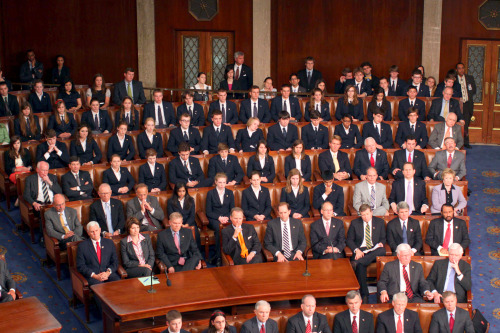
Of the 89 people sitting on the Republican members’ side of the aisle, pretending to listen attentively to President Calderón’s speech to the United States House of Representatives, only 29 were actually House Members. The other 60 were mostly teen-aged pages, along with a few staffers rounded up to make it look as if the party of business is actually interested in the United States’ relations with its third largest trading partner and foreign oil supplier, and second largest export market.
On the other hand, it was kind of a dull speech.
Marisa Treviño at Latina Lista looks at the two more popular rationales given for supporting laws that “have the potential of being applied in a discriminatory fashion” (as one mealy-mouthed politico put it),
… escalating crime committed by the undocumented and abuse of the healthcare system.
Looking at Arizona, one has to wonder why the crime portion would be a premise for their infamous SB 1070 when crime rates are actually at their lowest in four decades.
…
The other often cited complaint of undocumented immigrants which inspires swift action to enact punitive state immigration enforcement is healthcare. According to the rhetoric, undocumented immigrants take advantage of our healthcare system and are overburdening our emergency rooms.
Yet, a new report by the National Center for Health Statistics finds that this common argument is nothing more than another smokebomb thrown at a gullible public and even more gullible politicians.
According to the report, the majority of people filling up emergency rooms are senior citizens and African Americans.
Among the three ethnic groups: white, black and Hispanic, Hispanics had the lowest rates of emergency room visits.
…
These are only two examples illustrating how two of the arguments levied against the undocumented, as reasons enough to create the kind of legislation we, as a nation, condemn other countries for, are manipulated and exaggerated to fit an agenda of a small self-serving group.
Of course, as H.L. Mencken said, “no one ever went broke underestimating the intelligence of the American public” — 55 percent of whom still believe this nonsense.
Their loss is Sonora’s gain
Interesting. Since the passage of Arizona’s SB-1070, retail sales in Hermosillo, Sonora have gone up thirty percent. Gustavo Clausen Iberri, of the Sonora Chamber of Commerce says it’s due to a boycott of Arizona purchases. It may be, but I don’t think the boycott has really taken hold yet. But it looks as if more and more Sonorans are saying it’s not worth the hassle of going into Arizona for shopping and are heading for Hermosillo instead. The boycott will probably mean a much larger drop in Arizona purchases by Mexican consumers.
Hate to the chief
While I’m used to the “black humor” of Mexicans and wasn’t really shocked by the twisted comments I’ve read on some news articles about Diego Fernandez de Cevellos’ “disappearance,” Aurelia Fierros, in Metáforia política sees those comments — and others on Twitter and Facebook — as having a deeper political and social meaning. My translation from El Jefe Diego y el odio (18 May 2010)
“Jefe Diego” was disappeared Friday night. Within hours, several versions of what happened – a kidnapping, a settling of old score by organized crime, revenge for past legal battles, or a shameful attempt to break the political class and the National Action Party – circulated through the social media, none quite matching the official investigation.
Diego Fernandez de Cevallos, the prominent PANista and former presidential candidate who legitimized the Salinas government by his endorsement of the burning of the ballot boxes in 1988 when “the system crashed” presumably denying Cuauhtémoc Cardenas the presidency was, as a ministerial report put it, “reported missing.”
Before there was official confirmation of this startling development, a stream of micro Twitter messages, and even more extensive comments on Facebook cheered the disappearance of Fernandez de Cevallos with coldness, contempt and cruelty.
“It’s divine justice,” said a youth, recounting the details of rumors of the PANista’s death. Someone else claimed “he’s under his bed, if they look hard enough,” in a clear and mocking reference to the Paulette Gebara Farah disappearance. Others referred to him as a “disgrace” and worse, with some – assuming he was kidnapped by organized crime – praising the cartels and thanking them for their “public service.”
This phenomenon of media communication facilitated by increasing access to social networks by the most heterogeneous and by the most vulnerable in Mexican society undoubtedly reflects the collective rejection of Fernandez de Cevallos and a general resentment the political class.
The reaction to the kidnapping appears unstoppable. Within hours, mostly young people, using sarcastic language, had created Facebook pages for and against the presumed kidnappers of “El Jefe Diego.”.
“Because I don’t care about Diego Fernandez de Cevallos!”, “Where is (Jefe) Diego Fernandez de Cevallos?”, “Freedom for Jefe Diego”, Solidarity with Diego Fernandez de Cevallos ” and “We Are All Jefe Diego” are the most widely circulated groups on Facebook related to the case, their names having little to do with the positions taken by their subscribers, most of whom joined up only to continue venting their spleen and contempt for the lawyer and politician.
Although many also defend the controversial character, the worrying thing is that some of the comments are sadistic, nothing more than a sign that the growing social decay that prevails in the country has found an outlet in cyberspace.
Among the publicly known facts about Fernandez de Cevallos rehashed on these site is his 1997 defense of Santa Monica hospital, where Amado Carrillo Fuentes, the famous “Lord of the Skies” died during plastic surgery, and his later representation of Garcia Lopez funeral parlor, which conducted services for the capo under a false name.
Others bring up Punta Diamante scandal in which Fernandez de Cevallos earned millions on land deals in Acapulco, which they say, he received in exchange for facilitating Ernesto Zedillo’s presidential victory in 1994 after the assassination of Luis Donaldo Colosio, during an election in which he was the PAN presidential candidate.
A naturally dominating – if not to say domineering – personality whom I first got to know as a reporter in Mexico City during and after the 1994 presidential campaign, “Jefe” Diego, won the nickname because of his ballsy attitude, his oratorical gifts and his sharp-tongued criticism of certain members of the Mexican political elite. However, the controversy over his connections and his ethics, diminished the value of his intellectual brilliance, the credibility of his oratory and his contribution to democratic transition and the alternation of power in Mexico.
Authorities have not yet revealed the true reasons, or who is behind, the disappearance of Diego Fernandez de Cevallos. The only clear fact is that the clamor and indignation over the event that is playing out on the national stages clearly demonstrates that Mexico’s collective memory neither forgets nor forgives.
A shotgun blast from the past
Jacqueline LeBaron — one of the Chihuahua Le Barons of Colonia Lebarón, Chihuahua — was arrested in Honduras and extradited to the United States to face multiple murder charges from the 1988 killing of three adults and an eight-year old girl in Texas.
Yup, she one of THOSE Le Barons, who are usually only described as U.S. citizens when they’re sympathetic figures (usually as murder victims) and as Mexicans when they’re not. At least this time, the U.S. press is describing the unsympathetic LeBaron as an American, and glossing over the Mexicanidad.
The LeBaron colony in Chihuahua, which was founded in the 1920s by Jacqueline’s grandfather, Alma Dyer LeBaron was excommunicated by the Mormon Church in Utah and fled to Chihuahua where his colony became associated with Apostolic United Brethren, a relatively “mainstream” polygamous offshoot of Mormonism. After Alma’s death, his son Joel left the colony and moved to Baja California where he founded the Church of the Firstborn of the Fulness of Times. Another son, Ervil, founded his own sect, The Church of the Lamb of God.
Ervil launched a jihad against Joel, which left a string of corpses across northern Mexico and the southwest United States. Most of the Lambs were Ervil’s 13 wives and fifty or so children, many of whom joined in the killing spree. Jacqueline was indicted for mass murder (three adults and an eight-year old child) in 1992 and has been a Lamb of God on the lam (with the godly sum of $20,000 offered for her capture).
The LeBaron colony in Chihuahua lived down the notoriety (and claims Ervil was a paranoid schizophrenic, but they’re just hard-working Mexican farmers. Except when they’re U.S. second hand furniture dealers.
Back in 2008, the colony was again in the news, as a possible refuge for a polygamous sect in Texas accused of child abuse (the charges turning out to be false) and again in July 2009, when the colony garnered sympathy after a kidnapping and murder which fed into both Mexican and U.S. story lines about narco-violence — the U.S. using the violence to claim AMERICANS were unsafe and the Mexican administration milking it to justify more state security spending.
When I first wrote about the LeBarons, Jason — who is an expert on the varieties of religious experience in Mexico — said “Colonia Lebaron is to the [mainstream Mormon] folks in Chihuahua what Santa Muerte is to the Archbishop of Mexico: A real pain in the patootie, something like that weird second cousin that keeps flashing the neighbors and you wish you weren’t distantly related to.”
Sort of what what I expect colonia LeBarón’s residents are thinking about the latest of the extended clan to make the papers.
Re-branding
Ginger Rough and Dawn Gilbertson in the Arizona Republic (14 may 2010):
Acknowledging that Arizona has developed a serious image problem because of its tough new immigration law, Gov. Jan Brewer and tourism-industry leaders said Thursday that they will launch a new effort to stanch the flow of lost trade and convention business in the state.
The first efforts look promising:
Meanwhile, Patricio suggests taking “rebranding” in another direction:


Apatzingán is in Michoacán.
¡Todos somos Arizona! ¿Sarah Palin tambíen?

Photo: Miguel Espinosa/El Universal
I suppose one could make some comment about wet backs, but the downpour in Mexico City this afternoon did not stop 50,000 people from showing up for the Todos Somos Arizona concert on the Zocalo.
Headlined by los Jaguares, Maldita Vecindad and Molotov. the Todos Somos Arizona concert and teach-in

Molotov lead singer Micky Huidobro with a message for Arizona Governor Jan Brewer
was sponsored by the Federal District Secretariat of Education. In addition to the Mexican groups, Cuban band Kiki and Los Bunkers from Chile were also featured artists.
Meanwhile, in Cuenca, Ecuador, there was an anti-Arizona march on Friday, led by Julia Quintuña, mother of the late José Sucozhañay, the Ecuadorian beaten to death in New York by idiots who thought he was a gay Mexican. Which is doubly, or triply moronic.
And, in Arizona itself, speaking of idiocy multiplied — Sarah Palin, who you may remember as the former governor of the North American state even more socialist than Venezuela (giving direct subsidies to its citizens from the oil money) and who who abruptly quit her post after two years in office when she came under fire for ethical violations and nepotism — also said “We Are All Arizona”. However, Ms. Palin apparently meant “Some of us, are some Arizonans.” but perhaps her odd linguistic quirks don’t quite translate into Spanish or Pima or Piute or Navajo or even English.
Jefe Diego: Chronicle of a death foretold?
With the big, big, big news being Diego Fernández de Cevallos’ kidnapping Friday night, I’ll make an exception to my “never on Sunday” rule while reports of his demise are still rumors… thus not speaking ill of the dead.
Jefe Diego, as he’s known, is not particularly well-liked even in his own party. Rather, he commanded (or commands) respect mixed with fear as as a power-broker and strategist: a sort of Mexican love child of Richard Nixon and Karl Rove. Every foreign report mentions that he was PAN’s 1994 presidential candidte and tries to re-brand him as a great democratic figure for his role in the Fox campaign’s victory over the PRI in 2000. What’s overlooked is that when there was clear evidence of an opposition victory in 1988, until a “mysterious” computer fire stopped the ballot counting, Jefe Diego was the key figure in throwing PAN support to the government, burning the ballots and giving the presidency to Carlos Salinas.
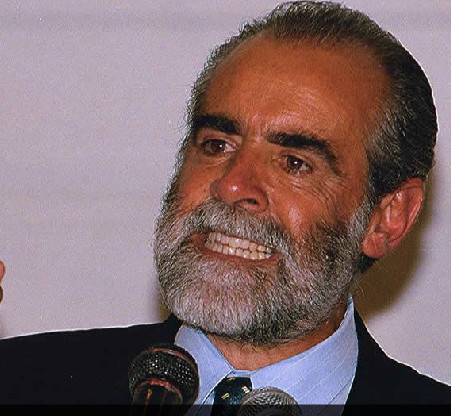 The Salinas presidency was very good to Fernández de Cevallos who — as a lawyer for the private business interests that prospered from hasty denationalization, and as the defense attorney for individuals whose egregious behavior was too much even for the Salinas administration to swallow — made himself extremely rich. As a legislator, he at least had the virtue of not being a hypocrite… openly admitting to supporting legislation in his personal interest or those of his clients. As a lawyer, his reputation as “the Devil’s Advocate” doesn’t refer to his intellectual prowess, but to his client list: the bankers who looted bailout money in the 90s, media monopolies and drug lords.
Rumors that he was dead led to lots of “good, let’s start the party” comments in the various newspapers, mostly from the usual lefty sorts. But more interesting was a “tweet from a twit” — PAN’s former party chair and “piety wing” leader Manuel Espino — claimed Jefe Diego’s corpse had turned up at a military base in Queretaro. Espino later was sending abject “I was mislead” tweets, but the idea that Jefe Diego COULD have been taken by the military — was plausible.
Fueling speculation, President Calderón is “conveniently” out of the country, and this past week also saw the shakedown of Chapo Guzmán’s ex-wife and rumored capture of former (or present) Chapo associate Ignacio Coronel.
I had to rely on a google translation, but it appears that Dutch reporter Jan-Albert Hootsen, El Pinche Holandés, is the only one to pick up on this. He writes (or, the Googelese version of what he writes):
… there is the phenomenon arraigo, without charge, trial or legal representation picking up “suspects” by the Mexican army. Many hundreds of Mexicans by a legislative amendment may be arrested without mercy if they suspected of any ties to organized crime…
Throw into the mix the under-reported news that the United States is training and funding “cazacapos” (“capo” hunters) a military strike against Jefe Diego makes sense in a twisted way.
Then again, it could be that narco-gangs took Jefe Diego as a hostage for some other figure’s release; or that somebody just wants to make some money and it’s just a plain old “rich-guy snatching”; a former or present legal client is cleaning up loose ends; or that — given Fernández de Cevallos political activities — he was snatched to send a warning to the administration, to PAN, to a faction within PAN, to the political establishment in general: or all of the above.
Or any combination of the above.


 mexfiles.net