Many Mexicos, many passions
In Itzapalapa, the 167th annual re-enactment of the Passion drew an estimated 800,000 visitors to watch Francisco Gerardo Serrano, in the role of Jesus carry a cross through the city streets and re-enact the Crucifixion and Resurrection that define the Christian faith. Itzapalapa was the location of the Aztec Cerro de la Estrella, where the New Fire Ceremony was held to mark the Resurrection of the Aztec calendar and their faith in a continuing world.

Photo by Adrian Hernandez, El Universal
In northern Sinaloa, where the Jesuit missionaries introduced Christianity in the 17th Century, but, after the expulsion of the Jesuits from all Spanish possessions in 1767, the people adapted Roman Catholicism to their own needs. The dance of the Pharisees may have its roots in medieval Spanish anti-Semitism, but the Yoromi people, in their celebrations at San Miguel Zapotitlán Church in Ahome, see their comic devils slightly differently than the Jesuits might have.

Photo: El Debate
And, here in Mazatlán, Acapulco and other cities by the sea, Semana Santa is Mexican Spring Break. The passion is for play. And beer, sand, beer, surf, beer, sun, beer, sex… and beer.

Photo: Saúl López, Cuartoscuro

Photo: Noroeste (You didn't think I was going to put up a picture of the college kids pissing in my parking lot, did you?)
Didn’t quite make it: Juan Carlos Caballero
Sad new. Juan Carlos Caballero, Pancho Villa’s former chauffeur, whom I wrote about in last June, passed away. Don Carlitos — one of the last veterans of the Revolution still lucid enough to give interviews — was interviewed by EFE on his 109th birthday:
By all means, “I hope that God allows me to arrive at the centenary of the Mexican Revolution”, which begins 20 November 2010. Caballero, born 24 June 1900 in Chihuahua, Chihuahua, joined Villas Division de la Norte at the age of 14, bringing himself to the Centaur of the North’s attention with his honesty. Asked why he wanted to join the army, young Juan Carlos said, “to meet girls.”
In 1914, he was also one of the few people around who knew how to drive, let alone how to repair an engine(his father’s had one of the few mechanized farms in Chihuahua at the time, and like a lot of farm boys, Juan Carlos learned to handle heavy equipment at a very young age) and he could shoot. Both of which he faithfully did on behalf of Villa and the Revolution for about two years, returning home in late 1916 as Villa’s political and military clout was evaporating. He later moved to the United States where he worked as a mechanic for many years and raised a family before returning to Mexico.
As he said during last June’s interview, and after, Don Carlitos remained willing to return to the fray and to fight injustice wherever it appeared. As the last survivor of the Columbus, New Mexico raid of 16 March 1916, maybe people on the other side of the border can sleep easily tonight hearing today’s news.
D.E.P. Don Carlitos

Photo: Gustavo Mendoza in Milenio
The last supper

Can walls stop migration? Maybe so, say Mixtecs
We’re used to hearing from people in the United States about the need to build walls to keep OUT immigrants. The arguments given by the wall builders in the United States are that the immigrants don’t contribute to society. In Mexico, where the reasons given for emigration are that there is nothing to keep people at home, and they are forced to emigrate, building walls takes on a different meaning.
It’s not that the Oaxaca community René López writes about in Correspondales Indígenas want to keep the world out … but that certain kinds of walls will bring the world in… and — more importantly — allow those who would be called by the would-be wall builders in the United States socially useless to become a valued part of the community. Confused? The students in one Mixteca community understand it, and are willing to give up their spring break to build the walls they need.
In my loose translation, I left the word tequio in the original, as there isn’t a good equivalent word in English for communal work projects undertaken by members of indigenous communes as part of one’s “membership dues.”
San Pedro Ñumi, Tlaxiaco, Oax .- To prevent further migration of young people to the United States this year, construction has been stepped up on the San Pedro Ñumi Communal High School Project. Forty percent of the community’s initial 400,000 investment in the school is to provide study space for students. Between work by parents, tequitos and cooperative projects foundations have been laid for what the school needs most: a building.
San Pedro Ñumi’s municipal agent, Bernardo Sosa Chávez, said in an interview that now that there is a high school, more young people are staying in the community and need a place to continue their studies. This year, instead of the thirty young San Pedrans who would be expected to migrate, only twelve left for the United States.
He said that times have changed because of the three year old school: instead of emigrating, the youths are willing to work within the community, and contributing their tequios. This year, students and graduates are contributing their tequios to this project. By the end of the year, there will be three classrooms, and by 2011 the Communal High School will have its own plant.
The communal assembly and the 52 students in the High School agreed that over spring break, the students and their parents will haul bricks, carry cement, pour water, wait on the delivery of industrial bricks and collect construction material and other resources the commune will need to finish the project over the next year.
The high school project involves not just the 900 residents of the commune, but the entire 5000 residents of the municipality, as was the case when the commune built a telesecundaria* four years ago. Parents understand that the High School means not only that their children will remain in the community another three years to finish their studies, but that if they leave, it will be to further their professional studies.
The young people are responsible in their studies and in their community, an example for others in the Mixteca who do not want to be left behind while waiting for outside assistance, according to project directors Agustín Cruz Guzmán y Sara Simón.
* Providing an adequate education was one goal of the Mexican Revolution that has been, for the most part, met. It has always been a challenge to provide access to schooling in the rural areas, especially in isolated communities like San Pedro Ñumi. While there are many dedicated and creative teachers, the problem has always been to find enough teachers, and supplies and equipment to staff every school, especially in small, isolated communities. For these communities, the telesecondaria has meant rural kids are able to receive the same education as kids in Mexico City. The teachers ARE in Mexico City, and classes are by satellite communication.
It takes a village idiot

… to preside over a village full of idiots.
He stood and delivered
Jaime Escalante, the hero of the only good movie, — make that the only movie– ever made about calculus died yesterday in Los Angeles at the age of 79. The film recounted the story of the “controversy” that erupted in California when fourteen of Escalantes’ students — from poor cholo and Latin immigrant families — were accused of cheating after passing Calfornia’s Advanced Placement calculus examination in 1982.
Advanced Placement examinations give university credit to high school students. At the time, they were fairly rare, and Advanced Placement classes were usually only found in the more prestigious private schools, or in public schools in wealthy communities (in the United States, schools are largely financed and educational requirements are largely controlled by locally elected school boards). About three percent of U.S. students took the calculus examination in that year. A passing score on the Advanced Placement calculus examination is 3 out of 5. Eighteen of Escalante’s students took the examination, and all passed. Seven received a five.
That fourteen of the students derived their solutions to problems using the same logic shouldn’t have been surprising, but served as a basis for assuming that Escalante’s students cheated. Cholos and immigrants aren’t supposed to be taking these examinations, let alone passing them.
His later involvement in conservative politics in California was problematic (he opposed bilingual education, and was at one point an educational adviser to George W. Bush). Escalante was somewhat unpopular among the educational establishment and in his later career, never managed to have a class repeat the performance of his 1982 Garfield High School class.
What was not part of the film, and largely overlooked, is that Escalante was the typical immigrant success story. The son of school teachers in Bolivia, he was fortunate in attending the better schools in that country, and being a graduate of the Bolivian Normal Superior. There’s a reason U.S. schools are now recruiting Mexican math teachers beyond the need for more Spanish speakers.
Although he later complained that “There’s a tremendous amount of feeling that the Hispanic is incapable of handling higher math and science,” my limited (very limited) experience with Latin American schools is that mathematics are much better taught than in the United States. As Escalante did, Latin American math teachers use observable phenonoma (famously in Escalate’s case, using basketball shots to explain a parabola) to explain the workings of the theorems and corollaries- And anyone who has seen a builder — who certainly is not a graduate of a Superior Normal school — lay out an addition on a house, calculating the dimensions, the number of bricks required, and get it mostly right without writing down a thing, should know that “hispanics” certainly can handle mathematics.
After his retirement in 2001, he returned to Bolivia, where he taught university courses part-time, until returning to the United States to be near his children and receive treatment for the cancer that finally killed him.
The guy cleaning the floors in your local cafe — the job Escalante had when he first came to the United States in 1963 — or short order cook — which he was while working on his U.S. teaching degree after learning English — might be smarter than you are. And, more calculating.
Elaine Woo wrote the excellent obituary of Escalante published in today’s Los Angeles Times.
The slaughter of the innocents
In rural Pueblo Nuevo, Durango, ten children and teenagers from an ejido were murdered after the truck they were riding in was attacked with grenades and gun-fire on the highway Sunday. Following as it did the death of two graduate students at Tec de Monterrey during an army attack on presumed narcos last week, it shouldn’t be surprising that Secretarío de Gobernacíon, Fernando Gomez Montt, felt it necessary to stress that there was no army involvement in the Pueblo Nuevo slaughter.
Of course, it’s likely the Pueblo Nuevo incident had absolutely nothing to do with the “narco war” — a similar slaughter in Oaxaca a few years ago, which at first blush seemed to have some relation to the latest political violence in that States, turned out to be the latest chapter in a five hundred year old water rights dispute between two small communities. Or, it may only be tangentially related to the “narco war”. the “tools of the trade” — guns and grenades — being too easily available for dispute settlement.
To label this a “terrorist attack” — implying the violence had some higher purpose — is premature. Like the Le Barón attacks in Chihuahua (against the breakaway Mormon colonists in that state last year), which quickly assumed a political importance they turned out not to have, I expect the story will get more complicated — and more simple — as more is known.
What’s intriguing is that between the LeBarón murders last July and now, there has been a genuine change in the Mexican perception of the Army’s role in rural peacekeeping. Then the call was for for more arms and militarization, now it’s the army that’s immediately a suspect when there is a crime in a rural backwater.
I don’t mean that the army SHOULD be suspected, or that they are deviating from the task they were given, but do question whether they should have been given the task in the first place. Not so under the surface, the twin problems of the Fuero Militar (the military justice system’s oversight of military personnel’s crimes against civilians) and the after-the-fact attempts to legalize the use of the military for the U.S. sponsored “drug war” are being raised not just by the Mexican intelligencia and outside agents, but by ordinary people.

The early colonial settlement of South Africa, by the Dutch puritans and religious exiles known as the Boers or Afrikaners wasn’t all that different from that of the English colonies in what became the United States. The descendants of both colonists saw themselves as the rightful (and righteous) possessors of their territory. While the later apartheid regime was odious, it was a simply a 20th century (and more efficient) codification of the same attempt to maintain a tradition after the trauma to the prevailing ethos that was seen in the United States after the American Civil War in the “Jim Crow laws”.
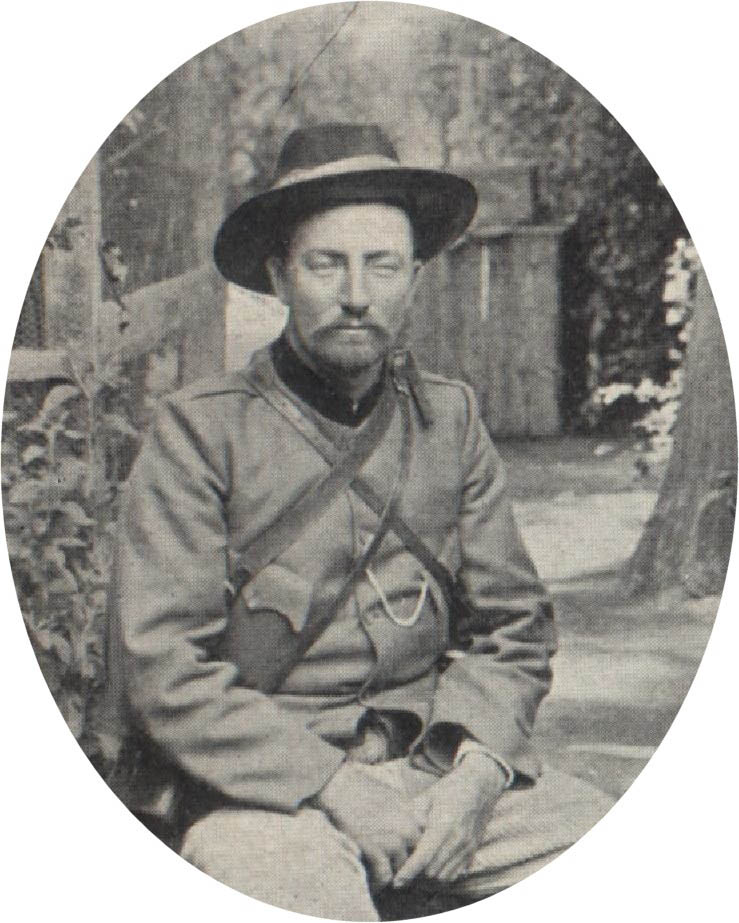
Viljoen during the Boer War
Both the First and Second Boer Wars were modern wars, the only difference being that the British invaders made no secret of their intentions to seize control of the regions’ mineral assets. The Second Boer War is noted today for its um…er… social innovations. Fighting an asymmetrical war against an indigenous (or indigenized) population, the British invented a new euphemism and new form of control — the “concentration camp” –for dealing with the locals. Secondly, to dispose of the military and political leadership — or potential leadership — the British pioneered the use of indefinite detention on far away islands, out of sight, and — in those pre-internet (and pre-television, and pre-radio and pre-wire service reports) days, out of mind.
By this time, the United States had, of course, become an emerging world power, and had changed dramatically, although the “original families” still largely set the prevailing social and political standards. Naturally, as fellow puritans, as republicans who had resisted colonialism (and as fellow “white men” who took up their burden) there was a good deal of sympathy and support for the Afrikaner Republics in their hopeless fight against the might of the British Empire.
Being a world power, there were restrictions on what the United States would commit itself to, and — as a new colonial power itself — it was not going to intervene politically or militarily for the Orange Free State or the Transvaal Republic. However, the elites, and much of the press, and the people of the United States, were sympathetic to the Boer cause.
When, at the end of the war, one of the stalwarts of the Transvaal forces, and a pioneer in another innovation of that war, the modern commando army, General Benjamin Johannes Viljoen was released from prison on the Isle of Saint Helena (where Napoleon was also isolated), there was nothing much for him to come home to. Before the way, Viljoen had been a dirt farmer, during the war, an expert on asymetical warfare, and afterwards, an exile in need of a job.
Viljoen wasn’t the only Afrikaner exile. A number of “enemy combatants” had been held in Bermuda, and like some of their carceral descendants today (to coin a phrase) in Guantanamo, could not be returned to their homeland for political reasons. Where to send them? Why Mexico, of course!
The early 20th century was the heyday of “white” settlement in northern Mexico. Porfirio Diaz’ cientificos had, in keeping with the Social Darwinist theories of the time, assumed that European (or European-descended) immigrants would, simply on the basis of their bloodlines, improve the stock in the largely undeveloped north. So…
Exiles from the “detention centers” in Bermuda, led by Wilhelm Snyman (who was allowed to leave Bermuda for the United States) were offered a chance to buy undeveloped properties in Mexico at cut-rate prices. The Mexican government was willing not just to take the Afrikaners, but to assist them in founding an exile colony. But, the Mexican government only had so much money available and the Boers were expected to pay something for the land. And these guys were broke.
In April 1901, Snyman met with then U.S. President Theodore Roosevelt. Roosevelt was not only an heir to the original puritan elites, he was from a Dutch puritan family. Officially (Snyman and Roosevelt met at Roosevelt’s home on Long Island, New York), the President could not over-annoy the British with assistance to what the Crown saw as terrorists, but, unofficially, there was much he could do. General Viljoen had already scoped out suitable land in New Mexico, but found the price much too high. Roosevelt contacted Porfirio Diaz about resettlement and arranged for the South Africans to meet with Mexican Secretary of the Treasury José Ives Limantour.
Limantour took the Afrikaners on a … well… Liman-tour, by Pullman coach on a government train to look at several sites, After rejecting the Yaqui Valley of Sonora (which would need repopulating, as the Yaqui were being sent to their own concentration camps in the Yucatan), the Boers found what they wanted near Carmargo, Chihuahua. Fifty thousand pesos for the 33,615 square hectares of the ex-Hacienda de Santa Rosalia was a steal.
Or, would be if the Snymans could come up with the cash. Roosevelt, a successful author himself as well as a sometime military man quietly pulled a few strings among his fellow New York elites to guarantee Benjamin Viljoen’s My Reminiscences of the Anglo-Boer War and An Exiled General would have respectable reviews and decent sales.
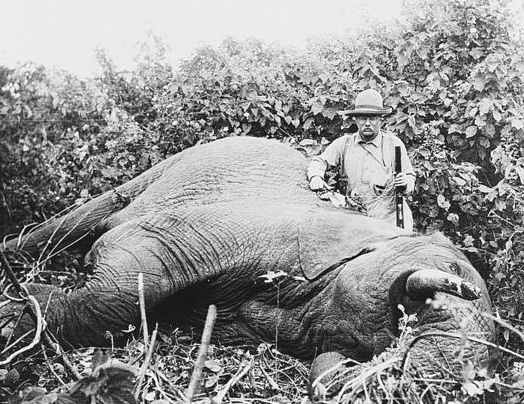
And TR had some interest in African slaughters, too!
Furthermore, Roosevelt — who seemed to embody every American myth of his time — had been a wild west rancher and law man back in the day — was no snob when it came to raising money. And enough of a showman to recognize that the Buffalo Bill Wild West Shows of recent fame still had their audience. So, Viljoen and several other South Africans, joined by a collection of footloose British veterans of the conflict, mounted the Boer War Circus at the 1904 Saint Louis Exhibition to raise the last of the necessary funds for the Chihuahua colony. Viljoen himself, though, made enough from these enterprises to buy the land he’d previously seen in New Mexico, which apparently he liked well enough to leave his first wife back in South Africa and pick up a new bride in the Mesilla Valley.
The Snyman colony — Hacienda Humboldt — managed to hold on, although its isolation (roads were slow in reaching the colonists) made it hard to attract new blood. The Afrikaners were relatively quick to realize that the labor practices acceptable back in Africa with regard the “natives” weren’t going to fly in Mexico and quick to adjust, there were very few social problems with their neighbors. Apartheid wasn’t in the colony’s future… just the opposite. Willingness to socialize began the decline of the specifically Boer nature of the enterprise, as Snyman’s sons and other younger members of the colony quickly married into local families.
Adopting their neighbor’s political and social views — and sensing that Limantour had forgotten about them — even the unassimilated colonists were on the side of the Revolution. And one of their own — ex-General Viljoen was, in some ways, leading the troops.
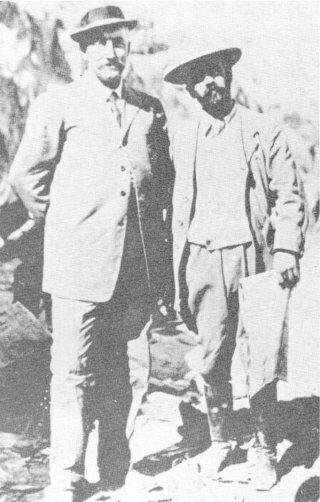
Viljoen and Madero, 1911. Photo: Die Suid-Afrikaanse Krygshistoriese Vereniging, V2, No. 9
Francisco I. Madero may have been an “idealist” and more than slightly eccentric, but his family were good, hard-headed business people with their own elitist, born-to-rule sensibilities. When the Maderos decided on Revolution, they didn’t just shop for guns, but for proper advisers and agents. And went shopping for experienced experts on asymmetrical warfare too. They knew of, and about, the Boer War veterans colony, and were keen followers of trends in the United States. Viljoen — whose motto in the Boer War was “God and Mauser Rifles Will Prevail” was offered the job as chief-of-staff to the Madero Provisional Government.
Although the Revolution was successful, in that Porfirio left power and Madero was elected to the Presidency, Viljoen was never an important enough figure in the Revolution to be more than a footnote.
From the beginning there were problems. Giving orders to people like Pancho Villa was always problematic, more so when the Chief-of-Staff doesn’t speak Spanish, and Villa’s English was never as good as he thought. Villa usually did what he wanted, and just claimed he hadn’t been able to understand Viljoen. Viljoen, being a commando expert himself, was wise enough to figure that as long as Villa was winning, he wasn’t going to worry too much about it, facing bigger problems with Pascual Orozco, another loose cannon, and a more immediate danger. Orozco was suspected in May 1911 of attempting to bribe Viljoen to switch sides, and — by June of that year, was openly defiant of the Chief of Staff (Viljoen wanted to move troops to the Baja, while Orozco was threatening to overrun Ciudad Juarez).
Villa and Orozco, besides able to communicate directly with their troops, also knew the countryside intimately — which Viljoen didn’t. And, his war having been in a country without railroads, and fought outside the few cities, had little relevance to the Mexican Revolutionaries, who recognized the strategic importance of the rail lines, and where even rural residents resided in towns, not on individual farms. Increasingly ignored, and distrusted by many because of his status as what was basically a foreign mercenary, Viljoet stayed on as Chief of Staff, but more as a theorist (and one that could be ignored) and media spokesman (his English was much better than most of the other Generals) than a key figure. He left the Mexican army when Madero was overthrown, returning to New Mexico to take up an active role in local politics in the new U.S. state. He died in 1917.
Hacienda Humboldt slowly disintegrated. Ironically, resolving the colonist’s original complaint sealed its demise. With access to the outside world, people left, most simply assimilating into the larger Mexican community. The more conservative Boers, looking for a South African community resettled near Viljoens in the Mesilla Valley, although during the Great Depression, most eventually moved elsewhere. Today, Hacienda Humbolt is part of Ejido Julimes, with under 300 residents, none of whom would be identified as Afrikaner.

Plaza Julimes (Hacienda Humboldt) today. Photo: "Kekox" Panoramio.com
Lawrence Douglas Taylor Hansen’s La colonización bóer en Chihuahua y el suroeste de Estados Unidos, 1903-1917 can be downloaded in PDF for those seeking a scholarly study of the Afrikaner colonies. Viljoen’s 1903 My Reminiscences of the Anglo-Boer War is available on-line from Project Gutenburg)
Un-surprising development
I’m not talking about Ricky Martin finally coming out , but the arrest of the presumed killer of the two American Consulate employees (and an American citizen dependent) by the Mexican Army. I had to read the articles a couple of times to figure out what we should have known (and actually did) from the beginning… that this was a crime “Made in the U.S.A.” The suspect — Ricardo Valles — was arrested ENTERING Mexico FROM the United States.
The reports of the arrest — de manera extraoficial, as Jornada styles it — raise some questions about the event.
- The Aztecas are the “cartel of the week” in the Mexican media, although before this incident, I don’t think I’d ever seen mention of them in the Mexican press, except in connection with their alleged role as subcontractors to various narcotics export groups and as possible go-betweens in the supplying weaponry from the United States for the various Mexican crime syndicates.
- Like United States citizen, Edgar Valdez Villareal, aka “El Barbie”– who is supposedly leading the Beltran Leyva faction in the crime wars — U.S. criminals operating in Mexico have been known to U.S. and Mexican authorities for a very long time. Ricardo Valles apparently is a Mexican citizen, but he is a legal resident of Texas, and the Azteca gang, the presumed authors of the gringo hit, are a U.S. gang, not a Mexican one.
- While the Aztecas may have ties to Mexican gangsters, and are an ethnic gang, that no more makes Mexico responsible for them than Italy was responsible for the depredations of Sicilian-born Carlo Gambino in the United States during the 1940s and 50s. There were ties between the American mafia and various south Italian criminal organizations, but even with the limited intelligence-gathering capabilities of governments sixty years ago, when a U.S. gangster was setting up operations in Italy, both governments were kept in the loop.
For the Aztecas, let alone Edgar Valdez, to have operated so freely (if indeed they were, or are, operating freely) until now leads many to suspect it wasn’t an accident. “Amelia”, commenting on the news on the Valles’ arrest in Jornada, posts [my translation]:
Anyone who has read Naomi Klein’s “The Shock Doctrine” can see what happened was an agreement between the Mexican government and the gringos to come up with an justification to bring the FBI into the country to investigate.
The killing was no mistake: it was a calculated and premeditated murder of two gringos — street theater. What else can one expect when corporate interests are so strongly affected?
Amelia is not alone in her suspicions that something is just not right about all this. The idea that the U.S. government purposely “sacrificed” the employees (whose roles have never been identified to my knowledge, and seem to have been low-level non-diplomatic personnel) is something best left in a Robert Ludlam novel. But, the kernel of a real concern is there. Once again, the present Mexican administration is changing the target of the “drug war” from one criminal gang to another (which is never, ever the Sinaloa Cartel), but now — given that the gangsters have United States ties, there is a rationale for U.S. intervention and cover for the “rescue” of Mexico.
Mexico has had enough “shocks” and is already beholden to the United States for much of its economic, political and social policies. This “shock” — the murders and their aftermath — which Amelia believes are a cover for more U.S. infiltration into Mexican policy may also prove to be a shock for the United States and it’s own bizarre and deadly “drug war.”
Thoughts on tourism
- First, speak no harm. That’s the word coming down from Don Felipe to the tourism industry, which is seeking to recover from the bad publicity this country has received in light of it’s relatively high (but half that of Brazil) murder rate and the incessant press reports of violence in the wholesale narcotics industry (as opposed to the violence among the retailers, I guess).
- I suppose we should start thinking about changes in the medical tourism trade, now that the United States has finally taken the first baby steps towards a rational health care system. Not to worry… it’ll be years and years and years before it kicks in, and, anyway, it’s not going to cover cosmetic surgery. We’ll always have the cut-rate face lift crowd.
- Religious tourists — it’s not just the Virgin of Guadalupe that brings ’em in. 2012 should be a banner year for the Yucatan. With all the end of the worlders coming down, I see a great boom in selling full price return plane tickets.
- Gay marriage tourism. While it is still unclear what the rules are for foreigners marrying in Mexico (they always have) same-gender couples from throughout the Republic are getting married — legally — in the Federal District and it appears the only drawback is, that in case of divorce, the couple would have to file in Federal District courts. Otherwise… while a marriage license for foreigners is two pesos more than for a resident, I can see a market here… maybe with a combined honeymoon tour.
Crime and no punishment
The most vituperous comments ever sent to the Mex Files were in response to a post on the death of Marciel Maciel. I only left two of the best, rather mild on the “fuckyouometer”. My “secular leftist agenda”, as one of those commentators had it, had more to do less with the obvious relief one feels when a serial child-molester is permanently removed from the human race than with my own interest in Mexican history and politics.
Back in May 2006, I had praised the Vatican leadership for — belatedly — realizing that Maciel’s ties to fascism and the cult of personality that had been built around him during his tenure as head of the Legionaires of Christ — and the unfortunate results of Maciel’s role as the former Pope’s Mexican expert — had a baleful result on Mexico and the Church.
While I’ve followed the subsequent fallout of the Church’s investigation into the issue, and the growing scandal not just over Maciel’s life, but over child-molestation within the Church, it’s not something I particularly saw as relevant to this forum.
However, I noticed at the time of Maciel’s death something odd. Maciel, when packed off to “to do penance for the rest of his life” (and facing civil and criminal charges in a number of countries, including Mexico) went into a Texas monestry where he died in January 2008.
It’s perfectly understandable that the Vatican would want to do an internal investigation of it’s own, and I might even accept that the Vatican — as a state — has the rights to not extradite wanted criminals. But, how did Maciel get a visa to enter the United States, and was he considered a “registered sex offender” under Texas and U.S. law? And, why were foreign justice officials, like the Mexicans, not alerted that a suspect in serious criminal charges was sitting not too far from the Mexican border? I never heard of any asylum hearing… was he an “illegal alien?” that the U.S. government chose to overlook?
What made me think of this isn’t so much the continuing saga of the Maciel scandals, but a small notice in Jornada that Jean Succar Kuri has finally been imprisoned. Succar Kuri was a prominent businessman in Quintana Roo and, like Maciel, his seemingly respectable political and social position covered up his career as a pervert and child molester. The “blue jeans king’s” kiddie-porn and child prostitution ring was the subject of Lydia Cacho’s Los Demonios del Edén which created a firestorm here in Mexico, both over the organized kiddy prostitution tourism trade and the attempts to silence Cacho. The attempts by the Governor of Puebla (who was receiving financial and political support from one of Succar Kuri’s associates) to have Cacho kidnapped and “disappeared” under the pretext of charging her with criminal libel, backfired and led not just to her release, but a reform of the libel laws and a bit more protection for journalists and researchers in this country. As with the Vatican’s forced retirement of Maciel, it was a positive step, but allowed the main perp to get away.
In the same post I wrote about the Vatican action, I noted that Succar Kuri had lost his battle to avoid extradition to Mexico. That was 19 May 2006. The Jornada story on his imprisonment was 28 March 2010. It seems the United States was really in no hurry to send a convicted child molester back.
Convicted terrorist Luis Posada Cariiles, wanted in Cuba for blowing up a civilian airliner over Bahamian air space, and elsewhere for various criminal activities, all of which he admits is also, despite his conviction on various immigration charges in the United States — and recognition that he is wanted in other countries, walking around free. His prominent presence at an anti-Cuban rally in Miami wasn’t reported much in the Untied States, but which cast doubt on the motives and the validity of the protest.
Guillermo Ramirez Peyro, a Drug Enforcement Agency “snitch” and mass murderer here in Mexico, won what Bill Conroy of Narconews called a “huge victory” in being granted asylum in the United States.
While both Ramirez and Posada may have a valid argument in claiming they would be tortured and/or executed for their criminal offenses in their own countries, there is a pattern here.
The United States expects us to “hold the line” and prevent crime from “spilling over” into the United States. But, when criminals DO cross the line into the United States, it is loathe to return them to us. If, as Ramirez and Posada claim, Latin American justice is brutal (and it is) then it cannot simultaneously demand Mexico lock up or “eliminate” (without benefit of trial) those whose crimes are directed towards the United States, and overtly financed and enthusiastically supported by the United States.
Bribery? In Mexico? Out-Wrage-ous!
Redacted from EFE (via SPDNoticias):
Mexico City – 85% of bribery solicitations in Mexico are from people associated with the government, with 45 percent of requests coming from the police, according to a report issued today by United States based Trace International.
“Over 85% of all reported bribe demands in Mexico were made by people associated with the Government, including 45 percent by police, and 12 percent by various officials at the national level, according to the document released in the United States which analyzed 151 incidents reported by July 2007 to January 2010.
The report also indicates that ten percent of Mexican officials at the provincial or state level are involved in kickbacks or bribes, which also include bribes between other employees of government agencies (6%), municipalities (4%), judges or representatives of the judiciary ( 4%), members of the Army (2%) and officials of the party in power (2%).
…
The document compiles anonymous complaints by frequency, type and purpose of the bribe demands, from throughout Mexico, which have been reported to BRIBEline.org
…
TRACE’s spokesman explained that “cash is the preferred form of payment of bribes”, 80 percent of bribe requests in Mexico are in the form of cash payments. Five percent were for greater company participation in a project, four percent sexual demands, four percent for benefits assistance (visa processing, medical care or education), four percent for gifts, entertainment or accommodations and two percent for travel….
Of course, it would be silly to claim that bribery doesn’t exist in Mexico, or that the police aren’t likely to be more enthusiastic collectors of irregular payments than other governmental officers (for one thing, you run into a lot more police officers than other officials in your day to day life). But really, how much stock can one put into the results of a self-reporting, anonomyous foreign website neither well-known, nor regularly accessed by Mexicans? I know a lot about Mexico, and about Mexican websites (and U.S. websites) — or so I like to think — and this is the first time I’ve ever heard of “bribeline.com” or TRACE international.
Is one going to run over to the computer, search the web for a foreign site and input the data if you uh… um… resolved matters in a less than legal manner the day you left your license at home and got stopped for not wearing your seat-belt (speaking hypothetically … of course!)? And, if, as TRACE mentions, a lot of bribery is made under threats of violence or other unpleasantness, can you really see the person going and reporting the incident in clinical detail on a foreign website?
And how seriously would we take studies based on these kinds of results… especially coming from a country that starts wars seemingly to support the industrial firms that “contributed” to a given President’s campaign? Or.. that create crimes so that an entire “for profit” prison industry can soak the taxpayers and citizens? Or that’s run by the same kind of people that advise the businesses for which bribery is standard operating practice?
TRACE International, according to their website, is basically Alexandra Wrage, the former Senior Counsel – International with Northrop Grumman Corporation. Northrup Grumman Corporation: fine, upstanding citizens all, I’m sure. Prior to working for the company that right now is “currently believed by some legislators to be cheating the state [of Virginia] on an information technology contract,” and which is now complaining that it lost a bid to build some military planes because they bribed the wrong political party, and that’s not fair, she worked for MCI Corporation.
To be fair, Ms. Wrage was not one of the MCI corporate executives who “received prison terms… for their roles in a multimillion dollar scheme that demanded kickbacks from vendors trying to obtain company business.”
Besides, her business has a board of directors to oversee things. Her, the Senior Counsel with the Upstream Special Projects Law Department of Exxon Mobil Corporation and a Washington attorney who “represents corporations and individuals in a wide variety of civil and criminal investigations and enforcement matters, including grand jury investigations, SEC enforcement actions and Congressional inquiries”.
I suppose I could say something about removing the beam in your eye, and all that, but maybe I should just find some obscure website in some other country to talk about it.


 mexfiles.net