Hot merchandise
Translated from Crisol Plural (Aguascalientes):
Construction worker César Óscar López Larios,20; office worker Jorge Adrián X. López, 19; and waiter Dante Daniel Esquivel Ruiz, 28, were detained by the officers of car number 1316 at 03.12 at the corner of Cerro del Pinal and Siglo XXI, in the Cerro Alto subdivision.
As reported by Juan Carlos Loera Mandujano the trio are presumably responsible for having robbed a stove that had been built-in to the kitchen of a house located at 21 Cerro de Pinal.
The stove in question was encountered in the trunk of a gray 1986 Chevrolet Buick, with State of Nuevo León plates RZA 2361. The three defendants have been locked up in the cells of the Municipal Justice facility.
No severed heads, no shootouts, not even an armored Humvee… just a Chevrolet Buick (whatever that is, though I’ve seen a few mix-n-match automobiles in this country that might just fit that description)… crime the way it should be.
Controlling border violence the old fashioned way
In 1786, recognizing that the Crown could claim few lasting victories against the Apache despite almost a century of bitter warfare, the recently appointed viceroy for the northern
frontier, Bernado de Gálvez, adopted a pacification plan based in part on Spanish imperial policies in North Africa. Arguing that “[p]eace is founded, as everything else, on private interests,” Gálvez… proposed the Crown bestow weekly rations… to Apaches who settled peaceably near Spanish presidios. In exchange, these Apaches would be expected to serve as auxiliaries against hostile Indian groups. While this program did not portend the complete subjugation of the Apache… it did promise to reduce the violence of recent years to a more tolerable level: “[A] bad peace with all tribes which ask for it would be more fruitful than the gains of a successful war.”
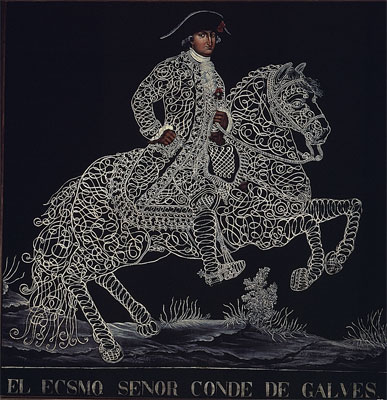
Karl Jacoby. Shadows at Dawn: An Apache Massacre and The Violence of History, 2008. Page 55
 Gálvez was a hard-ass, basically bribing favored cartels bands to leave legitimate businesses alone. Sonora — which included what is now Arizona (where the 1871 massacre of Apache women and children Jacoby writes about occurred) — was, if not completely peaceful, at least prosperous and less dangerous than most of the northern frontier for the next fifty odd years. What finally undid the program, leading to economic disaster and violence in the borderlands was not just that the new Mexican state was unable to keep up the payments to the “pacified” Apaches, but that more violent marauding Apache and Comanche bands were able to obtain arms and found a ready buyer for fruits of their labor in the United States.
Of course, the uptick in violence in the late 1830s was nothing compared to what happened once the United States intervened militarily in Mexico a decade later.
Be afraid, be very afraid…
Thanks to Maggie Drake for bringing this to my attention. From an interview with Robert Siegel of National Public Radio.
“Just to be clear,” Robert continued. “Are you saying that (Mexican President Felipe) Calderon has expressed an openness toward a uniformed, U.S. military presence within Mexico?”
Napolitano’s response:
“Yes. Let me be very, very clear (because) this is a very delicate subject. … Our military in certain limited ways has been working with the Mexican military in their efforts against the drug cartels. But, it is at the request of the Mexican government, in consultation with the Mexican government. And it is only one part of our overall efforts with Mexico, which are primarily civilian in nature.”
Does this mean the U.S. has advisers on the ground, or “people actually engaged in operations?” Robert asked.
Napolitano wouldn’t go into specifics: “All I’m saying in this interview is; that you can deduce from the fact that the chair of the Joint Chiefs was at this meeting and the secretary of Defense was at this meeting that the United States, and its military, are also and have been offering assistance to Mexico.”
To Mexico or to Felipe Calderón? I notice that Don Felipe is already thinking about his successor… who should be of his “color” when it comes to signing off on his version of security — and he is labeling those who disagree with him as a “ridiculous minority” supporting the narcos. To paraphrase another recent conservative president of a North American country whose electoral victory has always been dubious, “Either you’re with him, or you’re with the narcos”.
I haven’t heard (and no one outside the official people have heard either, to my knowledge) exactly what “assistance” is planned, but given the recent decision to grant political asylum to a D.E.A. informant who also worked as a hitman for Vincent Carrillo Fuentes, I’d be very nervous about any U.S. “advisers” if I was one of those public figures the present administration decided was part of a “ridiculous minority”.
While I’m not expecting incoming drone attacks today, I do expect incoming rhetoric from San Lazaro Palace and all media outlets in ten… nine… eight…
We’re here from the government…
I have been reading the late Carlos Montemayor‘s La Violencia de estado en México (Mexico: Debate, 2010) dealing with the state repression. Although Montemayor focuses his reseach on the 2 October 1968 Tlatelolco, and 10 June 1971 “Jueves de Corpus Christi” Massacres, and the lesser known, but in many ways more shocking Acteal Massacre (22 December 1997), he also looks at several, lesser known, small-scale examples of state repression and state violence. Much of Montemayor’s research is based on after the fact published documentation from declassified U.S. intelligence sources.
In March 1969, a U.S. Air Force C-118 transport, flown by Captain Donald W. Reider, landed the explosives used in September of that year by the Mexican military intelligence units to bombings that could be attributed to “terrorists” (of the domestic variety), and used to justify to the public the crackdown on student dissent. According to National Security Archive (a non-governmental research institute located at George Washington University), U.S. intelligence sources were well aware of military and national police assistance to the paramilitaries responsible for the Acteal Massacre.
Both examples — taken pretty much at random from Montemayor’s book — demonstrate two things: first, that the United States already has, and has had, intelligence operatives in Mexico; and, second: if violence is in the State’s interest (as at Acteal), a military or police presence is no barrier to an atrocity.
On the first, I’m dubious of what was accomplished by Hillary Clinton — or was it Janet Napolitano who was leading the show — turning what should have been a routine discussion of continued financing for a bi-national cooperative program (the so-called Merida Initiative) into an overt invitation for an increasingly militarized solution. I recognize that Clinton, Napolitano, et. al., all made nice noises about “respecting Mexican sovereignty” and Secretary Clinton made the ritual remarks suitable to such occasions:
“Yes, we accept our share of the responsibility,” Clinton said. “We know that the demand for drugs drives much of this illicit trade and that guns purchases in the U.S. are used to facilitate violence here in Mexico.”
She said that Washington “firmly” supports the campaign launched by Mexican President Felipe Calderon to fight drug trafficking cartels.
Frankly, that “support” seems more designed to prop up an administration than the nation, but I suppose there’s something positive to be said (as the New York Times does), for a less overtly militaristic approach:
Responding to a growing sense that Mexico’s military-led fight against drug traffickers is not gaining ground, the United States and Mexico set their counternarcotics strategy on a new course on Tuesday by refocusing their efforts on strengthening civilian law enforcement institutions and rebuilding communities crippled by poverty and crime.
Overtly, and unapologetically, this “new, improved” plan is based on U.S. military models… specifically from that country’s occupations in Iraq and Afghanistan:
Documentos oficiales y declaraciones de jefes del Pentágono ante el Congreso de Estados Unidos corroboran la intención de la Casa Blanca para aplicar contra el narcotráfico mexicano las técnicas de inteligencia militar utilizadas en Iraq y Afganistán, a fin de reemplazar a la fallida estrategia calderonista y favorecer el eventual repliegue del Ejército Mexicano de las plazas más “calientes”.
[Official documents and declarations by the Pentagon chiefs before the United States congress confirm the White House’s intention to apply to counter-narcotics efforts in Mexico the intelligence techniques used in Iraq and Afganistan, replacing the failed Calderón strategy and the eventual withdrawal of the Mexican Army from “hot spots”]
Presumably, “hot spots” like Juarez, where opposition to the militaristic solution has led to overt calls not just in Chihuahua, but throughout Mexico for Calderón’s resignation.
The same day as the meeting, 50 “Aztecas” (the U.S. based gangsters supposedly responsible for murdering two U.S. consular employees and a consular dependent in Juarez) were arrested, Daniel Borunda of the El Paso Times reported:
A total of 54 members and associates of the Barrio Azteca gang have been arrested as part of Operation Knock Down, a spokeswoman for the U.S. Drug Enforcement Administration said Monday.
The DEA-led crackdown is one of the largest law enforcement efforts ever in El Paso, with more than 200 officers from 21 different agencies. The operation was launched last Thursday to pressure members of the Barrio Azteca gang for information on the deaths of three people linked to the U.S. Consulate in Juárez.
Meaning… there has always been the intelligence capacity in the United States to identify and locate people considered a threat to state security… but the timing makes one suspicious.
Will “better intelligence” or doubling the number of DEA agents working in Mexico, or U.S. based training (the intellectual authors, and many of the hitmen in the worst acts of Mexican state violence received their training in the United States, so I’m not sure what it means) prevent disasters like that earlier this week here in Sinaloa, where six Picachos Dam protesters were gunned down, supposedly by gangsters trying to control a roadway. In Acteal, the authorities knew who the armed aggressors were, and chose not to act when the target was a politically inconvenient group (the only difference being those murdered in Acteal were women and children from a religious pacifist group).
President James Knox Polk couldn’t contain his glee when he heard a couple of U.S. soldiers were killed during the “Mexican Stand-off” of 1846, giving him the cover he needed for his “intervention” into Mexico. I don’t think the State Department, or the White House, in 2010 was exactly gleeful over the murder of two American citizens (and a Mexican employee of the United States government), but I will venture that it was a “green light” for implementing a strategy already in place.
24 de Marzo de 1980
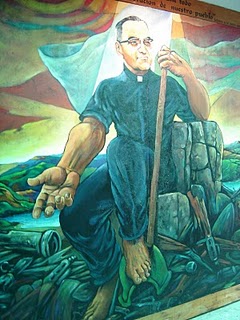
Photo: John Donaghy
Óscar Arnulfo Romero y Galdámez, Archbishop of San Salvador was gunned down during Mass at a hospital chapel (he lived in a three-room house on the hospital grounds) the day after giving a sermon in his Cathedral including this direct appeal to the Salvadorian Army:
Brothers: you are of part of our own people. You kill your own campesino brothers and sisters. Before an order to kill that a man may give, God’s law must prevail: Thou shalt not kill! No soldier is obliged to obey an order against the law of God. No one has to fulfill an immoral law. It is time to take back your consciences and to obey your consciences rather than the orders of sin. The Church, defender of the rights of God, of the law of God, of human dignity, of the person, cannot remain silent before such abominations. We want the government to understand seriously that reforms are worth nothing if they are stained with so much blood. In the name of God, and in the name of this suffering people, whose laments rise to heaven each day more tumultuous, I beg you, I beseech you, I order you in the name of God: Stop the repression!
Like a more famous advocate of justice, equality and compassion for the poor, Romero was a carpenter before entering preaching as a profession. Born in 1917, Romero was ordained in Rome in 1942, where he was working on a doctorate. Sent home to El Salvador in 1943, he was for a time incarcerated in Cuba, suspected of being an agent of Italy’s fascist regime. Four months later he was expelled from the island on a ship to Mexico, from which he was able to return home to take up his pastoral duties.
In 1970, he was appointed Auxiliary Bishop of San Salvador, and in 1975 as Bishop of Santiago de María. His reputation was as a conservative or even a reactionary defender of the status quo, both in politics and religion. Supporters of the Church’s Liberation Theologians in particular objected to his elevation as Archbishop in 1977.
A worsening human rights situation in Salvador throughout the 1970s led to an extreme rightist coup in 1979. Romero reacted with dismay to the increasing repression and violence, especially when attacks were directed at clerics and religious workers. He came to the conclusion that the only way to stop the violence was to stop the repression … and the only way to end the repression was to stop funding and supporting the military.
On 17 February 1980, he sent a letter to the Military government’s patron and supplier, United States President Jimmy Carter.
… Because you are a Christian and because you have shown that you want to defend human rights, I venture to set forth for you my pastoral point of view in regard to this news and to make a specific request of you.
I am very concerned by the news that the government of the United States is planning to further El Salvador’s arms race…
I have an obligation to see that faith and justice reign in my country, I ask you, if you truly want to defend human rights:
* to forbid that military aid be given to the Salvadoran government;
* to guarantee that your government will not intervene directly or indirectly, with military, economic, diplomatic, or other pressures, in determining the destiny of the Salvadoran people;
In these moments, we are living through a grave economic and political crisis in our country, but it is certain that increasingly the people are awakening and organizing and have begun to prepare themselves to manage and be responsible for the future of El Salvador, as the only ones capable of overcoming the crisis.
It would be unjust and deplorable for foreign powers to intervene and frustrate the Salvadoran people, to repress them and keep them from deciding autonomously the economic and political course that our nation should follow. It would be to violate a right that the Latin American bishops, meeting at Puebla, recognized publicly when we spoke of “the legitimate self-determination of our peoples, which allows them to organize according to their own spirit and the course of their history and to cooperate in a new international order”
The letter would, of course, be ignored.
Romero ratcheted up the pressure to cut off military aid to his country’s rulers, leading fascist death squad leader — and founder of Salvador’s ARENA Party — Roberto D’Aubuisson to take up the task of ridding El Salvador of this meddlesome priest.
Romero’s murder, and the subsequent murder of at least 40 people during his funeral, did not end Salvador’s nightmare, but did force the issue of United States support into public consciousness. If anything, it led to many within the Church into re-examine their previously apolitical stance or their support for the ruling regime and hardened opposition, leading to another 12 years of civil war.
The Salvadorian Civil War ended inconclusively in 1992 with a Mexican brokered agreement — the Chaputepec Accords — which basically implemented a cease-fire between the various factions, and a military demobilization. The United States backed the Accords, mostly because they had no choice the country wanted any control over a country where the regime had lost all credibility on 24 March 1980.
As a matter of theological trivia, Pope John-Paul II’s initial response to Romero’s murder echoed that of Alexander III, who after Thomas Beckett’s murder (also a desecration of the Mass) specifically permitted the lead bishop of a nation’s Church to post bodyguards during services. The Anglican Church’s vergers are usually elderly, harmless gents today, but originally they were big guys carrying big clubs to bash would-be bishop-stabbers. Romero being gunned down, the Salvadorian guards carry firearms.
 Romero was proposed for Canonization as a Martyr to the Faith during the Papacy of John-Paul II, although (possibly because of his seeming ties to Liberation Theology) the process seems to have stalled. The people themselves however, have venerated the site of the Archbishop’s martyrdom and his tomb has — like Beckett’s — become a pilgrimage site for the faithful from Central America and beyond. Unofficially, for them, Romero is already a saint… and viewed as the patron of human rights and freedom from state sponsored terrorism.
Forgive us our debts…
The annual meetings of the governors of the Inter-American Development Bank (IDB) — not to be confused with the World Bank — this last weekend in Cancún, agreed to cancel 479 million dollars of Haiti’s 1.2 billion dollar debt. This is very good news, of course. The bank is a pool of funds from the region’s and wealthy nations treasuries used for development projects (including private businesses) and grants which, in theory, allow for regional growth: the old “rising tide raises all boats” argument.
But something odd is going on in Cancún. With both Latin America being a low (or non-existent) priority for the Obama Administration and the relative survival of most Latin economies during “la crisis” (or, rather, the not complete collapse), what should be a given — that a big bank making big loans should be properly capitalized (and the meeting is looking at increasing the share each nation puts into the bank’s capital reserves) is being fought by the United States Treasury:
… It has simply not been a top priority for the Obama administration with the many important domestic issues on the agenda. Moreover, moving forward another request with Congress, which ultimately has to authorize any capital increase commitment, is understandably not the Treasury’s favorite course of action. The fact that Latin America has weathered the crisis relatively well is another factor to consider. Throughout last year, this issue has been considered important but not urgent.
Speaking of not getting with the program as far as banking reforms are concerned, the IBD also dismissed the idea of more transparency (as even the World Bank has done this past year), arguing that
… it is time to focus not on what can be disclosed, but rather to set a policy in which the practice is to disclose and publish as a general rule, with a list of exceptions that are agreed by its board.
In other words, we’ll decide what we want to talk about, otherwise, don’t ask us.
More bizarre was the Bank’s President, Luis Alberto Moreno, praising Felipe Calderón’s “War on Drugs” as some indication of Mexican economic stability. Moreno is a Colombian diplomat, and was making a point about his own country’s “progress” (at the cost of a lot of “false positives” and a false democracy) in a dissimilar war against somewhat similar exporters (the only thing in common is an appalling body count), but even then, it doesn’t make a lot of sense.
Somehow, the loss of 25 percent of the value of the Mexican Peso against the U.S. dollar, reflecting Mexico’s economic ties to the United States is — like the carnage on the border (and here in Sinaloa and Michoacan and elsewhere) — a sign of a robust economy. Certainly, as Moreno pointed out, Mexican banks are secure, but it doesn’t mean the people are, or that a low inflation rate doesn’t mean the staples (food, water, cooking gas…) haven’t been priced out of reach of a goodly number of Mexicans, or that banking regulations passed in the 1990s — pre Calderón –mean stable banks which somehow translates into eventual “success” in the “War on Drugs”.
Shady character

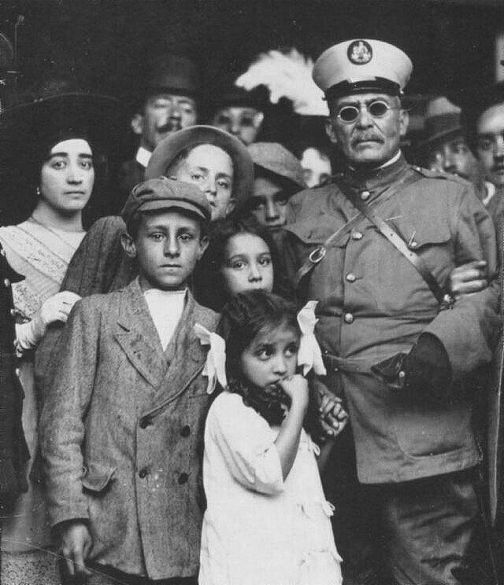
Drunk, sadistic and treacherous — that’s how we remember today’s birthday boy (23 March 1850), Victoriano Huerta.
Rosa King, whose “Tempest Over Mexico” is required reading for any student of the Mexican Revolution, was his landlady during his stay at her Cuernavaca hotel, while he hunted down Zapatistas (and anyone who looked like they might be a Zapatista — meaning, basically — everybody), stringing them up and engaging in a scorched earth policy across Morelos State said of him:
He himself drank heavily, and nearly every evening had to be led off to bed; but he was always up in the morning bright and early, looking as though he were not even acquainted with the odor of drink.
Pancho Villa, who had to work with Huerta during the early months of the Madero Administration when Huerta was badly commanding the Mexican Army in Chihuahua and Villa was leading irregular forces, was a tee-totaler, so may have been slightly exaggerating when he said that “Huerta is a good soldier… when he’s sober. Which he is, from the time he wakes up until about 7 A.M.”
When U.S. Ambassador Henry Lane Wilson decided that President Madero was just too open to raising extraction taxes on foreign mineral deposits, and decided the Mexican government needed replacing, he worked it out with Felíx Díaz to take control. Huerta, in a convincing show of loyalty to Madero needlessly lobbed shells from the National Palace in the vague direction of Diaz loyalists in the Ciudadela, mostly succeeding in slaughtering a few hundred civilians who had nothing to do with the political struggle. Then for good measure double-crossed Diaz and took over the government himself, while his men murdered Madero after stomping Madero’s brother Gustavo into an unidentifiable mass of bloody tissue.
Forced out of Mexico in July 1914, he was a useful idiot in several plots to keep Mexico in turmoil (and the United States out of the First World War). He died of cirrosis of the liver while under house arrest in El Paso Texas where he was detained as an undesirable alien after attempting to return on yet another mission of mayhem. His well-pickled corpse was planted in El Paso’s Everygreen Cemetery, within staggering distance of Rosa’s Cantina. Perhaps the dark glasses hid eyes like Farina’s: ;”wicked and evil while casting a spell”.
The only good thing one can say about the guy signed off on some of the first modern labor reforms (including the first 8-hour work day and weekly paid rest day, as well as maternity leave for women workers). However, that’s due more to progressive bureaucrats who recognized there was an opportunity for quick regulatory reform when the leader is busy clinging to power through murder, assassination and wholesale terrorism but is too shit-faced to be bothered with the trivial details.
Anyway, I guess somebody liked him… Edith O’Shaughnessy and… his family, or some of them. The little girl look kinda scared of the guy. Maybe you shouldn’t raise a glass (or twenty) to his memory, but a small toast to maternity leave and the eight-hour work day might be in order.
Food? and drinks
Two news items that did not belong together (or maybe did) both appeared in El Universal on Saturday.
The first dealt with the fact that an estimated 11.2 million Mexicans do not have the needed 842 pesos a month to acquire the basic food needed for a healthy diet — and even more lack access to healthy food, junk food — like soda pop and raman noodles often filling the hunger gap — which accounts for much of the obesity seen in this country.
The second, from Guadalajara, was about a company called Vinos y Licores Azteca, which is introducing a new tequila — specifically for export to the United States, Canada, Belgium, England and other European nations — that includes “edible gold and silver leaf”.
In other words, while Mexicans go hungry, we’re growing luxury crops (like agave and marijuna) for export, and putting the food supply into the hands of manufacturers of three-liter bottles of carbonated beverages, potato chips and Raman noodles.
The wonders of “free trade” never cease to amaze me.
Spring break and Benito Juarez
Jason Dormady nails Spring Break:
Spoiled children of the middle class demand their thrill without having to deal with the cost – exactly the parable of the narcotics war. US Americans want their buzz, and Mexico pays the price via the violence.
Jason, of course, is a professor of Latin American studies, and has to deal with the excuses for undone term papers — and the misperceptions his students return with, but for me… with the annual invasion of the irresponsible gringos pretty much come and gone with no major disasters… I can be a little more relaxed about it.
Spring break doesn’t much affect me personally. The tourists I deal with are mostly geezers or people happy to sit on the beach and read books, not the sort likely to be throwing up on me, and I can honestly say no one has ever flashed their tits or mooned us in our place of business (we did have one old guy come in shirtless, which is kinda tacky, but that’s more an aesthetic criticism than anything). Besides, I’m busy with finishing up some editing work for Ray’s book and when I did get out this week, it was to a book fair, so I really didn’t spend much time watching the spring breakers… something I kind of regret, my neighbors finding their antics infinitely amusing or at least worthy of gossip.
As it is, this country, and the tourism industry (and everyone else) goes far out of their way to assure the safety of even the most clueless and obnoxious of tourists. Mexico is not Jamaica where the tourists have to be kept isolated from the citizens (and vice-versa) and Mexicans are renowned for their ability to pretend to not hear (or understand) the rudeness, racism and rampant stupidity of many of our guests.
Besides, since it took me longer than most people to figure out that sexdrugsandrock-n-roll are three separate nouns and not an all-inclusive package word, I really can’t complain that foreign students come here looking for all kinds of thrills. Besides, I’m a Juarezista at heart: Peace is respect for the rights of others.
What I wonder about is what Don Benito (who would have been 204 yesterday) himself would have thought of “los springbreakers”.
He was, in the 19th century understand of the term, a “liberal” who was willing to tolerate weird foreign ways (within some reason) as the quid pro quo for economic investment by foreigners. And, despite his rather austere image, he didn’t seem to have anything against people having a good time. When the Church threatened to declare an anathema against his government for passing laws restricting the power of the Church, Juarez briefly considered an organized effort to bring in Protestant missionaries. But thought better of it, since the Protestants were… well… frankly boring. With no saints, and no fiestas in honor of saints, life could be pretty dull for your average 19th century camposino.
As the attempted lease of the Isthmus of Tehuanatepic to the United States demonstrates, he was quite willing to cede control of Mexican territory to the gringos for economic reasons, although the offer was made only under extreme duress (like Mexico was bankrupt and fending off the French occupation).
 And… as Princess Alice Salm-Salm suggested… Juarez had an eye for pretty ladies, so might have welcomed the chance to openly ogle the foreigners. After all, it wasn’t him, but Porfirio Diaz who wanted to make Mexico safe enough for a blond gringa to walk unmolested from El Paso to the Guatemalan border… in her undies.
And, having worked his way through law school as a waiter himself, Juarez might not want to deny his occupational descendants the chance to make a few extra pesos … although, like Juarez, they have to deal with more than their share of complete dickheads. Allegedly, Juarez’ decision after the rout of the Mexican Army in the war of 1846-48 to forbid General Santa Ana’s entry into Oaxaca (where Juarez was Governor) went back to a long-term resentment against the “Napoleon of the West” for having said something about “stupid indians” at a dinner Juarez happened to be working.
On the other hand, maybe Santa Ana was just a lousy tipper. I don’t know if there are any future Don Benitos waiting tables today who will have the future opportunity for such exquisite revenge, but you never know.
The last wave by…
Gary Denness, the Mexile — living la vida loca in the big enchilada — hears from a denizen of one of the gringo-ghettos out in provincia —
…Of course it’s lovely, but it seems mostly populated by old (bitter) Gringos, who argue mostly about where they can get the cheapest services, or who’s going to the Walmart in Queretaro, or how dangerous is it really, to drive down from Texas this month.
… I see that most of the general unhappiness here comes from Old people Who Are Not Working Anymore. There is nothing to do for them but take a morning walk, and hit the bottle in the afternoon, and angry-blog in the evenings. I too am beginning to angry-blog back, which is a bad sign. Mostly they are concerned with their real-estate values, and they have ‘head-in-the-sand attitudes about what a mess Mexico is becoming, in terms of personal safety (as they drive their shiny new cars and wear their expensive clothes).
Perhaps the Mexile’s anonymous correspondent needs to remember that the over-posted life is usually not worth reading.
Not that there aren’t are personal sites I read profitably– mostly those having some broader interest than the mere individual experiences (I especially like From Xico, Mexile , Rolly Brook and Mexico Bob) or are observations on parts unknown to me (like Maggie’s Madness and Tim’s El Salvador Blog). Not caring to read someone else’s home news, I don’t expect people to read mine. Sure, life in Mexico may be different, or even “colorful” compared to back wherever, but it’s just the way I live — normal to me, if rather dull: as a misplaced urbanite, the anomie expressed by the anonymous correspondent resonates here in Gringotitlan-by-the-sea.
Otherwise, except for business reasons, I’m not particularly interested in the “expat/tourist” sites, and have stopped reading them. I don’t really care about who is going to WalMart or what some winter resident thinks about some local crime, and it’s not worth wasting bandwidth berating silly people with questions about something like buying “American coffee” or special dog food. But, I glance at them, if only because I understand perfectly well that my neighbors and I live by catering to the desires of the gringos… for sunny climates, cheap property, sand, surf and narcotics. And books.
After all I originally moved here to work on a book, and actually finished it (after a detour to Texas). The Mex Files — at least in it’s matured state — was intended to be a sideline to other writing. I saw it half as a cheap way to flog my book, put out some advance publicity, and dig into some issues I wouldn’t research otherwise. And, it was half a response to what I saw as a dearth of accessible English-language writing on contemporary Mexico. One thing now, is that there are several decent “Mexico news blogs” — most still too U.S.-centric, and based in U.S. assumptions about Mexico and Latin America, but they are at least quoting Mexican sources and providing better translations than I can.
As a NOT quite old person who is definitely NOT “Not Working Anymore”, I am working on another book (a passel of source material showed up at the Post Office on Thursday), have work that needs to be done with the publishing biz, editing to do, etc., as well as living a “normal” off-line life. And sometimes, I just need to sleep and eat or read or — in my pursuit of cultural understanding — set aside the time to watch a telenovela.
Nezua, the Unapologetic Mexican, who has more balls in the air at one time than I can contemplate, sees the problem of over-writing in terms of sine waves. It’s just not natural to always be in a peak.
Originally this site held itself out to be about history, culture, politics and economics. Politics seems to have taken over, creating huge waves of writing, when there need to be some troughs… too many “drug war” highs and not enough on Nueva España under the Hapsburg, or farming or the Revolution or luche libre or… the troughs for some, but the things I want to write about. There isn’t the rhythm I want, and I get to set the beat.
Writing here every day misses the point… I can’t write well (and never have found the time to edit properly, or even acceptably) … and when I’m looking at culture and history, not every event — no matter how headline grabbing it is — needs my reaction. I’m going to ride the waves, so to speak … I’ll still be posting, but not every day, and not at all on weekends. And probably not on Mexican holidays either. Unless I want to.
What’s in a name?
Crisol Plural (Aguascalientes) has a small notice about a couple of foreign car companies that are looking for Spanish-speaking marketing consultants.
Suzuki — manufacturer of the “Kei” class (very light vehicle) Moca, and Mazda — which has had success in Asia with it’s Kei-SUV crossover, Laputa — seem to be both have trouble selling these products in Latin America.

We wuz robbed!
Sticky fingered United States Postal Service workers apparently made off with sixteen copies of Gods, Gachupines and Gringos sometime in the last two weeks. Amazon.com told us they FINALLY received — not the case they ordered from my publisher’s Albuquerque warehouse — the obviously opened and emptied top. Oh well, as Amazon.com’s web site says, “Order now and we’ll deliver when available.”
Speaking of which, a gringo walked off with a copy of the Moon Guide to Puerto Vallarta from the shop here. I wouldn’t have noticed, but it was my book. As in I owned it, not that I wrote it (although I did have three copies, by way of thanks from the truly excellent Robin Noelle, who I was happy to oblige with some “back page” updates on recent Mexican politics and history). Geeze, it’s marked down at Amazon right now — we’d have to charge full retail, in pesos plus the shipping costs. By the way, for the sticky-fingered gringos, I recommend viewing this video to get a feel for the way shoplifters are treated in Latin America — we make you come clean BEFORE the legal process even starts.
And… not affecting me personally… but there were two conflicting stories run in Raw Story yesterday about the 160 million dollar “fine” paid by Wachovia Bank to the U.S. government for failure to stop money laundering. The Agence France-Presse article says the bank failed to stop money going TO Mexico, while the Associated Press says it was money coming FROM Mexico.
 I know possession is nine-tenths of the law and all that, but if the money was earned by Mexican ah, um, entrepreneurs, if it’s illegal booty, it should be Mexico’s money. If the money was coming FROM Mexico, shouldn’t it be returned to sender?
I’m more intrigued and frankly worried by the idea that the money was coming FROM Mexican casas de cambio. One would think, given the alleged value of narcotics sales coming from this country, that — even with seizures — the country would be awash in cash. It’s not (and Sinaloa certainly isn’t). Oh, the gangsters can afford bribes and armored Humvees and plenty of weaponry, but those are just legitimate business expenses for an illegitimate business. That wouldn’t account for all the money said to be coming in, and the seizure doesn’t amount to more than 0.00016 percent of Chapo Guzman’s estimated wealth.
Possibilities: the narcotics trade is propping up a lot more of the U.S. economy than anyone wants to admit (probably true) or the way we calculate the profits is totally skewed (also probably true). Or, the gringos will try to get away with anything when they’re dealing with Mexicans. Definitely true.


 mexfiles.net