The gay deceivers
 Is it genetics or environment that makes right wingers act stupid? Perhaps it’s a hormonal imbalance that leads right-wingers into the dangerous lifestyle of cruising about the outer limits of credibility when it comes to sex.
It can’t be environment, since we’re having a hemispheric wide outbreak of stupid this week.
USA: In South Carolina, Lieutenant Governor André Bauer said the state should not be providing nutritional assistance to schoolchildren, lest they breed. Bauer, attempting to “clarify” his remarks said his reference to feeding stray animals was simply illustrative… of what people “who don’t know any better” will do if they are given assistance. That should clear up any misunderstanding about Bauer. The thin, neat, well-groomed and — as they say — “married to his job” Bauer has nothing personal against breeders. Not that there’s anything wrong with that.
COLOMBIA: Carlos Moreno de Caro, the former Colombian Ambassador to South Africa (in which position he attempted to have a former Miss Colombia, a couple of his favorite Futbol players and a few of his thuggish right-wing paramilitary killer buddies given diplomatic posts in his mission) is now a candidate for Senate from the ADN party. On asked not just why so many of his party’s candidates have ties to death squads and narcotics dealers, Moreno de Caro proves he’s an upright, upstanding candidate. He’s not financed by drug dealers he says, but rather his campaign finances comes from a legitimate source: “a faggot from South Africa who is in love with me is sending me money”
MEXICO: With no hope of blocking the the Federal District’s same sex marriage bill, but desperate to marry themselves to some cause, the Federal District PAN conducted an on-line survey (which they tried to sell as a legitimate referendum) on three questions:
1. Do you argee or disagree with allowing homosexual couples to adopt children?
2. Do you agree or disagree with allowing homosexuals to marry?
3. Do you think children with homosexual parents will face discrimination from their schoolmates?
In other words, your typical right-wing push-poll. It hasn’t worked out well.. PAN claimed 937,326 persons answered the survey (neglecting to mention how many were even registered voters within the Federal District) and the results were overwhelmingly opposed to adoption and marriage… and people were worried about social problems for the children of gay couples.
Um… PAN’s website originally showed less than half that number of voters… and the results were the exact opposite of what the party reported. “Twitteros” — cyber-geek activists who managed to kill an internet tax proposal a few months ago, cached the results … and spread them around the internet before the entire poll, and its results mysteriously disappeared from PAN-DF’s website.
 PAN, in a letter to the on-line SDPNoticias (an outgrowth of the Lopez Obradór movement) claims robots attacked their system and changed the numbers.
Gay robots? Uh-huh.
Maybe these were South African gay robots, and somebody was feeding them.
Memo to California: don’t try to con us
What is it with Californians, that they want to dump their social problems (not to mention their toxic wastes and the excrement) in Mexico?
Can’t afford the over-sized houses that are part and parcel of the American experience? No problem… build in the Baja. Can’t get your act together and provide affordable insurance to your citizens? No problem… go to Mexico for “medical vacations.” Can’t dispose of your mounting piles of garbage caused by the excessive and wasteful lifestyle of a consumerist society? No problem… ship it to Mexico? Finding a legal system based on incarcerating huge numbers of people a burden? No problem… ship the inmates to Mexico. Er… wait a minute.
In the movies, Arnold Schwarzenegger may have been an innovative, if crude, problem solver who could brush aside the petty concerns of mere mortals, but the California governor isn’t in the movies any more.
Sacramento, CA – California Governor Arnold Schwarzenegger suggested that one billion dollars of California’s budget crisis could easily be solved by paying private Mexican companies to build private prisons, and then housing California’s approximate 20,000 illegal immigrant prisoners there.
The idea of outsourcing is not new, not even when it comes to jails and prisons. California’s jails and prisons are grossly overcrowded, some running at more than one and a half times capacity, with mattresses on floors and small cells stuffed past capacity…
Mexican prisons are even more crowded, and its prisons are in worse condition than those of California. Prison reforms have stalled (“thanks” to over-emphasis on the “drug war”) and there are enough problems taking care of our own, even if the entire country has a much, much, much lower rate of incarceration than the United States. Texas alone has more people in jail than the entire Republic of Mexico. And California has more prisoners than Texas.
Private prisons have been suggested from time to time in Mexico. Contracts were let in 2004, but nothing was ever built, and the idea has languished except among hard-core privatization enthusiasts. Given that the theories of Mexican penology, like those in other Latin American countries, are grounded in the concept of rehabilitation and return to society, not removal from society; AND, that every time the idea comes up, it dies for lack of political support (and would be unlikely to stand up to legal challenges); AND is regarded with horror for historical reasons (see my book on the Yucatan haciendas and the Valle Nacional, or read John Kenneth Turner’s classic “Barbarous Mexico“) by a people who value their history (unlike, say, Californians) — don’t expect any sudden change in attitude on this.
Schwarzenegger’s idea isn’t even new. The lower house of Arizona’s state legislature actually managed to get a bill through doing exactly the same thing the Gobernator is suggesting, back in 2005. The Mexican government was not amused:
“To start with, they cannot decide to open a jail in Sonora. It’s a matter of national sovereignty,” said Foreign Secretary Luis Ernesto Derbez.
“They can take all the decisions they want,” Derbez said, “but that has no validity.”
…followed by a rather curt note from Secretary Derbez to then Governor Janet Napolitano telling the Arizonans that they should have at least checked with the Mexicans that the idea was even feasible.
Which didn’t stop the Texas Senate from introducing a similar bill in 2007 “…[d]espite the analysis of the Senate Criminal Justice committee that it was beyond the authority of Texas to pursue such a measure…”. The Texans pursued the bill for a time, but then again, the Texas Legislature is the world’s laboratory for bad policy ideas. Nothing ever came of it.
I don’t think this idea is going to advance to the stage where the Mexican government becomes the Terminator and has to say “hasta la vista, bay-bee” to the whole stupid idea — though it’s Schwarzenegger’s own fault he’s starring in “Dumb and Dumber III”
Enjoy México in Spanish…
Yes, that’s also the title of a book you should read and study if you’re expecting to do things like… oh… enter the country, get on a bus, drive a car, shop, eat, etc. It doesn’t include ALL the words you might need for every situation, of course, but it will get you by with much less hassle.
This (not safe for work, especially if you have coworkers who understand Spanish, video) is from a 1990s Mexican MTV public service announcement. It gives you a number of different terms for the same thing — not covered in Enjoy México in Spanish, but which should be covered, if you’re enjoying Mexicans… in Spanish or any other language.
This is your media on drugs
Malcolm Beith’s “News and analysis on the global war on organized crime” has been all Mexico, all drugs, all the time (with one post on Haiti), but even he notices the obvious problem with U.S. media coverage of Mexico:
… Calderon made the drug war a priority in December 2006. But now that he’s said he’s shifting gears, will that change foreign reporting? I haven’t seen any evidence of that… but we’ll see what the English-language foreign correspondents write about Mexico in weeks to come.
Personally, I think it’s also a symptom of the Bush years. Many US journalists who covered that period spent time in Iraq and Afghanistan, and are now capable/willing to report on things in Mexico that previously were left untouched by the foreign media…
But beyond just being able, I think there are a number of journalists (I probably am sometimes among them) who are now simply obsessed with the darker side of the news.
…
I’ve tried to pitch stories about the good: the arts, travel, turtle-saving, etc. But no one’s willing to pay for them…*
Malcolm may be right about editors. It seems impossible to write about Mexico without some reference to the “drug war”. There was an amusing story in the Sunday New York Times on the possible battle of the telenovela stars in the next Presidential election: PRD front-runner Marcelio Ebrard is married to actress Mariagna Prats; PRI front-runnger Enrique Peña Nieto — whose wife died in soap-opratic worthy mystery in 2007 — is the “constant companion” of Angelica Rivera (and — left unmentioned — PAN wannabe candidate, Santiago Creel Miranda fathered a daughter during his liaison with liaison with Edith Gonzales).
All great fun — and hopefully making for extra drama in the 2012 elections — but the Times (or rather the Associated Press) drops in its obligatory “Mexico = drugs” reference:
Neither [Ebrard nor Peña Nieto] has said much about the top problem on most Mexicans’ minds: the drug war and violent crime. That may be why they remain so popular, a welcome diversion from a sober reality.
Could it also be that “the drug war and violent crime” aren’t the top problem on most Mexicans’ minds? The most recent El Universal poll, which was about political reform, found only nine percent of Mexicans mentioned “insecurity” as a political issue… and “insecurity” does not necessarily mean insecurity related to the “drug war”
You won’t see it in the U.S. press, but at least well-read Mexicans are aware that the murder rate — never nearly as high as in other Latin American nations – has been dropping for a number of years, despite the “war on drugs”, and drug use here, even if it doubled as the Administration claims, is a fraction of that in other places.
Muggings, robberies, shoplifting… the types of crimes associated with bad economic times… create the sense of insecurity more than murder does.
The typical “stranger on stranger” type murders common north of the border (and elsewhere in the Americas) are very rare here. Even a shooting like that of Americas’ forward Salvador Cabañas — which of course is going to dominate the news cycle — may have been the work of an obsessive futbol fan, who in a sense “knows” his victim. In a sense, everybody “knows” Cabañas, and reportage on his shooting feeds the sense of insecurity much more than reports on some low-level gangster (or gangster informant, or hanger-on) being found with his head in a garbage bag and the rest of him scattered around the town.
This isn’t to say the concerns aren’t real, nor that crime — in the border area especially — is an irrational fear. What is real is that the crimes, especially in the border region, are taking on more a U.S. style violence. Maggie Drake, the Woodward and Bernstein (both of ’em… in one “old radical surfer”) of the Baja, has made a specialty of reporting on the crimes BY and against gringos in her corner of the Republic. There is real crime there, and much of it is ignored… by the local gringo press, which has pecunary reasons to overlook it (they want to sell real estate), and — as she notes in her recent post on carjackings in Rosarito — by the San Diego press as well. It’s troubling that such a U.S. style of violent crime is happening in the Baja, but I have to let the San Diego press off the hook on this one. It doesn’t appear to have the “Mexican drug angle” their editors require, and — in a city where a carjacking with a shooting only merits five sentences — carjackings without anyone getting shot just don’t rate a mention.
The point is, that “insecurity” , “the drug war” and “drug users” .. and despite what the editors expect foreign readers to believe … are seen as separate issues, and none of them dominate political and social discourse to the point of paralyzing the political system. For policymakers, like Ebrard and Peña Nieto, there isn’t much reason for them to blather on about the “drug war”, which isn’t associated with their parties — but is a “made for media” event from the Calderón Administration (my interpretation of their non-platform). That the editors are “buying” the drug war — with its implications for other economic and social policies — THAT may be an issue.
* I don’t expect to sell this piece to the editors — even though it does have the obligatory “drug war” reference, but on the other hand, a “free press” isn’t expense-free.

To see oursels as ithers see us!
Today is Robert Burns’ birthday, an occasion for the respectable to pay homage to a disreputable Scots peasant: a radical populist who went out of his way to annoy the rich and powerful, or at least to make common cause with the lowest of the low, and see the world from their perspective, as in his praise of a louse crawling across the head of a pompous church-lady:
O wad some Power the giftie gie us
To see oursels as ithers see us!
It wad frae monie a blunder free us
An foolish notion:
What airs in dress an gait wad lea’es us,
An ev’n devotion!
What made me remember Burns was this cartoon by Naranjo that I saw in the “middle-of-the-road” Sinaloa Noroeste …captions translated the for the “Spanish-impaired”:
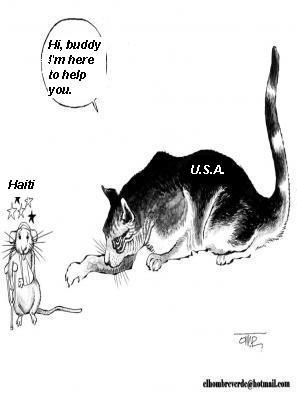
Not the greatest of cartoons, to be sure, but a reminder that even with the best of intentions, the powerful need to remember how they are seen by the rest of their fellow creatures depends on perspective and history:
I’m truly sorry Man’s dominion
Has broken Nature’s social union,
An’ justifies that ill opinion,
Which makes thee startle,
At me, thy poor, earth-born companion,
An’ fellow-mortal!
(To a Field Mouse)
“Kind of neat”

Imitation is the greatest form of flattery?
Palestinian-born Tennessee businessman, Haitham Alyousef owns two gas stations in largely Mexican immigrant neighborhoods. SO… discovering that foreign brand names not used in the United States are usually not covered under U.S. law … there are now two “Pemex” stations in Memphis that make you pump your own gas.
Some say !Qué barbáro!… while others agree with Alyousef that Pemex stations look “kinda neat”.
(Sombrero tip to Laura Martinez)
AND AN UPDATE: Rolly Brook mentioned this post on one of the expat sites (thanks Rolly!), which seems to have led a few people into channeling their inner patent attorney. They might want to read the link, which is to a Memphis Commercial-Advertiser article which includes a sidebar discussing those legal issues. One person speculated the “photo” at the top wasn’t a stock photo. I believe it’s actually an architectural drawing of a generic PEMEX station –whatever.
Thanks to Travis Ashby for turning up a youtube clip of the “real” fake PEMEX station — posted in June 2008, according to its poster (“corazondeleon”) … meaning this little squib of a post isn’t exactly “breaking news” but simply one more report on the “general weirdness that usually comes blowing in from the north.”
Haiti — another donor steps up
Aporea, via “Green Left Weekly“:
Spokespeople for the so-called Somali pirates have expressed willingness to part of their loot captured from transnational boats to Haiti.
Leaders of these groups have declared they have links in various places around the world to help them ensure the delivery of aid without being detected by the armed forces of enemy governments.
The “pirates” typically redistribute a significant portion of their profits among relatives and the local population.
A Somali “pirate” spokesperson said: “The humanitarian aid to Haiti can not be controlled by the United States and European countries; they have no moral authority to do so.
“They are the ones pirating mankind for many years.”
 It makes sense in a way. At least according to some theories, the pirates of the Caribbean were the first modern corporates.
It just wouldn’t have done to admit that Elizabeth the First of England was financing her naval expansion with piracy: not to put a fine gloss on it, she was hiring thugs to rob the Spanish gold fleets . Even though Philip II of Spain was her brother-in-law and hating one’s in-laws is an old and honored tradition, it still is a bit gauche to engage in outright theft (never mind that it wasn’t Spanish gold, and Philip was busy robbing the Americans).
So… some bright lad came up with the simple idea of hiding the ownership of the enterprise behind a smokescreen. Who got a share of the booty? The “shareholders”… and who knew who they might be? Certainly, the people who dealt in paper were fine, upstanding types. It was good to be Queen.
OK, so the Somali pirates are a closed corporation and not traded on the exchange. But they’re hardly the only one that isn’t publicly traded. And most of the loot they’re distributing belonged to someone else at some point, and the Somalis aren’t the first corporation to be suspected of unfair pricing and cutthroat competitive practices. With pirates corporations still looting the Caribbean, obtaining commodities often at the point of a gun, then divvying up the proceeds with their mateys o’er the water. At least one group of corporate raiders shows they have the right sense of values.
Arrrgh…
When the going gets tough…
They don’t need no steenkin’ permission…
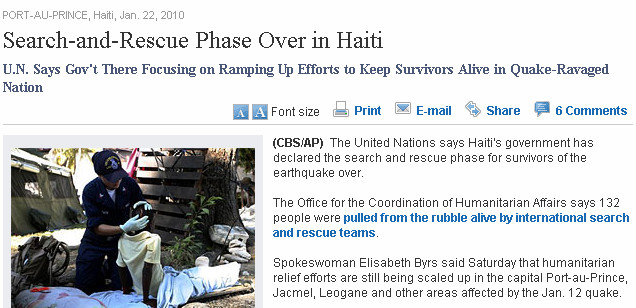
This, of course, means “U.S. controlled rescue efforts” — and, as we know, only what involves the United States matters, right?
The Mole-Men of Tlatelolco aren’t about to let minor things like the withdrawal of U.S. support, the U.N or the Mexican Navy stop them. The Mole-Men, so far, have dug out fifteen living persons, and only paused for a brief service after recovering the body of Archbishop Joseph Serge Miot from the ruins of the Cathedral.
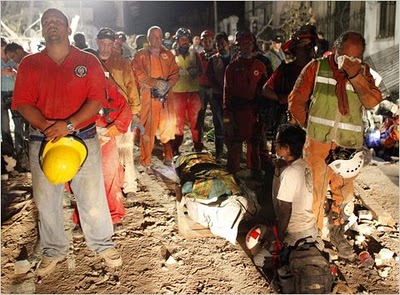
Brigada de Rescate Tlatelolco's wake for Archbishop Miot (Wolfgang Rattay/Reuters)
“The Invicibles” as other search-and-rescue teams have nicknamed los Topos have been joined by French, Brazilian and Argentine rescuers who have also decided to continue working — as los topos have been doing all along –with their own resources, and ignore the U.S. headlines and the Mexican Navy.
 t’s not like these guys need protection, anyway. The head of the Cancún chapter of the Mole Men was interviewed two nights ago by Adela Micha on Televisa, saying the Haitians are protecting them… as if a bunch of men and women who seem genetically immune to fear need protection from people who understand immediately what is being done to help them… with no expectation of any reciprocity (or, long-term trade agreements).
Speaking of that, Burro Hall — reading the Queretaro paper — sees that the Cámara Mexicana de la Industria de la Construcción and its 8000 member businesses, is ready to start reconstruction in Haiti. If anyone can think of a better group to take on rebuilding after a massive earthquake, they’ve got about two weeks to come up with it.
Jason, at Secret History, also is reading the Mexican press .. in his case, the conservative business daily, El Economista, which suggests another Mexican development project — tree planting. So… Mexico hasn’t planted the billion trees the Calderón Administration talked about before they started talking about … the war on drugs, energy reform, the war on drugs, the war on drugs, legal reforms, the war on drugs, the war on drugs, immigration, the war on drugs, the war on drugs, financial reform, the war on drugs, legislative reforms, the war on drugs. Mexicans do know how to plant trees, and the Haitians need the trees (and carbon credits would be a nice benefit to their economy).
Multi-cultural Sunday readings

… In volume 2 of the five-volume work entitled Five Thousand Years of History of China and Foreign Cultural Exchange from China’s World Knowledge Publishing House, section six of chapter 10 narrates the settlement of the Chinese in Latin America.
According to documents that date back to around the late 16th century and first half of the 17th century, Chinese merchants, artisans, sailors and helpers arrived in Mexico and Peru to do business or work there, through the Manila galleon trade.
Since Spanish colonizers monopolized the trade between the Philippines and Mexico, the Chinese who went to Latin America had to pass through Manila. Consequently, they were called Manila Chinese. They were mostly merchants, serfs and sailors.
In the late 16th century, in order to develop and exploit Latin America, the Spanish colonizers ordered and allowed Chinese artisans to enter Latin America. Thus, thousands of Chinese artisans, including weavers, tailors, carpenters, masons, blacksmiths, jewelry smiths and barbers were continuously transferred from Manila to work there.
Go Bon Juan, Manila Times, via Chinese In Mexico
Chinese In Mexico (which I had a hand in getting started, but has been since taken over, upgraded and turned in an invaluable resource on Asian-Latin history by Scott Parks) has several new postings, all making fascinating reading on an overlooked influence on Latin-American culture.
Another multi-cultural site that should be visited is vachiem eecha, which gives you your choice of learning about the Yaquí and Mayo people of Sonora in English, Spanish or Yoemi. Lots of good material here:
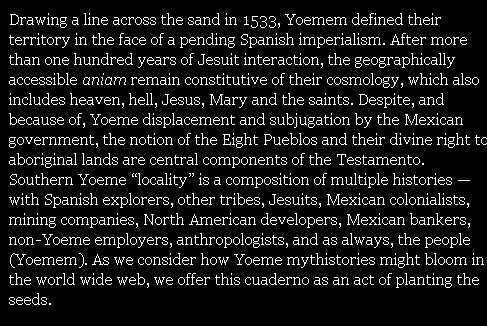
From a back issue (way back in May 2009) of Mexico Premier is a visit to the Museo de Arte Popular in Mexico City… something that really, really, really should be toured in person:
The Museo de Arte Popular (MAP) is located downtown one block south 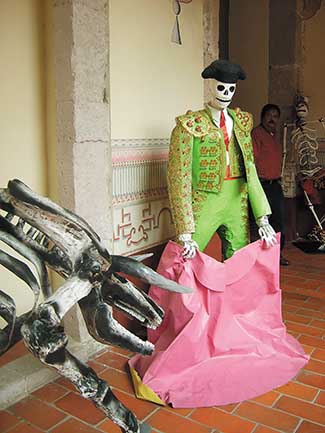 of the Parque Alameda Central inside a handsome Art Deco building that would look perfectly at home in Gotham City. This former police and fire station may seem an unlikely spot for a museum, but it is one of the best of its kind in the country, bringing together folk art from all of Mexico’s 31 states.
Inaugurated on February 28, 2006, this new museum now showcases some 2000 contemporary and traditional pieces reflecting Mexico’s cultural and geographical diversity. The collections — which range from fanciful papier maché and ceramic sculptures (see photo above) to colorful indigenous costumes and religious art — are arrayed in spacious, well-lighted galleries occupying two upper floors. Descriptions in both Spanish and English accompany the exhibits, and video screens show the production of various crafts as well as festivals and dances from around the country. On the building’s ground floor is one of the best-stocked handicrafts stores that I’ve come across in Mexico City. There is also a peaceful courtyard café that makes an ideal spot to decompress in after roaming the city’s bustling streets.
King Farouk of Egypt remarked in exile that in the future, there would only be five kings — The Kings of Hearts, Spades, Clubs, Diamonds and England. He forgot Tonga. (Jerome Taylor, The Independent):
There aren’t many guides published on how to greet a Pacific island monarch, but an internet search the night before reveals that Tongans obey a strict code of ancient etiquette when addressing their royals including, I now know, making sure they never walk in front of them.
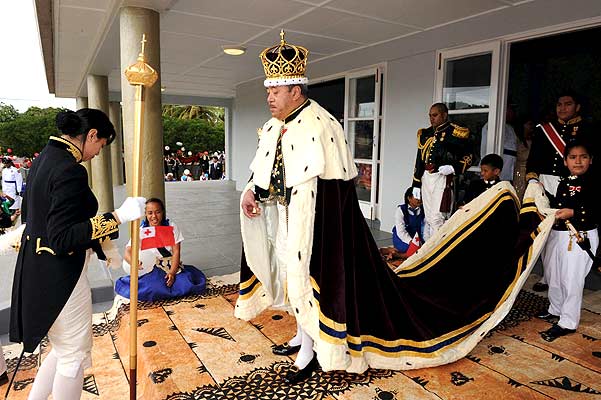 … Siaosi Taufa’ahau Manumataongo Tuku’aho Tupou V, better known as King George Tupou V, sweeps into the room and warmly greets our respectful Western bows with smiles. Known for his love of bespoke couture he is dressed like the perfect country squire in a tailored double-breasted suit and a salmon pink shirt and sports an immaculate pencil moustache. His English accent, honed at Oxford and Sandhurst, is as spotless as his clothes.
…
King George ascended Tonga’s throne in 2006 following the death of his much loved father Taufa’ahau Tupou IV who, at 6ft 5in and 33 stone, was famously defined by the Guinness Book of Records as being the world’s largest monarch. Taufa’ahau ruled the Pacific’s last remaining monarchy with a mixture of paternalism and absolute control for more than four decades. His son was regarded in Tonga as something of a playboy – a rich kid, educated in boarding schools overseas who was detached from Tonga’s largely impoverished and deeply Christian population.
Overseas he was renowned for eccentric hobbies (collecting toy soldiers, military uniforms and pith helmets) and behaviour. For official engagements, for instance, he preferred to be chauffeured in a pristinely upholstered London cab because, he once explained, it was “easier to get in and out of when you’re wearing a sword”.
Had he not been made Crown Prince, King George would have been happy to continue living his quiet but gilded life. But duty inevitably came calling. And life has been anything but quiet since taking Tonga’s throne.
Just because you’re paranoid…
“Lfarkins” (Lawyers, Guns and Money) writes:
Apparently, if Hugo Chavez says something stupid, Evo Morales has to follow suit:
President Evo Morales said Wednesday that Bolivia would seek U.N. condemnation of what he called the U.S. military occupation of earthquake-stricken Haiti. “The United States cannot use a natural disaster to militarily occupy Haiti,” he told reporters at the presidential palace.
The “stupid quote” from Hugo Chavez turns out to be something Chavez never said (but is attributed to him by a Russian website, and picked up by Fox News) about super-secret nuclear tests causing the Haitian earthquake * . The Evo Morales comments come, not from the Bolivian President, but from the VICE-President, Alvaro Linara, and were misreported (or sloppily reported is more the point) by the Miami Herald.
There is a cognitive disconnect between what Latin Americans of all political persuasions think of U.S. intervention and how those same interventions are viewed in the United States. Certainly, it’s a good thing that the U.S. did send immediate assistance to Haiti, and disaster relief requires the healthy young people, heavy equipment and communications/logistics organization that are immediately available from military forces. None of which says the United States hasn’t historically used military intervention (under any number of pretexts) to enforce “yanquí imperialismo”. This has been a complaint of Latin Americas, from the extreme right (Bolivarianism was originally a far-right movement, after all) to the extreme left for a long time. It’s history, not good intentions, that is seen here.
Case in point. USAID — the United States Agency for International Development — although it has financed useful and welcome projects, is designed to further U.S. economic penetration of recipient countries:
U.S. foreign assistance has always had the twofold purpose of furthering America’s foreign policy interests in expanding democracy and free markets while improving the lives of the citizens of the developing world.
This historically has included close collaboration with the Central Intelligence Agency, and probably still does, most recently in Honduras. Certainly the left in Latin America tends to reject “America’s foreign policy interests in expanding …free markets” more readily than the right, but — regardless of persuasion, there is an assumption in Latin America that any USAID program is a cover for the CIA. I know people who refused to use the rather harmless (and very nice) Biblioteca Benjamin Franklin in Mexico City, on the assumption that the (now formerly) USAID sponsored English-Language library was a cover for spooks, and something as harmless as reading Time Magazine made you a target for foreign intriguers. And, I’m not talking about political people, but ordinary, well-educated, apolitical types.
From the “progressive” Rachel Maddow (one of the few U.S. news readers who actually has a PhD in a real academic field, and isn’t by training a journalist) — who at least has had the decency and intelligence to mention Haitian history in her broadcasts, spent ten minutes on 13 January propagandizing for USAID and its representation of “America’s power in the world”.
Of course, working in conjunction with the massive U.S. military presence, and the complaints from Latin Americans and others that they have been pushed aside in favor of U.S. efforts (and U.S. military programs designed to provide “security” to relief workers who don’t feel particularly threatened), USAID is seen as just another manifestation of that “power” and the United States’ willingness to project that power, even as the rest of the planet is more concerned with providing immediate relief to suffering people.
Notice what’s NOT in the CNN article, but is in the Toronto Sun.
| CNN | Toronto Sun |
| Port-au-Prince, Haiti (CNN) — Rescue workers pulled a woman out of rubble near Haiti’s national cathedral Tuesday, a week after a magnitude 7.0 earthquake struck.
The rescue crews believe two other people may be alive under wreckage nearby, in part because of a text message the crews believe was sent from under the rubble, a CNN crew reported. Men carried the woman, Ena Zizi, who is in her 70s, from the rubble on a wooden board as she grasped its edges. They took her to a nearby clinic, although it doesn’t have the operating facilities needed to treat her, the CNN crew reported. Zizi’s right femur was fractured and she was in shock, the crew reported. The earthquake struck the afternoon of January 12. Its epicenter was just south of Port-au-Prince. |
PORT-AU-PRINCE, Haiti — A Mexican rescue team rejoiced Tuesday after finding an elderly woman alive amid the pile of concrete rubble at this Haitian capital’s cathedral.
Salvador Arturo Acuna Rico was one of the Cancun rescuers who found a 70-year-old woman in perfect health after being trapped for a week. “She was praying,” he said, adding that’s how they heard her in the middle of the collapse building. “She was conscious – really, really healthy. No broken bones.” Search and rescue workers from Germany believe another person may be alive in the building that once housed the cathedral’s priests. Another two people are believed to be alive in a nearby building, said rescuer Frank Schultes. |
If the United States is not “beloved” in Latin America, it’s its own fault and can’t simply be based on the discredited former Administration. A mind set that rejects history, and is terribly provincial may have the best military equipment, logistical capability, and informational resources in the world, but to limit those resources to “projecting power in the world” will not make the country seen as anything but a bully even if its intentions are honorable.
* BoRev has the breakkdown of the tale like this:
1. Some Venezuelan blogger wrote a weird story about the U.S. causing the Haiti earthquake with some sort of earthquake weapon. 2. A website operated by a Venezuelan state TV channel included a link to the post in their roundup of Haiti coverage from all over the country. 3. Some right-wing newspaper in Spain published a story about the link, referring to it as a Venezuelan state “press release.” 4. Fox News reports the Spanish story, saying the earthquake weapon claim comes from “Hugo Chavez’ mouthpiece.” 5. Randomly, Vladimir Putin’s English language teevee channel Russia Today claims that Chavez himself made the statement. This video report is picked up all over the fucking place, Drudge sirens!! 6. Right wing news “analysts” opine about what level of threat this represents to the United States.
Medics, Kreyól translators, $$ needed
I don’t know the identity of the writer, but my source (Inca Kola) vouches for him, and that should be good enough for any of us.
I am working with the Dominican Civil Defense helping to coordinate convoys participating in relief efforts from Jimani, the closest town to Port au Prince where trips are being staged twice daily (6:30AM, 2PM). If you know any individuals or organizations wanting to send aid, this is the best route to avoid the problems being caused by the US military at the Haitian airport.
If anyone plans on personally traveling to Haiti, it would be best to come with an organization that has a vehicle. We can send people by bus, but space is limited. It would be nice if people would really think about whether their skills are truly needed at the moment so they do not just become another mouth to feed.
Medics, translators (Haitian Creole, French), etc. are particularly needed.
Anyone coming to Haiti needs to bring a tent and whatever else they need for sleeping. I have been surprised by how many have shown up without such essentials. Keep in mind there was another earthquake Wednesday and aftershocks continue to rattle the area. Last night we felt brief shaking in Jimani, but it was not enough to knock anything over. Volunteers need to consider the psychological effects of these tremors before heading to the island.
The Civil Defense has long been underfunded, so even basic office supplies are lacking. If you want to donate toward relief efforts, Partners in Health and MPP (a member of Via Campesina) are the only organizations I would personally recommend, as they work at the grassroots level, with the big picture in mind. Un abrazo
Not everyone can go to the Dominican Republic, and not everyone is able to make donations through the United States. I’ve added a button at the left linking to my list of Mexican based donor sites … this button in fact —

Erwin is updating lists of mostly U.S. based donor sites on “The LatinAmericanist”
Something old, something new…
Bulibya Mamallaqta… also known as Wuliwya Suyu… also known as Tetã Volívia… also known as el Estado Plurinacional de Bolivia used to have two capitals (La Paz and Sucre), but under its new constitution has only one… but as a consolation prize, it has two flags and four official names. And, in inaugurating the first President of the Plurinational State — and president of plain old Bolivia for the second time, two inaugural ceremonies: at Tiawanaku, President Evo Morales took the baton of office as leader of the people, and then went to LaPaz for the more Euro-style swearing an oath to uphold the new Constitution.
With attempts over the last several years to undo the 1917 Mexican constitution, which was the first to formally recognize the people’s ownership of natural resources, the new Bolivian constitution (which came into force yesterday) gives new meaning to the concept. It also builds on another Mexican constitutional innovation, the 1994 indigenous rights clause, giving formal recognition to the rights of indigenous communities.
While indigenous communal rights were recognized by treaty and under the Spanish colonial Ley de las indies (although, as under the Republic, often ignored in practice), indigenous peoples were in practice second class citizens, despite Mexico’s radical innovation at independence in recognizing all people — specifically including indigenous people — as citizens (The United States didn’t recognize “Indians” as citizens completely until 1924, Canada and Costa Rica until the 1970s), indigenous communities — with different legal and cultural concepts than the larger community — did not have any specific legal recognition.
I don’t think the 1994 “San Andreas Accords” clause, which recognized the rights of communities, was well thought out (it creates a conflict between individual guarantees and in some ways abrogating the individual rights of members of indigenous communities), but was the start of a new legal theory, which the Bolivians (or Bulibyans or Wuliwyans or Volívians) is putting into practice in a — one hopes — improved and better form.
It’s a start, and anyway, as El Duderino (Abiding in Bolivia) writes:
It is the beauty of a plurinational state, you get to have more of everything. Multiple languages, two flags, and two inauguration parties!

The second flag, by the way, is an improvement on an existing form… searching for a symbol of the seven nations that we collectively call the Incas, the “Cusco” flag (used by the Peruvian department of Cusco) created a rather tame, and predictable design — which was either cooped, or independently developed to represent another multi-cultural — and overlooked — minority group (and created some amusement for foreign visitors who’d see it flying over Cusco’s cathedral). Gonna be hard to miss a Bolivian Embassy now.

(L-R) Cusco, gay rights and Bolivia's "Aymara" flag


 mexfiles.net