…over the line, sweet Jesus…
Yikes!
Msgr. Hugo Valdemar, the quasi-official spokesman for Cardinal Rivera, is skirting awfully close to imposing the Church into political affairs. Speaking specifically of the PRD, Msgr. Valdemar said (my translation):
They have no respect for life and have legislated the murder of innocent children in the womb; they are the people who do not respect our faith, as they equate marriage with the union of same-sex couples.
Those who were victims of repression in undemocratic times have now become executioners… and when they unmask some criticism, they ask [the Secretaría de gobernacíon, which has responsibility for regulating religious affairs] to repress us.”
Added the irrepressible Monsignor: “Curious, seeing that they don’t recognize the government.”
Although Msgr. Valdemar — and Cardinal Rivera — as citizens can say what they want, denominations have no rights to political participation (although they do it all the time). Monsignor Valdemar’s closing riposte was a reference to the start of the latest feud (going back a few hundred years) between the Mexican government and the Catholic Church, over an incident back in November 2007. AMLO — as “legitimate president” — was addressing a large crowd in the Zocalo, going about his usual denunciations of the Calderón “de facto presidency.” Someone in the Cathedral started ringing the bells, effectively drowning him out. At that time, I wrote:
Normally, if there is a major event on the Zocalo, the Cathedral does not ring its bells and accommodates their landlord, the Mexican government*. Even during [Stanly Tunick’s] nude photo session, the Church cooperated. But, not with AMLO. The Church’s claim is that they always ring the Angelus bells at noon on Sunday. Not for 12 straight minutes they don’t.
… people from the Zocalo crowd — went into the Cathedral, got into a fight with the ushers at Mass and knocked over a few benches — and, according to who you believe, maybe peed on the floor. Your usual anti-clerical action.
Complicating things, it isn’t clear the “action” had anything to do with AMLO. Photos show that the protesters were carrying anti-Cardinal Rivera placards accusing his Eminence of covering up clerical pedophilia scandals. The Cardinal himself was in Rome.
It’s no secret that the Church favors the clerical PAN leadership, and Ironically, pissing off AMLO (if that was the intention of the chimeral chimers) may have lost the Church their last sympathetic leader within the PRD. A privately religious man by all accounts, AMLO — although always careful to uphold the Juarezista anti-clerical political traditions — during his tenure as head of the Federal District, had the clout to hold off reforms like the abortion and same-sex marriage acts from coming up in the District Assembly. He not only wanted to avoid confrontations with the Church… but sought church cooperation (and the Cardinal’s) on projects of common interest like historic preservation and restoration projects within the Historic District, as well as anti-poverty and housing programs**.
Even doubly ironic, is that the Church’s problems with the PRD stem from the PRD’s anti-AMLO wing… the “Chucos”, so-called because so many of their leaders have the same nickname, “Chuy” — which means, of course, that their problem is with Jesus!
Jesús Ortega to be exact… the PRD Party President. Hugo Valdemar was responding Ortega’s statement earlier last week that if they Church had no business telling people who aren’t communicants what they should or shouldn’t do or think… and, come to think of it, in Mexico, the Church shouldn’t be telling people what political party to vote for — or not vote for — in the first place.
- * Since the 1850s, the Mexican State has owned the Church properties, and the Federal District IS the Cathedral’s owner, the Catholic Church has, however, exclusive rights to use the property for religious purposes.
- **Sorry, no on-line link. My source is Grayson, George W. y Óscar Aguilar Ascencio, Mesías Mexicano: Biografía criítical de Andrés Manuel López Obrador, Mexico: Grijalbo Actualidad, 2006. p. 218 et. passum.
A request…
A post written by the sorely missed Lyn about the Mexican Mennonites back in October 2006 is still one of the top Mex Files (by number of hits) of all times. As it should be. It was a great post on a not-well understood minority . The comment left last night might be of interest to someone, or someone might know someone who knows someone who can help with this project:
I’m working on a project with a local mennonite radio broadcasting station on putting together children’s programming that will be broadcast in low german. I am looking for stories, etc. that would be suitable. The people who listen to this station have deep roots in Mexico. Can anyone out there direct me to any resources that might help?
Julie (jewelweed2@gmail.com)
Philip Crowley, spokesman for the United States Department of State Spokesman was asked yesterday about Deputy Secretary of State for Western Hemisphere Affairs Craig Kelly, and the purpose of Kelly’s visit to Tegucigalpa… and by extension, the viability of the so-called “San Jose Accords.”

Some of that "clear tension" as presented on French television (misidentified as Iranian "popular resistence")
Crowley, insisting the United States still had a job to do to ” move forward and to overcome the clear tension that resulted in the actions taken last June” (i.e., a coup) said:
… we do have some decisions to make in the future about the future nature of our relationship. As we said back in November, the election was a step forward. We felt that the results did reflect the will of the Honduran people. That said, the election by itself was not enough to – we have some decisions to make in terms of the nature of our relationship, the nature of assistance in the future.
So there are still steps that Honduras has to take, and we are encouraged by comments by President-elect Lobo, but we are there to continue to move this process forward not only to get to January 27, but most importantly, to see that government advance once it’s in office.
The San Jose Accords, forced on the legitimate government by the United States and the military backed regime that had hustled the president out of the country (in his PJs), then used a forged resignation letter (with the wrong date on it!) to justify his replacement by a guy who — went back on his promise to resign in favor of a “coalition government” (make up of those who backed the coup-mongers, and those who… didn’t oppose it) — has clung to power as highly dubious elections (considered illegitimate by all but the United States and Panama) elected a replacement … who has to “advance” Craig Kelly’s, and the United States’, interests… not the Hondurans.
Change we can believe in.
The Latin way
Considering the threat posed to the United States by tighty-whitey terrorists perhaps the United States will consider a low-cost, simple and innovative Latin American solution to what’s got their panties in a twist:
Don’t cry for me, Wasilla…
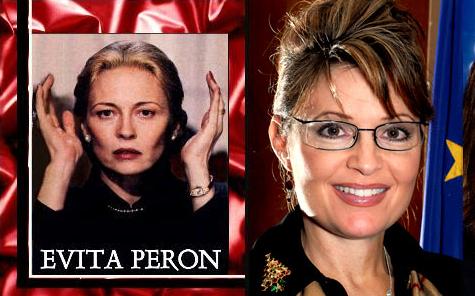
Other than one was portrayed in movies by Madonna and Fay Dunaway and the other satirized on a television program by Tina Fey, and they lived at opposite sides of the Western Hemisphere, Jane Stillwater (Daily Kos) mightily strives to find some comparison between two of the America’s most notable women politicians…
Back in the 1950s, before it was even stylish and WAY before grassroots bloggers like myself took up the cause of America’s economic underdogs, Evita Peron seemed to be obsessed with offering help to the poverty-stricken underclasses of Argentina — and her main goal in life appeared to be to narrow the huge gap between the very rich in Argentina and the very poor. Sarah Palin’s life goal, however, appears only to try to make herself wealthy too — while using America’s discontented poor as a stepladder, climbing up to the top on their backs.
I think it is fair to say that Evita Peron changed Argentina forever — from a feudal society of barrios, peasants and overlords to a much more economically democratic mix. And the few rich people who controlled Argentina at that time hated her. But do rich people today hate Sarah Palin? I think not.
In America today, like in 1950s Argentina, the goals of the rich seem to be to create cheap labor and to use government money for themselves. And the rich in America appear to be achieving these two goals easily — by dividing us lower and working class types into two different camps and then encouraging us go at each others’ throats so that we won’t be noticing so much as our wealthiest 1% clean out the till.
And with regard to splitting America’s lower and working classes into two warring factions, Sarah Palin has been a really big help.
I myself find Palin to be rather tedious and a media-hog. On the other hand, however, I find Evita Peron to be endlessly fascinating.

Weenies and the butchers’ bill
Reducing the citizenry to a frightened puddle of passivity, hysteria and a child-like expectation of Absolute Safety is irrevocable and far more consequential than any specific new laws. Fear is always the enabling force of authoritarianism: the desire to vest unlimited power in political authority in exchange for promises of protection.
Glenn Greenwald on the hysteria surrounding U.S. reaction to, in one writer’s delicate description, “a recent attempt involving a guy who flame-broiled his dick while the no smoking sign was on”.
The United States “war on terror”, or whatever it’s called these days, has always been more theoretical than real. When back in the U.S. one sees the flags, and the “I support the troops” bumper stickers, but gets no sense of being in a country at war. There are no calls for sacrifice (except from the overwhelmingly rural and minority kids who are getting the asses shot off), no sense of national sacrifice, and — most troubling — no acceptance of risk.
And, in order to maintain the illusion of a sacrifice free safety, are willing to pawn the family jewels, their liberties. Greenwald’s remarks were an approving comment upon “middle of the road” New York Times columnist David Brooks, who wrote of the hysteria surrounding the failure to detect the abject BVD Bomber somewhere before he gave himself the blowjob from Hell:
… we seem to expect perfection from government and then throw temper tantrums when it is not achieved. We seem to be in the position of young adolescents — who believe mommy and daddy can take care of everything, and then grow angry and cynical when it becomes clear they can’t.
Even had the incident hadn’t become just fodder for really bad and tasteless jokes (the best way to fight terrorists is to refuse to be terrified — especially by those whose threats are… ahem… impotent), Brooks’ critique would still be valid — perhaps even more so, in light of the experience here in Mexico with our own “war on [not nice people]”.
Mexicans, in common with other Americans, generally distrust their authorities (perhaps more so than north of the border, but that distrust is common throughout the hemisphere). However, having had a longer history with authoritarian leaders than those northern neighbors, have developed strategies for resistance unavailable to them. Like seeing and hearing, but not obeying. Or simply seeing the government as an impediment on their own liberty. There is a difference between passive resistance to authoritarians (as here) and passive acceptance (north of the border).
At any rate , Mexicans don’t expect a government of men (and women) to be perfect or infallible. When things go wrong, no one is surprised, but no one is in denial either.
In the United States, where a relatively long history of responsive government has convinced people that their leaders can “do something” — with apparently unending resources (while simultaneously not collecting taxes) — even about such unlikely potential threats as Nigerians with pyroplastic panties. Although there is a nagging sense that normal and expected services (oh, like watching the national economy) are being neglected, the overriding fear of an uncertainty in life is creating that “frightened puddle of passivity,” as Greenwald called it.
The United States administration’s claim is that the country is under constant threat from the people they’ve invested (or pissed away) untold billions of dollars to protect themselves against. But, at the same time, by design kept isolated from the reality of that way, people are unable to accept that in war, once in a while, the other side will inflict damage on your side.
Here, where we have real people dying in a real war — but to my mind even more unnessary and pointless than the United States’ war against Iraq, Afghanistan et. al — the administration is at least willing, and the people to accept, that people get hurt… badly.
The “butcher’s bill” for Mexico’s “war” has come in for last year, but only one item on that bill is being scrutinized:
- El Universal reports that upwards of 7,700 people were killed in violence stemming from organized crime in Mexico in 2009, a leap of more than 2,000 according to their figures…
Less noticed (and largely ignored north of the border) are a list of very real costs that make the bill even larger and more difficult to pay:
- The Mexican army is responsible for a long list of disappearances and murders, along with the torture of 25 Tijuana police officers accused of corruption, according to a new report by London-based human rights group Amnesty International.
(Stephen C. Webster, Raw Story)
- Governmental inaction and the inability of communications media to protect its reporters in high risk areas have contributed to converting Mexico into the most dangerous country on the continent for practicing the profession.
Reporters in this north American nation have lived through the worst year for their trade, 12 of their colleagues having been murdered, with seeming impunity in most cases.
(Emilio Godoy, IPS, via Jornada)
- Fourteen people died and 21 others were injured early Saturday when a bus carrying agricultural workers and their families plunged more than 300 feet down an embankment off a curving mountain road about 70 miles east of Tijuana.
(Sandra Dibble, San Diego Union-Tribune, 2 January 2010)
The first of those items, military misconduct, is particularly galling in that my source was a north of the border news item, where even the idea of using the military in civilian law enforcement is universally condemned by the right and the left. It’s no secret that soldiers, like any other group given power (and weapons) will sometimes abuse that power. And, even the best disciplined military will engage in abuses (Abu Garib, anyone?). When the Mexican government decided to “do something”… at the behest of the United States in my opinion… there were going to be problems. If the cost was not calculated at the beginning of the operation, it should be looked at now.
The second — the deaths of journalists (and the unknown effect on other journalists) — is not always, and not usually “collateral damage” from the “war on narcotics traffickers”. But, having made the decision to stamp out an export to the United States by any means necessary, the State is overlooking normal civil protections. Most of the reporters killed in the last year had nothing to do with the “narco wars”, but were involved in investigations of environmental or public heath and safety issues.
The bus accident happened after the close of 2009, but transportation safety and regulations are federal responsibilities. That is just one of those environmental and public health and saftty issues that has been shunted aside. The bus did not appear to be properly registered, and it had a brake problem that should have kept it off the road. As in the United States, and on behalf of the United States, basic protections and basic governmental services are being stinted as funds are spent — or wasted — on this single overriding and expensive “war”.
- In 2009,750 Mexicans — 58 percent of them women or minors — died while crossing into the United States.
How many of these women and children are driven to emigrate by fear of state induced violence against the narcos, or by the narcos, is probably negligible. But, that the Mexican government has sunk its resources into a an economically wasteful enterprise of dubious value (much as the United States has) and — more immediately — has taken policy steps more designed to protect the very people it is sending its soldiers to protect from receiving a profitable rural export, it is contributing to those 750 deaths.
A few small credits, way down on the “butcher’s bill” are worth scrutinizing:
- On December 3, Mexico City police freed 107 human trafficking victims who were forced to manufacture shopping bags and clothespins under “slave-like” circumstances. Officials reported that the victims exhibited signs of physical and sexual abuse, and were also malnourished, as they had been given only chicken feet and rotten vegetables
(Council on Hemispheric Affairs)
- The Federal District prosecutor announced that thirteen men and two women have been consigned to prison, accused of aggravated corruption of minors, pimping, trafficking in humans and criminal conspiracy…
(el Universal, 29 December 2009)
Note these two “successes” are the result of local police and prosecutorial investigations. Those who, like the people in the United States who expect “the government” to resolve “the” problem, are pushing the idea of a unified national police might take note. Labor violations (which both these cases involved) should not be a local police matter, but the federal officials are “otherwise engaged”. Local people are left to ameliorate (not guarantee they never happen) the sins of omission and commission of imperfect human beings on a budget badly eroded by both the Mexican and the U.S. “wars.” And sometimes do.
But those credits are more than canceled out by the hidden charges. Hidden charges like court and legal reforms; the stalled (and now forgotten) billion tree plan; forest and watershed protection; mine safety; teacher training… things announced by the Calderón Administration but then forgotten as focus turned to preventing the people of the United States from indulging in whatever it is they find worth indulging in about Latin American agriculture products and rural industries like meth production.
Mexican’s public is NOT, as the Los Angeles Times put it, “Missing in Action” in the “Drug Battle”. Mexicans are appalled by the butcher’s bill. Mexicans also questioning why they are paying for steaks, when they wanted hot dogs, and when, north of the border, they are demanding secure steaks, bought on credit with their liberties, and acting like weenies.
Funny money
With the price of everything going up, we’re likely to see more 500-peso bills in circulation.

All natural Sunday morning readings
Things go better with coca…
Otto and BoRev indulged in dueling snark over “Coca Colla” (“Colla” is Bolivian slang for one indigenous group, which has traditionally grown coca, and has been looking for alternative internal markets). Sabina, at Hollow Hill, reviews the non-recreational uses of the popular Andean crop:
Coca in its natural state is not enough to give a mosquito a buzz, either. There is so little alkaloid in fresh or dried unprocessed coca that tonnes of it are needed to make just a kilo of cocaine. And believe me, you don’t want to know just how much, and how many, polluting nasty chemicals go into the making of that stuff. (How about a snootful of chlorine, acid and kerosene–sounds appealing, eh?)
The sacred leaf is, however, an effective suppressant of hunger, thirst and exhaustion. And whether chewed plain, or with a small pinch of powdered lime made from burnt, crushed seashells, or brewed as tea, it’s the only remedy that really works for high-altitude sickness. You can see why the indigenous peoples of the Andes, from Colombia right down to Chile, have used it for as far back as any of their histories go. It makes farming at higher altitudes possible–something it would not have been if not for coca. Use of lime makes coca work better, which may be one reason why the indigenous peoples of Bolivia remain hopeful that one day, their country will again have access to the sea–a ready source of that helpful coca-boosting mineral.
But again, this is not about being stoned all the time. At altitude, coca leaf enables people to live and work normally. Without it, they’d all have whanging headaches and be in a constant state of exhaustion. Is that much human suffering really worth the approval of the ignorant moralists of the northern global elite?
And speaking of all-natural products…
Sarah Menkedik (Posa Tigres) on growing up a “normal” blond in Ohio, and becoming a güera in Oaxaca:
…Ohio’s often a stand-in for American “normality,” the bland singular personality of flag-waving middle ‘merica. Obviously you could shake Ohio around for awhile like a piggybank and all sorts of normality-defying truths would fall out, and same goes with the monolithic notion of “middle class” or “white.” But still, these categories – Ohio, middle class, white – seem to be commonly accepted as normality defaults.
But blonde? I didn’t think to question it at all as a function of the standard normality myth until I was walking down the street a few days ago and somebody shouted, for the upteenth time, “RUBIA!” in yet another act of Macho-Stating-The-Obvious-In-A-Mildly-Threatening-And-Self-Congratulatory-Way. It’s always one of two things with me: guërita or rubia. Little whitie or blondie. The two are interchangeable. Blondeness is whiteness and foreignness. It makes me so much more of a female object, confirms and reinforces a stereotypical gringa-ness that makes it OK to treat me like a small plastic doll that can be picked up and played with.
But, more interestingly, it feeds into, shapes and reaffirms my definition of what it is to be a “normal” American and acts on my sense of identity. It makes blondness a part of me in a way it wasn’t before – makes it that thing that separates me from them, that thing that says this is me and I’m from here and these are my roots in the way that the indigenous costuming of Oaxaca’s artists says this is me and I’m from here. That cultural street always goes both ways- the way other people see you in another place reflects their given prejudices and their worldview, and simultaneously alters, contradicts, and/or compliments your perception of your own identity.
Natural sceptics
I didn’t see this until last week, but Rajeev Syal, in the Observer, finds British bankers a tad reluctant to accept the theory that people put money into banks:
Gangs are now believed to make most of their profits from the drugs trade and are estimated to be worth £352bn, the UN says. They have traditionally kept proceeds in cash or moved it offshore to hide it from the authorities. It is understood that evidence that drug money has flowed into banks came from officials in Britain, Switzerland, Italy and the US.
British bankers would want to see any evidence that Costa has to back his claims. A British Bankers’ Association spokesman said: “We have not been party to any regulatory dialogue that would support a theory of this kind. There was clearly a lack of liquidity in the system and to a large degree this was filled by the intervention of central banks.”
Back to nature
The late Lady Bird Johnson fought long and hard to have advertising billboards (“hoardings” to some of you) removed from federal roadways. In Mexico City, Edna Alcantara (Latin American Herald-Tribune [Caracas] reports, it’s a case of “if you can’t fight ’em, join em”:
A dozen vertical gardens featuring a broad selection of different plants will decorate the sides of Mexico City’s main thoroughfares beginning next year, adding a touch of green to this notoriously polluted city of 19 million inhabitants, organizers of the project said.
More than 15 fern species and an ample variety of plants and flowers are to be placed on some signs and billboards situated alongside highways and atop buildings.
The goal is to create environmental awareness and promote sustainable development, according to the heads of the groups sponsoring the initiative – the environmentalist organization VERDF and the Grupo Rentable company, which rents outdoor advertising space.
Crimes against nature?
Mexico City health worker, Natanya Robinowitz, on restricting abortions in Veracruz and other states (reprinted in Counterpunch from CIP Americas’ Program):
The reforms to the Veracruz State Constitution include a last-minute stipulation by the National Action Party (PAN) that women who illegally obtain abortions can avoid jail time by accepting medical and psychological treatment. This change, they say, will “defend the right to life and protect women.” Margarita Guillaumín, of the Party of the Democratic Revolution (PRD), retorted, “Now women who feel driven to abort are ill, crazy, unhinged, perturbed—and they are going to rehabilitate them. Hallelujah!”
The debate in Veracruz, fueled by passion and anger, is characteristic of the larger fight throughout Mexico on the issue of abortion that spans the personal and the political. The abortion wars in Mexico involve political issues, such as the direct intervention of the Catholic Church in a secular state, and health issues deriving from the high incidence of complications from clandestine abortions.
On a personal level, the abortion debate forces the society and politicians to examine the hidden implications of stringent abortion policies and clandestine abortions on the health and lives of Mexican women.
Narcotics industry consolidation continues
With the second Beltran Leyva brother, Carlos, forcibly retired (at least temporarily) from the narco trade, Chapo Guzmán y Asociados is well poised to restore stability to what has been a volatile market.
Although this should have no effect on supply within the basic commodies market, and only margin effects on consumer prices, consolidation within the key industrial sector may lead to widespread cutbacks within certain portions of the labor market. Hitmen may be especially vulnerable to cut-backs, although there may be limited growth for head-choppers and body disposal technicians.
Silly me, I thought conservatives like the Calderón Administration were all in favor of competition and staying out of the free market.
¡Feliz 2010! — Friday Night Video
It’s a small world, afterall.
Courtesy of a Dutchman in Paris, comes German pop star, Thomas Anders (who is married to Claudia Hess and has one child), singing in English a holiday greeting for Tierra del Fuego and Mexico City:
The blond who came in from the cold
(26 March 2010: Many thanks to David from Texas who pointed out I had used the wrong Ramon Betana’s photo in my original post. As David noticed, the original photo was of the nephew (Mario Ramon Betana Monsalve) of Hilde’s conquest, Ramon Betana Quintana. I should have caught this before, but I was busy. which could be a decent excuse… but: what I’ve been tied up with the last several months was fact-checking a manuscript on the Mexican Revolution. That often meant distinguishing between various early twentieth century political figures by carefully checking for both their apellido paterno and apellido materno. My error must have been some kind of karmic payback for nitpicking with the author about those names.)
11 May 2013: some additional information, thanks to the authors of a German Wikipedia article still under development (place and date of death) and a lucky find going through book catalogs
I’ve been told that some of the great “dumb blondes” of the movies like Marilyn Monroe and Judy Holliday were anything but dumb, just smart enough to act and really good at their trade. How much more talent did it take to play the part of a really bad actress playing the dumb blond… when that may have been an act too?
Her most famous role being as the German military intelligence agent who managed to infiltrate first the inner circles of the oil industry in the United States and then the Mexican government may have been stereotypical “dumb blond” bad movie actress Hilde Krüger’s best performance. And, given that her spy ring was rolled up in March 1942, but she was never imprisoned, but went on to a long career as a respectable, but obscure, scholar, maybe we left before the final act.
The mystery starts with her birth. Some records say she was born in Berlin in 1912, while others say only that she was born in Germany on 11 September 1914. Katerina Matilde Krüger was a –er — demonstrative child. From what little is available about her early life, she appears to have demanded to be the center of attention from the time she was three.
 Her first movie role (as a secretary to a psychiatric patient) was in 1934. That was a significant year for the German film industry (well… duh… Germany as a whole). Josef Goebbels, as Minister of Propaganda (and Film) saw it as part of his official duties to … um… “mentor” young, blond, big-breasted Aryan starlets. While it was other assets than her brains that first brought her to Goebbels attention, even he recognized that her real talents lay elsewhere than on the casting couch. Besides, Magda Goebbels, who was no slouch when it came to deviousness herself, told Joe to get rid of the bimbo.
This is where it gets tricky. Both the Goebbels tried to pass Krüger along to the Gestapo, which would only make sense, given that Hide couldn’t speak any foreign languages and had no experience outside Germany. But, somehow, Admiral Wilhelm Canaris — who was no horndog, but had an eye for talent — personally recruited the unpromising young starlet for the Abwehr, the military intelligence service. Canaris, a thoroughgoing military professional, despised the Nazis and everything they stood for. Torn between his German patriotism and stern Lutheran sense of morality on one hand, and his military role as spymaster on the other, Canaris was already working to bring down the Nazis from within. He would eventually be hanged in Flossenberg Concentration Camp for his part in the 1943 Generals’ Plot, two weeks before its liberation.
Canaris was unusual in another way too. He had a deep appreciation of Hispanic culture, and an abiding interest in Latin America. As a young naval intelligence officer, he had served in the South Atlantic, and was familiar with Latin American waters. In the First World War, he became a naval hero not just for his role in saving his ship, the SMS Dresden, from the British fleet at the December 1914 Battle of the Falklands, but for his subsequent escape from an internment camp after the German ship was trapped and scuttled in Chilean waters off the Juan Fernandez Islands.
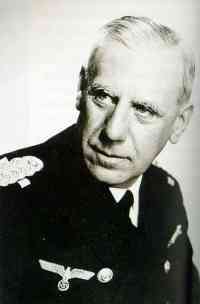
Admiral Canaris
Fluent in Spanish, Canaris hid in plain sight, adding to his already considerable knowledge of Latin American culture during the two years he spent looking for a way to return home, and an undercover assignment in Spain. The Latin American adventure, coupled with his work in Spain led to his promotion within naval intelligence, and his eventual appointment as head of military intelligence.
Which makes one wonder why the multi-lingual (besides Spanish and German, Canaris spoke fluent English and more than adequate French) multi-cultural, sophisticated Admiral took an interest in a starlet known, if at all, just for being a good Aryan and an easy lay. To send her to Hollywood, of course.

Krüger, ca 1935 (German cigarette card)
Some biographies claim that Hilde had a German husband, but that he was insufficiently Aryan (in other words, Jewish) whom she had already divorced, others that her first marriage was in the United States, to a German-American businessman. None of which prevented Hilde from her next performance. She may not have landed any parts in Hollywood, but someone was paying the bills for her luxury hotel suite she rented in Los Angeles in May 1940. The somebody, according to FBI records declassified in 1985, was oilman John Paul Getty.
The F.B.I. and later the O.S.S. (forerunner to the C.I.A.) had become interested in Krüger not so much as arm-candy to Getty, but as a former protege of Goebbels, who was arm candy to a lot of business executives in strategic industrial sectors. Ostensively to divorce her American husband (and, just coincidentally, because the United States was overtly backing the British and already beginning to neutralize German agents), she crossed into Mexico in 1941.
Although the Mexican government was apparently warned that she might be a German agent (which, of course, was a correct assumption), Krüger started at the bottom… working her way up from insignificant boyfriends like Ramon Betata, who was a mere undersecretary of foreign relations to Miguel Alemán Valdés, then Secretaría de Gobernación (and later President) who paid for her apartment in Colonia Roma (the accounting department back at Abwehr headquarters must have loved her expense reports!) where she also, “entertained” General Juan Andrew Almazán (then the presumptive future president) and the jilted Ramon Betata’s boss, Foreign Minister, Ezekial Padilla.
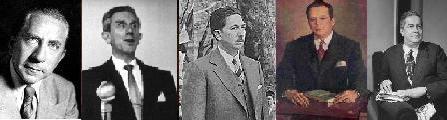
Chumps: Getty, Betana, Alemán, Padilla, Andreu Almazán
Even with that busy social calendar, and a better film career than she’d had in the United States (one of the more successful films being the 1943 comedy “Adulteria” — perhaps she was an early method actor), she still found the time for old-fashioned spy work, passing on to the Admiral information from Friedrich Von Schleebrugge and Georg Nicolaus, Abwehr agents in Monterrey. Again, there’s something fishy going on. Although Mexico did not enter the war until 22 May 1942, acting on information from the OSS, the spies were rounded up and imprisoned in March. Except for Hilde Krüger.
Juan Alberto Cedillo’s “Nazis en Mexico” (Quo, Octubre 2009) suggests Krüger was protected by her boy-friends. However, most of the agents in Mexico were not working for the Abwehr, but for the Gestapo, and Von Schleebrugge and Nicolaus were Nazis. Admiral Canaris was passing along information to the Allies at the time, and had already been involved in several attempted anti-Nazi coups. If he was spying on his own spies, he’d need spies to spy on those spies who needed spying on. Right?
Hilde Krüger, who was known to both the United States and Mexican secret services as a foreign agent was allowed to simply fade away. While most presume her enrollment at UNAM was simply to avoid the restrictions on the movement of German nationals, and to stay out of the slammer, there’s another mystery there. She dumped the boy friends and really did become a scholar. She continued to act in Mexican films for a few years, and had a role in a 1958 German movie, but any mention of her after 1942 is as a scholar.
With a degree in history (she wrote her thesis on La Malache, the Aztec femme fatale who slept with the enemy, and reinvented herself ) she became an expert on documents of the Napoleonic era… sorting the true from the false. Who better?
There is mention of a book, “Malinche, or farewell to the myths: On the relationship between Mariana de Jaramillo and Hernando Cortés” with a printing date of 1948 with a frontispiece by Josè Clemente Orozco (she DID have connections, didn’t she?), found in some on-line bookseller’s catalogs, but no copy seems to be available for love or money.
One on-line source says she died in Germany in 1988, another, written in 2004, had her still hale and hearty at the age of 92, and the Quo magazine article from last October had her still living in New York. Who knows, maybe she’s up to something still. Thomas Blubacher: Befreiung von der Wirklichkeit? Das Schauspiel am Stadttheater Basel 1933–1945. Edition Theaterkultur, Basel 1995, ISBN 3-908145-27-9, page 104 says she died in 8 May 1991 in Lichtenfels, Germany).
In (Cuba) like Flynn

Errol Flynn, underground rebel
Just in time for the 51th anniversary of the Cuban Revolution, “magbana” at Honduras Oye! digs out the most amazing documentary on Fidel Castro and the overthrow of the Batista regime. A self-described “simple peace-loving, home-loving, peaceful man with the heart of a child” Errol Flynn narrates — or wrote much of the narration for — this 50 minute documentary, apparently put together from material meant for Flynn’s last film (he died in October 1959), Cuban Rebel Girls.
Cuban Rebel Girls, filmed during the revolution with Casto’s cooperation, written by Flynn was the story of an international freedom fighter (played by… not surprisingly… Errol Flynn) fighting with the Cubans for the liberation of the island. And, as a vehicle for launching a film career for Bevery Aadland, his new girl-friend. No one has heard of Aadland since, but they have heard of Fidel Castro, who is really the star of both Cuban Rebel Girls and this documentary.
I can’t say it’s modeled on the successful 1914 “Life of General Villa” (released on several different titles) which also had the cooperation of a rebel leader, was filmed during the revolution and included the rebels playing themselves. Raoul Walsh’s film footage, like Flynn’s, was also used for different productions, and as propaganda. That’s a tenuous Mexican connection, I know, but Flynn does make mention of Mexico’s active role in the Cuban Revolution, not just providing asylum to Castro and the other leaders, and helping supply the sources (and the Granma) that returned the 81 fighters to the Island, but also allowing Spanish Republicans to train Cubans in guerrilla warfare.
I’m not sure how to embed a “google video” (and it’s much too long for a youtube upload), so go to here to watch. Ok, there’s no good sword fights with Basil Rathbone, but plenty of action, drama and adventure.


 mexfiles.net