Haunting city hall
Some local politicians just never have accepted term limits!
Mexico City’s historic council chambers, el Salón de Cabildos, has a long history and more than a few ghosts. A fun factoid. When Pope John-Paul II was to use the Salón for a discourse to Mexican leaders, more than a few wags suggested giving His Holiness the flying chair — just to see what happened. As it is, both Roman Catholic and Aztec priests were asked to come in ahead of time and ask the rowdy ghosts to behave themselves.
From Milenio Noticias, 31-October-2009:
Honduras and the fat ladies
(Updated at 8:30 PM with reference to “The Nation”)
Throughout the Honduran crisis the media have reported agreements between the two sides as if Micheletti was really capable of making concessions and President Zelaya was certain nothing would happen to him if he walked out of the Brazilian embassy. Things happening now must be analyzed based on what happened before. But, most media accounts are devoid of such context. The three factors that must be considered when analyzing developments in Honduras are: everything that has taken place in the last four months, a Fat Lady about to sing and several of her sisters waiting in the wings. If you will, the past, the present, and betting on what is likely to take place in the future.
(“Magbana”, Honduras Oye!)
What BoRev calls a “New Weird Probably Terrible ‘Power Sharing’ Deal” was brokered yesterday, under which it looks like the legitimate president, Manuel Zelaya, will return to office for the remaining couple of weeks of his term, presupposing Congress pretends it is constitutionally un-voting it’s previous and dubiously constitutional destitution of Zelaya and appointment of Micheletti as interim president, while pushing aside the supposedly constitutional ruling by the Supreme Court upon which the congress originally relied for their claim that Zelayas forced unconstitutional exile was legitimate and he had abandoned the presidency, all of which came about because the Supreme Court had ruled that Zelaya’s non-binding resolution calling for a constituent assembly (which, were it approved, might kinda sorta pressure the congress into acting to call such an assembly) to revise that constitution which is now being ignored, was itself an unconstitutional act.
Getting that previous sentence to parse was enough of a challenge… making it logical is beyond my ability. But, that’s the “agreement” worked out between the two governments last Thursday, which get even weirder (and less logical). The legitimate president, Manuel Zelaya, will have to share power in his cabinet with representatives of the “de facto” (i.e., illegitimate) one, and the whole bunch is apparently up for legal action (assuming the courts are legal entities at this time). All of which is supposed to allow the November 29 elections to come off as originally scheduled… or maybe they’ll be moved … or maybe they’ll scrap the whole constitution (which was the point of the exercise in the first place) or … who knows?
As Greg Grandin writes in The Nation (and I didn’t see until Saturday night), the whole “agreement” is probably just another exercise in stalling for time, and forcing international acceptance of the “de facto” regime:
…no sooner was the ink dry on the accord when a top Micheletti advisor, Marcia Facusse de Villeda, told Bloomberg News that “Zelaya won’t be restored.” In a barefaced admission that the coup government was trying to buy time, Facusse said that “just by signing this agreement we already have the recognition of the international community for the elections.” Another Micheletti aide, Arturo Corrales, said that since the congress is not in session, no vote on the agreement could be scheduled until “after the elections.”
On Thursday night (before the agreement was actually reached) Hermano Juancito had ringside seat to a local comedy sketch on the negotiations, which make as much sense as the real one:
It began with a mimicking of the crazy and spooky music that has preceded all the government press conferences during the past four months. Then all the actors walked onto the “stage” and sat at a table. Oscar Arias was there to negotiate, but Zelaya and Micheletti were seated at opposite sides of the small table.
… I joined all present laughing hysterically as “Micheletti” began his discourse addressing all of us as “¡Hijos mios! My children.” He talked about waiting for Santos and repeated the mantra “The elections are coming, are coming.” He ended proclaiming “¡Viva Honduras! Long live Honduras!”
“Zelaya” was more long-winded but, complete with cowboy hat, he regaled the crowd and provoked laughter (from people who are very sympathetic to his restitution). He began, “Micheletti, my friend,” and, to fits of laughter, spoke of the “Calvary” he was going through.
“Arias” asked the two parties for their solution: “Micheletti” said, “The elections go forward,” and “Zelaya” called for his immediate restitution.
… It’s been a good interchange – but both a sign and challenge that the struggle for justice and real participation is long and won’t be solved by the restitution of Zelaya nor with elections. They are only temporary palliatives as the people of Honduras face the greater challenge to organize and work together for a country where there is greater justice and less economic disparity.
In other words, the people recognize the whole settlement is a farce. However, as The Center for Economic Policy and Research suggested last week, by forcing though this bizarre settlement, “the U.S. could accept the results of the November 29 elections as valid”. With no time for the normal three month election period (and it’s hard to count the supposed electioneering that was going on with on and off press censorship, dusk to dawn curfews and a state of siege as legitimate) the results of such an election would favor either of the two traditional candidates, neither of whom would be any threat (as were Zelaya’s supporters) to changing the present system under which the United States maintains an (UNCONSTITUTIONAL!!!) airbase in Honduras… something Zelaya has offhandedly suggested needs to be addressed.
In a bizarre article on the “neo-conservative” Foreign Policy Passport site, Otto Reich — the Reagan era U.S. Ambassador to Honduras (who actively and covertly supported the “Contras” in Nicaragua, various death squads throughout Latin America and was instrumental in smuggling Cuban terrorists into the United States when he wasn’t trying to overthrow the Venezuelan government or lobbying for sweatshops) sees the crisis as an “opportunity” to bring back Reagan era style diplomacy to Latin America.
Canada, angered by the Zelaya government’s 2006 cancellation of future mining concessions, was the only major country to overtly support the coup government. Whether Canadian firms were able to wrest concessions from the Micheletti government, I don’t know, but with a “coalition” — and the legal vacuum in which Honduras finds itself, the Canadians stand to make out like bandits.
As do the Colombians… who, given that the government (if there is one) will be distracted with other things (like continuing calls for social justice and genuine political change)… should be able to continue their profitable cocaine transshipments without too much interference.
Otto Reich, sweatshop owners, Colombian narcotics traffickers, Canadian mine owners should all breathe easier with this quasi-settlement in place. For the Hondurans, as Hermano Juancito writes, “Primero Dios – God first – or, less literally, “God willing”… something will turn up.
Unfortunately, what’s going to turn up are probably a lot of unmarked graves, refugees and arms merchants if the fat lady’s sisters are not given their change to sing.

Friday Night Video Roadtrip
On the Road with Lola and Lucha. Cars were bigger back in the early 1960s when Sinaloa’s queen of the rancheras, Lola Beltran (born 24 March 1932 in Rosario) and Lucha Villa could cruise the streets in a BelAire convertible with an entire orchestra hidden in the back seat.
From Miguel Delgado’s 1964 México en mi corazón
Día de los perros muertos
The Dallas Morning News’ entire Havana bureau is Tracy Eaton. Half of the entire original United States press corps in Cuba (the other was Laurie Goering of the Chicago Tribune) since 2000, Eaton also posts his affectionate, but clear-eyed blog about his fellow Habeñenos (two and four legged) at Along the Malecón.
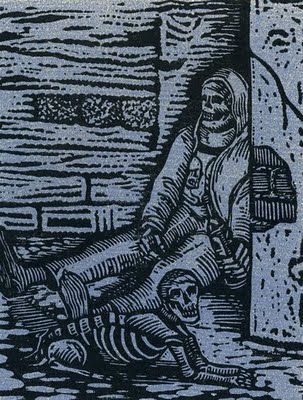
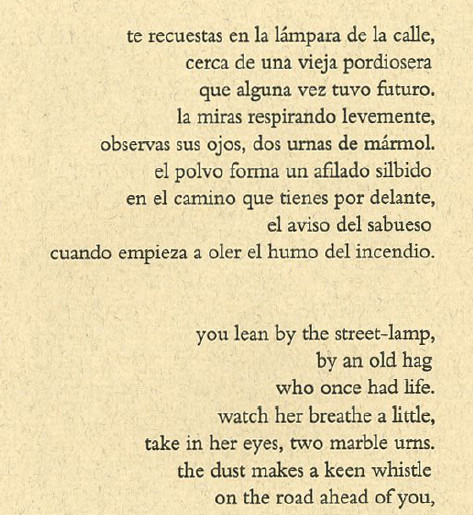
Just in time for both Hallowe’en and Día de los muertos, he writes about the collaborative effort of Cuban artist Julio César Peña Peralta and Alabama book designer Steve Miller in creating a fine print edition of Cade Collum’s eight poem series, “The Dogs of Havana”, with translations into Spanish by Maria Vargas.
Published by Red Hydra Press, the 250 edition (75 signed and numbered hand-bound copies at $475 US, the other $275 each) are collector’s items, naturally, but the Red Hyrda Press has had pity on those of us of limited means, making a PDF download available free.
(Poems © 2008, Cade Collum)
Dearth and taxes
The rebellion of the geeks succeeded. The three percent telecommunciations connection tax is dead. However, it appears that PRI and PAN senators have more or less signed off on a one percent raise in the sales tax (IVA), and higher taxes on alchohol, tabacco and lottery tickets, all regressive taxes.
By way of progressive taxation, there is a two percent raise in the income tax rate (from 28 to 30 percent at the top rate), and the Senate and the Administration is starting to be put some long overdue focus on businesses who evade taxes altogether.
Felipe Calderón is sort of begging the big businesses to start paying their taxes, Augustin Carstens is saying it’s socially irresponsible to look for loopholes in the tax system, but I don’t see anyone volunteering to pay their taxes. By using unlimited deferments, the big companies never pay today what can be put off until tomorrow, and tomorrow never comes: according to Calderón, the largest businesses are only paying a 1.7% tax on revenues, less than half that paid by the very low taxed corporations in the United States. And those large agricultural export businesses that the now former Undersecretary of Agriculture held out as an example to agricultural producers yesterday pay none at all.
(semi) CENSORED!
La Granja, the Los Tigres del Norte fable about the collapse of Mexican agriculture (and society) under the mismanagement of the “drug war” is not exactly banned by the government. However, several radio stations have refused to play the anti-government (and, incidentally, anti-narco) song, and Los Tigres canceled their appearance at the Las Lunas music awards show after organizers of the private event refused to allow the group to perform their contemporary Mexican version of “Animal Farm” .
This is not a “narco-corrido” but a critique (and a devastating one) of the effects of the “drug war” on rural Mexico. As the masked music critic, “Mr. Tochtli” explains, La Granja is an allegory: The fox (as in Vicente) unwisely releases the dog (the narcos). As the pigs (the PRI for Mr. Tochtli, although he notes that “oink! oink! oink!” sounds like Vicente Fox’s repeatedly shouted “¡Hoy! ¡Hoy! ¡Hoy!” as he promised a change in governing parties would bring a change to society) worry about their own grain supplies (and dollars… imports?), the chickens (the press) do nothing and the rabbit (a small time drug dealer) is locked up, the countryside languishes… and there is no escape… although the timely appearance of a Tigre (del Norte) might solve one problem on La Granja.
Ag biz and funny biz: or putting the cartel before the horse
I’m not the first person to suggest that fighting the narcotics cartels is a waste of Mexican resources, and legalizing the production end of the business might be the way to go, letting the governments in the user countries figure out their own way of dealing with the problem.
With a right-wing federal government right now, the “libertarian” — or perhaps “Reagan-Thatcher” theory that the job of government officials is to find reasons NOT to do their job… like, for the undersecretary of Agriculture for Agribusiness, rationalizing the failure to find new markets for Mexican crops. And, of course, these kinds of folks are allergic to government subsidies, and want to tout “free market success stories”.
Or, so it seems, that’s what the Undersecretary of Agriculture for Agribusiness (as I chose to translate “subsecretario de Fomento a los Agronegocios”) with the unusual Anglo name is doing.
From El Universal (28-Oct-09), my translation:
The Undersecretary for Agribusiness Development of the Mexican Deprtment of Agriculture (SAGARPA, from its Spanish acronym) Jeffrey Max Jones Jones, recommends rural Mexican learn from the drug trade about marketing.
Speaking at a forum on the economic crisis and food policy, the SAGARPA official said that narcotics producers have been able to dominate the market without relying on a government subsidy.
“Drug trafficking is one industry that learned it needed to identify its market, and build the supply logistics to meet demand. Unfortunately they are devoted to a crop that is injurious to health, but the same logic, — that logic is that we must learn – applies: identify the market, and then orient the apparatus of production to providing those markets,” he said.
In the first forum on the economic crises and food production, the undersecretary also noted that drug traffickers have had to swim against the current, having to both fight the government and dominate the market without receiving subsidies.
“We have made this — unsubsidized (market dominance) our theme. You know how when you learn to use (…), market logic everything else falls into place by inertia alone and that’s what we have to learn in the Mexican countryside, “he said.
Jeffrey Max Jones reiterated that the drug traffickers have managed to meet Mexico’s platform to serve a market industry that they have given good dividends, while other rural producers first air their fears and only then start producing.
Agriculture Secretary Francisco Mayorga, reached at a meeting in Jamaica, described Jones’ remarks as in no way reflecting the interests or policies of the government, nor of SAGARPA.
ビバメキシコ!

Japanese immigration to Mexico officially began in 1897, when peasants were recruited to work on coffee plantations in Chiapas, but there were probably a few Japanese immigrants — accidental or intentional before then. Given Mexico’s trade with the Philippines, there was some immigration as early as the 16th century. Mexican missionaries, carried Catholicism to successfully to the Philipines, and with less success to Japan: Saint Philip of Jesus — who left the Franciscan Order to enter the Manila trade, re-entered the order in 1590 to work as a missionary to the Japanese… who crucified him in Nagasaki in 1597. Japanese Franciscan monks supposedly painted some of the frescos in the Cuernavaca Cathedral.

Hasekura Tsunenaga
Samurai and diplomat, Hasekura Tsunenaga, arrived in Acapulco in 1613 and crossed Mexico to Veracruz (stopping to call on the Viceroy in Mexico City) on the start of diplomatic mission to the Vatican, returning across Mexico in 1617. Less august — or divinely inspired — Japanese also came to Mexico, and may have settled in the country over the centuries before and after Hasekura’s sojourns.
There is evidence that Japanese had been crossing the Pacific to Alaska and British Colombia for centuries, and some may have come further south. In 1815, a U.S. Naval Frigate picked up the survivors of a shipwrecked fishing junk that had washed up on the Mexican Pacific coast two years earlier, taking them to China (and a little closer to home); in the 1840s, the crew of another Japanese shipwreck spent several months in Mazatlan as guests of the Filipino-born Juan Machado … and later wrote a book about their experiences.

Maria and Uriel Nonaka of Tijuana, 1930s (San Diego Union-Tribune)
After Japan was open to foreign trade in 1853, there was increased cross Pacific traffic, with regular commercial shipping calling at Mexican ports. While the main body of Japanese immigrants settled in Oaxaca and Chiapas, small communities were found throughout the north, especially in the Baja Peninsula by 1910. Unlike the Chinese, who were often viewed as agents of foreign business interests, the Japanese were viewed as fellow campesinos and workers, making them less likely to suffer the pograms Villa would launch against the Chinese and the harassment Mexican-Chinese often faced in northern Mexico throughout the 1920s and 30s.
With Japan’s emergence, especially after the 1905 Russo-Japanese War as a naval power in the Pacific, in Mexico there was a new respect for the Japanese as soldiers and military men. And, in the United States there were genuine fears that Mexico would allow the Japanese Navy to build a base in Baja California. In 1917, fear of the “yellow peril” combined with William Randolf Hearst’s campaign to villify Pancho Villa led the media mogul to finance Patria, a film in which Pancho Villa making common cause with the Japanese Army to invade southern California. Wallace Beery, who played Villa in this film was later a much more sympathetic and likable Villa (after the real Villa was safely dead) in the 1933 Viva Villa!. In Patria, the Japanese villain is played by Swedish actor Warner Oland, who later portrayed the Chinese hero, Charlie Chan in several 1930s films.
The Pancho Villa-Japanese connection was not completely fictious, although the Japanese in Villa’s Army were mostly immigrant fishermen and workers living in northern Mexico.
Like these guys… pictured on a postcard, undated but from the Mexican Revolution, and identified only as “Japanese with Insurrectos”

These gentlemen are fighting on one or another of the sides in the Mexican Revolution… probably — but by no means certainly — for Pancho Villa, whose army included not all sorts of people, including a would-be Japanese hitman. As I wrote in Gods, Gachupines and Gringos:
Only declasssified in the 1970s were the details of a Bureau of Investigation (the forerunner of the Federal Bureau of Investigation) plot, which [General John] Pershing approved, to suborn Japanese volunteers in Villa’s army. Most were machine gunners, but one, Gemichi Tatemastu, usually made breakfast for Villa. Tatematsu was supposed to poison Villa’s morning coffee, but for some reason, Persing’s nemesis was late for an appointment that day and only had time for one cup.
Good thing for Pancho he had the unMexican habit of showing up on time for meetings.
John Hardman — an Ohio postcard collector — has a website, Soldiers of Fortune Postcards, including not just the anonymous Japanese Insurrectionists, but a whole series of foreigners… rouges, dreamers, schemers, mercenaries: ” menagerie of international warriors” who found themselves on one side or another (or several different sides) during the Mexican Revolution.
(By the way, ビバメキシコ!is Japanese for ¡Viva Mexico!)
Co-incidence?
I really don’t care much about U.S. television (I normally check on-line sources, and if I want to see U.S. television news, I wait until MSNBC programs are posted on the internet about an hour after their airing in the U.S. –and maybe watch two or three segments that looks halfway interesting) and have given up on a lot of the U.S. based political websites I used to read, because all they seem to talk about is how much money some politician or the other raised (what’s called bribery down here) or deconstruct whatever some TV talking head said about something. Apparently, people are shocked, shocked I tell you, to discover that corporate media companies have biases like every other media outlet.
That said, I have been not paying attention to the BIG ISSUE on the local expat message board (something that was of so little interest to me, I dropped my membership)… the local cable-TV services have been dumping the U.S. based CNN English channel. CNN (en Inglés) seems to be dropping off the Mexican cable box, and I wonder if there isn’t a connection to another news story I only caught because I follow immigration-rights news:
CNN last week took steps to repair its tattered image with the Latino community by running a heart-warming series, Latino in America, that does a reasonable job of exploring the realities of daily life the nation’s fastest-growing minority bloc.
But what they really don’t want to talk about is Lou Dobbs — the most Latino-bashing media figure of them all. And it’s already biting them in the butt…
I’ve been hearing for years from the Latin American left (and center-left, the Mexican political mainstream) complaints that CNN En Español is — if not an active propaganda organ of the United States — prone to intrerpret the news through the lens of United States thinking and coverage of issues outside the United States is as scanty as coverage of “foreign” news in other U.S. sources (Not to say that CNN en Español is worthless… the United States is the third largest Spanish-speaking country — second if you include Puerto Rico — and there’s a need for a “mainstream” Spanish language news channel. The issue for Mexicans is whether or not it serves Mexican news viewer’s needs, and mostly, they say it doesn’t).
As to the disappearance of CNN “en Inglés” the local forum’s group think seems to be just that there aren’t enough English-language customers to justify carrying that particular channel. But, then again, maybe it’s something else. Maybe the Mexican company is asking itself why it buys a service that insults the intelligence of its English-language subscribers. And all Mexicans… and Guatemalans, and Hondurans, and Salvadorians… and…
Doing well by doing good
What kind of bank makes money in this economic climate? Banks like Banco Compartamos, S.A. — which isn’t your ordinary bank. Oh sure, it offers savings, credit and insurance services, but not too many banks have gone from a non-profit charity to a commercial bank with a listing on the Bolsa de Valores (COMPART) within sixteen years.
Banco Compartamos is a kind of weird commercial bank — making loans not to companies, per se, but to people like Chiapas juice mogul Blanca Rosa Gamboa to diversify into two two taco stands; or Veracruz potter and weaver Leocadia Cruz, whose collateral was having been apprenticed to her trade at the age of eight, and now several stores as well as giving craft training in remote rural communities.
People are likely to pay loans back… especially when, like Compartamos’ clients, financial training and counseling is part of the package. And not just any people… people who are providing goods and services, like juice and tacos and pots or swimming lessons (a Mexico City client got a loan to rent a pool to run swimming classes): tangible things.
Given that Compartamos works with the client to assure they are able to pay the loan, what started as a not-for-profit microlending service became a normal business in 2000 and the next year became the first microlender to issue debt in the capital markets. In 2006 it was transformed into a “normal” commercial bank… with one important difference. It’s not only considered one of the best employers in Mexico, it’s doing what banks aren’t supposed to do… turn a healthy profit in an economic slump. According to its latest financial statement (30 September 2009), Banco Compartamos
has experienced four successful and consecutive quarters of growth despite a challenging market environment, particularly in the hard-hit financial sector. We are very pleased with the results of our clear strategy, which has allowed Compartamos to reach very aggressive numbers, — interest income growth of 36.7%, total loan portfolio growth of 40.2% and a client base increase of 36.0% — compared to the third quarter of 2008. Additionally, despite the strong growth we have experienced, during the third quarter of 2009, we were able to control costs and improve the efficiency ratio to 55.0%, even though we grew the number employees as well as the number of service offices; this demonstrates Compartamos’ ability to generate strong results while controlling spending.
Maized and confused…
Esther at “From Xico” has a long post up this morning… essential reading on yet another assault on Mexican agriculture. I’m not opposed to cross-breeding… after all, that’s why Mexico has forty-one separate races and several thousand different varieties of our native crop, so what Monsanto is up to probably falls somewhere on the scale of Mexican invasions somewhere up there with the Conquest in terms of its likely effects on the culture and people. READ ESTHER’S POST.
Monsanto is the largest producer of genetically modified seed in the world. This company with its tentacles spread across continents has a tightening grip on the production of some of the world’s basic foods, like corn and soy. Its grip doesn’t have to do with the superiority of its products but with its relentless pursuit of profit at any cost and with any tools at hand. Genetically modified seed production is the latest and most ominous of its activities….
… Mexico has just granted 15 permits for GM seed research projects in the states of Sinaloa, Chihuaha, Sonora and Tamaulipas, with another eight pending. Nine of the just granted permits go to Monsanto, six to its brother-in-crime Dow AgroScience.

Hun-Hunahpu, First Father, and Maize God of the Mayan
Of course the government offers all kinds of assurances and in fact has put in place some protections. But according to El Processo,
“[T]here was no pressure, but rather everything is according to the law, now that the most important thing is to guarantee to society that the goverment is doing its best. Enriqe Sánchez Cruz, director in chief of the National Public Health and Food Safety Service explained that expert opinion was taken into account in setting up experimental seed projects, that it is all according to law, and that they have the support of the [Mexican] Inter-departmental Commission of Biosecurity on Genetically Modified Organisms.
“He said that the plantings which will be undertaken will be strictly experimental and that they will take place on controlled plots and totally isolated from other types of cultivars.
“Addressing the measures of biosecurity established by law, Mauricio Limón Aguirre, subsecretary of Management for the Protection of the Environment, referred to the construction of cycle fencing to avoid easy access to these little land parcels where the experiments will take place; mentioned that there will be a minimum distance of 500 meters from other crops, and there will be a temporary period of isolation after a month to avoid the flow of genetic material to a possible conventional maize crop.

Centeotl, Corn God of the Aztecs
“Furthermore, [they will be required] to specify geographic coordinates; to establish a log, to erect pollen plants so that there won’t be any flow through this means (whatever that means), and in addition to burn the product so that it doesn’t enter the food supply.
“During the press conference, Juan Elvira Quezada [head of the Secretariat of the Environment and Natural resources, or Semarnat] did not specify exactly what the permits said and what area was covered, among other things. He only said that you could find the information on the [Senasica] web page.
However, at consulting the page at http://www.senasica.gov.mx and linking to transgenics, only the phrase, ‘Forgive the inconvenience. The information which meets the criteria of your search does not exist.'”

Yankeedollar, Corn God of Montsanto
There will be more to say on this later, but you should have read Esther’s post first. What are you still doing here. Go read Monstrous Montsanto in Mexico and the World.
Go… go… Now.
Go.
BIG Sunday Readings
Big ego
For the second or third time I can remember, there are plans to re-create the Mexican federal police agencies “modeled on the FBI”. While John Lyons of the Wall Street Journal seems to miss a key point that the 3000 plus police agencies in Mexico range from small town two man forces to federal agencies, and talking about changes in the federal agency by talking about forces with officers who haven’t gone beyond secondary school is like comparing the Barney Fife to Eliot Ness. Even so, his portrait of the controversial Genaro Garcia Luna, Calderón’s Secretario de Seguridad Pública, provides an interesting look at a guy with a oversized ability to create controversy:
Critics, including some opposition lawmakers, deride him as a wannabe J. Edgar Hoover, the FBI’s first director, and say his efforts are plagued by incompetence and ethical lapses. Like Mr. Hoover, they say, he has used strong-arm tactics against critics, trumping up legal charges against them to compel their silence. In his zeal for boosting the image of the Federal Police, he admitted to staging a kidnap rescue for the benefit of television cameras. During a raucous, eight-hour appearance before congress in September, opposition lawmakers blasted him for failing to keep Mexico’s murder rate from soaring this year.
A rash of scandals among those close to him hasn’t helped Mr. García Luna build credibility. Though he has never been charged with a criminal act or implicated in a corruption scandal, some of his senior aides have. Last year, his top antidrug commander was arrested and charged with helping a cartel. He is in jail awaiting trial. Another officer in Mr. García Luna’s anti-kidnap squad was arrested for allegedly organizing phony police checkpoints to abduct victims on behalf of a kidnapping gang. She is being held for possible trial by Mexico City authorities.
(Mexican Cops Seek Upgrade, Wall Street Journal)
Big man on campus…
Universidad San Sebastián… a private Chilean institution ranking near the bottom of educational surveys in that country (46th out of 47; 48th out of 53 in another) … so it needs to think big as it builds its Santiago campus.
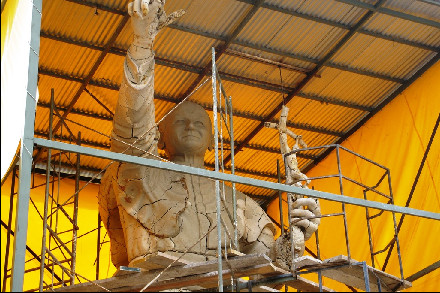
The neighbors couldn’t help but notice the huge head of Pope John Paul II rising out of the sculptor’s workshop next door.
Hidden behind the walls, the pope’s left hand gripped Jesus on the cross while his right extended outward, an imitation of the gesture he had made during his visit to Santiago two decades earlier.
Popezilla
But this was no private religious homage — it was the makings of a 40-foot-tall bronze statue meant to tower over a bohemian neighborhood in this capital city.
The idea of installing the statue in such a public place has sparked outrage, not only over its enormity but also over the lack of transparency in urban planning.
Not even the Catholic Church supports the project.
“The size of this giant statue is proportional to the lack of delicacy of those who, having money, power and influence, feel they own the city,” said Jesuit priest Felipe Berrios.
(Pascale Bonnefoy, Global Post)
Big Problem…
Secret History watched the ALMA Award show and noticed how small the slice of Latino community was at that gala:
… Elegantly dressed stars – all brilliantly groomed for public consumption – dazzled the crowd as they would at any other celebrity gathering. Standard. What was NOT standard, however, is the extreme “whiteness” of the crowd. Hold on, you say, mestizo power fully ruled the evening. Did not Eva Longoria Parker melt fans with all her shiny Cal State Chicano Studies charm? And that is exactly it. What we saw at the ABC hosted awards was the Mestizo and “Spanish” middle and upper class partying the night away. Mestizaje – the mask for ignoring the indigenous presence – reveled in full glory that night. When George Lopez is the darkest man in the room, something has gone awry.


 mexfiles.net