An ounce of prevention…
Seth Hoy, Immigration Impact (Immigration Policy Center)
Yesterday, the Sun Sentinel reported on what health experts have been saying throughout the factious health care debate: excluding immigrants from health care reform could jeopardize public health and leave costly gaps in insurance coverage. Health experts agree that preventative care, rather than costly emergency room visits—which cost, on average, about $1000 per visit—not only prevents the spread of infectious disease but also saves American taxpayers money in the long run.

Help wanted

I’m not job hunting (although I am looking for a second hand refrigerator), but I happened to take a glance at the classifieds in today’s local newspaper. One thing to notice is that employers expect you to show up in person, not send a resume. The company looking for English teachers wants a resume… with the candidate.
Mexicans in general, although much more polite than English speakers and even other Latin Americans, are sometimes brutally blunt. Though both age and gender discrimination are technically illegal, employers have no compunction about spelling out their prejudices and assumptions to potential job seekers. Job solicitations specifying gender or age requirements … or both… are common.
Traditional sex roles in the workplace still exist, as in the last two ads (both for tourism industry workers). Receptionists and room cleaners are still considered “women’s work”. While neither specify age, I can guarantee you that the 50-year-old has a better shot at the cleaning job than the receptionist’s one.
I suppose one could make an argument that a person over 35 is just too decrepit to work as a pollster, but that is probably not the rationale the employer in the first ad (“Ideas Frescas”) has in mind. If there is a rationale. It could be the company wants a youthful image, and with a national health care system, it’s not like the employer is worried much about higher insurance premiums for older workers (if 36 is old), but more likely, the employer doesn’t want to hire people he has to respect as his or her elders or is him/herself older, and expects respect beyond that of just a normal boss.
But, the tailor shop (or, perhaps, seamstress) assistant’s ad is a new one on me. Er, a new two on me.
I have seen ads for “secretaries” that use the code “must be open minded”… run by some perv looking for a bimbo who will put up with sexist pigs… and it crossed my mind that the person running the ad has some less mainstream kinks… but given that there are also some minimal (very minimal… junior high graduate) educational requirements, it probably is just for an assistant in a tailor shop.
I donno… it could be that there’s a certain amount of stereotyping going on… gay guys are supposed to be better at fashion, or maybe the assistant has to deal with girls being fitted for their quinceaneras, and their mom’s are less likely to object to a young man if they know he’s more interested in their escorts than in their precious daughters; or perhaps this shop specializes in drag queens (this is a seaport and a Navy town, not just a hangout for aging touristas); … or maybe it’s just affirmative action for working class gay kids.
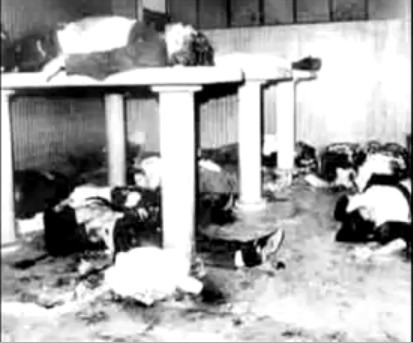
2 de Octubre…
… the United States insists on providing “assistance” to Mexico to deal with a so-called “internal threat” and what IT calls a “terrorist threat” which justifies using the military for normal civilian police functions.
There’s a reason Mexicans don’t automatically sign off on the idea…
Honduran coup reloaded
Still attempting to convince the world that the coup was not a coup because it was sorta constitutional, the de facto regime, is looking desperately seeking a way to make their own convoluted rationales acceptable enough to keep them from being ignominously tossed out of the country (maybe in their PJs?).
Pretend president Micheletti imposed a very real state of siege (abrogating constitutional rights) last week — claiming it would protect the constitutional transfer of power (which, if you remember, was the rationale behind the original unconstitutional act of exiling a Honduran citizen, in this case, the sitting president). Yesterday, the
The Supreme Electoral Tribunal (TSE, in its Spanish initials) of Honduras … asked president Roberto Micheletti to cancel the decree that suspended constitutional rights because it harms the electoral process scheduled for November… and thus joined in similar demands made by Congress, presidential candidates and other sectors…
Micheletti said… that he would agree to analyze the request and insisted that the decree will be “cancelled in the opportune moment.”
“Analyze” means “baffle ’em with bullshit”. As Al Giordano wrote yesterday (The Field):
In typical style, he fools gullible reporters to repeat claims that he has already backed off the decree, while this morning military and police troops continued attacks on peaceful demonstrators that have maintained government agricultural offices occupied for three months now. Clearly, the real powers behind the decree – the Supreme Court and the military – want to make sure it meets its main goals before having to call it off.
What the electoral commissioners can clearly see that the inner trinity of coup power – the Army, the Court and Micheletti – don’t seem to “get” is how the decree has destroyed any hope of convincing Hondurans or the world that the November 29 elections can be made free or fair. It’s already too late. Smarter minds are seeing it, while the the Army, the Court and Micheletti push on out of an apparent belief that if they don’t keep brutally repressing and silencing speech, the nonviolent civil resistance is going to roll right over the coup.
So… with no one even listening to Micheletti — and no one really believing him, the real powers are looking for their own out. J.F. Strang from Hemispheric Briefs tries to make some sense out of the next move:
The focus today turns to the proposed plan forwarded by some in the Honduran business community which, according to the New York Times, for the “first time suggests Mel Zelaya’s return as president” while at the same time demanding the ousted President face trial on charges that he stole money while in office. “What we’re trying to do is break the ice,” business leader Adolfo Facusse said Wednesday, adding that the U.S. and others were “deteriorating” the Honduran election process, “the most destructive thing they can do in a democracy.” However, the Honduran business association which Facusse heads distanced itself from his plan proposed this week, saying this was Facusse’s own personal initiative rather than that of the business council. In La Tribuna, the president of the Cámara de Comercio e Industrias de Cortés (CCIC), Luis Larach, said Wednesday that determining whether or not Mr. Zelaya should be reinstated are decisions for the National Congress and Supreme Court to make. Moreover, advisers to Mr. Zelaya are of course very skeptical of the Facussé plan, with one economic adviser calling it a plan that was “born dead.”
However, that Facussé plan — besides the novel idea of coming up with new charges to justify the original coup (allegations of Zelaya’s corruption have been raised, post-coup, and — for all I know — may even be valid, but weren’t the “legal” reasons for his illegal exile) — also includes (as Elisabeth Malkin writes in the New York Times):
Mr. Facussé and other leaders have proposed that after an accord is reached, troops or police officers from other countries in the hemisphere will keep the peace and an interim multiparty government will take charge. Mr. Zelaya would face trial, but he would not serve prison time if convicted; instead, he would be sentenced to house arrest.
In other words, admitting the coup supporters totally screwed up, and — like Haiti — putting the country under international tutelage, while nothing really changes for the people.
The auxillary bishop of Tegacigalpa, Juan Jose Pineda, meanwhile, is at least recognizes there are other players (like the people) who need to be considered in this mess. My source, believe it or not, is the gardener from La Ceiba, who carps that “international mediation” has been the problem all along (a new one for her):
President [sic]Micheletti and ex[sic]-president Zelaya will each select 2-3 honorable and responsible representatives. The Unión Civicá Democrática (the association of civic groups) and the “Resistencia” will each also select 2-3 representatives. An international mediator will be selected.
So, rather than deal with the first set of international mediation… which didn’t give the Micheletti gang what it wanted, it’s time to send in a new envoy. Okey-dokie.
The few remaining friends of the coup are also starting to sound desperate. U.S. House Representative Iliana Ros-Lehtinen, who — having already made up her mind — appears to be seeking confirmation of her opinion:
“I am traveling to Honduras to conduct my own assessment of the situation on the ground and the state of U.S. interests in light of the U.S.’s misguided Zelaya-focused approach,” she says.
Her fellow Republican, South Carolina Senator Jim DeMint was also supposedly going to Honduras, but — with the Senate Foreign Relations Committee insisting De Mint pay for his own trip (since it is not Senate business) may or may not be going, depending on whether or not he can strong-arm the Senate leadership into picking up his tab in exchange for releasing his “hold” on the confirmation of U.S. State Department Deputy Secretary for Latin American Affairs, Arturo Valenzuela (and, incidentally, the appointment of a U.S. Ambassador to Brazil, which has a dog in this hunt, too).
None of which means the coup has not succeeded in its basic goal of preventing a call for structural change within Honduras. Shannon O’Neill, the Council on Foreign Relations Latin America expert (and probably the best informed “inside the beltway” person when it comes to the situation) suggests in her podcast (here, or here) outlining the Honduran situation that an election — even a tainted one — is a “win” for the golpistas, in that the status quo is preserved and international attention will turn away from Honduras.
I can see Mexico from my monitor…
Visitors to a small website:
 (0 seconds doesn’t always mean the person stayed less than a second. I just happened to grab this while looking up someone else, and the Wassilite — Wassilonian? — was probably still on line).
Hope it’s not another of those shady folks scoping out a sunny refuge:

OH? Canada
“We also have no history of colonialism…”
(Stephen Harper, Canadian Prime Minister during a G-20 press conference in Pittsburgh)
Two Qeqchi leaders were shot and killed and over a dozen wounded this week near the site of a shuttered nickel mine in Guatemala.
The first shooting took place on Sunday, September 27 on land claimed by the community of Las Nubes, which Compañia Guatemalteca de Niquel (CGN), a subsidiary of Manitoba’s HudBay Minerals, also claims to own.
Early reports indicated CGN’s private security guards opened fire while attempting to remove families from their land. Adolfo Ichi Chamán, a teacher and community leader, was killed by gunshot, at least eight more wounded by bullets fired from an AK-47.
…
One day after the murder of Chamán, men armed with machine guns opened fire on a mini-bus carrying Indigenous educators and leaders from the El Estor region to Cobán. One man, Martin Choc, was killed, and at least nine more wounded.
These killings are a flare up in a tense area, where the track record of Canadian mining companies includes forced displacement over multiple generations, co-operation with the army, and the burning of homes belonging to Indigenous people.
Shortly after a series of violent evictions that took place on nearby lands in 2007, Skye Resources (later acquired by Hudbay) representatives went on the record and lied through their teeth to defend their actions.
The English-language corporate media has repeatedly turned a blind eye to recent and past events unfolding in El Estor. This kind of reporting facilitates corporate lies and deceit, plain and simple.
(The Dominion, Canada)
One might see how Mr. Harper is easily confused.
They fly through the air, with the greatest of ease
The traditional Totonac Voladores ritual has been recognized by the United Nation Educational, Scientific and Cultural Organization (UNESCO) as a “Intangible Cultural Heritage”. The Totanaca were the first people in Mexico to fall under Spanish rule… and the last to stage a mass uprising against foreigners in north America.
Veracriz was the first European city on the mainland, and — given the Totonac propensity for both good living and resistance — has had a dual reputation as THE party town of the Americas and as the “Thrice Heroic” city for withstanding attacks by the French in 1828, the United States in 1846 and the United States (again) in 1914. Not to mention various pirates and adventurers like the comically inept Austrian admiral, Maximilan von Hapsburg, misdirected his landing craft and came ashore in a cemetery in the French occupied city on 28 May 1864. Locals hid behind closed doors and snickered.
The City of Veracruz, of course, has long subsumed the Totanac culture, but it has survived, mostly in rural parts of the state and in the State of Mexico. In what was, until the 20th century, the relatively isolated community of Papantla, the last major “Indian massacre” in North America was 1920, late in the Mexican Revolution, when what was basically an indigenous protest against exploitation of natural resources by foreign multinationals (oil, in this case) turned to ethnic cleansing, with the “whites” being run out of town, or killed.
This was unusual, the Totonacs being noted for their tolerance, and Papantla certainly welcomes outsiders today (just don’t rip them off). It’s a small city, best known for vanilla production and Voladores. Given a Christian overlay — as so many survivors of indigenous ritual were — the better known ceremony is said to honor the Virgin Mary, and, in Papantla, the Volodores use a permanent platform located in the church yard. The near-by El Tajín ruins — which predate the Totanac culture — also have a permanent platform and are probably the best place to see the amazing “flying men” of Mexico.
But, as in this video distributed by UNESCO, there is more to the ritual, and more than an extra-large prayer wheel involved.
In rural areas (both in Veracruz, and over the state line in the State of Mexico),
Looking past each other in the drug war
I have tried,with varying success, to understand Mexico and Mexican politics and culture, for years, and to interpret it for my mostly U.S. (or U.S.-centric) readers. At base, one needs to understand Mexican history to make sense of anything… including Mexican military policy and the expectations and needs of Mexico in the so-called “drug war”.
Martín Parades, an El Paso based consultant, has written what should be required reading for any policy analyst, drug warrior, military affairs writer, pundit or wanna-be pundit on Mexico.
“U.S., Mexico uneasy allies in the Drug Wars” was posted on-line 28 September 2009, in the excellent (but, unfortunately not as well known as it should be) Newspaper Tree, El Paso’s on-line newspaper should be read in full.
In order to understand the drug policy of the Mexican government it is first important to understand how Mexicans interpret the world around them. Mexico and the U.S. started out as two different countries with two very different perspectives. The U.S. launched its independence as a spring board towards the future. …
Mexico, on the other hand, sees itself from a very different point of view. Mexicans, for the most part, identify themselves as a continuation of a long history of a conquered people. As Mexicans, we don’t see our independence from Spain as a new start, rather we see ourselves as having liberated ourselves from the Spanish conquest of our land. As soon as we liberated ourselves from Spain we were forced to defend ourselves again and again from other countries, including the United States, intent on annexing us. Octavio Paz defines this psyche as Mexican tradition and history being the center of the Mexican universe. America, on the other hand, he writes, sees its independence as a new beginning.
…
For Mexico, the drug cartels are a national security threat because of the economic power they wield and, to a much lesser degree, because of their potential to create an entire generation of addicted individuals. For the U.S., the problem is one that needs to be controlled outside its borders and the only way to do so is through action in other countries. Although the drug policy actions of both countries may seem cohesive, the reality is that they are not, they just seem like they are.
Mexico’s recent decriminalization of small quantities of personal use drugs was not about a change in national policy but rather it was an exercise in political gamesmanship. The reality is that using resources to jail and prosecute small time drug dealers distracts the nation from the true threat: the cartels. The confusion among U.S. officials is based on the lack of understanding of the Mexican psyche. For those wondering if Mexico is about to embark on a national debate about legalizing drugs as a serious government initiative, the probability is that it will not happen anytime soon. Not because Mexico wants to be subservient to American interests, but because it cannot appear to be weak under the threat of cartel domination of the state, whether it is a reality or not. The added plus to the Merida Initiative is that it allows Mexico the ability to strengthen its security apparatus by using America’s own foreign policy framework to pay for it.
Go… read the full article. There will be a test.
Doing a job Mexican can
Alex Alvarez (Guanabee) on the newest competitors in the oldest profession:
More and more U.S. sex workers are heading south of the border (you shut up) in order to seek work in a safer, regulated and potentially more lucrative environment than on U.S. streets – even despite recent reports that suggest their patrons could do a little better when it comes to wrapping it up.
Gloria, an activist in “Las Magdalenas”, a sex-workers’ rights organization — while not overtly hostile to the foreign competition — notices more and more of these foreign workers in a already tough market.
Tijuana’s tourist zone’s normal two percent unemployment rate has been pushed to eight percent by both the recession and a media fueled worries among U.S. tourists about violence and the flu.
Gloria was interviewed by Yurina Rico of the U.S. based La Opinion, as was Victor Clark, a University of California at San Diego professor and Director of Tijuana’s Centro Binacional de Derechos Humanos . According to Clark, the foreign prostitutes tend to be older than the average Tijuana street walker, and are more likely to be homeless or drug addicts.
Prostitution, being “not illegal” (although regulated) in Mexico, makes it a safer work environment than north of the border, but that foreign workers without authorization for “activides lucrativas” which cannot be filled by Mexican workers can get them deported. I suppose being native speakers of English might be a special skill, but its’ unlikely to be seen as necessary to their job.
Then again…
You thought Mexican head-choppers were bad?

(Via New of the Restless, not Lorena Bobbitt )
My way or the highway: Micheletti
The defecto (ooops… “de facto”) Honduran government is not making friends or influencing people with this kind of “leadership”:
Honduran interim President Roberto Micheletti issued an ultimatum Monday, giving Mexico and three other countries 10 days to recognize his de facto rule and asked to have his diplomatic privileges returned.
The ultimatum was given to Mexico, Venezuela, Argentina, and Spain. Micheletti is threatening to withdraw all flags and national symbols from those countries’ embassies in Honduras. The Organization of American States and the European Union have decided to send diplomats back to Honduras after having abandoned Honduras during the coup. Diplomatic representatives are planning to return to the country in the coming days. However, the de facto Honduran authorities announced Monday that they will not receive the ambassadors of those nations.
“The Honduran government will not receive diplomats from countries that unilaterally decided to break their diplomatic relations with Honduras during the coup or to maintain them at the level of concurrent embassies,” said a Spanish diplomatic source.
Roberto Micheletti, who assumed the de facto presidency in Honduras after the military overthrow of President Manuel Zelaya about three months ago, said that he will not get into any further conflicts. “We don’t want arguments with anyone,” he said.
Funny way of not arguing with people.


 mexfiles.net