Resolution for Malvinas/Falklands issue at hand?
The Malvinas/Falklands have been losing population — even the penguins are leaving — and is already overwhelmingly old and white. This might not only meet the future needs of the islands, but settle the Anglo-Argentine dispute quite nicely:
Honduras — running out the clock
By the way, today is recognized as Honduran Independence Day. It was part of Nuevo Espagna, but figures Father Hildago rang his chimes sometime before midnight.
Honduran independence is kind of up in the air right now. Yeah, it’s an independent nation, but it’s internal self-governance seems to be in the hands of Hillary Clinton and Oscar Arias. Or — at least, Hillary Clinton seems to think she has the right to give Oscar Arias the right to set the rules for Honduran governance.
From Bloggings by Boz:
The best way out of this crisis remains some version of Arias’ San Jose Accord. President Zelaya should be allowed to return, some form of amnesty should be granted for all sides of the coup process and elections should proceed this year.
With all due respect, an amnesty is rewarding the gangsters who seized the state. The nonsense that this was a “constitutional change” of government holds no more true than nearly any other coup in Latin American history, the example I always use being Victoriano Huerta’s February 1913 coup, in which he was technically the presidential successor. Using the military to force the president out is a coup, and in Honduras, you don’t even have a “voluntary” resignation though an obviously forged document was presented to the members of congress who bothered to show up after “President” Micheletti seized power.
Honduras Oye! writes:
Who has the right to run Honduras, the democratically-elected President or the guy who collaborated in the kidnapping of the president and takeover of the government through a military coup? Seemed like it was a no-brainer. You’d think that Hillary was throwing Arias a softball. It didn’t take long for all to realize that Arias job was to prolong the “negotiations” so that even Job would have to say “oh, the hell with this!” And, eat up the clock it did. The result was that President Zelaya agreed to all conditions of the San Jose accord and Micheletti just stamped his feet and bellowed a lot. And all the while, the people of Honduras marched, were detained without cause, and killed in politically motivated assassinations. Nice job, Oscar.
Boz usually is tuned into the “official” U.S. government position on Latin America, which seems to be that the elections will be either meaningful, or accepted by anyone other than the United States (if even them). And, apparently, the Michelleti “government” seems to believe that an election will absolve them of their future status as international fugitives (or Miami emigres).
Your friendly Family bank
Ovaciones is a sports daily, so how much stock to put into this item from Bloomberg, I don’t know. I’ve said before that just legitimizing and regulating the narcotics export and meth production business (and let the user countries take care of their own problems) is perfectly rational.
Mexico’s La Familia drug gang, the dominant cartel in Michoacan state, is offering consumer loans, Ovaciones reported.
The criminal organization makes loans against the total value of any assets from the applicant, the Mexico City-based newspaper reported, citing pamphlets said to be from the cartel and interviews with unidentified people.
Loans from La Familia take less than 72 hours to be issued and the debt carries a lower interest rate than banks would give, Ovaciones reported.
Within a week of receiving a loan from La Familia, customers receive a message saying “Thank you for your trust, now you’re part of La Familia Michoacana,” the newspaper said.
PAN: “No Plan B for the poor”
The federal government does not have a backup plan in case opposition legislators reject its budgetary proposals for 2010, says the leader of the National Action Party (PAN) parliamentary group, Josefina Vázquez Mota.
The administration’s economic package proposes imposing a general two percent tax, which would apply to food and medicine.
…
“We are going to watch the discussion and debate,” she said. “And surely from there we will start paying attention to other considerations, but for the moment we have no Plan B. Instead, we want to step back and allow a responsible discussion on the administration’s proposal.”
(Ivonne Reyes Campos, The [Mexico City] News)
Although the Administration is also suggesting that there are no alternatives to a two percent raise in the IVA (Value-Added tax) given the drop in oil revenue, the “take it or else” nature of the proposal has already aborted the idea, and — like it or not — several plan Bs already exist.
Although the tax increase was praised by the likes of Standard and Poors, your standard poor Mexican is calling it bullshit. With no increase in wages, “small” increases (bus fares here in Mazatlan went up twelve percent at the beginning of the month) are an immediate hardship. The new “poor tax” would also apply to previously untaxed items — food, medicine and school supplies — things that the poor cannot do without, and are already stinting on.
The proposal was D.O.A. as soon as it hit the media, and discussion has hardly been limited to the wonkish back pages of financial papers. This hits the voters hard, and has already got the PRI (and PRD) casting about for both political advantage and — catching the administration flat footed — probably forcing the administration to give up on its own neo-liberal biases and give up on the economic dogma pursued by PAN and the “technocratic wing” that ran the PRI since the 80s.
While lower level state employees have taken the brunt of the cuts (I’m hearing of government employees being told to bring their own toilet paper to work) within the federal budget, the administration has yet to reign in salaries and benefits at the top. This is a populist austerity measure that — naturally — the “ins” never seem to get around to considering. However, being in the unusual position of having a divided legislature and executive, it might be possible for one branch or the other to cut the salaries of the other branch… or better, for either (or both) to involve the judiciary and gang up on each other. Maybe, if everyone’s lucky, they’ll get into revenge salary cuts.
Those savings might not be as substantial as they are symbolic, and I know they were part of the “other presidency’s” proposals back in 2006, but it’s not the only one of the Lopez Obrador proposals that are being reconsidered (although not touted as such). Luxury taxes (including that on large engine foreign cars — which was proposed as a environmental tax) — were eliminated under the Fox Administration, and are less painful to most than taxes on food. Everyone eats, but only a few drive Escalantes.
And, there is always income tax. Or going into debt. Or both.
Stopped clocks: the drug war and decriminalization
Much as it goes against my lefty grain, I have to admit that Mary Anasasia O’Grady, the Wall Street Journal columnist who usually manages to write something silly about Latin America (and sometimes seems to make stuff up) was mostly right the other day when she said:
… Mexico’s attempt to question the status quo in drug policy deserves praise. Unlike American drug warriors, Mexico at least acknowledges that it is insane to repeat the same thing over and over again and expect a different outcome.
Because so many Americans like to snort cocaine, that business has flourished over four decades. Most of the traffic once went through the Caribbean, but a crackdown on the sea routes caused suppliers to shift to paths over land through Central America and Mexico. In just two decades Mexican drug capos took over the industry, adding other drugs to their product lines. By paying their employees in kind rather than in cash, they also grew the business at home; lower-level “mules” have to push locally to turn their salary into money. Now Latins have become consumers. In other words, demand and prohibition up north have poisoned the entire region.
…
By decriminalizing consumption, Mexico is admitting that things are not getting better. It says its hope is to concentrate limited resources in going after producers, traffickers and retail distributors. According to the Mexican Embassy in Washington, another goal is to end the corruption that comes from the “free interpretation of what constitutes ‘retail drug-dealing.'” The aim is to reduce police graft while going after big fish, not little ones.
The war on supply is a failure, something any first-year economics student could have predicted. But this plan is unlikely to reverse the situation. It is demand north of the border that is the primary driver of organized-crime terror. And that shows no signs of abating.
Also surprising me, Jorge Casteñeda, another New York establishment figure (in his case, Colombia University New York University [my bad… thanks Esther!]) who has often been wrong about Latin America (and, in Casteñeda’s case, somewhat more damaging to Mexico, having been recruited by a headhunting firm* to serve as Foreign Minister in the Fox Administration) is the only one of the “mainstream talking heads” to get it right — noting that the so-called “decrimininalization” is actually making drug possession a more serious matter than it was previously:
The recently approved new “drug” law in Mexico is in fact not a step toward decriminalization, but rather toward mandatory sentencing. Until last month, possession of small (unspecified) amounts of drugs was not a criminal offense in Mexico; only the sale or purchase was. The new law establishes a minuscule limit on legal possession, meaning that today, almost anyone caught carrying any drug is subject to arrest, prosecution and jail.
If anything, the new law criminalizes drug use much more radically than before, and it is probably for this reason that President Calderón signed it, and that the Obamaadministration has looked the other way.
…
The growth of marijuana, heroin and metaphetamine consumption is flat in all categories (addiction, occasional use, at-least-once-in-a-lifetime use), and while cocaine addiction, for example, did rise from 300 000 victims in 2002 to 450 000 in 2008 (a 50 percent increase, or roughly 6 percent per year), it did so from a tiny baseline, for a tiny percentage (0.4 percent) of Mexico’s population, a much smaller share than for the U.S., Western Europe and practically every country in Latin America.
* This is true. Although Casteñeda, connected with a small “democratic leftist” party (oddly enough, financed with seed money provided by the Reagan Administration) that had been part of Fox’s election coalition and was given the post to balance the rightist PAN cabinet, Fox outsourced vetting the cabinet to Robert Half and Associates, which was presented as evidence that the new administration was both business oriented and willing to think outside the political box.
We’re #1… cool
Mexico and Argentina are leading a shift to make the global economy more climate friendly, according to an index of “carbon competitiveness”, the London-based thinktank E3G said on Sunday.
G20 leaders meet at a summit on Sept 24-25 in Pittsburgh to help steer the global economy out of recession, and will also discuss ways to finance the fight against climate change.
Long-term policies to limit climate change are widely expected to force nations to cut greenhouse gas emissions, favouring leaner, more efficient economies run on renewable and other low-carbon energy supplies.
“Countries that adapt quickly to a carbon-constrained world will be better able to deliver lasting prosperity for their citizens,” said the E3G report, “G20 Low Carbon Competitiveness”…
Otto the Inca mentions that Joseph Stiglitz is presenting a report tomorrow that looks at how we measure prosperity, relying less on Gross Domestic Product and more at “general well being”. I haven’t a clue what he will be proposing, but Stiglitz is generally the best regarded economist in Latin America (one of the few gringos Latin Americans think “gets it”) and his focus on “quality of life” rather may change the way we think about economic rankings.
We may be doing better or worse than we are accustomed to think of ourselves.
Brilliant!
Now here´s a fantastic small-business stimulus package… with long term payoffs well beyond just keeping small factories humming. From Tim’s El Salvador Blog:
On August 24, Vice-President and Minister of Education Salvador Sanchez Cerén officially opened the bidding process for some 7 million yards of fabric for the production of school uniforms, as the first step towards implementation of President Mauricio Funes’ plan to distribute two school uniforms, one pair of shoes, and a set of school supplies to every public school student in the country. The program will not only benefit 1,360,000 students, but will also create jobs for small- and medium-sized Salvadoran businesses. Fabric will be purchased from Salvadoran businesses and production will be carried out at a local level, with each municipality contracting local businesses and collectives to make the uniforms for their students.
The truth is out there, just not here
How did I miss this? From the undoubtedly highly reliable The Telegraph (U.K.) via the unimpeachable Paranoids On-line:

Mexican TV revealed the almost unbelievable story – in 2007, a baby ‘alien’ was found alive by a farmer in Mexico.
He drowned it in a ditch out of fear, and now two years later scientists have finally been able to announce the results of their tests on this sinister-looking carcass.
At the end of last year the farmer, Marao Lopez, handed the corpse over to university scientists who carried out DNA tests and scans.
He claimed that it took him three attempts to drown the creature and he had to hold it underwater for hours.
Tests revealed a creature that is unknown to scientists – its skeleton has characteristics of a lizard, its teeth do not have any roots like humans and it can stay underwater for a long time.
But it also has some similar joints to humans.
Its brain was huge, particularly the rear section, leading scientists to the conclusion that the odd creature was very intelligent.
The odd creature was apparently smarter than the British press. Mulder and Scully might not have found the truth, but it was out there… in the always entertainingly weird Inexplicata, the Journal of Hispanic UFOlogy who called in Capt. Alejandro Franz of Mexican airlines… who called in a specialist:
“The veterinarian [who researched the case] said that the animal was submerged in liquid to cure its hide; the proprietor of the ranch says the animal swallowed a poisoned rat. Why can’t they get their lies straight? [This] is history-making physical evidence. The story of a “strange being” that a simple analysis – within the reach of any primary school child doing a 30 minute web search – would have confirmed as the carcass of a “squirrel monkey” caught in a trap…
Yup, this probably was on Mexican TV, but I was watching another channel, with something more believable… the badly dubbed report on an exciting new scientific discovery that led to the development of creams to make you lose body fat. Must have been true. The guy was wearing a white lab coat.
Oh well, at least Squirrel monkeys do, as the Telegraph reported, have a huge brain. According to the semi-reliable Wikipedia:
Squirrel monkeys grow to 25 to 35 cm, plus a 35 to 42 cm tail. They weigh 750 to 1100g. Remarkably, the brain mass to body mass ratio for squirrel monkeys is 1:17, which gives them the largest brain, proportionately, of all the primates.Humans have a 1:35 ratio.
I don’t know what’s up with Inexplicata, taking all the fun out of alien corpses (and the alien fetus from Puerto Rico, found in a a car with a dead junkie sounded so promising). This is probably a website not needing to be looked at daily, but worth perusing from time to time for the latest in UFO sightings (all of Latin America must be an intergalactic rest stop or something), and chupacabra attacks.
13 September 1847
13 September 1847 saw not just the fall of Mexico City to the U.S. invasion, but also the execution of 30 San Patricio’s, at Mixcoac and in San Angel (Plaza San Jacinto, where a plaque marks the spot today). The executions in San Angel took place as the United States flag was raised over Chapultepec Castle.
Considered traitors and deserters by the United States (which they were), the San Patricios’ included not only Irish immigrants, but Germans, Hungarians, native-born whites and self-liberated slaves who had been with the U.S. invasion forces. The Irish, of course, were mostly recent immigrants to the United States, fleeing land grabbing English-speaking Protestants, only to find themselves fighting on behalf of the same kinds of people. Rampant anti-Catholicism in the Army (and in the United States generally) also played a role. There were only two Roman Catholic chaplains with the occupation (and one died before reaching Mexico), both volunteers whose expenses were not paid by Congress or the War Department, but under the table by President Polk (who hid the transaction in the White House entertainment budget).
This is sort of the forgotten war of the United States — go into any U.S. bookstore and the war section skips from the War of 1812 to the Civil War — and, if thought of at all, is thought of in terms of being a prelude to the devastating Civil War. As Ulysses S. Grant would write:
The Southern rebellion was largely the outgrowth of the Mexican war. Nations, like individuals, are punished for their transgressions. We got our punishment in the most sanguinary and expensive war of modern times.
Anti-immigrant sentiment, religious bigotry, a war policy based on financial calculations… it’s not a new thing. That these soldiers had to take such a huge risk (and paid such a horrible price) to preserve their own integrity makes them — in Mexico and in Ireland — heroes today.
In the notes to the video, singer David Rovics writes:
Dubious about why they were fighting a Catholic country and fed up with mistreatment by their Anglo-Protestant officers, hundreds of Irish, German and other immigrants deserted Taylor’s army and joined forces with Mexico.
Led by Capt. John Riley of Co. Galway, they called themselves the St. Patrick’s Battalion (in Spanish, the San Patricios) and fought against their former comrades in all the major campaigns of the war.
The history of the San Patricios is a woeful tale of angry, bewildered, naive, or calculating young men, from varied backgrounds, who deserted for a myriad of reasons and paid a fearful price.
The San Patricios, in the words of one Mexican general, “deserved the highest praise, because they fought with daring bravery.” But eventually, Mexico surrendered, ceding almost half its territory to the United States.
Each San Patricio who deserted from the US side was interned after the war in Mexico and subsequently given an individual court-martial trial. Many of the Irish were set free, but some paid the ultimate price. Roughly half of the San Patricio defectors who were executed by the US for desertion were Irish.
A grande sweep of the sombrero to Mary O’Grady (now there’s a good Mexican name!) for passing this along:
Remember the Alamo? Some of us DO!
This is the second (and I hope) last time I comment on the — until recently unknown to me — gloriously moronic Glenn Beck. That whiny adolescent voice (neither authoritative nor ominous enough for a good propagandist) is Beck reading some polemic by some woman in support of some march that I guess came off in Washington, DC Saturday.
The video, and whatever their cause is (damned if I can tell, though you notice the only non-white people in the whole video are the President, who I guess these folks are mad at, and a Presidential aide) would be completely irrelevant to The Mex Files, if it wasn’t for this slide, at 1:13 of the 1:36 video:

Uh… the Battle of the Alamo was between illegal aliens in Mexico and the Mexican Army. Seeing they thought they were fighting for a separate republic (which did exist for a couple of years after this 1836 battle), I suppose the makers of this video might be trying to drum up support for Texas separatists (only about 173 years late), or… maybe they’re saying something about the advisability of Mexicans killing English-speaking white guys in the name of black liberation.
I DO remember the Alamo. The surviving defenders were shot after three men were released. Brigado Guerrero, an AWOL Mexican soldier had been trapped in the fort. Joe was taken with arms in hand, and slightly wounded before an officer order his men to cease and desist. Joe was personally interrogated by General Santa Ana. Joe had not known that his enslavement by insurgent leader William Travis was illegal in Mexican territory, and he was released. As was Sam, a non-combatant, had been brought into Texas by Jim Bowie and “freed” by Bowie during the siege.
I guess what Beck’s group is trying to say is that restoring the rights of two black people justified the slaughter of somewhere between 182 and 257 of those denying them their rights, and the 450 or more who died to free them from bondage.
The protest in question took up about half the Washington Mall, the other half being filled with picnickers celebrating “National Black Families Reunion”. I hope none of Sam and Joe’s descendents were there, or at least that those descendants don’t draw the same conclusions I do about this silly event.
Economy-sized Sunday readings
Stimulus package?
This week, Allison Vivas of Pink Visual received a fax from Newt Gingrich’s American Solutions for Winning the Future (ASWF) group, informing her that she’s been chosen for a 2009 Entrepreneur of the Year award by his Business Defense and Advisory Council.
…
Pink Visual is a porn DVD superstore…
For a few cents more
OK, this press release from Chipolote Mexican Grill (a U.S. chain that sells quasi-Mexican food) is self-serving, but it’s good to see a business getting down to business…
Chipotle Mexican Grill… announced that it has reached an agreement with East Coast Farms, one of Florida’s largest tomato growers, under which workers who harvest tomatoes for Chipotle will receive an additional penny per pound, a wage increase of 64 percent, for tomatoes picked for Chipotle.
The agreement between Chipotle and East Coast Farms comes following months of discussion between Chipotle and the Coalition of Immokalee Workers (CIW), a community-based organization that has led a campaign to improve wages and working conditions for Florida farm workers.
Similar agreements between other large tomato buyers, like Chipotle, and the CIW have been blocked by a Florida tomato industry cooperative.
Penny pinching
Un-fucking-believable! Translated from Citius64:
The year has not passed, but I think we have the key quote of 2009. I copied this quote entirely from remarks made yesterday by President Calderon at a conference on housing:
“If we (the government) ensure that poorer households consume less water, without sacrificing their needs, and consume less electricity, we will save these families hard cash from the disposable income, and also pass the savings on to us, because kilowatt hour not consumed is a subsidy that we won’t need to pay. “
Alfredo adds:
The president is a genius, without a doubt. How do we cut subsidies to the poor? By making sure at the outset that they use less water and electricity! Calderon should win the Nobel Prize in Economics for sure. How do we stop giving money to the poor? Well… we can let them die of thirst, or not warm their coffee, or use their electric stoves…. poor country!
Money isn’t everything, but it sure calms the nerves (María Felíx)
During a nationally televised address, [Guatemalan President Alvaro] Colom … said the nation’s food problems are the result of a drought this year, global warming and the effects of the international economic crisis. He also cited the Central American nation’s “history of unfairness that has made Guatemala live since long ago with high and shameful poverty levels, extreme poverty and undernutrition… I am making a fervent call to all of the country’s sectors to contribute to confronting this grave problem.”
Emiliano Zapata, Prince Albert of Monaco and the gay caballero

Fact checking can lead down some strange paths. Editorial Mazatlan is working (overtime) to get a book ready for press: The Mexican Revolution: Day by Day (more on that later), Ramon Acosta’s exquisitely detailed chronology of the 1910-20 Revolution (with major events before and after those dates) , an amazing work of scholarship, and an invaluable tool for researchers and historians.
Ray’s research is solid, but that doesn’t mean we stint on fact-checking … even for relatively minor matters, like the full name — apallido paterno and apallido materno — of a minor figure like Ignacio de la Torre (de la Torre y Mier, as it turns out). But, as with most research, it is the journey, not the goal, that is the reward.
De la Torre y Mier is a troublesome figure, one that pops up in the unlikeliest of places, and deserving to be considered more than I did, as two footnotes in Gods, Gachupines and Gringos.
Malcolm Forbes once wrote that the surest way to become very rich is be born rich. Ignacio de la Torre y Mier was born — in 1866 in Mexico City (during Maximiliano’s reign — very rich. His father was the Mexican partner to the notorious Monsieur Jecker, the Swiss banker who — with his other partner, Napoleon III’s half-brother, the Duque de Morney — held the loans that bankrupted Mexico and provided France with a plausible excuse to invade, and then occupy, the country. Ignacio was heir presumptive not just to the banking fortune, but to ten haciendas. With sugar production from Cuba falling after 1880 due to guerrilla wars on the island, de la Torres’ land in Morelos would make him even richer. And even more pretentious.
In short, the perfect villain for a revolution. A dime a dozen…
But, Ignacio is the villain who made Emiliano Zapata a leader, in part began the movement for gay and lesbian rights in Latin America. Not to mention doing his bit for the future of Monaco.
 Although the Mexican Empire would not last, young Don Ignacio who –as eldest son — was head of the De la Torre family following his father’s death. I don’t have the exact date for Isadoro de la Torre y Gil’s death, but by the 1880s, he was head of a family which still had its royalist pretensions. He apparently was a competent businessman, using his social connections to build up the family sugar fortune and shopping for dynastic connections. Successfully, he married off his sister Susanna to Count Maxence Melchior de Polignac. Maxence and Susanna’s son, Prince Pierre would marry the illegitimate (and later adopted) only child of Prince Louis II of Monaco. The throne of the mini-state could not pass to a female child, so Prince Pierre (who was somehow related, as all European royals are) became the consort-apparent. Both Prince and Princess were rather shady characters (the Princess eventually ran off with an Italian jewel thief) but they did have a couple of children, the eldest son being Prince Rainer III. Rainer rescued the magic principality’s reputation as an sunny place for shady people, married Grace Kelly and spawned a new generation of royal gossip-fodder, including the reining prince, Albert.
While the rich have always been different than you and I, and it’s good to be king (or at least reining prince), Albert owes a small debt to his great-great uncle Ignacio. No one today would presume to force a gay an allegedly gay**man like Prince Albert to marry, as Ignacio was. And did.
“Gay” and “straight” and “bisexual” weren’t part of 19th century vocabulary, nor has occasional same-sex activity been particularly viewed as all that unusual in Mexico, so Don Porfirio may not have realized how much misery he was inflicting on his favorite daughter, Amada Díaz Ortega, when she and Ignacio married in 1888. Mexican historian Sara Sefchovitch (La Suerte de la Consorte, Oceana, 2002) writes that father and daughter were deeply hurt when Ignacio proceeded to “scandalize society with his licentious habits.”
Amada was obviously not going to present Porfirio with any grandchildren to dote upon, and he turned more and more to his nephew, Felíx, the son of his long dead brother who had been lynched after desecrating a church back in Oaxaca. Felíx — among other favors bestowed on him by his uncle — was Mexico City’s police chief in 1901, when on November 20 of that year police arrested 42 men who may have just been cruising, but — with several in drag and apparently making speeches — seems to have been an early gay rights demonstration.
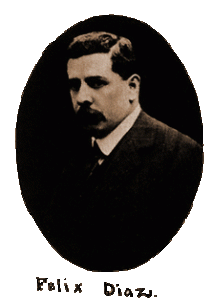 Felíx took advantage of his uncle’s regime, not only in finding himself lucrative positions, but in using the other machines of dictatorship for his own benefit. The “Valle Nacional” in Oaxaca, a rich tobacco-growing region, functioned as a sort of gulag for political prisoners… the tobacco growers needed cheap labor, the cheaper the better. Not feeding workers cut down on overhead, and — besides — they were prisoners. Felíx regularly supplemented his income cleaning out the city jails — and, when he needed extra cash — rounding up vagrants or other “inconveniences” to ship off at five pesos a head.
One of the 41 men rounded up, only 41 were sent to the Valle. While Igancio was not, in our sense of the word, closeted, he was never charged with anything (nor were the others), and he was never shipped off to the death camp. To this day “41” is Mexico City slang for a closeted gay man.
 The “scandalous and licentious” acts of the very rich and well-connected have always been overlooked, but the importance of this raid (and the fate of the 41 less well-connected victims) have haunted the consciences of Mexicans ever since. Of course, gays continued to be shaken down, beaten up, or arrested on bogus charges by Mexico City police but never with the same enthusiasm — and the well-heeled gay man was more likely to be left alone.
Ignacio did not get off entirely scot-free. While under continual surveillance by his father-in-law’s secret police, his occasional weekend parties at his hacienda in Cuatla might be reported, but — as long as he stayed in Cuatla — he was left alone.
I can’t find a photo of the guy (and I’ve been looking), but maybe it’s enough to say that he liked to show visitors his “library” — meaning his extensive clothing and shoe collection. He’s described by a pseudonymous biographer in the gay literary journal, Enkidu Magazine (“Juana la loca*”) as tall and slim, well known and popular (at least with his buddies from Mexico City).
“Juana” probably doesn’t read Edwin Arlington Robinson, but the lines from Richard Corey fit: We the people used to look at him/Clean favored and imperially slim.
Not too many people in Cuatla were likely to have a lot of fashion sense. They were more likely to appreciate that Ignacio was spending his spare time raising horses. And, as every horse breeder in Morelos knew, the “go to guy” for training was Emiliano Zapata.
 Zapata began working for De La Torre in 1906, but, responding to complaints from other landowners about the horse-trainer’s annoying habit of demanding rights for the local peasants — and protesting land grabs — he was drafted into the army in 1908. As Ray Acosta uncovered, De La Torre used whatever credibility he had with his father-in-law to arranged for Zapata’s discharge in March 1910 in return for agreeing to work as De La Torre’s groom.
The two had an unlikely relationship beyond the business relationship. Perhaps Zapata — a snappy dresser himself — was one of the few people to appreciate those suits and shoes. Perhaps De la Torre just had a taste for good looking working class guys. We don’t know, but, the fact that Zapata was friends with an obviously gay man was used after his death to attempt to discredit his political followers, and his memory.
In the early stages of the Revolution, De la Torre protected Zapata, even passing along Zapata’s messages to Don Porfirio during the 1910 election. Porfirio wrote “Nacho (Ignacio) is a continual headache.”
Naturally, though, as a rich guy, not to mention as a relation of Porfirio, he was going to end up on the wrong side of the Revolution. Although his land was seized, Zapata did release De La Torre from prison, when he briefly controlled Mexico City in 1914.
Personal friendship aside, the enemy of your enemy is my friend. Both De La Torre and Zapata had a common enemy in Venustiano Carranza, and he was protected during his time in Morelos, until 1917, when he was again arrested. This time, he fled to the United States where he died (under anesthesia during a hemorrhoid operation) on April Fools´Day, 1918.
* For those not familiar with Spanish, or Spanish history, the name is a double pun. ¨Loca” is often used for an effeminate gay man — a “screaming queen”.
Juana la Loca, the mother of Carlos I (Emperor Charles V of the Holy Roman Empire) was briefly Queen of Castille. She was the only surviving child of the greatest power couple of the time, Ferdinand and Isabella. However Ferdinand was only King of Aragon, not of Castille. Juana made the mistake of actually loving her husband, Philip the Handsome (I love those Spanish royal nicknames!). In the middle of the power struggle to control Castille (which was quickly becoming Spain), Philip died, and Juana — either a depressive or a schizophrenic — got a little funny in the head, eventually being locked up until the teenaged Carlos could be put on the throne. And then, neglected and abused the rest of her short life… became a tragic figure in Spanish literature and history — and, literally, a screaming Queen.
** Prince Albert “allegedly” married South African Charlene Whitstock (is she really gonna be called “Princess Charlene” and will the footmen be able to keep a straight face?)… something I knew nothing about until I started getting a few hundred hits on this post over this weekend. (2-july-2011).


 mexfiles.net