Last Honduran post for tonight
Apparently, it’s not being reported within Honduras that Roberto Micheletti’s claims that his “government” has the support of Taiwan was seen as kind of pathetic. And the news that Taiwan was supporting the Honduran putchists was news to Ma Ying-jeou too.
President Ma Ying-jeou has criticized the coup in Honduras which has seen the Honduran President Manuel Zelaya forced out of the country. Ma made his remarks in a speech in the National Assembly of Panama on Thursday.
Ma said that Taiwan, as a democratic country, condemns the removal from power of a democratically-elected leader.
“The Republic of China has always supported freedom and democratic and legal institutions. We express our condemnation of any action that violates democracy and the rule of law,” said Ma.
Ma called on Honduras to resolve its presidential crisis in line with the country’s constitution.
On Wednesday Ma met briefly with the exiled President Zelaya at the inauguration of Panama’s President Ricardo Martinelli. Other governments in Central America have also urged Honduras to restore Mr. Zelaya. Furthermore the United Nations has also passed a resolution calling on countries not to recognize any government in Honduras other than that of Mr. Zelaya.
President Ma Ying-jeou was originally scheduled to visit Honduras as part of his trip to Taiwan’s diplomatic allies in the region. This was cancelled however after news of the coup emerged. Ma will travel to Nicaragua next before returning to Taiwan.
Milenio (a middle-of-the-road/conservative Mexican paper) is reporting that the Honduran authorities have extended the “state of emergency” and Hermano Juancito writes of the demonstrations throughout the country:
The anti-coup forces are claiming that 50 thousand people were demonstrating in various cities in the country: 30,000 in Tegucigalpa, thousands more in San Pedo Sula, Comayagua, and Progreso. Some of their demonstrations have turned violent, especially in San Pedro Sula, but some have been violently broken up by police or military forces.
The pro-coup forces are claiming 70,000 or more in their demonstration in Tegucigalpa and tens of thousands in San Pedro Sula, Choluteca, and other cities. Often the speakers are local businessmen and politicians. They typically are protected by police and are peaceful.
An e-mail from “Ing. Wilson Rubio” posted on Honduras Frente al Golpe de Estado claims that the Chamber of Commerce is levying a “donation” on its members to support the so-called “Peace Marches” (which sound suspicously like the pro-Calderon “anti-crime marches” here in Mexico pushed by Televisa). I can’t imagine why “spontaneous” demonstrations would require corporate donations, can you?
Also, check GlobalPost’s article by Ione Grillo (via Inca Kola News) on press censorship… something even reported (on the news pages) by the Wall Street Journal.
Street battles in Tegucigalpa?
Argentine news service TELAM is reporting that Organization of American States Secretary-General Miguel Insulza, managed to meet with the Honduran Supreme Court… for a response to OAS demands for return to democratic and constitutional government. The demands have been rejected according to El Salvador’s La Prensa. Tomorrow is the 72 hour deadline for the return of the legitimate president, at which time, the OAS ultimatum will kick in, leading to Honduras’ expulsion for the hemispheric organization. Insulza arrived and left Tegucigalpa under massive military protection.
At the same time, Pablo Palomo of NOTIMEX is reporting that the scene around the Presidential Palace in Tegucigalpa is a “battleground”, while ABC (Spain) reports that bombs have gone off at the airport. Spanish media is also reporting that King Juan-Carlos has spoken against the coup. And, having put down a coup that was supposedly in support of him (and of right-wing oligarchs) back in 1981, the man knows a thing or two about coups.
Mexican sources have mentioned dissention within the military, with possible mutinies against the coup, but I’m having a hard time finding on-line sources and confirmation right now.
Stereotypical Friday Night Video
This Japanese short promotes film-making in Mexico — or (with the exception of the very short clip from the one and only Mexican film shown at the end) at least making movies Mexicans hate… and find stereotyped and bone-headed. You know… Hollywood films.
Why Honduras Matters — to the U.S. and Mexico
I’m not all that interested in the fate of Mel Zelaya, the deposed president of Honduras. I really don’t care if he is impeached… for any number of things. The original justification for the coup — that Zelaya “disobeyed” a court order is pretty tenuous: when the Supreme Court ruled a planned referendum was unconstitutional, the President changed it to a non-binding referendum; when the Elections Commission said their resources couldn’t be legally involved, the now non-binding referendum became something no different than the on-line polls, as “la gringa” wants coup supporters to manipulate). Perhaps government funds were involved, and perhaps it’s an impeachable offense. Who cares?
The rights and wrongs of the Zelaya Administration are irrelevant, as are the rationales being spun in Tecapagalpa and presented to a skeptical world.
The best reason, and one that doesn’t involve geo-politics, was given by Inca Kola News:
I have two kids, five and nearly three years old. When they’re 21 and 18 I’m going to have enough trouble on my hands worrying about boys and drugs and getting them into unversities and making sure they get there unpregnant and all the rest. I really don’t need to worry whether they’re going to take a bullet in the chest if they decide to protest the government of the day. Or maybe just disappear.
Not having kids, that’s not a worry of mine… but I live here, too. And, I am a United States citizen. In both Mexico, and in the United States, there is a creeping (or rather blatant) attempt to move the military into more civilian roles. In Mexico, military involvement in civilian police matters has been applauded and supported by the United States — but the record of human rights abuses is growing. In the United States, where “terrorism” is used to justify an expanded military role in civilian affairs, there haven’t been that many overt problems… yet.

Gloriosa Victoria, Diego Rivera (1954), commemorating the coup overthrowing Guatemala's democratically-elected President, Jacobo Arbenz (Photo: BBC)
There seems to be a myth that coups are outside a constitutional framework. Not so. Victoriana Huerta became president in 1913 constitutionally. For real. Jose Pino Suarez, the vice-president resigned, leaving Foreign Minister Pedro Lascuráin as second in line when Francisco I. Madero resigned for reasons of health (like there was a gun pointed at him). Lascuráin holds the world record for the shortest term in office for a legitimate president of all times… probably about 45 minutes.. long enough to appoint Victoriano Huerta HIS foreign minister, and then resign himself. All constitutional, all legal. And… defended by the right as a way of “restoring order” and dealing with a president over his head during a time of calls for social change.
Constitutional… but no one in their right mind would say that wasn’t a coup. Lydia Gueller was President of Bolivia (remembered only for being Bolivia’s one and only Presidenta) for eight months (November 1979 – July 1980) to provide a “constitutional” cover for a military dictatorship. Until, of course, she acted too civil, and was overthrown by the “Cocaine Coup” of General Luis Garcia Meza.
People forget that the United States very nearly did have a military coup — which was crafted to fit “constitutional norms” in the early 1930s. How seriously the “Business Plot” had advanced is a matter of historical speculation, but it would have been a “constitutional” solution that allowed for a military and fascist state. That the coup failed was ironically due to one of the major figures in U.S. intervention in Latin America, General Smedley Butler. The plan called for “persuading” the President to create a “Secretary of General Affairs” (perfectly constitutional) and installing a fascist economic system (also constitutional… nowhere does the U.S. Constitution require any particular economic system).
In 1935, as in 2009, you had deep economic unrest, political calls for “change”, and resistance from those who were willing to turn to a military solution to preserve the status quo. Butler was something of a crank, and maybe so were the organizers (which included Prescott Bush, father and grandfather of two future Presidents) , but there are overt signals being given by today’s right-wingers that they would accept the use of military force to create an extra-legal solution to temporary problems… and to after-the-fact develop a legal fiction to cover the event. What stopped the coup in 1935, more than anything, was that Smedley Butler was the wrong man for the job. Not that he wasn’t experienced in military intervention. He was… all too well. As he said to the New Britain CT American Legion (31 August 1931):
“I spent 33 years…being a high-class muscle man for Big Business, for Wall Street and the bankers. In short, I was a racketeer for capitalism….
“I helped purify Nicaragua for the international banking house of Brown Brothers in 1909-1912. I helped make Mexico and especially Tampico safe for American oil interests in 1916. I brought light to the Dominican Republic for American sugar interests in 1916. I helped make Haiti and Cuba a decent place for the National City [Bank] boys to collect revenue in. I helped in the rape of half a dozen Central American republics for the benefit of Wall Street….
“In China in 1927 I helped see to it that Standard Oil went its way unmolested….I had…a swell racket. I was rewarded with honors, medals, promotions….I might have given Al Capone a few hints. The best he could do was to operate a racket in three cities. The Marines operated on three continents…”
Calls for social and economic change here in Mexico have largely gone unheeded. One reason for the high abstention rate, and the voto nulo campaign is disgust with the existing political system, and the sense that voting is a futile act. After the 2006 Presidental election (which many believe was manipulated), a huge segment of the people feel the system failed them. That doesn’t mean they don’t want social change, however. And… with the sitting administration turning to using the military (which, many argue, is unconstitutional), there is a sense in some quarters that this country did have a “constitutional” coup.
The danger isn’t the preservation of legal formality, but the after-effects. The military has been used here to attack domestic dissent — sometimes in the guise of fighting the “drug war” (as with the Zapatistas) and there are there have already been minor incidents in the United States when the military is used to “fight terrorists” along the border. Almost unnoticed, the Calderon Administration slipped in a bill allowing for a “state of exception” (i.e., the abrogation of civil rights) in the latest crime bill. More on our “state of exception” here.
In Honduras, where the “constitutional” fig leaf is slipping, there are reports of forced recruitments into the Army … or, perhaps, into those pro-coup protests the gardener tries to sell as “proof” of the rightness to the coup (not that one can’t create a crowd to support a government proposal easily. PRI mastered the mass demonstration years ago, and the Calderon Adminstration, with the help of Televisa, convinced even foreigners to turn out for an “anti-crime” rally to justify continued military intervention in civil justice), arbitrary replacement of elected officials, and, in the words of Bishop Luis Alfonso Santos, speaking for the Diocese of Santa Rosa de Copán, read from the Cathedral altar yesterday:
… protests of the citizenry in the streets and highways, a climate of insecurity and fear in families because of the limitation of constitutional rights, including:
The right to freedom of movement, freedom of association and to demonstrate, inviolability of one’s home, the right of private property, freedom of the press and of dissemination of ideas and opinions, personal freedom, including the right not to be detained administratively in a police station for more than 24 hours and [the right to] a limit of six days of investigative detention under judicial orders, which would lead to indefinite detentions. All this mentioned above is contained in the Decree about the “State of Exception” which was being drawn up yesterday, July 1, in the National Congress. With this we are coming near to a massive violation of human rights.
When even factually challenged, supposedly “progressive”, voices in the United States make excuses for military intervention (and abrogation of civil rights, as well as state terrorism), there’s a sense that — given the U.S. propensity to use Latin American social and political events only as object lessons for whatever political football is being kicked around within Washington — tolerance for extra-legal ways of resolving political disputes is acceptable to more people than we realize.
Consider this, broadcast among other places, on Armed Forces Radio (“Nork” means “North Koreans”).
It can’t happen here? Mexico or the United States?
Non-fiction, right?
Editorial Mazatlan‘s offices are in a bookstore, that makes a tidy business in the beach-reading biz. I’ve been trying to get the bookstore’s shelves in a little less disorder. We don’t often get people reading political biographies while on vacation, but I suppose South Carolina governor Mark Sanford’s biography might prove rather entertaining.

Hemano Juancito from Honduras
The first public pronouncement of the Catholic Church in Honduras can be found in article on a Spanish church website that reiterates a position the church took ten days before the coup. The article begins: “The executive director of Caritas of Honduras, Father Germán Calíx, make it clear that the Catholic Church rejects the coup against the constitutional government of its country, but at the same time demands that the deposed official Manuel Zelaya respect the constitutional requirements for plebiscites and referenda in regard to constitutional reforms.” The full text in my English translation can be found below in the previous post.
The bishop of Santa Rosa has been meeting with the priests of the diocese and I suspect that a statement may be released by tomorrow afternoon. When I have a copy I will publish and translate it.
Hemano Juancito, 1-July-09, 10:59 P.M.
Late on Saturday 27-June (the coup was the next morning) Hermano Juancito posted “Rumors abound here. I won’t comment until I have some real information.”
It’s no secret the Church has its own problems with President Zelaya, which is rather beside the point. Hermano Juancito is John Donaghy, a lay volunteer with the Catholic relief organization Caritas, in Santa Rosa de Copán, Honduras is commenting, meaning he has some real information.
His reports of violence, news blackouts and of civil liberties being rescinded are what we are hearing from others and I hope no one is foolish enough to start suggesting a Catholic missionary worker from Ames Iowa is in cahoots with Fidel Castro.
His blog was mentioned by Andrew Sullivan of the Atlantic Magazine, which he mentions has caused his traffic to explode… “And so my ministry grows – hopefully still ‘in service to those most in need.’ Brother Juanito writes.
Stay safe, Brother John.
And keep checking Hermano Juancito for updates (and — for those who do so — pray he can keep posting).
Days of reflection… on Batman
Yup, “Jornadas de reflexión” is the official phrase used for the 72 hours before the election, when no polls can be published, no campaigning is allowed and … I guess… everyone is supposed to “reflect” on their voting. One nice thing is we don’t have to put up with all that last-minute campaign news and exit polling (also not allowed) though there is an official “quick vote” tally that will start appearing at 8 PM on Sunday night.
Since at least last March, all polls have shown that the PRI will form the legislative majority in the next Senate and Chamber. The only question is how many of the 300 district seats they’ll win in the Chamber, and how many of the 200 plurinomal seats they’ll be entitled to as a result. It’s a little complicated. There are 300 electoral districts, where the top vote getter becomes the delegate. Based on how the party vote goes in each state, there are additional seats awarded… but no one party is allowed to hold more than 2/3rds minus one of the total seats.
Best guesses are that PRI will hold somewhere between 200 and 220 seats.
In the Senate, it gets very complicated, with two senators per State (as in the United States and two for the Federal District (96 Senators in all), PLUS another 32 Senators selected (based on party vote) by “Conscription”… a regional lumping of the States into five super-districts called “Conscriptiones”.
The relatively large PRD faction in the outgoing legislature was something of a fluke, based mostly on the Lopez Obrador coat-tails. PRD is expected to fall back to its normal 15 to 20 percent of the total.
 The “null vote” — those who plan to mark their ballot for no one, or write in a candidate (“Batman” — always a favorite write-in protest candidate — may garner more votes than listed candidates in several districts) — has become a factor, though the votes will not count in assigning seats. The “nullistas” have a variety of causes… from demanding an electoral system that allows for independent candidates (both rightists and leftists have their own candidates in mind), or change the law to allow for referendum and recall, to those in the media who want to legalize paid political advertising. The recent Honduran coup… caused in some part by dependence on the political party system (and having a elections commission system based on Mexico’s) and the crisis that developed when the President’s policies conflicted with his party’s, may have given the nullistas a boost in the last few days.
Depending on how poorly the Social Democrats do (they need at least 2.5 percent of the vote to keep their party registration), I expect they’ll be part of the nullista faction next time out.
However, the real winner will be nobody… somewhere between 60 and 70 percent of voters are abstaining.
Expect calls for electoral changes by the end of the year… and expect PRI to defend the system that it took them a few years to get used to, but that they’ve been able to spin to their advantage once again.
After the election, I hope to write a fairly long piece on the PRI’s resurgence, but want to see how resurgent they really are, first. So, for now, I’m in my own “jornadas de reflexión”
A high-tech lynching …
A new youtube vido (which I’m not going to post) has surfaced supposedly showing “Zetas” being tortured and confessing to naming various federal and state police and other officials from Quintana Roo and Veracruz involved with the Zetas in a Cuban (or, rather, Cuban-American) smuggling operation.
Joe Reynold’s “NarcoGuerra Times” posted about this story yesterday, but I think Joe seems to be under the impression that the video is from Veracruz State, and not… as I believe… Quintana Roo. It’s a small matter, but an important one.
The bizarre story from June 2008 of Cuban “indocumentados” being “kidnapped” by Zetas (from Tapachula, Chiapas on the Guatemalan border), did involve the State of Veracruz (where the Cubans who were rounded up said they had been held by their supposed “kidnappers”) but both Mexican and Cuban investigators focused in on what they thought were the centers of a wide-spread operation organized in Miami (by the U.S. government supported “Cuban American National Foundation), which involved smuggling through Cancun.
The men in the video are presumably some of those who were found outside Merida (the capital of Quintana Roo) with their heads chopped off. Shortly thereafter, two Cubans were arrested in connection with the crime and at the time, I wrote what I considered the most plausible explaination for this murder … exile Cuban death squads getting rid of their patsies makes more sense to me.
Given that just a couple of weeks ago, what appears to be a death squad using the name “Mata Zetas” appeared in Cancun… it’s tempting to think this is the same group. What’s scary is that these guys mimic a police interrogation video so closely — from the hooded, uniformed guards to the off-camera interrogator to even the shirtless (presumably to document for the court that no physical torture was performed) “perps”… or, maybe it was filmed by police officers acting extra-judicially.
My point is that Quintana Roo seems a more likely spot for something like this to happen. Veracruz may have cultural ties to Cuba, but Cancun and Miami have much closer business ties (and Cuba is closer to Quintana Roo than Veracruz), including shady business. American gangsters (including Cuban-American gangsters) go where the money is… and there’s more money (and more opportunity for laundering money) in Cancun than in Veracruz.
Death Squads are usually associated with the extreme right. There are rightists in Veracruz, to be sure, but a lot more of them among the shadier figures in Miami’s Cuban community (most of whom are perfectly respectable people, naturally)… and Miami has become a Mecca for all kinds of rightist Latin American organizations.
If, however, NarcoGuerra News is correct, and this death squad (or another death squad) is ALSO working in Veracruz, that is even more disturbing.
The middle-class v. real class
Thanks to “Manuel” — a college student somewhere in the United States who writes about the pressures of being a student (something I vaguely remember) compounded by his uncertain future as an “undocumented” person (which I can only hope to comprehend) comes a real “feel good” story.
The Matsui Nursery Foundation in Monterrey California gives a very generous scholarship to local high school students who plan to return to their local community after graduation and perform socially beneficial work. The same day that East Salinas, California’s Everett High School graduating Senior Leticia Garcia-Romo was offered a “full ride” at Princeton University (about $700,000 in all), she was also offered the Matsui Foundation Scholarship. $40,000 is not a lot of money when you’re talking about a university education in the United States (especially at a high prestige private university like Princeton), but declining the scholarship means a world of difference for the alternate winner, Hector Rojas.
Rojas is “undocumented” (his parents moved to the United States when Hector was five years old), and — while he is eligible to attend state universities in California (as a resident of the State, and as a high academic achiever in that state), he is not allowed to receive state financial assistance, or any government-sponsored loans. And, he has to pay the full tuition rate. Which that $40,000 will just cover.
A story about the incredible generosity of both the Matsui Foundation and Ms. Garcia-Romo was the subject of a broadcast on Salinas’ local television station, KSBW. Comments on the story — and on the pair’s achievement in being the first in their families to finish high school (let alone receive such high academic honors) — led to several comments… including one person who complained:
“College is for Middle-class Americans.”
Unfortunately, I can’t embed the follow-up story, from KSBW, but watch it if you want to see REAL class from real Americans.
Best of luck, and congratulations to Leticia, Hector … and “Manuel”, who should be graduating, if he hasn’t done so already.
We destroyed the law to save it
Any pretentions of legality in the Honduran coup have been lost (as well as any pretentions of civility) with the suspension of all civil liberties today.
Otto (Inca Kola News) has another post from Dario in San Pedro Sula. Besides what we already knew (and has been reported in the outside world) about the suspension of civil liberties and the curtailment of the media, Dario mentions that civil servants have gone on strike.
Here is what happened this morning (10:30 AM Honduran time) in Progresso:
“Hondurasdigna” is uploading YouTube videos when (s)he can from Progresso.
Another on-line resource that has sprung up is “Honduras Frente al Golpe de Estado“… in Spanish only at this point. So far, it’s link sources are to TelSur, which may lead some to question it’s objectivity, but then… when dealing with fascists, do we really need to ask the fascist point of view?
Message from Honduras
As I said in my reply to “La Gringa” (who normally blogs on gardening in the tropics, but — being a resident of la Ceiba Honduras’ ex-pat community — is an alternative source for information on what’s happening in Honduras right now), the low rate of internet access in Honduras makes it difficult to get information except from a small number of people. Still, Otto, at Inca Kola, has heard from a person in San Pedro Sula, who sent the following:
… We have no access to communications and the only information presented is that which helps the coupmongers.
I inform you that in communities such as El Progreso, department of Yoro they have ordered forced military recruitment aimed mostly at youths (to use them as a barricade in any confrontation). Also, in the department of Olancho (the biggest in the country and the home territory of Zelaya) they have repressed people who were travelling to the capital in buses, beating them and forcing them off the buses and shooting through the bus tires.
In San Pedro Sula, the place where I live, they have given an order to depose the mayor of the city (who was one of the mayors allied to Zelaya) and have issued an arrest warrant for him. They are trying to replace him with one William Hall (strangely the cousin of Michelleti)…
The full message (and the Spanish original) is posted here.
Inca Kola gets about the same number of hits as this site, but those readers include more of the “mainstream media” types… especially in the financial and business world. And as a business investor site, it isn’t as easily written off as politically motivated when publishing Honduran information.
Otto is better positioned than I am to get out this kind of information, so, for anyone in Honduras:
I’ve noticed a sudden surge in people arriving at the blog from IP addresses inside Honduras. I’d be happy to receive and re-print any comments or observations you might have from inside the country without any sort of editing. If you prefer to write in Spanish I can translate..
Me di cuenta que hay bastante gente ahora llegando al blog desde Honduras mismo. Si vds quieren mandar observaciones desde tu punto de vista les publicaré en el blog. Tambien puedo traducir si prefieren escribir en castellano
email: otto.rock1 (AT) gmail (DOT) com
Messages sent here (richmx2 (AT) live (DOT) com will also be translated, published and distributed to other English-language Latin American sites and may be reposted without special permission.
The face that launched a million tourists
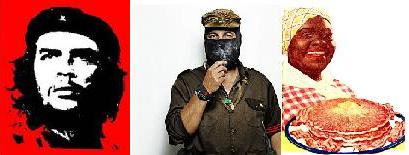
Said to be responsible for a million European tourists a year, it’s no wonder Rafael Cal y Mayor, Secretary of Tourism for the State of Chiapas calls Rafael Sebastián Guillén Vicente, the best public relations the state could have.
Guillén is a rather surpring figure to represent the south Mexican state best known for its Mayan culture. The son of a Spanish-immigrant Tampico furniture store owner and brother of Tamulipas Attorney-General Mercedes del Carmen Guillén Vicente, he studied philosophy at UNAM, and worked in Tamalipas for the PRI before crafting a new career as spokesmodel for Zapatista®-Brand Revolutionary Politics.
Of the four million mostly European visitors who come to Chiapas every year, a full quarter of them mention Zapatista®-Brand when making their travel plans. For most of these tourists, Guillén’s “sub-comandante Marcos” persona IS Zapatista®-Brand’… raising him to that rare pantheon of models who ARE their product: What Argentine pathologist Ernesto Guevera did for tee-shirts and Kentucky cook Nancy Green did for pancakes, Guillén — and his ski-mask — do for the State of Chiapas.


 mexfiles.net