Keep smiling, pretty boy
“I’m announcing my retirement because I’ve been doing this since I was five years old and it’s just the love of my life for boxing is my passion and it was what I was born to do. And when I can’t do it any more and come in at the highest level, it’s not fair to me, it’s not fair to the fans, and it’s not fair to nobody. I’ve come to the conclusion that’s it’s over.”
— Oscar de la Hoya, announcing his retirement from professional boxing. De la Hoya turned professional at the age of 19, after winning a gold medal at the 1992 Barcelona Olympics. Since then, he has fought 32 bouts, and held 10 world titles in different weight classes.
While a few fans have carped that the Golden Boy should have gone a few more rounds, De la Hoya just hasn’t been at his best the last few fights, and at age 36… his boyish smile and most of his brain cells are still intact, but his left hook just isn’t what it used to be… it’s time to hang up his gloves.
David A. Avila, at The Sweet Science has a review of de la Hoya’s career and his emotional retirement announcement. Even boxing fans who never were in de la Hoya’s corner were a bit saddened by the news. “The Roast” commented:
Back when we all were younger, I was pretty angry at Oscar for beating up on one of my heros and yours, Juilo Ceasar Chavez. I thought keep smiling pretty boy, some day a younger, bigger, stronger fighter will come along and you’ll get your’s and I’ll be there to watch. Well since then I’ve learned that that’s the way boxing goes. A younger guy always comes along and beats your hero. As fans we could have done a lot worse than Oscar De La Hoya. So long Champ.
Nobody write like a virgin anymore
Danielle Steel, who has written a measly 79 novels, is a slacker compared to María del Socorro Tellado López, better known as Corín Tellado. Steel is a slow writer, though capable of multi-tasking, reportedly taking two years to finish a book. Or, maybe sex slows her down (writing about it, I mean… I have no idea what Ms. Steel does in her personal life, or even if she has one). Since 1946, Tellado turned out a minimum novels a week — often hinting at the possibility of, but never doing, the deed.
No one seems to be sure exactly how many novels Tellado wrote … well over 4000. They were simple stories. Girl meets boy, girl almost loses boy, girl snags boy… with the plot twist that the girl remains a virgin. Her last work was finished two days before her death last week… which means she probably had time to at least knock out a chunk of the next one.
These were not literary masterpieces, nor meant to be. Unlike world-champ romance writer, Barbara Cartland, who could only pull off the trick of presenting virginal heroines by using a historical setting, Tellado was noted among romance writers for using a contemporary European setting. At least for the first half of her career, a virginal heroine was believable, being set in Francoist Spain. As time went on, and her Latin American readership grew, the stories were a bit more, shall we say, racy. In a nice, convent-educated way.
That’s not to denigrate Tellado. While her plots and characters were, of course, predictable, Tellado has carved out a niche in literature. She basically invented the contemporary romance novel, which, according to Wikipedia (about as far into researching this field of literature I’m willing to go), has only been considered a genre since the 1970s.
This makes Tellado a true pioneer in the field, one reason she was praised by more “literary” writers, like Peruvian Mario Vargas Llosa. Though perhaps not on the cutting edge of literary style, Tellado kept up with the changes in her readership. Following Franco’s death, when Spain was rapidly catching up with the rest of the world in mores and manners, the author produced a series of erotic novels, protecting the “Corín Tellado” brand by publishing under the English sounding pseudonym “Ada Miller Lewsy”. Tellado also wrote probably the first Spanish-language internet novel, Milagro en el camino (2000)
As a Spanish-language writer, Tellado’s only competitor, when it comes to readership is Miguel Cervantes… but then, he’s required reading everywhere Spanish is spoken.
Anahí got her gun… where?
Anahí Beltrán Cabrera was pulled over yesterday driving her Chevy Cheyenne pickup with a slightly irregular accessory — an anti-aircraft gun capable of firing 800 rounds per minute and a range of 1.5 Km.
The misleading Associated Press story meanders off into talking about Guatamalan civil war relics, suggesting the weapon (other than being an anti-aircraft gun of a type not used by the Mexican military, press reports had no other description than “gun”) somehow was smuggled the 36 hours up from the nearest Guatemalan border crossing, along with the two Barrett 50-mils, the Browing machine gun, the Barrett AR-50 and 29 cases of various shells and bullets. Why is it more likely that Ms. Beltrán — a resident of Santa Ana, Sonora and pulled over in that city six or seven hours an hour* south of Nogales, Arizona, and in a Chevy Cheyanne with Sonora plates probably acquired her accessories a bit closer to home than Guatemala? Santa Ana is where the main north-south highway (15-D) to Nogales meets the Highway 2 running up to Tijuana.
Anahí is undoubtedly a sweet, innocent girl who just needed a little something to fend off unwarranted attention from brutish males. A nice family girl… the family believed to be the Beltrán Leyva’s, whose family values include torture and mayhem on only a slightly smaller scale than the infamous Texas Bush family.

Accessories for the modern working girl. Photo: NOTIMEX
* Silly me… I meant 60 Km, and wrote 6 hours. Not sure who it was who caught this, but thanks.
¡¡¡GUÁCALA!!!!
Mix together cajun sauce, cheddar cheese, meat taco and beans and what do you get? Stereotyping only slightly less annoying than corn-chip stealing banditos:
To Amazon boycotters
For those boycotting Amazon.com either because of perceived censorship (and cover-up) or because they think Kindle prices are too high:
Gods, Gachupines and Gringos is available (as are Editorial Mazatlan’s other books) in the United States and Mexico direct from the publisher. (e-mail: publisher@editorialmazatlan.com) and in Mexico at: Read more…
Midde-aged women go wild

One of the weird Sábado de Gloria traditions, which are an excuse to break the Lenten solemnity a bit early, are water fights between housewives. With water rationing (both to recharge the dangerously low reservoirs and to repair the water system) in Mexico City, the police have been arresting people for wasting resources. While most arrests have been of people doing things like washing their cars over the three day water suspension, these Wet n’ Wild women went off to be “socially readapted” for a couple of hours… and dry out.
(Photo: La Prensa)
Bye-bye Blackhawks? Bonjour, Cougars
Although U.S. arms imports are a touchy issue in Mexico right now, last month, Secretary of State Hillary Clinton vowed financing for US-made Blackhawk helicopters on top of a 1.4-billion-dollar US plan to help train and equip Mexican anti-drug forces, which still needs to be approved by Congress.
However, when it comes to funding the Mérida Initiative, the U.S. response has been “manaña”. Initially, the Merida Plan called for 500 million dollars in logistics and support, which was scaled back, and then never delivered. Hillary Clinton finally, last month, agreed to sell Mexico (or rather, transfer funds to Sikorsky aircraft) for a couple Blackhawks, to be delivered… whenever. There is no guarantee the budget item will make it through Congress.
In the meantime, the Mexican military helicopter fleet is aging. Almost unnoticed outside Mexico (and I didn’t pay much attention to it either), Nicolas Sakorzy made a state visit just before Clinton. Media attention was focused on Sakorzy’s request that a French woman, serving time here for kidnapping, be repatriated to France, but little was made of the French President’s main objective… drumming up business for his country’s industries.
SEDENA (Secretaría de la Defensa Nacional) says they need helicopters to continue the “drug war.” The might (or might not) get Blackhawks from the United States. Going back to Porfirio Diaz, the Mexican military has always bought a basket of armnaments from different foreign suppliers — partially to avoid being at the mercy of any one nation’s foreign policy, and partially because Mexico really doesn’t have all that much need for military hardware, and it tends to buy in fairly small quantities. The army has Polish tanks and the navy has Russian fighter jets, and it looks like its getting … not the three or six Blackhawks, at some time… but six EC-725 Cougar from the French company, EADS/ Eurocopter, to replace its fleet of difficult to maintain Russian built MI-17s.
I don’t think new attack gunships is going to “win” any war on drugs, but I’m not sure the Mérida Initiative is really designed to do that, any more than Plan Colombia is designed to really wipe out cocaine production in Colombia (which has gone up since “Plan Colombia” started pumping weapons and “advisors” into the South American nation). It’s about sales and marketing .
Honest graft
I’m always amused (or bemused) by those yearly reports from accounting firms (they used to be underwritten by Arthur Andersen, which knew something about how to define corruption) that claim Mexico is “corrupt” compared to other major economic powers. I guess corruption is in the eye of the beholder… being defined as relatively poor people extorting money from other relatively poor people, and not rich people doing it to everyone.
The law, in its majesty, makes it a crime for the rich and the poor alike to sleep under a bridge. And to pay a few hundred pesos to a policeman. Paying a few hundred thousand to a congressman though… that’s an investment!
 As David Sirota notes, it’s not corruption, it’s an investment opportunity:
… you probably didn’t hear about corporate America’s newest sure thing: a path to financial freedom far more reliable than any decent-paying job. It’s something so old-fashioned that even amateur investors can understand it!
It’s called graft — a surefire wealth creator that takes your investments, modifies laws and delivers returns that the best stock trader could never dream of! …
In the last decade, the financial industry’s $5 billion investment in campaign contributions and lobbyists resulted in deregulation, which generated trillions for executives. And when the bubble burst, there was another boatload of free money! By Bloomberg News’ account, $12.8 trillion worth of taxpayer loans, grants and guarantees — all to Wall Street!
But wait … there’s more!
The Associated Press this week reports that “companies that spent hundreds of millions lobbying successfully for a tax break enacted in 2004 got a 22,000-percent return on that investment” — $100 billion in all. That could be you!
Of course, the secret is investing heavily in specific political stocks.
… it’s perfectly legal!
That, of course, makes it OK.
WWWD? (What will Washington Do?)
Today’s The [Mexico City] News:
A forum on the regulation of cannabis begins on Monday at the Chamber of Deputies and organizers promise to give a hearing for all points of view, including those promoting legalization.
Forum participants will include politicians, academics, Supreme Court justices, military officials, Interior Secretary Fernando Gómez Mont and Attorney General Eduardo Medina Mora.
The idea of overhauling Mexico’s marijuana laws has gained some traction as the war against narcotics trafficking cartels and organized crime has claimed more than 9,000 lives since December 2006. Congress previously approved the decriminalization of drug use in the spring of 2006, but then-President Vicente Fox vetoed the measure after U.S. authorities complained.
Ghost busters at the Summit of the Americas
The Summit of the Americas, coming up April 17 to 19 in Port-of-Spain Trinidad and Tobago on April 17th to 19th will be nothing but Cuba, Cuba, Cuba, according to the Economist. Which will not be present.
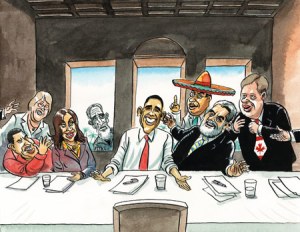
Peter Schrank in The Economist
The real ghosts in Port-of-Spain are not the Castro brothers… nobody believes in ghosts anymore, and no one pays any attention to the ghost-busters of Washington. What scares everyone, and won’t be talked about are the demons: guns, money and drugs.
When not talking about the Cubans behind their backs, a few other pertinent inter-American issues MIGHT get a hearing, but
… this will not include any commitment from the United States to lift its tariff on Brazilian ethanol. Many Latin Americans would like to rethink the “war on drugs”, which they see as failing. Instead, there may be talk of beefing up anti-drug aid to Central America and the Caribbean, because of evidence that Mexico’s crackdown on drug gangs is driving the trade to neighbouring countries.
In other words, the Summit of the Americas is a nice beach-side get-together in which Barack Obama — with admittedly better manners than the last White House resident — dictates what inter-American policies are, and are not, to be considered relevant.
Manuel Pérez-Rocha (Foreign Policy in Focus, via Upside Down World) has his hopes (and end to the Security and Prosperity Partnership, a renegotiation of NAFTA, more respect for indendent political action within the Americas). Quite rightly, he notes that the Security and Prosperity Partnership never did come together, but is more likely to be expanded under more salable names than ended:
…the SPP wasn’t going to perform as advertised to provide more security and prosperity to “North American” people. What better proof of this than the failed war on drugs in Mexico that took about 6,200 lives in 2008 alone? The SPP has failed also thanks to the opposition of a wide array of civil society groups in the three countries — Canada, the United States, and Mexico — that denounced its secret dealings.
This apparent victory of civil society groups hasn’t eliminated the need for skepticism, however. Wholesale change won’t happen without further struggle. Economic, corporate, and military interests remain largely the same, and militaristic and deregulation initiatives are well underway. First among them is the Mérida Initiative with which the United States is providing military hardware to Mexico. This program, while intended to fight drug traffic, is much more likely to exacerbate violence, since it doesn’t address structural problems like widespread corruption, deficiencies in Mexico’s police and judiciary system, arms smuggling from the U.S. into Mexico, or money laundering.
Those “civil society” groups frankly aren’t very effective, and haven’t altered the reality. There are a few groups working on single-nation issues (like immigration enforcement abuses in the United States, or civil rights in Mexico, or the labor violations of Canadian mine operators), but no coordinated, or even “apparent” victory of civil society groups.
While Latin America has changed, partially in response to the “with us or against us” rhetoric from the previous U.S. Administration, Obama’s non-confrontational style won’t change much. It seems the present U.S. Administration at least offering to make some changes (a few controls on gun exports to Mexico, for example), but nothing substantive.
The Obama Administration has been backing off on the gun issue lately, and even supported the G-20 in not taking any real action against money laundering (notice that none of the countries with substantial British and U.S. investments were even talked about — it wasn’t commonwealth countries like the Caymans, or British dependencies like Jersey, nor popular money laundering sites like Panama, that were singled out for corrective action… it was Uruguay and the Philippines).
If you don’t think all these are connected, think again. Al Giordino (Narco News) hit on the real reason the Washington would rather chase ghosts:
… a peaceful and democratic revolution has occurred in much of Latin America during this time period. Only two major powers in the region drag their feet: Colombia and Mexico, coincidentally the two nations where US-imposed drug policies have wreaked the most havoc, violence and criminal enrichment from the mouths of the poor.
And, purely by coincidence, Colombia and Mexico are the two nations where the U.S. is making a killing exporting firearms and sending laundered cash. And, also by coincidence, the two countries where a military solution to the narcotics export “problem” by rightist administrations. And, which have governments receptive to “Free trade” agreements with the United States.
About about all that… nobody is gonna say “boo”.
Deliver us evil
 On Holy Saturday (Sábado de Gloria), Mexicans remember that ultimate sell-out, snitch and all round baddy, Judas. The Bible says that Judas went out and hanged himself after ratting out Jesus, and presumably did that the day after Jesus was crucified. So… while the Spanish sometimes still put up very realistic (and gruesome) representations of a hanged man, the Mexicans (and other Latins), who like to mix and match their religious images anyway, give Judas horns and a tail, and you literally “beat the devil” before he’s set ablaze. Yeah, it’s got it’s religious side (as in “Deliver us from evil”), but “evil” takes many forms in our world, and with so many evils in this world, it’s hard to pick just one.
Besides, you can’t really defeat evil, but you can mock it. And mockery is what the Judas burning is all about. And, it’s an excuse to drink beer and party while sorta-kinda acting religious.
The Judas at the left, from Monterrey, is dressed as a bureaucrat from the Water and Sewage Company, which isn’t real popular in this fellow’s neighborhood.
I was at an Nahuatl-language Judas burning where one Judas was shooting up, and another was labeled as the AIDS virus. In Mexico City, Uncle Sam (clutching his ill-got gains) is popular, as is Andres Manuel Lopez Obrador, Felipe Calderon and Esther Elba Gordillo. Global Warming Judas is a good seller this year.
One Judas-maker (there’s an artisan for every popular art form, and the Judases are basically pinatas, without candy) had an order this year for a wife-beating Judas. Who after being beaten (by wives) this Judas will, like the many Judi (Judases?) be set ablaze to cheers and jeers.