All they are saying… is give violence a chance
The annual Tlatelolco Massacre memorial march… usually the rationale for attacks against the state, state repression, a few deportations, and numerous arrests and property damages in the millions … was held this week, resulting in… a few broken windows, a handful of arrests, some grafitti washed off buildings within hours, a handful of arrests and three hospitalizations for minor injuries. A relative success, all told.
But, given that the annual event is commemorating state repression, and on-going resistance to the state… when the state is on the side of the people, the opposition is forced to oppose… I don’t know what to call it… a failure to repress?
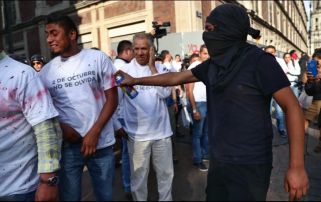
Provocateur not getting his way.
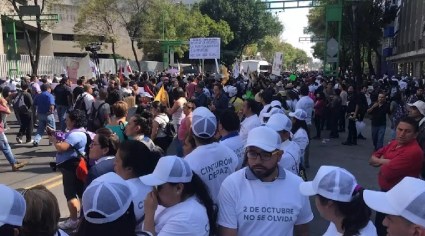
What kept the mayhem to a minimum was savvy planning by the Sheinbaum Administration, and a change in attitude towards public demonstrations. Civil servants and volunteers made up a 12l strong “Peace belt” lining the streets. Dressed in white tee-shirts, as official escorts, this sent a signal that the Administration was not opposed to the demonstration and, as “eyes and ears” probably discouraged the more opportunistic wannabe looters and vandals any large demonstration will attract, while also providing some security from the “black blocs”.
Whether, as governments in the past, and even now, contend, the “black blocs” are “anarchists” or… as seems to be the consensus (especially on the left) are anarchists being used (or paid) to provoke an confrontation. the purpose has always been to discredit the demonstration in the public sphere, and … if the anarchists do have a cause… it is to create more state repression, hoping to eventually cause a popular uprising against the state itself.
The “peace belt”, standing between the demonstrators and the police… the agents of state repression… for the most part thwarted any effort to provoke violence. Grafittists were most ignored (with plywood or cheap metal barriers around public monuments and historic facades, and… I think brilliantly… the city had sprayed paint-resistant coatings on the most likely targets. As it was, the marchers were followed by a continent of street cleaners, including trucks with power washers, there wasn’t much point in spray can walk-by messaging,
Not to say there weren’t SOME incidents… a few firecrackers and smoke bombs tossed, a couple of fist fights, and the like… but not enough violence it seems to meet the expectations… and HOPES… of the opposition.
 The opposition parties (the former ruling parties) and much of the major media in this country, perhaps in retaliation for the cut in subsidies and advertising revenue under the new “austerity” programs) , has been desperately trying to paint the new administrations as abject failures, and their programs as wasteful and amateurish ventures into “feel good” populism. Given the broad public outcry following the feminist demonstrations a few weeks back in which national monuments (like the Angel of Independence) were vandalized or “tagged”) and bystanders were injured, the opposition had hoped that another major incident would turn public opinion toward their contention that the “4th Transformation” is just as repressive as they were during their too long control of the country. Or… that repression is needed to prevent the threat of… I donno… them losing whatever credibility they still have?
Although the media was able to play, seemingly in an endless loop, the same videos of the same couple of “troubling” incidents (a molotov cocktail being thrown… only reluctantly showing the peace-belters clearing marchers out of the trajectory of said molotov.. and the fireman standing at the ready with an extinguisher… a fist fight, a few taggings) my favorite complaint so far is that a million pesos (or, rather “almost” a million) was spent ot buy the white tees worn by the peace-belters. Even adding in the cost of overtime for the civil servants, the investments in plywood and old laminate roofing around the monuments, and the 87 pesos (about US$4.50) each for the very quickly ordered, printed and delivered peace-belt tee-shirts… avoiding damaged to public institutions, the public, and the right to assembly… it was a bargain.
Crazy AMLO! He’ll save you money!
Socialists are supposed to be big spenders. What are they doing wrong?
For the first six months of the year, despite major increases in Social Security, National Health, welfare programs and the military budget (mostly raises for soldiers, sailors, marines, and airmen/women), the Mexican government UNDERSPENT its budget by 5.2%
 Most of the savings were in discretionary budgets, led by 85% less spent by the Presidency. Admittedly, 40% of the drop was dispensing with the “Estado Mayor”, the Presidential military guard (which included a whole military band, and ceremonial artillery battalion), but even so… along with a 75% cut in spending by the Secretary of Tourism.. The Home Secretary (Secretary of Governance) cut her spending by almost 35% and all cabinet level departments spent less than programmed. The Legislature finally got serious about their ridiculous overhead, cutting their expenses by about a third, and even the judiciary, which fought tooth and nail to maintain their privileges spend six percent less than they could have.
Despite more funding going to what are now called “State Productive Enterprises”, PEMEX and the state electric company, CFE, also cut discretionary spending about five percent.
Aside from discretionary spending, there was a budget increase to pay off the national debt, although spending more now will lead to savings in the future.
Show me the… body?
It’s hard to say whether it is more a Mexican telenovela script, or the usual weirdness one expects to come out of Florida, but the case of the missing body (and death certificate) for José José makes for a welcome break from the usual run of the news.
Presumably, the master of the “slit your wrists” ballads did die last Saturday in Miami, where he was being treated for pancreatic cancer… and under the care of his youngest daughter, Sarita. However, when the late crooners two older children from a previous marriage arrived from Mexico to view their father’s remains… they were nowhere to be found. Although the matter was reported to the local police, and …. absent a death certificate… there is no indication that José José IS dead, with Sarita refusing to divulge further details, one is free to speculate about what’s going on.
Based on vast experience with the doings of the elites… i.e., watching a couple of Telenovelas over the years…. best guess is that, with his recordings still hugely profitable, and having (allegely) signed over his rights to Sarita, the details of the patriarch’s death had been covered up (a la the latest Netflix rich family with squabbling heir drama, “Monarcha”) …. not so much that dying from cancer is scandalous… but that the financial situation is not as cut and dried as we think. Or, that he wasn’t as well cared for as one would expect, and the “dutiful” Sarita has something to hide.
OR…. less Telenovelesque, but certainly in the cut-throat traditions of Florida… José José body is being commodified. His funeral will be a major event sure to draw in massive crowds, and probably televised…. with high priced ad revenues from throughout Latin America. Given the near fanaticism of José José’s fan base, a Florida send-off is a sure money-maker. Videos of his “tributes” are bound to sell well. Were the Mexican children to have custody of the body, the funeral would be one of those semi-state occasions (like María Felix, Carlos Monsiváis, and Gabriel Garcia Marquez — despite being a Colombian — merited). Certainly over the top, with screaming fans cheering on the hearse as it made its way to wherever the remains were to be deposited, but nothing likely to bring in a quick financial return.
Or… maybe it will be an on-going saga, with a secret will, a plot twist, and an unexpected heir. Stay tuned for the next episode.
Is the Inter-American Treaty of Reciprocal Assistance really reciprocal?
The Inter-American Treaty of Reciprocal Assistance, better know in Latin American than the United States, where it is generally referred to by its Spanish initials (TIAR) is one of those post-World War II, Cold War relics the present U.S: administration would like to dust off in their on-going … and so far fruitless… attempt to force though a “regime change” in Venezuela… and possibly elsewhere.
Signed on September 2, 1947 when the threat of pro-Nazi regimes taking over various American states was was still fresh in the minds of the various American leaders, it was a perfect “Cold War” pact… a weapon to be wielded against any country that stood in the way of U.S: dominance in the region. In addition, the TIAR served as a mechanism for training and propagandizing Latin American military personnel. It was first used in 1961, to justify the invasion of Cuba.
The Bay of Pigs Invasion was a spectacular bust, but it was the rationale for an economic blockade that has lasted to this day. TIAR was ignored when pro-US dictators, such as Augusto Pinochet in Chile and several others tortured and murdered civilians. A similar agreement with the Caribbean nations was used in 1983 to justify the US invasion of tiny Grenada.
That the United States is now turing to TIAR to justify moves (so far limited to sanctions) against Venezuela, and making references to TIAR when it comes to other left-leaning government like that of Bolivia, as well as other Latin American nations that are looking to China, India, or Russia for markets and military/economic ties, shouldn’t be a surprise. Growing economic instability in the United States has led to a belief that the country is facing more and more internal and external threats.
But how much bite does TIAR have? Mexico never signed on to the Cuban sanctions (due to long-standing economic and cultural ties to the island country) and withdrew officially on 6 October 2002, ostensibly in protest of the United States’ refusal to block an execution of a Mexican citizen in Texas, but also because of U.S. and British pressure on Mexico’s United Nations delegation during Mexico’s tenure on the Security Council during the build up to the US-British-Spanish-“coalition of the willing” invasion and occupation of Iraq. By 2012, Bolivia, Cuba, Ecuador, and Cuba had also abrogated the agreement.
If you read the agreement, you will see that the signatory members are obliged to inform the UN Security Council about possible threats to the area. But as is well known, the United Nations, and two of the five permanent member states of the Security Council has not recognized Juan Guaidó as president of Venezuela… a country which abandoned the treaty years ago.
If there is a threat to the region, it is the arbitrary move by the Trump administration, and the Colombians, to encourage Colombian guerilla bands to break that country’s peace accords. The United States, for its part, hoping to use TIAR as a rationale, hopes to provoke a war in Latin America without being accused of fomenting it. In addition, the TIAR served as a mechanism, as training and training of US armies.
If the United States has not been able to dominate all of Latin America, perhaps we should not forget that this empire crashed against Vietnam and also with China in the Korean war, and could not avoid other wars in Asia and various parts of the World.
With the United States’ economic and political objectives so painfully obvious, Mexico is beginning to wake up to the danger it faces, with 80% of its exports depending on United States markets, and the US able to twist the arms of the Mexican administration to make decisions more favorable to US interest than to their own.
Although the present (evolving) Mexican immigration policy is widely and correctly seen as dictated from Washington, Foreign Minister Ebrard has been talking about the need for better relations with the rest of the world, and diversifying economic and political relations. None too soon.
(Largely plagiarized from Antonio Gershenson, “El TIAR, hoy para Venezuela, como antes fue la OTAN para EU” Jornada, 29-Sept-2019)
The voices we need, not the voices we want
Tú no puedes comprar el viento
Tú no puedes comprar el sol
Tú no puedes comprar la lluvia
Tú no puedes comprar el calor
(Calle 13, “Latinoamérica)
The leadership of the broadly diverse movement against climate change should not depend on a single political actor. Partnerships with very different groups of politicized people are needed, but when it comes to decision making, often there is a tendency to heed only one type of speaker.
People fighting against the destruction of ecosystems and territorial dispossession have existed since the Conquest. In our time, dubbed “environmental defenders,” indigenous women and men who defend their territories in Latin America face a high likelihood of being crime and murder victims, as well as being at a disadvantage in resources and media attention. In the same UN forum where Greta spoke on Monday, only a single indigenous person, a Shuar leader from Ecuador, was allowed to speak… for two minutes. Raoni Metuktire of the Kayapo of Brazil was stopped by event security when he attempted to enter.
The necessary role of the indigenous in the climate movement is not simply a matter of superficial inclusion, but the introduction of such crucial demands for their collective rights to the land, as well their valuable contributions to discussions of alternative ways of thinking about our relationship to the natural world and systems of production. “Green” solutions can be so diverse that they veer into the danger of justifying territorial dispossession in the name of conservation… as has already happened.
The necessary meeting and joint work between the youth movement for climate change and organized indigenous peoples with a long history of territorial defense is a key part in the struggle.
(Orignal post, in Spanish, by Tania Daniela Gómez Perochena)
Eternal rest? Some restrictions may apply.
 Porfirio Díaz died 2 June 1915 in a Paris hotel. At the time, it still was not clear who would consolidate the Revolution, and how whatever state emerged would view the late dictator. His widow, Carmen Rubio, planted her late husband in a local churchyard. With the Revolution pretty much settled by 1920, Doña Carmen decided to return to Mexico. She was welcome to return as a private citizen, but could hardly expect a dead hero’s welcome for Don Porfirio. And, besides, lugging a corpse around — as Juan Peron was to discover with Eva (who had three or four burials, a corpse-nabbing or two, and was in the back room of a union hall for a couple of years, not to mention a stay in Peron’s living room during his Spanish exile) — does complicate travel plans. So… in 1921. having decided that Montparnasse Cemetery had the right cachet for a dead dictator (though what fellow resident Charles Baudelaire would have thought I can’t say) and built the mausoleum still visited by those mourning the 19th century’s “essential man”.
For now, anyway. Perpetual rest doesn’t mean forever… it means 99 years. Porfirio may have expired back in 1915, but his burial site’s lease expires next year.
There has been some talk (mostly just talk) of moving the body (or… whatever is left of it) back to Mexico, but so far, just talk. His descendants, which incidentally include Prince Albert of Monaco, could renew the lease. Or, have his bones cremated and pressed into an artificial diamond… or sot into space.. or….
Where better?
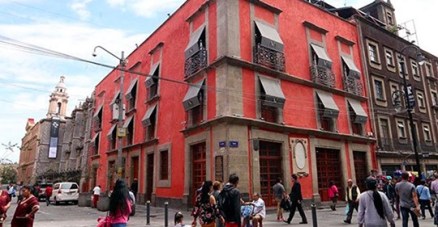
Casa de los Campanas, Licenciado Primo de Verdad número #10, Centro Hístorico
With Leonora Carrington’s former home and studio being renovated as a museum, the English-born Mexican artist’s works are to be housed, temporarily at the “House of the Bells” in the Centro Hístorio. Considering the building is the site of the first print shop, and the home of the woman editor and publisher, somehow I think Carrington would approve.
Pablos, like Carrington, was a double emigre. Born Giovani Paoli, he had emigrated to Spain to work for a Dutch firm with a contract to the Church. When Cronberger signed a contract to provide printing in the Americas, Pablos, who was about 40 at the time, made the arduous journey, settling in and marrying a Mexican, Geronima Gutierrez. She, and later her daughter, Maria de Figueroa acted as editors, and after Pablos’ death in 1560, as publisher. They expanded the business from simply Church related material (including Spanish-Nahuatl dictionaries) and government documents to include literature. One of the other may have been the ghost writer of the first novel in the Americas, “The Lieutenant Nun”… the supposed autobiography of Catarina de Erauso, the runaway nun who lived as a man, working as a mercenary and hitman, and later as a mule-skinner in Mexico.
Carrington, like de Erauso, had escaped a convent. While never a nun, as the “problem daughter” of a wealthy English family, her surrealist art was unappreciated both by her family, and by the English public. Moving to France, she lived with Max Ernst until he abandoned her (not so much he was a cad, but that the Gestapo was after him, and he married American art patron Peggy Gugenheim to obtain US residency). Carrington’s family swooped in, and to get her out of Vichy France, popped her into a Spanish mental hospital run by an order of nuns. Escaping out a bathroom window in a plot organized by her friend Pablo Picasso and a few others, she was whisked across the border in Portugal, hurriedly married to Mexican poet and diplomat Rene le Duc, and found a home in Mexico where her art was finally appreciated, and she would enjoy a long and successful career as a sculptor, painter, and novelist.

A different drug war
Met by the Secretary of the Treasury, the Undersecretary of Health, and a Deputy Secretary of the Navy, a French cargo plane’s arrival is being hailed as the first victory in AMLO’s own “war on drugs”.
The French plane was arriving with a load of methotrexate, used in the treatment of some cancers, emblematic of the administration’s changing economic policies.
During the Salinas Administration (December 1988 to November 1994) the prevailing theory, as in most of the world, was that privatize state functions where it was felt that the marketplace would create an incentive for better decision making and distribution. Like with pharmaceuticals.
With three different and competitive pharmaceutical distributors controlling about 70% of all drug purchases in Mexico, and a very competitive private pharmacy industry, coupled with price controls for medication, drugs are generally much lower priced in Mexico than in other countries. In addition, Mexico has a large pharmaceutical industry (subsidiaries of foreign manufacturers) of its own.
However, there are shortages, and the public health system, IMSS, has long been the focus of complaints about service and about the availability of necessary medication. The market for methotrexate is extremely tiny, but being used to treat children with cancer, its availability (or lack of availability) is a hot button issue. Justifying denying cancer treatment to children is not a winning political issue, no matter how much financial sense it might make. And, turning around IMSS which has been losing money for years, while expanding the public health system is a winning political issue.
By-passing the usual channels, the President, on his own authority, ordered methotrexate through a French source, and has launched an attack on the private distributors, claiming they are holding back certain medications, and over-charging for some products. Insulin, sildinifil (VIagra), xanax and other common prescriptions and over the counter drugs might be so widely available that pharmacies advertise sales on them, but try getting some special medication or a specific antibiotic in a rural community, or at a reasonable price.
Admittedly, the printed maximum price on any pharmaceutical is usually much more than one actually pays (just looking at a pain reliever I was prescribed, the maximum price is 57 pesos but I think I paid something like 30), it appears that the public health system is paying the full price, I can’t see what incentive the distributors would have to holding back medications, other than wanting to discredit expanding the public health system to the detriment of the private system… which would require collusion. Whether going directly to a foreign source to alleviate a temporary shortage or whether it is a sign that the government intends to change its policies, and de-de-nationalize some economic sectors, the administration has found a “winning” issue.
Holy Smokes!
With the explosion of shipping between old and new Spain, by 1530 there was already a need to resupply ships arriving in Mexico. Sailcloth was in huge demand. Hernan Cortés ordered Juan Cuadrado to begin planing hemp. Although there had always been some medicinal uses for hemp as well, by 1531 Cuadrado was starting to worry that the indigenous workers were finding some ritual or other use for the plant. taking the leaves home to burn or … perhaps to smoke. Something strange was cetainly going on, and the workers were rather cagey about it, and it seemed to be something of a joke to them. Whatever it was, it seemed rather “pagan” to Cuadrado and he brought his concerns to Bishop Zummaraga, who generally tolerated the customs of the “new Christians” as long as they didn’t directly contract Catholic teachings. As long as whatever those indigenous people were doing wasn’t some religious act he wasn’t soo concerned, but he recognized a business opportunity. The monks were better suited to keep an eye out for “unchristian” practices than Juan Cuadrado’s overseers, and besides, the missions needed a regular cash crop to support themselves. That the monks expected the “mission Indians” to start dressing in European style clothes (or, in some places, at least start wearing clothes), there was a need for cheap cloth anyway. Growing marijuana could be God’s work, and as an added bonus, ease the indigenous farmers into the cash economy. Zummarga dispatched marijuana seeds by the thousands to the missions, laying the groundwork for a still thriving industry, albeit one depending less on the needs of what was at the time the world’s largest navy, and having more to do with what it was that made Cuadrado’s field hands giggle.
Whatever it is, they’re against it
Translated from “Morena se ha convertido en el partido de la muerte: FNF” (Rodrigo Vera, in today’s Proceso)
MEXICO CITY (proces.com.mx) .— Waving banners reading“no to abortion” and “no to same-sex marriages”, demonstrations in 100 Mexican cities took place Saturday, organized by the National Front for the Family (FNF for it’s initials in Spanish).
The objective of the demonstrations is to prevent state legislatures around the country from passing bills that would ease abortion restrictions or bring laws regarding same sex marriage into conformity with the Constitution.
In Mexico City about 500 protesters marched from the Monument of the Angel of Independence to the Monument to the Mother, while chanting: “LIfe yes, abortion no!” and “Listen, President! LIfe defends itself” (it rhymes in Spanish) and “Mother and father. Original design” (presumably expressing opposition to adoption by same sex couples)
Demonstrators carried the Mexican flag, banners with the image of the Virgin of Guadalupe and placards reading among other things, “A human fetus has the same value as an adult”, “Gender ideology harms children”, “all life is worth”, and “We do not vote against the family” .
Women wore blue scarves, meant to symbolize their struggle for the life of the unborn. Other protesters carried rosaries in hand, praying as if they were on religious pilgrimage. Among the demonstrators were nuns in their traditional habits.
FNF leader Rodrigo Iván Cortés, interviewed by APRO, said that marches were held in about one hundred cities in the country, including the capitals of the 32 states. According to Cortés, “about 200 thousand people participated”.1
The main objective of the demonstrations, he adds, “is to reject the bills that currently under consideration in state congresses that are aimed at decriminalizing abortion and legalizing same-sex marriage.”
He points out that currently there are iniatiatives in 23 state congresses to decriminalize abortion, while 14 states are looking to legalize gay marriage. Hence, their claims are directed primarily at local and federal legislators, but also at President Andrés Manuel López Obrador.
The FNF president claims López Obrador’s policies are”contradictory”; on the one hand, Cortés says that AMLO claims to be defending the family, as evidenced by his references to the Cartela Moral in his speeches, but at the same time promoting abortion and same-sex marriage.2.
For Cortés, Interior Minister Olga Sánchez Cordero is the main driver of these measures in the lopezobradorista government, which leads to his conclusion that, Sánchez Cordero, as a party leader has made Morea the “party of death and gender ideology.”
He regrets that “to the deaths that the fight between drug cartels is leaving, the deaths of the unborn, of the most defenseless beings are being added. In Mexico we live a culture of death”.
He adds that the FNF is preparing for a larger national march and that the group plans to picket outside the National Palace during the President’s Monday morning press conference, bringing together hundreds of organizations from around the country, with the support of the Conference of the Mexican Episcopate (the Catholic Bishops’ Conference).
1 Without independent verification, it wouldn’t be possible to estimate the actual number of marchers, or marches, throughout the country. A demonstration attracting only 500 people is a very small one for Mexico City, and normally demonstrations favoring popular causes turn out a half million or more people.
2. The Cartiila Moral (“Moral Primer”), written by Mexican diplomat and philosopher Alfonsa Reyes shortly after the end of the Second World War was an attempt to define, in a simple, readable form, the moral and ethical duties of a citizen and the state. It says nothing specific about abortion or marriage, although it does mention respecting cultural traditions among the seven stages of respect (for self, for the family, for the community, for the culture, for the state, for humanity, for nature, for the planet),
If you can’t beat em… don’t beat it
I believe it was Molly Ivins who once described your average state legislator as having an IQ roughly equivalent to that of a parking garage. She, of course, was speaking of state legislators in her own country, but we have our share of them here, too. “Right to Life” activist and National Action (PAN) Party deputy in the Queretaro state legislator Elsa Adané Méndez is best known for her opposition to any attempts to decriminalize abortion in her state, and for opposing a proposed amnesty for minor criminals and indigent prisoners that would liberate some women (mostly indigenous women who, not speaking Spanish, or not having the money to hire an adequate defense) have been imprisoned under various state laws sanctioning abortions.
While abortion decriminalization (or rather, opposing decriminalization) remains a viable political issue, and PAN — which as the “Catholic party” finds some support for its “right to life” stance, it has largely lost any shred of legitimacy it ever had as the party of responsible governance. Seeking issues on which it might offer alternatives, it has begun to focus on new and different (i.e., tried and failed) approaches to crime prevention. Crimes against women, in particular.
Ms. Méndéz has come up with a unique approach of rape prevention. According to the legislator“self-pleasure” is a deformation of sexual behavior that could lead to rape.
“Masturbation is the beginning of the deformation of sexual behaviors in human beings, they st touching and stimulating themselves, increasing more and more until it leads to a psychological deformation that leads them to rape women to satisfy their sexual desires.”
So… going to the root of the problem, Méndéz proposes to criminalize masturbation. However, the state deputy’s initiative does not specify whether the proposed sanction (a fine of up to 3000 pesos) would be with the intention of prohibiting masturbation only in the case of men. However, in the interest of justice, it does indicate that to assess the fine, audiovisual evidence of the act must be available, or the perpetrator must be caught in flagrante delicto by a police officer… i.e., caught with his pants down, so to speak.
One imagines a swelling opposition to beat back this proposal. I hate to think of what form a civil disobedience campaign might take.
AMLO-ismos
A tip of the sombrero to Peter Melvoin for passing this along (from APF):
An AMLO glossary
Mexico City (AFP) – President Andres Manuel Lopez Obrador is reshaping the language of politics in Mexico with his colorful, folksy take on Spanish. Here is a glossary of key terms to understand the man known as “AMLO” and his opponents.
– AMLO –
Short for Andres Manuel Lopez Obrador, from his initials; used by both detractors and followers. See also: Peje.
– Camajan –
Used of a lazy person who finds creative ways to live off the efforts of others; frequently applied by Lopez Obrador to opposition politicians or business executives. Cuban in origin.
– Chairo –
A Lopez Obrador supporter; used by detractors.
– Cuarta Transformacion (Fourth Transformation) –
Lopez Obrador calls his government the “Fourth Transformation” of Mexico, putting his presidency on a par with what he considers the three other moments that changed the country’s history:
1) The war for independence from Spain (1810-1821).
2) The Reform (mid-19th century), a liberal overhaul of the country’s institutions.
3) The Mexican Revolution (1910-1920), which overthrew dictator Porfirio Diaz.
– Fifi –
An adjective to describe a wealthy, snobbish person. Last in widespread use during the Mexican Revolution, Lopez Obrador has revived the word as an insult for opponents.
– Machuchon –
Overly luxurious, swanky or expensive.
– Mananera –
Lopez Obrador’s morning news conference, held every weekday at 7:00 am; from a word meaning “morning sex.”
– Me canso ganso –
A comical rhyme popularized by a 1940s film, this roughly translates as: “Or I’ll be a monkey’s uncle.” Lopez Obrador frequently follows up his promises with this phrase.
– Moche –
A kick-back payment or bribe.
– Peje –
A nickname for Lopez Obrador; from “pez lagarto” or “pejelagarto,” a freshwater fish widespread in his home state, Tabasco. See also: AMLO.
– Pejezombie –
Someone who mindlessly follows Lopez Obrador; used by opponents.
– Pirruri –
Used by Lopez Obrador to describe an ignorant wealthy person; coined from the name of a 1970s television character played by comedian Luis de Alba.
– Senoritingo –
A pejorative version of the diminutive “senorito,” or “little mister;” used by Lopez Obrador to refer to opponents he perceives as aristocrats.


 mexfiles.net