Sunday readings: 16 November 2008
Playing both sides of the fence
Dr. Jason Dormandy, who teaches Mexican history (hey… I can recommend a good book) at Stephen F. Austin State University in Texas writes wide ranging “Reflections on Latin America” as in this piece, covering the travel literature of the late Bruce Chatwin, the meaning of mountains and the interconnectedness of the Americas. And music:
Glenn Weyant … plays the U.S./Mexico border fence with a cello bow. And mallets. And sticks. And an egg whisk. I meant it when I said he was an interesting character.
Looking at the fence between the United States and Mexico in Nogales, Glenn set out to overcome this fairly unnatural divide in the landscape and the people with music, and what better music could their be to bring two sides of a fence together than to play the actual fence. Glenn says on his web site that that he wants the listener to ask themselves “What is it I am hearing? Why do these things exist? Who is kept in and who is kept out?” And in the end, his big vision is to change the wall from “an implement of division” into “an instrument of creation with the power to unite.”
How long has this been goin’ on?
Joseph Nevins and Timothy Dunn on the history of the border wall and the immigration “crisis” (14-16 November 2008 Counterpunch):
It is unclear when the U.S. government first began constructing barriers along the boundary, but through most of the 20th century, they were few and far between, located in urbanized areas and often in a state of disrepair and easily breachable. The absence for more than a century of strong physical barriers along the boundary reflects how immigration and boundary enforcement were largely nonissues until relatively recently. Prior to the 1970s, the U.S.-Mexico border rarely received national-level attention. When it did—as around the time of the infamous Operation Wetback in 1954—it was short-lived.
But matters began to change in the late 1960s in the context of a growing conservative-led war on crime and drug use, which pointed the finger at Mexico as a source of illicit commodities. The guest-worker Bracero Program (initiated in 1942) had ended in 1964, which led to the formally legal migrant labor influx (of up to 450,000 workers each year, totaling some 4.5 million over its existence) going underground and a significant increase in Border Patrol apprehensions of unauthorized migrants. Moreover, the deep recession of the early 1970s took place at the same time that the head of the U.S. Immigration and Naturalization Service (INS) launched a highly effective public relations campaign warning of the dangers of unauthorized migration. [1] Together, these developments helped to bring unprecedented attention to the U.S.-Mexico border region and created the sense of an immigration “crisis.”
Could it be… SATAN?
Deborah Bonello, of the Los Angeles Times Mexico City bureau attends a book launch for a new profile of Jorge Serrano Limón, “Mexico’s most prominent Catholic fundamentalist and anti-abortion campaigner” (and one of the masterminds behind Martha Fox’s “Vamos Mexico” campaign — modeled on the Eva Peron Foundation of early 1950s Argentina, though with a much more right-ward political stance than Peron).
…when we arrived, attendees of the event were loitering outside on the sidewalk. “No hay luz,” they explained with a shrug. There was no electricity. Last night, the light was only out in the Centro Cultural de Foco where the launch was scheduled to take place.
The organizers joked that it was sabotage, and friends of the authors reported that cables had been deliberately cut.
But we weren’t put off. At around 5:30pm we all shuffled into the building carefully, guided by candlelight into our seats. We sat in the darkness waiting for the presentation to start.
“Serrano Limón is a fundamentalist who thinks that the modern world is wrong,” stated Roberto Blancarte, a professor and investigator at the Colegio de Mexico and a specialist on religion. The organizers were sitting in front of a black backdrop on which had been mounted a simple, wooden cross.
And then, as Blancarte spoke, the light returned. An electric spotlight suddenly illuminated the speakers, cutting through the darkness like a celestial beam. The audience applauded.
“He epitomizes the right. He summarizes in brief what is a bigger phenomenon,” said Blancarte….
Bretton Woods II
I don’t expect a lot, though it is notable that the second-tier economies (Mexico, Brazil, India, South Africa, etc.) were actually included in the discussions for once. From Mercopress (Montevideo, Uruguay):
The leaders also agreed to evaluate global accounting norms and the financing needs of international financial institutions.
Finally, they have agreed to draw up a list of financial institutions whose collapse would imperil the global financial system.
The plan said each country should act “as deemed appropriate to domestic conditions”, but stopped short of imposing a co-ordinated international stimulus plan.
“If you go through the document you see words like ‘reform of financial markets’, ‘transparency’, ‘integrity’ – it doesn’t really amount to a hill of beans,” John Terret, Al Jazeera’s correspondent in Washington DC, said.
“But what it does amount to is that we have seen for the first time under one roof here in Washigton DC, 20 of the key economic nations in the world. The crucial thing is that the emerging markets – the developing nations – are at the table as well.
“I think that really is an indication of how this crisis is being seen around the world, particularly in America – it’s serious and things have changed.”
Thanks for nothin’
Stewart Powell in the Houston Chronicle on the latest “assistance” from the Bush Administration and the United States government in keeping the narcotics Americans want out of the country…
WASHINGTON — Not a dime of the Merida Initiative’s $400 million in promised emergency security assistance has reached Mexico nearly five months after President Bush signed landmark legislation to help the beleaguered neighbor combat drug smugglers’ murderous violence.
The delays are being attributed to delicate U.S.-Mexican negotiations over measures to prevent corruption and protect human rights, the role and number of U.S. personnel in Mexico, and Bush administration steps to satisfy a series of congressional requirements.
Rep. Gene Green, D-Houston, a member of the House Foreign Affairs Committee’s panel on the Western Hemisphere, expressed surprise when he learned that none of the aid had reached Mexico.
I’m not in favor of the Merida Initiative for several reasons, but a promise is a promise… and this is yet another indication that the U.S. “war on (some) drugs” was never about anything but providing free government handouts to companies like Halliburton and Blackwater USA.
In other words, Bush (and Congress) lied… people died. There’s still no indication that the U.S. is doing squat about gun running and money laundering, and how much longer Mexico can… or should… keep bleeding to prevent the narcos from moving north is more and more in question. Maybe a few heads should roll in Washington… literally.
Latin 101
 If a 28-year old European man lives with his mother, people ask “What’s wrong with the mother?”
If a 28-year old Norteamericano lives with his mother, people might ask “What’s wrong with the guy?”
If a 28-year old Latin American is living with his mother, people say “What’s wrong with that?”
It’s perfectly natural that when 28-year old Roberto Alvarez, a Santiago Chile chemical engineer won a million Chilean pesos in a national contest (about 1600 U.S. Dollars) mom was there to cheer him on… and bask in the reflected glory. The only notable thing about this is that Roberto is the first Mister Gay Chile. (Sombrero tip, and photo courtesy of, Opus Gay — which should win some recognition just for coming up with such a witty name in a country where a radically conservative Catholic Church was able to prevent the country from even passing a law legalizing divorce until three years ago as of next week.)
It’s too much to expect Chile to recognize same sex marriages, though gay couples have limited “civil union” rights, and in the last Presidential election, both the Socialist winner and her conservative opponent were open to gay marriages. Uruguay and Ecuador also offer “civil unions,” as do Cuba, Honduras, a few states in Brazil and the Federal Districts of Mexico and Argentina. Gay marriages performed in the Mexican state of Coahuila MAY be valid anywhere else in the Republic, but there hasn’t been a test case on that. The Federal District (Mexico City) Assembly is expected to take up a bill to allow full civil marriages this session, although naturally, PAN — which seems to be emulating the now-discredited pracitice of the U.S. Republican Party when it comes to making social issues poltical ones — naturally plans to introduce a bill defining marriage as “one man-one woman”.
Chile, Colombia, Costa Rica, Brazil and Cuba (CUBA!) are all considering legalizing same-gender marriages. In the meantime, Roberto’s gonna have to live with mom. And that’s OK.
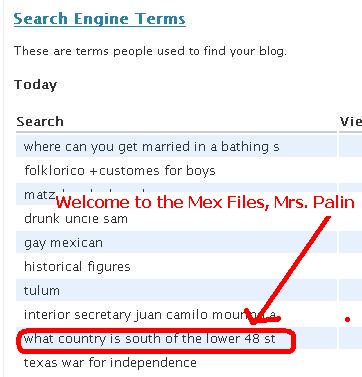
Who needs the Mex Files?
Friday night trucker’s video
A quick plug for Porter Corn (Mexico Trucker) who has been covering border transportation like no one else… and probably is the best border publication available on or off the net. His latest venture is in the world of “cyber-transport” of ideas, suggestions, information, etc. on immigration — “Immigration Clearinghouse”, using a “nofollow reciprocity” protocol designed to give smaller websites more exposure on the web. In other words, a system whereby even posts from the smaller, generally ignored sources, gets a higher page ranking and is more likely to be seen by people searching for information.
Porter’s day job is keeping things moving. And speaking of things moving in Mexico, from Los Felinos…
For family planning Mexico’s the one to watch
Although the Philipines is better known as a former colonial possession of the United States, culturally the Filipinos and the Mexicans are closely connected. From the time the Mexican sailor-monk Andres de Urdaneta found a route from Manila to the Mexican Pacific Coast in 1565 up to the time of Mexican independence, the Philippines were not so much “Spanish” as “Mexican”… the Viceroy in Mexico City oversaw (badly) Filipino administration and Franciscans from Cuernavaca spread the faith. In western Mexico, Filipino ancestry is common, especially in older mercantile families.
While both nations share certain cultural assumptions, and to some extent religious beliefs, one radical difference has been in the official attitude towards birth control . Rina Jimenez-David, writing in the Philippine Daily Enquirer explains the envy Filipino reproductive Health care professions feel towards their Mexican counterparts:
A glaring difference is the status of our national family planning and reproductive health programs. In the Philippines, reproductive health has not only been neglected, the term itself is looked on with hostility by President Macapagal-Arroyo. The family planning program has been reduced to the promotion of a single, unreliable method–the so-called natural family planning–which so far, despite the millions spent on its promotion, is still largely rejected by couples and women. And in Congress, a reproductive health bill is facing stiff opposition from religious conservatives, although a growing number of legislators have been supportive.
* * *
IN CONTRAST, the family planning program of Mexico has been, said Dr. Marco Antonio Olaya Vargas, head of the program at the Ministry of Health, “one of the programs with the most experience” in the country, having been established in the 1970s.
Today, Mexico boasts of 70.9 percent contraceptive coverage for women of reproductive age (compared to about 45 percent in the Philippines). Twenty years ago, said Olaya Vargas, the average fertility rate in Mexico was seven children, and the population growth rate (PGR) was 3 to 4 percent. Today, the fertility rate has fallen to 2.1 per woman, and the PGR is down to 1.9 percent.
“Family planning is a national policy and therefore it is mandatory and must be enforced in all the states (Mexico follows the federal system),” replied Olaya Vargas when asked about the possibility of conservatives in state governments simply refusing to implement the program in their areas. In cases where a local leader imposes his own personal beliefs in the implementation of the program, “we will have to go to that state and investigate, ask them what the problems are and how we can work to solve these problems.” But so far, said Olaya Vargas, “no state has openly said no to family planning.”
* * *
THE INFLUENCE of the Catholic Church, the health official said, “hasn’t been an obstacle.”…
One reason you read (or rather I read, but only because I have to) in anti-immigration and white supremacist propaganda about large Mexican immigrant families is that the immigrants tend to be the very poor who are inadequately served by the Mexican health care system… and, more importantly… because reproductive health care for the poor really sucks in the United States, if it exists at all. The Mexican birth rate has fallen below the replacement level and, even without emigration, the population will start to drop over the next century. Or.. it will have to take in immigrants, perhaps from the Philippines.
Mazatlan’s first tourists
I had an odd incident last week, when I stopped at one of my favored downtown cafes to read “Jornada” and tourist watch. The waiter gave me my change in U.S. dollar bills — something I have no way of spending, and like him, find absolutely useless (the banks don’t want ones and fives… and it’s a hassle to exchange them. I usually end up selling them below the exchange rate to a local business here that informally trades them off with snowbirds heading back north at the end of the season). The waiter wasn’t my usual guy, so I guess it was an honest mistake. And, I can’t blame him… with the annual invasion of the cruise ships right now, the tourists are thick on the ground and running amok in the local market. I have to put up with a few months of “Hey, Meester… what jew look for?” when what I’m looking for is something like carne molida or chayotes — not beads and trinkets.
Ah well… I really don’t much like tourist towns (and geezer towns at that), but I’m here, and tourism has been part of the Mexican economy for some time, making it well worth looking at. The cruise ship season is ramping up a little late, but perhaps the U.S. downturn isn’t going to be the huge disaster many thought. My sense is that the people who could otherwise afford to go to Europe or Hawai’i may be picking up some of the slack, and, being largely a community that caters to the retirees, we are still going to have a certain number of visitors who still have enough disposable income to come down this way… as well as the Canadians, whose dollar has held up well against the peso.
And, being expected while I’m here to “do” a Mazatlan history, tourism is certainly a huge part of that history. Here’s my notes on how the whole thing started:
Mazatlan’s future as a resort community, as well as a business center, probably owes a debt to Queen Elizabeth the First of England. Elizabeth, like other European rulers of the time, had a rather simple view of global commerce (and one still prevalent today): making yourself rich by robbing poor foreigners was perfectly acceptable. However, robbing from your fellow European rulers was – if nothing else – bad form. Piracy on the high seas – stealing the loot your fellow monarchs had stolen from the “New World” was certain to be frowned upon. And, there was no way a reigning Queen could just go out and grab ships – she’d at least need a Navy for that. Elizabeth’s father, Henry VIII had begun the buildup of the modern English Navy, but Elizabeth – a more outward looking ruler than her father – was strapped for the cash she needed to compete against the best royal thief of the era, her brother-in-law, Felipe II of Spain.

Typical Mazatlan tourist, 1579
England hadn’t grabbed any parts of the “New World” worth stealing gold from, and her subjects were loathe to pay higher taxes to support naval expansion, so Elizabeth – with the most patriotic of motives – decided to steal the gold she needed from Felipe. Not that she herself would be going down to the sea in ships. Oh no. Elizabeth was no sailor, and a reigning queen could hardly be expected to run a pirate ship. She could afford a few ships out of her own pocket, and she could convince the nobility to pony up. The only drawback to the scheme was that Elizabeth needed what today is called “plausible deniability” – she couldn’t be known as the proprietor of a pirate fleet. The solution radicalized the world, and changed business forever.
Elizabeth paid the expenses for the pirate ship, and in return was given written documents that could be exchanged when the ship returned to England for “shares” of whatever stolen property was on board. Documents could be kept secret, and as far as the pirates knew, the owner was not Elizabeth and her royal entourage, but a faceless “company”. The English pirates were the first modern corporations.
And the best of the pirates was Sir Francis Drake. On 13 December 1577, Drake sailed out of Plymouth Harbour with five ships, bound for the New World, and some “corporate raiding”. Raiding Spanish and Portuguese colonies in Africa and the Atlantic seaboard of the Americas, Drake lost two ships, acquired another and eventually made it though the Straits of Magellan into the Pacific. He sacked a treasure ship off the coast of Peru and hightailed it north with the Spanish in pursuit. Having shaken off the Spaniards somewhere around Huatalco, Oaxaca. But all that running, fighting sea battles, losing ships and making crews walk the plant was beginning to wear on the employees. It was time for a corporate retreat… or, in naval terms… shore leave.

Typical pirate, 2008
The exact date is unknown, but sometime in April or May of 1579 Drake and his crew sailed into Mazatlan harbor for … SPRING BREAK!
What exactly Drake’s crew did in Mazatlan (they anchored off today’s Olas Altas) is unknown… laze around, take on water, hang out. It’s unlikely the local people tried selling them real estate or time shares. Pirates then, as now, tend to stay out of each other’s way…. a professional courtesy of sorts.
The “magical reelism” of Carlos Fuentes
Although yet to win the Nobel Prize for Literature, Carlos Fuentes (born 11 November 1928) , remains at the top of anyone’s list of major Mexican writers, Latin American writers, late 20th century writers… writers.
Fuentes, like Elena Poniatowska, was the child of a diplomat and spent the first several years of life outside Mexico (Fuentes was born in Panama, not living in Mexico until he was a teenager). Perhaps the foreign childhood was essential to their clear-headed embrace of their people, and their city. La región mas transparente (in English, Where the Air Is Clear) is, as Amazon reviewer “A. Reader” wrote:
Considered by many to be Fuentes’ all-time masterpiece… a roller-coaster tour of post-revolutionary Mexican urban history. It’s all there, from roughneck taxi drivers and prostitues trying to make their daily bread, to bored members of a fading aristocracy, of which only the double-barreled names remain. The novel’s diverse characters meet and unmeet in a bizarre range of social situations, ever-observed by the Spanish-Indigenous hybrid Ixca Cienfuegos. Cienfuegos, a type of Greek Chorus character who watches the ups and downs of the novel’s cast like a mad-scientist doing an experiment, doesn’t hesitate to drop in for a chat to the characters, provoking them to pour out their hearts in sometimes tedious monologues. If you have a basic grasp of Mexico’s history you’ll understand this novel better, although if you don’t know the history, a stack of not too subtle symbols will help you out. … If you want to see how the thinking behind Octavio Paz’s Labyrinth of Solitude would work, applied to a TV mini-series, and have a few days to spare, give it a go.
I would have said “telenovela” instead of “mini-series” — something developed the same year La Region was first published and destined, with their interlocking stories of social class conflicts, coincidence and recurring themes, to be the defining Mexican style of story-telling.
Like La muerte de Artemio Cruz (1962) or the 1999 complimentary novel (featuring some of the same characters) Los años con Laura Díaz, Fuentes writes of the Mexican Revolution and its aftermath — the triumphs, tragedies and ironies of the nations’ always uncertain modernity with a filmmaker’s — or telenovelista’s — eye.
Regrettably only “The Old Gringo” (El viejo gringo) has made it to the big screen, but that novel deals with a minor incident of the Mexican Revolution (the disappearance of Hearst correspondent, Civil War veteran and short story writer Ambrose Bierce) and — probably making Fuentes cry all the way to the bank — was only made because the Italian producers could use well-known Hollywood actors and could deal in Mexican stereotypes. And, two of the three protagonists are gringos.
Gachupines and Gringos have caught Fuente’s eye in the last few years. As a companion piece to a television series on Latin America’s Hispanidad, he wrote El espijo enterrada (The Buried Mirror), his reflections on Spanish colonialism. “His black comedy “Eagle’s Throne” tells the story of a futuristic “war on drugs” with U.S. President Condaleeza Rice resorting to magic to manipulate the election to replace multi-term President Vicente Fox. A 93-year old Fidel Castro still holds power in this novel, set in 2020. In 2006, he wrote “Contra Bush” — which is what you’d expect from a Mexican, though Fuentes is a bit further to the right than most of his contemporaries and the main current of Mexican intelligencia. Like many others, he backed Vicente Fox and the conservative PAN party’s attempts to break the stranglehold PRI had on the presidency in 2000. Unlike the others, he continued to support the Fox administration, though with some distaste, now — as in his childhood — viewing his country from abroad.
Perhaps best able to view his people and his city, like the God Tezacatlipolco, only through a smoky mirror… or though a foggy one. Fuentes lives in London.
Why Associated Press sucks… part ∞
There’s been a recent scandal, covered in all Mexican newspapers (even my local Noroeste de Sinaloa) over the abrupt bankruptcy of Neoskin, a chain of depilation studios. A record number of consumer complaints (mostly for pre-paid services not performed) led to investigation. If I understand my business Spanish correctly, Neoskin (described as “una estructura escalonada”) was a multi-level company, with profits from the pre-sold hair-removal contracts going to the parent company, and losses listed as incurred by the studios around the country, which were listed as a separate company. Guadalupe Garza Martínez, the parent company’s legal representative, is on the lam, after an arrest warrant was issued for “generic fraud.”
What vaguely interested me in the story was that Ms. Garza is also wanted for “despidio injustificado”. Besides cheating all those hairy ladies, Ms. Garza skipped town, having plucked the company (and its clients) for what she could, Ms. Garza skinned the workers… basically, having skipped town with the loot, the employees were unjustly deprived of their livelihood. Specifically, they have been fired without due cause. I thought about writing something about employee rights in Mexico, but there really wasn’t much in the story to interest me.
The Associated Press also picked up the story, and — true to their crappy reportage — didn’t do any more than telephone the Mexico City office for a comment. They did report that the phone was disconnected, which is no suprise…
The company is (er… was) located in Monterrey.
Outsourcing U.S. health care — twice
This is an unusual idea — while people in the U.S. are used to Indian doctors, and some are getting used to the idea of going to Mexico for lower cost medical care, this is the first time I ever heard of combining the two.
From the Economic Times (India):
HYDERABAD: Indian hospital major Narayana Hrudayalaya plans to set up a health city in Mexico that will also cater to patients from the US.
“Our next project will be a health city in Mexico. We may tie up with some American hospitals for this project,” said Devi Shetty, eminent cardiologist and chairman of the Narayana Hrudayalaya group of hospitals.
Shetty was addressing a news conference here to announce the setting up of a health city – a multispecialty hospital with research facilities – in Hyderabad on the lines of the group’s famous facility in Bangalore.
“The health city in Mexico will be a 3,000 to 5,000-bed facility and we are looking for joint ventures,” he said adding that the government of Mexico had requested the group to set up a large health facility.
Sources said the health city would come up either in Mexico City, the capital of Mexico or at Guadalajara, the second largest city in Mexico.
Shetty said the proposed health city would also cater to the requirements of patients from America.
“We foresee healthcare delivery problems in the United States. They also have problems in undertaking a 20-hour journey to India for heart and other surgeries. As Mexico is closer to America, they will find it easy to undergo treatment there,” he said.
The chain of hospitals, which has already built one of the world’s biggest cardiac hospitals in Bangalore and is planning similar facilities in other cities, is reportedly in talks with the US-based Sutter Health for the Rs.10 billion health city project in Mexico.
The Rs.16 billion group, which currently has two hospitals in Bangalore and Kolkata, plans to invest Rs.50 billion over next five years in expanding its operations to six other Indian cities.
There are about 3.75 Rupees to the Peso, or 47.6 to the US Dollar… still, that’s a sizable investment. These kinds of “off-shoring” from India make a lot of sense. While the Indians do have a very good reputation for both engineering and medicine, Indian businesses face two problems: transportation costs (patients from the United States are unlikely to fly half way around the planet, when they can fly a couple of hours to Mexico City or Guadalajara) and the educational system in India turns out stars and barely adequately educated people (at least in Engineering), which leaves a huge middle ground to be covered. Indian software companies have started using Mexican programmers to meet midlevel demands, and I can see where Mexican doctors (whose training is at a par with other North American doctors for the most part) would easily meet the market demands for affordable heath care. Even if the U.S. does finally catch up to what every other country did by the 1950s and implement a national health care system, it’s going to be several years before it comes on line… and, given the way the U.S. does things, it will still be a mixed system that leaves a demand for services like the proposed “health city.”


