Sunday readings: 23-November-2008
Just say NO… and save the rainforest:
Four square metres of rainforest are destroyed for every gram of cocaine snorted in the UK, a conference of senior police officers as told yesterday.
Francisco Santos Calderón, the vice-president of Colombia, appealed to British users of the class A drug to consider the impact on the environment. He said that while the green agenda would not persuade addicts to give up, the middle-class social user who drove a hybrid car and was concerned about the environment might not take the drug if they knew its impact.
Santos said 300,000 hectares of rainforest were destroyed each year in Colombia to clear land for coca plant cultivation…
Of course, Santos blames FARC, and not his own government. No word on the damage caused by the “war on (this) tropical plant. Coca was never meant for intense cultivation, and does leach out the soil. The problem with cocaine’s popularity is a lot of people go into the coca-growing business who don’t know anything about farming, or soil conservation.
Never say never, again…
Professor Juan Cole, an expert on Middle-Eastern affairs, takes a break and goes to the movies.
Marc Forster’s “Quantum of Solace” [is]… a new phenomenon in the James Bond films, a Bond at odds with the United States, who risks his career to save Evo Morales’s leftist regime in Bolivia from being overthrown by a General Medrano, who is helped by the CIA and a private mercenary organization called Quantum. In short, this Bond is more Michael Moore than Roger Moore…
In the new film, Dominic Greene is a secret member of Quantum, a mercenary coup-making consulting firm. That is, it is represented as a private contractor to which the CIA is willing to farm out coup-making instead of doing it directly. Greene’s cover is that of the head of a conservation organization that buys up land in poor countries to ensure it is preserved from despoilment. In fact, he despoils it. In a complicated and not very plausible plot twist, Greene appears to be buying up land under which he is convinced there is oil, but in fact is trying to corner the market on Bolivia’s aquifers so as to overcharge the country for its water after the military coup unseats Morales…
The world really has turned upside down, if James Bond is joining the Axis of Evo. About time.
Say WHAT???
More proof that the average IQ in the Texas Legislature is somewhat equal to that of a parking garage.
… the state rep from my hometown – Leo Berman, R-Tyler – filed an hysterically funny piece of legislation in HB 254, “relating to restricting illegal immigrants to certain geographic regions.”
The thrust of HB 254 made me laugh out loud: It defines the terms “illegal immigrant” and “sanctuary city” and then declares that “All illegal immigrants residing in this state shall reside in a sanctuary city.”
That should be simple to enforce, huh? If writing a law could dictate where immigrants live, would we even have this problem?
Avoiding all discussion of enforcement, HB 254 directs the Department of Public Safety to “adopt procedures to implement and administer this subsection.” That should be easy, don’t you think? Surely there’d be no fiscal note attached to so small a task. 😉
Even funnier is Berman’s definition of “illegal immigrant,” which “means an individual who is not a citizen or a national of the United States and who has entered the United States without inspection and authorization by an immigration officer.”
Watch what you say
Words matter. Jurgen Schuldt, at the (Spanish language) “Memorias de Gregoria Samsa” caught a troubling quote from Peruvian President Alan Garcia about the need to make citizens who disagree with a proposed development project “go away forever”. Otto, at Inca Kola News lays out what exactly was so offensive about the remark:
The idea of “losing someone” in the way Alan theorizes is not just a metaphor in Latin America, dear reader. The word “desaparecido” (disappeared) is feared and reviled from Tijuana to Tierra del Fuego, and anyone with even a rough sense of regional modern history knows that it’s no laughing matter. Speak to the family of a disappeared and you’ll never laugh about it again, I assure you. No matter where, no matter if the regime were left, right, centre, revolutionary, military or (proclaiming to be) democratic. Chile, Argentina, Peru, Brazil, Colombia, and all the et ceteras.
But Alan García, the man who dragged Peru into the depths of economic and social chaos in the 1980s, still dreams of “losing” anyone that opposes him. The man is a danger to society, make no mistake. Under all that neoliberal, investor-friendly image that sits so well with the industrialized nations there’s a really nasty piece of work….
Say it right!
When I was still putting together “Gods, Gachupines and Gringos” a couple of different professors asked for review copies, and my publisher put together … not sure what to call them … “advanced” advance reading copies? Pre-advance reading copies? Cheapo, quickie-print manuscript copies? I was less annoyed with the prof who wanted (er, demanded) that I revise one or two paragraphs to fit his class needs (which I didn’t do, though I agreed to change a word here and there where he had a reasonable, though overly picky argument about a metaphor) than with the guy who complained I wasn’t writing in academic style.
That’s the point. I welcome professors as readers — and hope they buy lots of copies of the book (the publisher gives a 40% discount for bulk academic purchases by the way) — but they don’t have a monopoly on learning. The delays I’ve experienced working with a small Mexican publisher are making me crazy, but better that than a University press which would have edited the thing into a boring text, or dealing with the overly detailed contracts, and endless vetting by lawyers, I’d need to go through with a U.S. company.
So, when I read about people like ran across “Scarlett” — a dyslexic cook taking a history class — I know I’ve made the right decision. “Grace Un-dressed” has absolutely nothing to do with Mexico, Latin America or immigration issues, but the former stripper (thus the title) writes elegantly and … ahem… grace-fully on the real world of the ambitions, hopes and challenges of being poor, but not stupid, in the United States:
“This makes no sense to me,” Scarlett says. She shoves the textbook across the table at me. “I mean, I’m reading it, but I’m not reading it.”
I scan the paragraph she’s pointing at. I can’t say it makes a lot of sense to me either. It’s written in this horrible textbook-ese, all these dry words not quite adding up to information about colonial assemblies in pre-revolutionary America. “I think it’s just saying that — fuck, I have no idea what it’s saying.”
Scarlett slumps down and rests her forehead on the table for a second. It’s not really that bad, though. Actually, she’s been happier lately than I’ve seen her in months. …
She got hooked up with a doozy of a job, managing a small commercial kitchen, which is work she knows how to do and likes to do. Her bosses are already talking about a promotion and a raise. And now this history class at community college. If she proves to them that she’s dyslexic she can take her classes self-paced, and maybe this time she can finish, but she has to get a certification of disability from a doctor on a list of doctors they gave her, and that could cost a few hundred dollars. There are other expenses, too — unpaid traffic tickets, old warrants, defaulted credit cards. When you’ve been poor a long time your poverty starts to have this life of it’s own, starts to grow and feed on itself. Getting out is not all at once. Getting out is tough.
Makes me wish I wasn’t working poor myself, and could afford to give away copies, but I am, and I can’t.
The rich picket too…
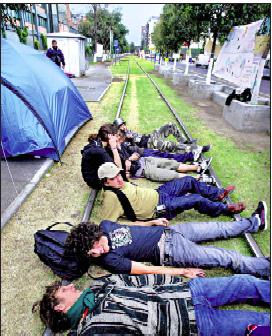
Jornada, photo by Alfredo Dominguez
In the United States, when there’s a local controversy, you write a letter to the editor. In Mexico, you set up a roadblock. Plans by local authorities to change some of the green spaces on Reforma running through Lomas de Chapultepec and Polanco caught the attention of private school students. Nice to see the rich kids taking an interest in civil affairs instead of the usual pinche junior activities… running amok and annoying everyone.
We’ll be ok…
… though Mexico (being too closely tied to U.S. markets may have a harder time), according to thems that knows:
|
Francisco González, president of the Bilbao Vizcaya Argentaria Bank, (BBVA) said that although the global outlook remains uncertain, Latinamerica is better prepared than in past international crisis mainly because of strong sound advances.
Speaking at the X Latibex Forum in Madrid, Gonzalez mentioned among the positive advances lesser indebtedness, higher international reserves (taking advantage of soaring commodity prices); balanced budgets and current accounts, plus stricter banking supervision which means the region has no major distortions regarding monetary and debt payments policies. Besides the region‘s economies, working on the reforms of the nineties, are far more open, the private sector and investments have a more dynamic role, together with an overall improved macroeconomic discipline. González said that for BBVA Latinamerica remains “a strong source of long term growth” because of its young population, improved education and availability of commodities. On the negative side Gonzalez mentioned certain risks such as the concentration of exports in a few commodities and “big spaces of informality” in the economy which limits financial services access to individuals and small companies. Gonzalez revealed that BBVA has invested over 14 billion US dollars in Latinamerica, where it has 26 million clients and 5 million in pension funds plus 60% of the bank’s total staff of over 66.000. “We are intent in growing in Iberoamerica and we believe that the BBVA group has become a significant asset for Latinamerica”, he underlined. Latibex is an annual event held in Madrid which brings together the CEO of 60 of Spain’s and Latinamerica’s leading companies. |
|
Better late than never
(Hopefully) soon to be replaced United States Ambassador to Mexico, Antonio Garza, Jr. — in a momentary lapse into good sense and clarity — has committed the unspeakable sin of actually telling the truth. Speaking at the Harlingen (Texas) Chamber of Commerce, Garza said that Mexico would not be experiencing the current levels of violence if it weren’t for the U.S., the world’s largest consumer of drugs and the main supplier of firearms to the criminal organizations dealing in drugs.
On the subject of firearms, the Spanish news agency EFE reports that:
The Senate of the (Mexican) Republic today asked the American Congress for a progress report on laws to control the purchase and sale of firearms that fall into the hands of organized criminals in Mexico. report The Senators underscored the importance of their request by stating that the United States “by taking on a mandate to interfere in affairs around the world must remember that with great power comes great responsibility.”
Senator Fernando Castro, Institutional Revolutionary Party (PRI), who introduced the proposal, said “The American Government lacks a national register of firearms in the hands of private citizens, which facilitates illegal traffic entering our country, creating a critical situation for Mexican security.”
Castro also urged the Mexican President to stress with Washington the need for “an energetic battale against the illegals arms trade which enters Mexico from the United States,” and called on both governments to redouble their efforts to secure Mexico’s northern border from smugglers.
Castro, who chairs the Legislative Studies Committee, asserted that over half of all illegal firearms and ammunition discovered in Mexico, and that it is not only Mexican gangsters who are engaged in the traffic, but also American citizens who aid and abet organized crime in purchasing weaponry.
He iterated that, “It is undeniable that firearms are an indispensable tool for organized crime and especially for narcotics traffickers” with which “they inflict fear and terrorize our citizens, which makes it incumbent on us to focus on this illegal trade, due to the grave violence now being experienced in Mexico.”
The proposal also called upon the Mexican Treasury and tax adminstration service, as well as the Federal Prosecutors’ Office and the Customs Service to weed out persons tied to organized criminal gangs.
(Translation of a translation from M3Report. I’m down with la grippe, so this may be it for today, maybe tomorrow)
Upside-down world
With the socialists complaining that the capitalists are stealing all their good ideas, it’s time to look at a few other assumptions that aren’t working out as the U.S. press insisted they would. Without opening PEMEX to foreign (i.e., major U.S.) oil company investiment, PEMEX was supposed to collapse, and without privatizing the gas stations, we’d have huge shortages caused by our gas subsidy. And… of course the Mexican auto industry would collapse.
The prospect of deep-water petroleum exploration in the Gulf by foreign companies, at the heart of the PEMEX reforms was assumed, in the U.S. to benefit the private majors. Au contraire: the companies that will be drilling in the Gulf are the Colombian firm Ecopetro and the Italian ENI.
Under the new PEMEX rules, these companies are only service contractors. They have the rights to drill in certain blocks, but under no circumstances will they become owners of the oil. That has not changed.
What has also not changed was what everyone who wanted PEMEX to privatize was calling our “gasoline subsidy”. As I was beating my head to explain, it was the not a subsidy, but simply that gasoline prices were set as if it had been refined within Mexico, but — due to a refinery shortage — was being processed in the United States. With the drop in U.S. gasoline prices, Mexican gasoline is now more expensive than most of the U.S.
The PEMEX reforms include funding for building more refinery capacity within Mexico, so what right now is a premium is a tax intended to finance self-sufficiency.
And… Volkswagen de Mexico is having another banner year.
As of Tuesday, the [Puebla] plant had made 411,000 cars this year, Volkswagen de Mexico said in a press release. The plant set its production record in 2000, when it manufactured 425,000 cars.
Finally, in what’s the upside-down-est of all, the new U.S. administration has turned to Mexican advisor to straighten out its screwed up energy policy. Mario Molina, the Mexican chemist who followed up his Nobel Prize in Chemistry (1995) with a stint as a pollution abatement advisor to the Federal District, is being hired by the Obama Administration to work on global warming issues.
Socialists Unite… and head for the beach
With the world news focused on the United States’ economic meltdown and the incoming Obama Administration, the Iraq War and… here in Mexico… the Mourino air crash and the war on (some) drugs, there’s been almost no coverage of this. The governing council of Socialist International — a world-wide body of various socialist, social-democratic and labor parties — is meeting in Puerta Vallarta.
Almost nothing has appeared in the press on this, and it is more or less a policy session for these various parties. SI president, George Papandreau of the Greek socialist party, PASOK, perhaps was speaking ironically when he opened the session with remarks on the “danger” of socialist priniciples becoming fashionable during the economic crisis:
“For us, this development was a pleasant surprise, but we do not want to become a fashion. We want our principles and values to remain clear and stable. We have a great responsibility to make things clear, as conservative forces have created an upheaval. However, the challenge we are facing is historic,” Papandreou said.
The SI president presented five proposals for a way out of the economic crisis.
Firstly, the creation of a fund for social protection in order for social security to be guaranteed, particularly in developing countries.
Secondly, the establishment of a special fund which will support small and medium-size businesses and the employees working in them. ?This will be an answer to one of the greatest problems of the international economic crisis,? Papandreou said.
Thirdly, the creation of a special fund which will undertake the support of fluidity in the economy.
Fourthly, special measures for the support of developing countries and their economies, which must have fluidity so that they do not end up bankrupt.
Fifthly, the promotion of the necessary reforms in the international organizations, such as the International Monetary Fund, the World Bank and the World Trade Organisation.
Nothing particularly remarkable in all this, but SI vice-president and host of the conference, is PRI chair Beatriz Paredes Rangel. We sometimes overlook the fact that the largest Mexican party, the PRI, and the third largest, PRD, are both socialist parties. Paredes has been trying during her tenure to move her party back to the left, and away from the “technocratic” and centerist role in Mexican politics. What was most notable at this Puerta Vallarta meeting was that Paredes is suggesting a merger between PRI and PRD.

La Presidenta? (Photo: Notimex)
Party switching is not a sin in Mexican politics, nor is changing coalition partners. The Greens were at one time allied with PAN, but having been frozen out of cabinet positions during the Fox Administration, have partnered with PRI. Fox, incidentally, would not have won the presidency without Green and two smaller (now defunct) Social Democratic party support. The PRI remains the largest party in Mexico, but PAN has been able to win national elections (assuming it did win) because of the split between them and PRD.
The PRD seems to be hopelessly split between two factions, with the AMLO-led faction which also theatens to break the “FAP” congressional coalition of the PRD, Convergencia and the Workers’ Party. AMLO, and his wing of the PRD may move to Convergencia, which would open the way for Paredes to unite PRD and PRI, at least create a strong fusion ticket that would represent over half the electorate. It could, conceivably, also work with the further left Convergencia and Workers’ Party in local elections (or at the national level) or the Social Democrats, who are not members of SI.
I don’t know what the former Tlaxcala governor’s long-range ambitions are, but I wouldn’t be at all surprised if she was the PRI presidential candidate in 2012… or Mexico’s first woman president. At the conference, Paredes outlined her own suggestions for the Mexican party, mostly financial protection for the poorest workers, more assistance to agricultural sectors and safe-guarding the political process from narco-dollars. The latter may cost her some party officials (quite a few, depending on who you listen to), but still, it’s not all that radical. And, a purge of those party leaders suspected of corruption (like Governor Ulises Ruiz of Oaxaca) might improve the PRI’s image with voters who backed PAN on the theory that it was somehow more “honest” than the others, but are having buyers’ remorse at this point.
And, by the way, there is no United States party represented in Socialist International. There’s a small informal “Democratic Socialists” organization in the U.S., but it has nothing to do with the Democratic party, nor any other U.S. party. The only Socialist in Federal office that I can think of is Senator Bernie Sanders of Vermont… and given what the Socialists International is talking about between dips in the ocean and trips to Senor Frog’s, they don’t sound all that radical right now.
Ritmo, not Gitmo, to undo Cheney?
Updates in bold-face italics.
WOW!
Vice President Dick Cheney and former Attorney General Alberto Gonzales have been indicted on state charges involving federal prisons in a South Texas county that has been a source of bizarre legal and political battles under the outgoing prosecutor.
The indictment returned Monday has not yet been signed by the presiding judge, and no action can be taken until that happens….
Cheney is charged with engaging in an organized criminal activity related to the vice president’s investment in the Vanguard Group, which holds financial interests in the private prison companies running the federal detention centers. It accuses Cheney of a conflict of interest and “at least misdemeanor assaults” on detainees because of his link to the prison companies.
Megan Mitchell, a spokeswoman for Cheney, declined to comment on Tuesday, saying that the vice president had not yet received a copy of the indictment.
The indictment accuses Gonzales of using his position while in office to stop an investigation in 2006 into abuses at one of the privately-run prisons.
Gonzales’ attorney, George Terwilliger III, said in a written statement, “This is obviously a bogus charge on its face, as any good prosecutor can recognize.” He said he hoped Texas authorities would take steps to stop “this abuse of the criminal justice system.”
…
Willacy County has become a prison hub with county, state and federal lockups. Guerra has gone after the prison-politician nexus before, extracting guilty pleas from three former Willacy and Webb county commissioners after investigating bribery related to federal prison contacts.
Last month, a Willacy County grand jury indicted The GEO Group, a Florida private prison company, on a murder charge in the death of a prisoner days before his release. The three-count indictment alleged The GEO Group allowed other inmates to beat Gregorio de la Rosa Jr. to death with padlocks stuffed into socks. The death happened in 2001 at the Raymondville facility.
In 2006, a jury ordered the company to pay de la Rosa’s family $47.5 million in a civil judgment. The Cheney-Gonzales indictment makes reference to the de la Rosa case.
None of the indictments released Tuesday had been signed by Presiding Judge Manuel Banales of the Fifth Administrative Judicial Region.
It’s not that I haven’t — and a lot of us haven’t — wondered what’s going on with those rent-a-pens in Willacy County, home of the largest private concentration camp in the United States and a violator of all kinds of Texas laws, not to mention an affront to human decency… but this is amazing. If nothing else, it may bring to light these abuses.
Probably nothing will come of it — although Presiding Judge Manuel Banales has set an arraignment date for Friday (but also ruled that Cheney, and co-defendant Alberto Gonzales, need not appear in person. Willarcy County politics is more bizarre than even Mexican politics, and I have no way of keeping up with this story. South Texas Chisme is probably the best source for reading up on the antics of District Attorney Juan Angel Guerra (who “couldbetrue” calls “D.A. Hissy Fit”), but then, a Grand Jury can do pretty much whatever it wants… even indicting Dick Cheney. Another great source (and a very good, often overlooked news source for border and north Mexico news) is the McAllen Monitor.
Miscellenous updates
The plane crash that killed Juan Camilo Mouriño and Jose Luis Vasconcellos, among others, has been offically explained as an accident… which has opened a whole new can of worms. Part of the problem with getting Mexicans to accept the explanation (that the Learjet was following a jumbo jet too closely and ran into turbulance) can be blamed on U.S. Ambassador Antonio Garza, Jr. who … for no discernable reason… called a press conference to blab that U.S. investigators had analyized the “black box” recorder and found no evidence of sabatage. True enough, but what Tony Garza had to do with that information, or why he would be privy to it before the Mexican authorities had concluded their investigations did nothing to clear the air so to speak.
PAN Senate leader Gustavo Madero complained that Garza showed disrespect, and spoke out of turn, while former Presidential candidate Francisco Labstida, speaking for PRI, said “The Ambassador really likes to talk. He talks a lot”.
While people are going to spin conspiracy theories no matter what, other questions — why did the Secretariat buy a plane known to have control problems?; why was maintenance and service (including the pilots) outsourced to a private company?; why was there an inexperienced pilot flying the plane?; why did an executive helicoper in the same area NOT experience turbulence? — are still unanswered.
Given the comments by “alejandro” to my original post on Mouriño, back when he was first nominated for Sec. de Gob. all questions about Mouriño and his family contracts with PEMEX are probably the fault of the “jewish media” anyway.
Another recent commentator, Larry Gwaltney, seemed to think think U.S. talking head Michelle Malkin’s status as an “anchor baby” is somehow different given that Ms. Malkin’s father was a green-card holder at the time of her birth, he may want to take a look at the source I quoted. There was no guarantee that Ms. Malkin’s parents would have remained legal residents at the time of her birth, nor had they lost their residency permission, would it have been any different from that of many other so-called (by Malkin) “anchor babies”.
I’d point out that so are a lot of the so-called “anchor babies” which is itself an insulting term and legally meaningless. As to his suggestion that I’m a supporter of La Raza, or that it is a “racist” organization, I’m not sure where he got that, unless he pulled it out of his ass. I’m not sure La Raza is aware of my existence or not… never having been formally introduced…Gwatney’s contention that somehow the KKK and “La Raza” are equivalent I’ve heard before — from people who don’t know Spanish. “Raza”, as I get a little tired of explaining, means “nationality”, not “race” as the term is used in the United States. nor is La Raza known for anti-semitism, anti-Catholicism, segregation by “color” or lynching. Ms. Malkin has notably defended the World War II era Japanese concentration camps and suggested Americans of Arab extraction also be incarcerated. If the hood fits…
Otto Rock, the only Latin American business writer you need, knows a good investment when he sees one:
…put in an order or seven for this book.

(Orders before Christmas include shipping: $24.95 via paypal: mazbook@prodigy.net.mx)
The fourth North American nation…
… after 25 November, the North American Free Trade Agreeement might have to be amended, or the name changed. Greenlanders go to the polls to decide whether to seek full independence from their present status as a dependency of the Danish monarchy in favor of a semi-autonomous republic and eventual full independence. Greenland would be one of the larger nations on earth by size (three times the size of Texas, or about 10% larger than Mexico) but with a population of only 57,000. Even with global warming, it’s unlikely to be a banana republic, but besides the fisheries, there is gold, diamonds, oil and fresh water (increasing a marketable commodity) that the larger nations’ and multi-nationals would love to get their paws on. Unless, of course, there is an Inuit version of Fidel Castro waiting in the wings. Never know.
Wonk-landia
The breathlessly awaited “Informe 2008” published every November by Corporación Latinobarómetro (Santiago de Chile). This is the very detailed annual survey of social and political attitudes throughout Latin America that, in something of an annual tradition, is cherry-picked by U.S. commentators to try to spin whatever the policy de jour is… as BoRev.net writes:
Every year the Chilean polling firm Latinobarometro releases the latest round of public opinion polling data from 18 Latin American countries, and every year Venezuela comes out on top in all the democracy and quality of life categories, and every year the press has no idea what to do with that, so they cover some marginally relevant data point en masse, and ignore the rest. It’s become a Thanksgiving tradition, like triptophan!
Venezuela isn’t my beat, particularly, so I’ll leave that to Bo. I have downloaded the entire PDF file to start my own cherry-picking, but haven’t really started plowing though it yet. One thing that caught my attention (page 24) though was that while “deliquency” and public security issues were the number one social problem mentioned by Mexicans, it was only put at the top of the list by a third (33%) of respondents. This is far below the number of Venezuelans (57%) who also put it at the top of their worry list. What I realized is that the number of respondents who mentioned “deliquency” nearly matches the percentage of voters who opted for PAN in the last Presidential election… for whom crime control was THE campaign issue.
I don’t mean that PAN didn’t win the election (though they may not have, based on other factors), nor that crime prevention shouldn’t be an important policy goal, but that it isn’t the overriding issue that foreign media often makes it out to be. Nor that the policies used by this particular administration are universally backed, or even considered effective.
I thought of that when I read yesterday’s posting in “Bloggings by Boz“. Quoting stories in both the Washington Times and the Los Angeles Times on Mexican narcotics-export outlets extending their business practices to the United States (how’s that a nice way of saying “murder and mayhem”?), Boz writes:
The worst case scenario for the US is that the cartel wars take place inside of our country. The best way to prevent that scenario is to start helping Mexico, Central America and the Caribbean improve their governments, economic development and security. We need the Merida Initiative money to start flowing and we may need to think beyond the Merida Initiative towards a more extensive program.
Boz is my native guide to the strange and exotic world of inside-the-Washington-beltway Latin American think-tank wonklandia. Obviously, the wonks are starting to push for spending that Merida Initiative money (which won’t be going to Mexican crime control, but to U.S. “consultants” and suppliers) rather than deal with an issue caused by the huge market for narcotics within the United States. With only a third of Mexicans even identifying delinquency as the number one social problem, and less than that buying the present administration’s anti-crime policies, this won’t be an easy sell for the U.S. government. And… the idea of the U.S. government “helping Mexico” has a long history of being seen as interference for the benefit of the United States. It ain’t gonna fly.
Given that the whole anti-narco policy within Mexico has been to drive the crooks out of the country, the present administration has been somewhat successful, if the news stories aren’t exaggerated, and the cartels are moving their operations to the United States. And… maybe the United States will start dealing with their narcotics use problem once a few heads start to roll… into the offices of the Washington Times or the Los Angeles Times… or a few narco-mantas start appearing on the overpasses of the Washington beltway.
That’s my spin, and I’m stickin’ to it.
Hyprocrisy at its best
Having written so well on his own fears and thwarted hopes as an “illegal alien”, the anonomous college student who calls himself “the shadow” had a good laugh over the weekend:
I couldn’t help but laugh when I found about this. I’ll quote the article of what I’m talking about.

Photoshopped? Yeah, well... close enough
Michelle Malkin, born Michelle Maglalang, is a dark skinned Filipino-American who loves the worst that white American civilization has to offer. Malkin is a darling of the right wing, a blogger and author who is eager to advocate invading other nations, and spewing hatred of immigrants in general and of Muslims in particular.
Malkin constantly rails against immigration, complaining about “drive by” and “accidental” citizenship attained by the children of immigrants who she and others label “anchor” and “jackpot”babies.
Malkin never told her loyal readership that her father came to the United States in 1970 on a temporary work visa. She was born in October 1970. Malkin is herself a jackpot baby, given automatic citizenship when her parents were not even permanent residents. The truth may set you free, but it doesn’t get you on Fox news.
She is an ‘anchor’ baby…
He-he-heee.
Adios to the white princess…
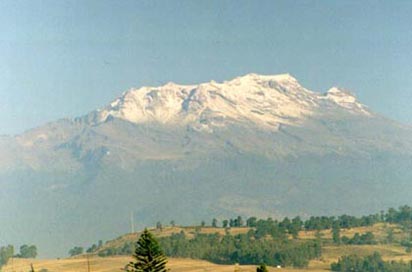
Take a good look at Iztaccíhuatl while you can… her glacier may be completely gone within ten years, due to climate change, according to Hugo Delgado Granados of UNAM’s Department of Geophysical Sciences. Should Iztaccíhuatl lose her snow cap, the loss will be more than aesthetic… the glacier is holding in place tons of boulders which will come crashing down and will release mudslides and floods on the agricultural lands below.
Iztaccíhuatl– the “white princess” — is one of the more dramatic sights in Mexico City. Although I saw it a couple of times a week while teaching a class at a plastics factory in Tlahuac, taking the bus east from the Taxquena Metro Station this was always an impressive sight as we crossed into Tlahuac. She is the princess guarded (we thought) for all eternity by her faithful warrior lover, Popaca, the Romeo of the Aztec “Romeo and Juliet” who still — literally — bears a torch for her. She rests uneasily under her white blanket… we thought… safe forever and and a mainstay of kitsch calendar art: