PAN panned in Coahuila
With very low turnout (40%), Coahuila legislative elections held over the weekend resulted in a huge victory for PRI, and a rout for PAN. PRD and the state United Cohauila Democratic (UCD) Party may barely have enough votes for even proportional seats. The twenty direct election districts were all PRI victories (in Saltillo, there was a PRI-Green-Workers-United Coahuila Democratic fusion ticket) were all won outright by PRI. Depending on final results PAN, which lost by margins of two to one or three to one in several districts will still be the second party, but only through proportional representation seats.
To avoid the problems with a single party dominating the legislatures, no party can hold more than 2/3rds of the seats. Coahuila’s legislature has 31 seats. With all twenty district seats won directly by PRI, the 11 proportional seats will go to PAN, unless PRD and/or UCD won over 3.5 percent of the vote, which will entitle them to one seat.
While of course, there are plenty of allegations of fraud, PRI has been making a remarkable comeback since its loss in the 2006 Presidential election, as both the PRD struggles with internal differences, and voters have lost interest in the conservative (or, in Mexican terms, “liberal”) PAN.
(Sources: Jornada, Milenio de Torreon, IEPC Coahuila)
The cold one war… Anheiser-Busch v. Modelo
It’s complicated: Anheiser-Busch (maker of watered-down urine colored beverages) is half-owner of Grupo Modelo, which brews Corona, Modelo, Pacifico and Victoria beers, among others. According to Modelo, a 1993 partnership agreement with Anheiser-Busch requires Modelo’s approval of any stock transfers.
Anheiser-Busch has been negotiating a friendly takeover by the Anglo-Brazilian brewer InBev (Becks, Bass, Bohemia, Brahma… and on and on) for $52 million dollars. Even with the economic meltdown, apparently breweries still have money (at least they create a real product, and not loans on the theoretical value of the future of loans based on… whatever). Modelo has not been a partner to the agreement and is demanding to pull out of the deal, or at least be granted the right to buy back it’s shares from Anheiser-Busch.
InBev is seeking to control the world beer market, so wants the deal to go through (plus, being a company with Euros, a dollar deal is particuarly attractive right now) and the whole thing will end up in arbitration, according to the Wall Street Journal’s Heidi N. Moore:
“What InBev and Anheuser-Bush have done is give [Modelo’s claims] the back of their hand since the beginning,” complained a person familiar with Modelo’s thinking. “It’s mealy-mouthed,” a person close to InBev and A-B said of the arbitration threat.
InBev and A-B say it would be unwise for Modelo to scuttle the deal, considering that A-B shareholders want that $70 a share deal price and probably would sue for it. That could result in a hefty legal tab for Modelo. For their part, A-B shareholders don’t seem concerned; the stock inched up 0.3% today to $59.95.
Modelo’s Mexican stock is controlled by Tresalia Capital — the business set up by María Asunción Aramburuzabala when she diversified her fortune (she was the heiress to the beer empire) into media, telecommunications and private education. There is a political connection with the United States. Mr. María Asunción Aramburuzabala is Texas political hack and Bush crony turned United States Ambassador Antonio Garza, Jr. If the Anheiser-Busch sale goes through, it would be one of the few recent stock deals that earn money for the investors (never mind that it moves another U.S. company into foreign control). If Modelo pulls out, it would be able to make it’s own deals with InBev, probably giving the Mexican company a larger stake in the international beverage giant… and giving Mexican beers a higher profile internationally than they would enjoy as a partly U.S. owned brand.
There must be some ticklish conversations around the Aramburuzabala-Garza household these days.
But, the real question is… will the beer be any good?
Apocrypha for the Apocalypse — Sunday Readings: 19 October 2008
It’s all Greek to me…
As I explained in my book (ahem…):
Gringo is not a pejorative at all and dates back to medieval Spain. It is a corruption of griego – Greek. During the Spanish Reconquista – the war between the Christian northerners and the Islamic Moors – Byzantine Christians, many of whom settled in Spain after the fall of Constantinople in 1453, were generically referred to as grecos – Greeks, and were allies of the Western, Christian Spaniards (the most Spanish of all Spanish artists, El Greco, was born Doménicos Theotokópoulos. He could have easily been known to us as El Gringo). Gringos are outsiders, foreigners who may have some odd customs and practices (in Chile, a gringo is a Portuguese-speaking Brazilian), but they are not necessarily invasores – invaders – as United States citizens are sometimes called.
A gringo — in the original sense of the word — Steppenwolf — writes about Mexico, Latin America and other appalling aspects of our world at Διαλείψεις & Παρεμβολές.
Strangers in a strange land
Jeremy Schwartz (Cox News Service) on returning migrant teenagers:
CIUDAD HIDALGO, Mich. – After nearly seven years in the United States, 16-year-old Edgar Gutiérrez was back in a hometown he hardly recognized.
He returned to relatives he couldn’t remember. Kids thought he was stuck up because he had lived in the United States. Teachers scolded him when he pronounced his name with an American accent. Edgar grew up in these mountains of Central Mexico, but now he felt like a stranger….
There goes the neighborhood…
Dropped in (Malcolm and Jillian) on “ex-pat bars”:
Many fellow Americans and Canadians living here in Yucatan have mentioned to me that they would never set foot in a dining establishment which self-identifies as an “expat hangout.” In general, expatriates here seem to be of one of two minds: Either fully embrace all that is Mexican, and dislike anything that is American or Canadian, or try to turn this little corner of Mexico into Little Miami, or at the very least, Little Scranton.
Hungry yet?
Michael Pollen, on what will be a critical issue in the United States (and Mexico):
… federal policies to promote maximum production of the commodity crops (corn, soybeans, wheat and rice) from which most of our supermarket foods are derived have succeeded impressively in keeping prices low and food more or less off the national political agenda. But with a suddenness that has taken us all by surprise, the era of cheap and abundant food appears to be drawing to a close.
The response may be “top down” — from Agriculture Secretaries and Presidents, but as April Howard discovers in Paraguay (Upside Down World) the solution may come from the bottom up:
In Paraguay, where 1 percent of the population owns 77 percent of all arable land, corrupt agrarian reform and the booming soybean industry is leading the country towards an industrial agricultural export model that leaves no room for small food producers. While many Paraguayan campesino [small farmer] families have moved into urban peripheries, tenacious farmers have fought not only for their right to land, but also to redefine and recreate the agricultural model based on cooperative, organic and people-friendly alternatives. As newly elected President Fernando Lugo moves to make good on campaign promises, the proposals of Paraguayan farming movements already point the way to sustainable change….
We didn’t do it…
Speaking of peasant economies, monoculture and absentee landlords, Frank Nowakowski reports (The News) that Toluca is off the hook as the culprit in the Irish potato famine. The blight came from Peru, but the blame for the disaster still rests with Old Blighty:
To find the origin of Phytophthora infestans, the organism that caused the famine, Jean Beagle Ristaino, professor of plant pathology at North Carolina State University, led a team that examined genetic sequences of nearly 100 pathogen samples from South America, Central America, North America and Europe.
In particular they looked at both the nuclear and cellular powerhouses known as mitochondria.
These “gene genealogies,” published in the Proceedings of the National éademy of Sciences, squarely point the finger at an Andean origin for the disease that devastated potato crops in Ireland, the Scottish Highlands and northern continental Europe in the 1840s.
“Miami is today a madhouse and Bush has turned into a ghost.”
Well known Caribbean and inter-American political analyst Fidel Castro writes on his blog:
President Bush deemed his presence unnecessary at that meeting of Finance ministers. He will meet with them on Saturday. Where was he on Friday October 10? No less than in Miami. He was attending a fundraising for Florida Republican candidates. Actually, with a 24 percent approval rate he is the head of State with the least support in the entire history of the United States. He was meeting with business people and ringleaders of the Cuban scum in Miami. There he was, driven by his maniac anti-Cuban obsession, at the end of his gloomy two terms as leader of the empire. He could not even count on the support of the Cuban-American National Foundation set up by Reagan as part of his crusade against Cuba.
For purely demagogical reasons, that organization had publicly asked him to provisionally lift the ban on sending direct assistance to relatives and others affected by the devastating hurricanes which hit our people. Raul Martinez, a former mayor of Hialeah and a rival of Congressman Lincoln Diaz-Balart, had criticized the current policy of the man who was elected President by fraudulent means with less national votes than his adversary, due to Florida’s weight in the electoral vote count, when he failed to have a majority even there.
Working for the Yankee Dollar…
Comrade Fidel hasn’t weighed in on this, but from the looks of this Lonely Planet video, the Latin American workers aren’t exactly the ones benefiting from this global industry:
The most stupid announcement… this century…”
What is without a doubt, the most stupid announcement to be made on the border this century, authorities announced a larger Border Patrol presence and that more heavily armed deputies will be authorized to return fire across the Mexican border.
A larger Border Patrol presence? No problems with that. but cowboys with automatic weapons authorized to fire across an international border into a sovereign country?
Gee, what could possibly go wrong?

Better late than never?
Yes, I know the wheels of justice turn slowly, but this is one of those legal cases where the plaintiffs and defendants have basically died of old age waiting for the settlement.
People only have from now until 23 December to present documentation that they worked as a Bracero between 1942 and 1946 to be included in a possible settlement of the unpaid ten percent set-aside that Braceros should have received for their work in the United States during the Second World War. There is a Mexican government fund, paying out 38,000 pesos to braceros (or their heirs) in compensation. It’s not a lot, but at this point, it’s probably the best that can be hoped for.
When Mexico declared war on the Axis Powers in May 1942, it was really in no position to provide much in the way of troops. However, Mexican workers were recruited for the war effort, to keep U.S. farms, factories and railroads running (and to free up manpower in the United States). This created huge labor shortages within Mexico itself, which was also rapidly industrializing to meet war time needs: Mexican labor law at the time forbade night-shifts in industrial plants, but third-shifts were allowed to meet the emergency. And, Mexico’s own version of Rosie the Riveter, The Women’s Workers’ Corp (who had their own uniforms) later formed the vanguard of a Mexican women’s sufferage movement.
Under the Bracero Agreement, the workers were supposed to receive ten percent of their salary after the war. This never happened… either because the money was lost or stolen by Mexican banks, or U.S. banks. Or… just as likely… it was error on the part of participants. Farmers and managers in the U.S. didn’t always understand the program, and didn’t keep accurate records (and sometimes just didn’t understand Mexican surnames — assuming Jose Gonzales Sanchez and Jose Sanchez Gonzales were the same person, for example). And, there was widespread exploitation. The Braceros were supposed to be free to elect their own representatives but there was no oversight and — as in California agricultural enterprises — the owners assigned their own representatives without any regard for the workers’ rights.
Compensation has been a sore point for years. The aging veterans at one point occupied Vicente Fox’s farm. Much to the consternation of Fox’s equally ancient mother, his bodyguards were not about to rough up a bunch of grand-dads. The war-time program continued into the 1960s, but the non-World War II era braceros are considered a different class under this lawsuit and their compensation claims are handled differently.
Several U.S. banks — notably Wells-Fargo when it assumed the debts of several banks in the last round of U.S. bank consolidation — have owned up to their failures and contributed to a Mexican government compensation fund, which the Mexican congress voted to set up to settle these claims. It is payments from that fund that are in question in Senorino Ramirez Cruz, et al. v. United States of America, et al, No. 01-0892-CRB, U.S. District Court, Northern District of California.
Bearing false witness, or coveting thy neighbor’s Picassos?
Los ministros de cultos, sus ascendientes, descendientes, hermanos y cónyuges, así como las
asociaciones religiosas a que aquellos pertenezcan, serán incapaces para heredar por testamento,
de las personas a quienes los propios ministros.(Ministers of religions, their immediate ancestors and descendents, siblings and spouses, in addition to the religious associations to which they belong, are ineligible to inherit from the wills of members of their congregation)
Article 131 of the Mexican Constitution
This particular paragraph — which I very roughly translated, not having any legal dictionaries at hand — was meant to end what 19th century anti-clericals claimed was a common clerical practice… convincing elderly and naive parishoners to will the pastor their fortune. You hear about this happening today in the U.S. now and again, though in 1916 no one gave any thought to televangalists (and, in Mexico, you can’t broadcast religious services anyway). And, hard-core anti-clericals that they mostly were, when it came to enshrining strict controls on the church in the 1916-17 Mexican constitution, the framers seemed to go to absurd lengths to close off any possible loophole.
I suppose it’s possible that somewhere, at some point, some priest disguised himself as the beneficiary of a will by convincing some dotty old lady to leave her family silver to his grandmother, who could give it to him, but I tend to think there were just too many lawyers sitting around and too much tequila that winter in Queretaro. Maybe not….
Citius64 writes about the latest clerical scandal to surface. Bishop Onésimo Cepeda of Ecatepec inherited an art collection, including works by José Clemente Orozco, Frida Kahlo, Diego Rivera, Rufino Tamayo, Joaquín Sorolla, Marc Chagall, Pablo Picasso and Modigliani worth an estimated 130 million DOLLARS from the late Olga Azcárraga (sister of Rogelio Azcárraga , who owns Radio Formula, and a member of the extended clan of media moguls) who died in 2003.
According to the late Ms. Azcárraga’s family, the art work had been left to several dozen different family members and various religious organizations in her original will. Some time in the last six months of her life, she made Bishop Cepeda sole heir. The Azcárraga family may be clerical supporters and “richer than God”… but they’re not about to turn over the loot to THIS man of God.
I’m sure it’s not the money… but the principle of the thing. Just as I’m sure pigs fly. The Azcárraga family lawyers have filed criminal charges against His Grace for fraud. This… should …. be … fun.

Man of God (front); Man of law (rear)
(
Stickin’ it too “el hombre”
From M3 Report (a compendium of translated murder and mayhem from the “National Association of Former Border Patrol Agents):
Some 32 undocumented Central Americans were kidnapped last Thursday in the state of Puebla and tortured by at least 12 men who identified themselves as members of Los Zetas. The kidnappers were assisted by municipal police of Lara Grajales with the intent to extort the migrants’ families in the US for $3,500 each. The victims managed to escape yesterday morning and their stories provoked the anger of the locals who then burned a police car and motorcycle in reprisal against the authorities.
Of course, all gangsters are supposedly “los Zetas” these days, but nice to see the locals supporting the “illegal immigrants”.
The other fourtieth anniversary in Mexico
Mention October 1968 and here we think “Tlatelolco”. Outside Mexico, the image people remember is this one:
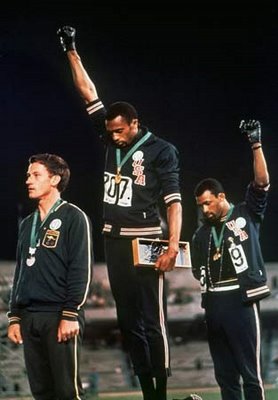
Tommie Smith said, on 16 October 1968:
If I win, I am American, not a black American. But if I did something bad, then they would say I am a Negro. We are black and we are proud of being black. Black America will understand what we did tonight.
Smith, now 64, was profiled in the Independent (U.K.) last Sunday:
“I don’t know what would have happened had I not won the gold medal,” he tells me. “And I had a pulled muscle, so I was not the favourite. But I did win, and John Carlos won bronze, with [the Australian] Peter Norman in second place. We were then escorted to a place known as ‘the dungeon’ to prepare for the medal ceremony, and that’s where John and I decided what we would do. Peter listened, but he didn’t have much to say because this was an American situation.”
Nonetheless, Norman lent his support by wearing an OPHR [Olympic Project for Human Rights] badge, unwittingly writing himself, too, into the history books. When he died, in October 2006, both Smith and Carlos were pall-bearers at his funeral. During the ceremony, however, all eyes were on the two Americans, who wore one black glove each. Smith had his right fist raised, Carlos his left. It was later claimed that Smith’s right fist denoted black power, with Carlos’s left fist representing black unity. The slightly less stirring truth is that the gloves were Smith’s, and they only had one pair between them.
Sarah Palin south of the (lower 48 states’) border …
Move over Tina Fey… the Chilean comedy team “Comedia otra vez” knows how to really make an Alaska politico’s big ambitions look… oh… small.
Welcome C.I.A. and other clandestine readers
I probably spend more time checking out my “stats” than is good for me, which isn’t an unusual obsession among bloggers . I sort of got excited the night I found out I got regular hits from an Army Intelligence Center in Germany, but figured it was just a fluke. I’m only slightly obsessive… other than I get regular hits from Northern Virginia I haven’t checked out whether or not they’re from the C.I.A. Could be, but it’s ok with me.
 The last few days, though, several of us “Latin American specialty bloggers” have started to talk about a new, and apparently regular visitor… the Central Intelligence Agency. I suppose we should be flattered that we’re either considered important enough to be a potential threat… or worried that the C.I.A. is so incompetent that they can’t pick up the “real news” from Latin America and have to depend on us free-lance independent news and culture analysts (sounds a lot more impressive than “blogger”, doesn’t it?) to do their legwork.
It’s been the Bolivians, and Peruvian bloggers that have noticed these hits (I use “statcounter” which would require a lot of analysis to figure out who exactly is looking at my site… and the only thing I’ve used it for is to decide if it’s worth looking at moving to a site where I can run ads., so am not totally obsessed with my readership). And it’s in Bolivia where the C.I.A. was so incompetent that the spies were reduced to trying to recruit Peace Corps volunteers to do their spookery for them.
Given the generally poor “mainstream media” coverage of Mexico, I’d guess that even here, the C.I.A. has no choice but to rely on guys like me. Fine, but c’mon… if you want to suborn me, you can at least send some cash… no questions asked. On what the Mexico City station chief used to spend on video games (at least, given the teenage rent-boys hanging out, I HOPE it was just for video games) in an afteroon on calle Genova in Mexico City, you guys are getting a bargain. And I won’t tell (of course, for all I know, Hugo Chavez and Fidel Castro are regular readers of mine).
Attention spies: “consulting fees,” bribes and hush money are accepted in any currency — even U.S. dollars:

Reefer madness!
The speaker in Mexico City´s Assembly presented a bill Tuesday that would not only legalize the possession of marijuana but also allow the sale of the drug in controlled settings.
If passed, the measure would not legalize marijuana in the capital, but rather would be used to sponsor a reform on behalf of the Mexico City government to decriminalize the drug in the federal Congress.
Local governments have the authority to present initiatives before the federal body, bringing with them the backing of an entire state instead of lawmakers only.
Under the legislation presented by Assemblyman Víctor Hugo Círigo, licensed shops would be able to sell 5 grams of cannabis to a customer, while consumers could carry as much as 30 grams. In addition, the bill would permit the growing of up to five marijuana plants per household.
One of the more amusing arguments against this bill is that “it would invite criminals to set up shop in Mexico.” As opposed to the situation now, I guess.
Before you stumble onto a plane for your blissed-out Mexico City vacation (ok, this “not legalization” might change the tourist mix somewhat, but there’s Acapulco Golden opportunities in this), I’d point out that the District Assembly is overwhelmingly controlled by the PRD, and I don’t think there’s much chance of getting it through the Federal Legislature.
On the other hand… and this is kind of ironic… it all goes back to the attempts to overthrow the Federal District’s abortion bill, which led to a Supreme Court ruling that local legislatures (like the District Assembly) can write their own health codes. Abortion leads to marijuana smoking?


