In the Navy…
I’ve heard that the cocaine traffickers have their own Army, but it seems they have a navy, too. Notice that the cocaine needed in the United States doesn’t have to go though Mexico, and alternative routes are already feasible. (From Der Speigel Online International. Sombrero tip to Guanabee):
Small, homemade submarines have become the preferred means of transport for the Colombian drug cartels — and a completely new challenge for the Joint Interagency Task Force South (JIATFS), a group consisting of members of the United States Navy, Coast Guard, CIA and drug control agents from 12 other countries.
The boats, made of plastic or steel, can carry up to 10 tons of cocaine each. Because they cannot submerge completely, the correct term for the boats is semi-submersibles. They are used primarily on the drug trafficking routes between Colombia and Guatemala or Mexico. The cartels have devised a complete logistics system, with fishing boats stationed along the way to warn the crews against patrols and provide them with food and water.
…
he semi-submersibles are already in their third generation. The new boats have larger diesel tanks, giving them a range of about 5,000 kilometers (3,105 miles), and they feature the latest in navigation equipment. Fishermen hired specifically for the task are often at the controls, and those who complete the trip successfully are paid more than $100,000 (€64,000). Once the smugglers have unloaded their cargo, somewhere off the coast of Guatemala or Mexico, they sink the boat. The homemade vessels, which come at a price tag of up to $1 million (€640,000), are disposable products. “If this continues, we’ll see the submarines traveling from eastern Brazil to West Africa, a distance of more than 3,000 kilometers (1,863 miles),” says Rear Admiral Nimmich.
PEMEX workers seek raise
July 28 (Bloomberg) — Mexico’s Oil Workers Union will seek a 10 percent increase in salaries and 5 percent increase in benefits from state-owned Petroleos Mexicanos, Reforma newspaper reported.
The union will hold a convention next week in Mexico City and will ask that the new terms go into effect by Aug. 1, the Mexico City-based daily newspaper reported.
The workers are currently under a two-year contract signed in July 2007, whose rules dictate that there can be no modifications except for wages and benefits, the newspaper reported.
Brendan Walsh
No surprises here, although this may be the start of a trend towards higher salaries. Inflation has especially hit food prices and economists fear more a slowdown in consumer spending than inflation. That the union request is such minor news is also another sign that PEMEX isn’t really in the dire condition the “privatizers” would have us believe. Already implemented tax reforms, and a few possible changes in other areas, should leave PEMEX the operating capital it needs.
Follow the (Merida) money
WOLA (Washington Office on Latin America), a group I’m not familiar with posted this about the $400 million “Meridia Iniative” package that’s been approved by the United States Congress:
The bill’s language recognizes the “shared responsibility between the United States and Mexico to combat drug trafficking and related violence and organized crime.” It’s good to see the U.S. Congress accept that fact, but Mérida is definitely a mixed bag and, in some ways, a missed opportunity for the United States to finally start getting it right on fighting drugs. It has some positive things — $3 million in technical assistance to help Mexico establish a unified national police registry, $10 million for drug demand reduction and rehabilitation in Mexico — but a lot of misguided spending on military hardware ranging from helicopters to surveillance systems to aircraft platforms. And it doesn’t address at all the critical need for drug demand reduction in the United States and controls on the smuggling of firearms over the border into Mexico from the United States. These are the twin traffics — drugs into the United States, guns into Mexico — that threaten to erase any chance Merida has of succeeding even before it starts.
I’m not sure a national police registry is a good thing. Most of this funding is simply a boondoggle for U.S. equipment suppliers, throwing a lot of money and equipment at one particular crime issue. Since narcotics smugglers really don’t affect day to day life for most people in Mexico, making anti-narcotics efforts the focus of so much attention detracts from what are probably more important — and, in the long run, permanent — reforms: better pay and training for the police, better record-keeping for the judiciary, more judges and courtrooms.
And, I know this is a controversial point, but what’s wrong with bringing in money from the trans-shipment of narcotics to the United States? Money is fungible. The source, within a few generations at most becomes the stuff of legends and only of minor interest to anyone but conspiracy theorists. I hope I’m wrong, but this is only a “problem” when the gangsters are “not-us” selling to “us”. I’m not sure if that’s a class or race issue, or just human nature: when Indians killed settlers on the frontier, it was a “massacre”; when settlers killed Indians, it was a “battle”.
Most of the resources on the Opium Wars that talk about the British fortunes made from 19th century British investments in the China opium trade are, alas, from the wacky Lyndon LaRouche people, but there’s a lesson there. Money has no morals… and eventually becomes “respectable” after a period of time. A lot of major corporations and family fortunes got their start in the opium biz. My bank is HSBC, which started life laundering British opium smuggling profits. The Bush family’s ties to Hitler m ay be controversial, but Barbara Pierce Bush’s family fortune came from the opium trade (and out of fairness, so did some of Franklin Roosevelt’s mother’s family money) too… while I don’t think they’re a respectable family, I haven’t heard any complaints about the fact that they had money to invest. It took less than a generation for the Kennedy family of Massachusetts to go from liquor smugglers to reputable political figures, so why can’t Chapo Guzman’s heirs someday be embarrassed by the original source of their funds?
Even now, that embarrassing narco-money is spread all over my state (Sinaloa) and there’s no way to “disinvest” those funds. While the state certainly has a right to track money entering the country (and to tax overseas earnings… i.e., narcotics sales), and tracing the funding back to the original financing source is going to be the only way to figure out who actually runs the narcotics trade (and are we sure we want to know?) I don’t think there’s much we can do about the money that’s already here. Nor, perhaps, should we.
Sunday readings: 29-June-2008
Are price controls on food products even healthy? Diego Cevallos (InterPress News) finds many Mexicans wondering about that:
The products whose prices will remain unchanged through December are all processed foods that are not staples in the local diet. Furthermore, as business leaders have acknowledged, an announcement that the products would not experience price hikes this year had already been planned.
The list is headed by a number of brands of canned foods high in sodium; mayonnaise; marmalade; tea; powdered soups; and brands of juice and jello with a high sugar content.
The only high-demand, staple product included in the group is cooking oil, but its price will only be frozen until the end of August.
John Ross writes in “Killing Farmers With Killer Seed” (Counterpunch, 23-June-2008 ) that the push for GM seeds is more than just an economic issue:
Last October, Armando Villareal, a farm leader in the Mexican border state of Chihuahua, was gunned down after a farmers’ meeting in Nuevo Casas Grandes. Villareal had been denouncing the illegal planting of GMO corn in the Mennonite-dominated municipalities of Cuauhtemoc and Naniquipa.
How do you say Justice in Mixteco?: David Bacon writes in Truthout about Fresno (California) farmworkers displaced by those “killer seeds”:
Erasto Vasquez was surprised to see a forklift appear one morning outside his trailer near the corner of East and Springfield, two small rural roads deep in the grapevines, ten miles southwest of Fresno. He and his neighbors pleaded with the driver, but to no avail. The machine uprooted the fence Vasquez had built around his home and left it smashed in the dirt. Then. the forklift’s metal tines lifted the side of one trailer high into the air. It groaned and tipped over, with a family’s possessions still inside. “We were scared,” Vasquez remembers. “I felt it shouldn’t be happening, that it showed a complete lack of respect. But who was there to speak for us?” …
…Vasquez had lived in his trailer for 17 years. His youngest daughter, Edith, was born while the family lived there. By the time the forklift appeared, she had started middle school, while her brother Jaime was in high school and her sister Soila had graduated. “Señora Bowen was a nice lady, and even though we had to make whatever repairs the trailers needed ourselves, sometimes she’d wait three or four months for the rent, if we hadn’t been working,” Vasquez says. The families had labored in her vines for years.
And betcha didn’t know where the largest community of ethnic Japanese outside Japan is… Maria Osava on the celebrations commemorating the 100th anniversary of the first Japanese immigrantion to Brazil… and a video from Al-Jazeera’s Gabriel Elizando.
…the development of agriculture was the main contribution of Japanese immigrants to Brazil, in his view. Today, the Nikkei stand out in different areas, with the exception of those that require “the gift of gab,” which they don’t generally have, he said.
That is the explanation, he said, for the scant Nikkei presence in politics, in contrast with the leadership positions they hold in the technological, business, professional and academic spheres.
In Peru, which has a much smaller Japanese community, a son of Japanese immigrants, Alberto Fujimori, served as president from 1990 to 2000.
In Brazil, there have been few ministers and legislators of Japanese descent. But in the United States, their participation in politics has been even more limited, according to Jeffrey Lesser, a history professor at Emory University in the southeastern U.S. state of Georgia.
May the best wall win
From the Edinburg (Scotland) Evening News:
THE first of 400,000 trees are being planted to form a “green wall” in protest at the fence the US is building along the border between Mexicoand Texas The treeline will eventually stretch for 318 miles.Coahuila Governor Humberto Moreira Valdes says “our wall is of life, and it competes with shame and hate.”
This actually isn’t a “new” idea… it was discussed two years ago. And, for bonus points, Mexican policy is to plant more trees throughout the country, so another 400,000 are a welcome addition.

How long has this been goin’ on?

Daniel Hernandez (Intersections) caught this eye-catching family portrait, one of a series under the title “Familias Mexicanas” now at the Centro Medico Metro Station. As Daniel writes
The metro in D.F. is truly the working citizen’s art museum. Many stations feature permanent murals and sculptures or pre-Hispanic artifacts, such as the Ehecatl pyramid that sits in the middle of metro Pino Suarez. There are also temporary exhibits.
Mexico City is fast gaining a reputation as one of the major centers of the world for cutting-edge art exhibits.
Such is life in the new Mexico City. A decade ago, such a heavy-hitting lineup of openings would have seemed incredible in a sprawling metropolis that is known more for its smog and crime — both of which are still omnipresent. But now the contemporary art scene has matured into one that’s so firmly international that such art-studded evenings are par for the course. And frankly, it’s a lot more fun than its counterparts in the northern art capitals like New York City and London.
Pinche frijolero Friday Night Video
MATAMOROS, México 26-June 2008 (AFP) – The Mexican rock group, Molotov, is the center of a controversy between its fans and the most conservative sectors of Matamoros, on the border of the United States. Church and educational authorities are asking youths not to attend the group’s upcoming concert.
“If you go, it will be on your concience,” warns parish priest Margarito Cepeda.
The state Secretary of Education, Oralia Vázquez, said she thinks Molotov’s music is “for idiots.”
In lieu of attending the July 4 concert at Auditorio Municipal, Vazquez invited youths to attend a theatrical performance the same day which will present an estudiantil performance. [Estudaintiles are traditional performing groups, with guitars and cellos, dressed in 18th century costumes who perform traditional and religious music].
“That’s a show the whole family can enjoy,” she ventures.
In 1997, the then municipal adminstration gave into pressures from the Dioceses of Matamoros and cancelled a Molotov concert after listening to lyrics from “¿Dónde jugarán las niñas?”.
The lyrics — “Hay que arrancar el problema de raíz y cambiar el gobierno de nuestro país/ A la gente que está en la burocracia, a esa gente que le gustan las migajas”, (loosely“They think they’ll settle the problems of our race, by putting a new government in its place/the people who run the bureaucracy, are the people who want us just to leave”) satirize the attitudes of North Americans towards Mexicans living in the United States.
In response to the educational and religious authorities, a group of Matamoros youths have begun distributing fliers in favor of Molotov.
Including, according to AFP, lyrics from this borderlands classic:
Forget the “reconquesta”… Mexicans are buying Texas!
More than a century and a half after Mexico lost Texas to the U.S., Virgilio Garza wants a piece of it back.
A “Texas for Sale” sign and cowgirls in boots and white hats greeted Garza at the Convex center in Monterrey, Mexico, earlier this month. A Monterrey developer and investor, Garza was in search of foreclosed U.S. property to buy.
“Texas is like our home,” said Garza, 45, who joined hundreds of Mexicans poring over lists of Texas properties at the four-day event. Garza, who owns manufacturing sites and other land in Mexico, said he and five partners may invest as much as $8 million in Texas. “We believe there can be some opportunities.”
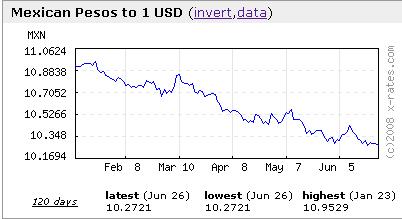
A rising peso and an economy growing faster than the U.S. have given some Mexicans the buying power to take advantage of the housing slump in Texas, which the U.S. annexed in 1845 after Texans gained independence from Mexico nine years earlier. A three-year war followed and ended with Mexico ceding about half its territory, including Arizona, Nevada and California
(Bloomberg — one of a plethora of news alternatives to the Associated Press)
The peso has been continuing to rise, which isn’t necessarily a good thing.
Another cartel sets up in Sinaola
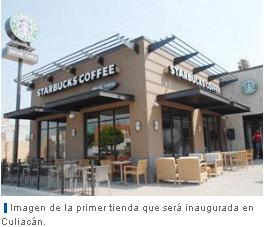
Dang… just what we need: more drug dealers in Cuilican:
Best left unsaid
MEXICO CITY, June 24 (Reuters) – Mexico agreed on Tuesday to extradite drug lord Benjamin Arellano Felix to the United States as suspected drug hitmen killed another six people in a border city in the latest round of a killing spree.
Arellano Felix, known as “El Min”, was head of the powerful Tijuana cartel that operates across the U.S. border from San Diego, California until his capture in early 2002.
Mexico’s Attorney General’s office said Arellano Felix will be tried in a Southern California court on charges of smuggling tonnes of cocaine into California between 1990 and 2000.
The decision overturns a decision in May by a Mexican federal judge to block the extradition.
Arellano Felix, whose cartel is now run by sister Enedina and brother Eduardo, is the latest high profile Mexican drug lord to be extradited by the government of President Felipe Calderon, who took office in 2006.
Was this a trade for older brother Francisco Rafael Arellano Felix, who was also extradited to the U.S. last year, tried and sentenced, to great publicity, then quietly returned to Mexico on last March 5? The guy didn’t even do the minimum time.
Back when Francisco Rafael was sent home, Lizbeth Diaz (Reuters) wrote:
President Felipe Calderon’s army-led crackdown has rounded up traffickers and busted police protection rings, and the powerful Sinaloa cartel from western Mexico has muscled its way into the Arellano Felix gang’s home turf.
Experts say some Tijuana smugglers are breaking away and teaming up with the Sinaloa cartel on some drug deals.
“We’re seeing the emergence of a post-Tijuana cartel structure in which you have smaller organizations, splinter groups, some of whom have now allied themselves with the Sinaloa cartel in a kind of confederation-like arrangement because they need protection,” said Bagley.
At the time, I wondered if sending Francisco Rafael home wasn’t an attempt to keep the Arellano Felix-Chapo Guzman feud going, with the hopes that the two gangs would kill each other off. Hasn’t worked so far (Felipe Calderon keeps telling us “the surge is working” when the death rate goes up in our so-called war), but it might help if when these wise-guys are taken out of circulation — even if it means extraditing them to foreign countries — they stayed gone.
Note to U.S. prosecutors: You wanted him, you keep him.
No justice, no peace
In Mexico, if you fuck up a bar raid and and get some kids killed, you get charged with murder:
El procurador de Justicia del DF, Rodolfo Félix Cárdenas, responsabilizó al ex director de Unipol, Guillermo Zayas González, de la muerte de 12 personas en la discoteca News Divine, por lo que, dijo, será procesado por el delito de homicidio doloso.
(Federal District Prosecutor, Rodolfo Félix Cárdenas, laying responsiblity on the ex-director of UNIPOL, Guillermo Zayas González, for the deaths of twelve persons at the News Divine discotec, said that Zayas is being charged with culpable homicide.)
However, in the U.S., if you fuck up the hunt for one international gangster, invade the wrong country and get 4000+ youngsters killed, nothing really happens, does it?

It comes as a surprise to many that prostitutes in Mexico City are unionized, and — while street walking isn’t legal — is tolerated. While some of that may have to do with the Catholic sense of humanity as a community of imperfect humans (as opposed to the puritanical north where every individual imperfection is seen as a sin to be stamped out), there’s a political and social difference between Mexico and the United States that’s overlooked. The single most important change the Revolution made for urban dwellers was the legal right of workers to organize for their collective benefits. Catholic priests — as workers — were able to go on strike in 1924 eventually forcing the State to take a “kinder gentler” of anti-clerical provisions in the 1917 Constitution. And prostitutes — the unionized ones anyway — have been collectively bargaining for some time.
The second surprising thing is that support for the prostitutes comes not from some “libertarian” group (the big-L “Libertarian” political party is unknown in Mexico, and, if known at all, is seen as a cranky bunch of right-wing anararchists, or an oddball offshoot of Fascist movements like the Synarchists), but from the labor-left parties. And the feminists. Jesusa Rodriguez, the actress and feminist organizer, has been quite active working with prostitutes, and was the go-between when the sex workers pushed the Lopez Obrador administration to provide some social services to their workers.
Besides, every women in the world owes a tremendous debt to Mexico City’s prostitutes. Before the clinical trials of “the pill” — which changed every woman’s life, and did more to improve women’s health in the 20th century than anything else — were scheduled in Puerto Rico, Russell Marker could not get funding from the pharmaceutical companies, and to test the wonder formula (based on a Huastaca folk remedy for avoiding unwanted pregnancy), turned to the City’s working girls.
Drug companies still do depend on the city’s prostitutes to test birth control devices and pharmaceutals, AIDS prevention strategies and treatments for sexually transmitted diseases. I knew the Mexican Human Resources director at one of the large European pharamceutical companies. Working out an agreement every year with the sex worker’s union was just part of the job… the workers mostly got medical and dental care through the company in exchange for their cooperation.
The big problem for the sex workers now is that while prostitution itself is not illegal, the workers are a target for police looking to make an easy arrest (or solicit … a bribe) since the nature of their work forces them to skirt the laws in other ways. Or, they are abused by pimps, and work in dangerous conditions, without much recourse to the normal (and minimal) protections other Mexican workers enjoy.
So… it’s no surprise the sex workers have been lobbying for better legal protections, and are likely to get it. My translation is from an article by Luis Velázquez in the 24 June 2008 Milenio:
The PRD plans to re-introduce a bill aimed at ending exploitation or extortion of sex workers by pimps and police officer to the Federal District Legislative Assembly during the extraordinary July session.
However, the joint commissions do not expect enactment of new regulations before the next ordinary session begins in September, since they have yet to hear from the Assembly’s Public Safety Commission.
Juan Bustos, president of the Human Rights Commission, and Daniel Ordóñez, of the Legal Affairs Commission (both PRD) said that regularizing prostitution is an urgent priority. According to UNAM researchers, there are approximately 200,000 commercial sex workers in the Federal District, and four and a half million clients for their services.
At a meeting of the Federal District’s Council for the Prevention and Erradication of Discrimination, the PRD members promised to bring a bill to the floor the next few weeks, and to bring the matter up for a vote within the Extraordinary July session. .
A bill to regularize prostitution in the Federal District had been formally presented to the District Assembly at the end of October 2007 by Juan Bustos and PRD leader and Governance Commmission chair Víctor Hugo Círigo. However, due to inter-party difference, the matter was never brought to a vote.
Since then, sex worker organizations have intensely lobbied their local legislators to make the bill a priority.
Within the Assembly, PAN opposes the bill on the grounds that it legalizes street walking.
Carmen Segura, local PAN deputy, and president of the Public Security Commission, however, is meeting with various local government officials about the proposed legislation, and is compiling data on the issue.


 mexfiles.net