We shall come rejoicing, bringing in the thieves
Not all Mexican criminals are involved in drugs. There are “ordinary, decent” crooks as well., and some apparently even go to church. Though I’m betting the Restored Christian New Harvest Church uses a slightly different version of the Ten Commandments than I learned, the one with all the stuff about not coveting and not stealing. They should have had one that read Thou Shalt Not Rat Out Thine Pastor.
(My translation is from a Notimex article in last Sunday’s Jornada, which usually doesn’t run notas rotas, but probably couldn’t pass up the chance to tweak the pious — and yeah, in Mexico City, Unidades Habitacionales — apartment projects — you could have a street address like “Fifth Cul-de-sac off Avenue 565)
México City. Capital police detained two suspects involved in violent auto theft, one of whom allowed stolen cars to be hidden in a church, and the other who drove a taxi used as a “wall” during the robberies.
The action occurred in Delegation Gustavo A. Madero, where three suspects riding around in a coral-colored Pointer taxi, plate L-20888, blocked the street to Maria Guadalupe Leyva, 53, who was driving a red Jetta, plate number LYP-73-05.
At the corner of Loreto Fabela and the Fifth Cul-de-sac off Avenue 565 in Colonia Unidad Habitacional San Juan de Aragón, Second Section, two of the delinquents descended from the taxi, and accosted the woman with drawn pistols, relieving her of her car.
They immediately fled the scene, as the taxi driver made way for them and the victim sought help. Minutes later, her car was found at the corner of Loreto Fabela and Avenue 586, in the Third Section of the Colonia, as well as the taxi, which held both the driver and the two presumed delinquents.
Later, uniformed officers asked to see the drivers’ licence of taxi driver Ricardo Crux López, 20, who said he didn’t have it with him using the excuse that he had just started working.
In the course of their routine investigation, the capital police discovered a license in the name of Alberto Iván Irigoyen Vázquez, with a picture identified by the victim as one of the robbers, and whose photo matched Cruz Lopéz.
Ricardo Cruz confessed to having taken part in robberies, having been payed a thousand pesos by a subject called El Chapulín, to drive the taxi and block in victims.
He also declared that the robbed vehicles were stored at the Iglesia Cristiana en Restauración Remanente Nuevo (Restored Christian Church of the New Harvest), Peluqueros 71, Colonia Morelos, where the pastor, 47 year old Daniel Castañeda Alvarez permitted them to keep the said automobiles.
In the building, eight automobiles were encountered, which had been reported to judicial authorities as having been stolen, according to official communications.
At this time, the Federal District Secretariat of Public Security has stated that the deliquent, the taxi driver and the pastor of the church have confessed, and been put at the disposition of the 16th Investigative Agency Ministerio Público.
See,
BURP!
Popocatepetl must have partied too hearty over New Years. Here he is Saturday (photo from APF):

He does that once in a while … the last time he belched like this, I had just hung my laundry to dry in Mexico City, and ended up with some lava streaks in my underwear, when the ash came down as brown hailstones.
As of today (this photo is from CENEPRED — Centro Nacional de Prevencíon des Desastres — which updates photos of Don Goyo every minute, 24 hours a day, 365 days a year on their website.

Cactus bandits v Mexican villagers!
No, really…
Roberto Aguilar reports in today’s El Universal (my translation):
JAUMAVE, Tamaulipas.— Several varieties of cacti, which are only found in the semi-desert high plains of Tamaulipas are being stolen by foreigners. In countries like Japan, people pay several thousand dollars for the cacti on the black market.
However, farmers in the region do not support a proposal from researchers at the Autonomous University of Tamaulipas who have been studying the intensive cactus-robberies to create an ecological reserve for endangered cacti managed by the Secretariat of Environment and Natural Resources.
A farmers’ representative from the Jaumave muncipality, Argirmir Tudón, has complained that people from Germany, Japan, China, the United States and Canada have been taking large numbers of plants without obtaining permits.
“They do it because they can sell these plants for thousands of dollars to foreign collectors, who find them attractive,” Tudón explained.
The most exploited cacti
According to Autonomous University of Tamaulipas researchers, the species of cacti found in the high plains include Turbinicarpus ysabelae, Ariocarpus kotschoubeyanus, Obregonia denegrii, Turbinicarpus gautii, Ariocarpus trigonus, Mammillaria roseoalba, Leuchtenbergia principis y Ferocatus pilosus.
Several of the twenty species of cacti are found in the municipalities of Tula, Miquihuana, Bustamante and Jaumave, but nowhere else in the world. The researchers concluded that thirteen of these species are in danger of extinction,
One research project, headed by José Guadalupe Martínez Ávalos, has focused on five species of cacti in danger of extinction: Astrophytum asterias, Ariocarpus agavoides, Mammillaria carmenae, Turbinicarpus schmiedickeanus and Pelecyphora strobiliformis.
Point of Sale
Announcing the results of his research, Martínez indicated that the species in the most critial danger is Pelecyphora strobiliformis.
 “During a canvass of the countryside, we only found three individual small plants at any distance frm the others. This suggests that the species has become nearly extinct in Tamaulipas,” according to the final report.
And, the report goes on to say, “Based on comments by residents of La Perdida, it appears this species has been intensely collected by the same for sale to Japanese and German collectors. “
Residents of the several municipalities in the area interviewed by El UNIVERSAL all complained of the complacency of the Federal Prosescutor for Environmental Protection, when it came to foreigners stealing cacti.
”They [the foreigners] come and take plants with no authority from anyone. I don’t know if the Federal Prosecutor isn’t interested, or just ignorant,” Dionisio Santos, of Jaumve said.
A paradox
Argimiro Tudón asserts that while foreigners and private individuals have been illegally taking flora, his ejito (communally owned farm) has been unable to receive permits to commercially grow cacti.
He explained that residents of the rural communities have decidied to set up nursuries for these plants, but cannot receive the permits needed for commercial operations from environmental agencies.
“We would be able to raise and reproduce about eleven thousand cacti, but cannot sell them because federal inspectors from the natural resources secretariat prohibit it, arguing that we lack permission to exploit natural resources,” he said.
“Until these cacti are commercially grown, what makes these cacti so attractive to collectors is their value on the black market.”
It’s ironic that just as Mexican agriculture is on the verge of collapse, small ejito farmers like Tudón are looking at viable alternatives — and ones that are environmentally responsible. However, the federal government, which until now has been unable to protect these endangered plants, can only suggest locking up the plants, rather than propagating them commercially (and incidentally driving down the price).
Another endangered cacti, Lophophora Williamsii, is endanged by competition for land use in both Texas and northern Mexico. However, Lophophora Williamsii — better known as peyote — also is vulnerable to damage wreaked by amateur collectors who value the plant… though not just for aesthetic reasons.
(P. strobiliformis photo of a specimen grown at the Huntington Library and Garden, San Marino, CA. from cactiguide.com)
A fan notes
Students new to the Spanish language are always amused to discover that the word for “fan” — as in the guy who buys the tee-shirt — is fánatico. In English, after all, we reserve “fanatic” for wild-eyed crazies — people who strap bombs to their chests, or send e-mails in support of Ron Paul… you know, lunatics.
When it comes to futbol though… maybe both senses of the word are correct. Via the always readable The Global Game (Soccer as a Second Language) I found a site that meshes a trinity of my favorite obsessions (Latin America, politics and futbol): Gramsci’s Kingdom. Not that I’m a great fan of Italian Marxist theorists of the early 20th century, but the site’s title comes from a quote (“Football is the open-air kingdom of human loyalty“) that neatly encapsulates the reality of Latin America.
Politics anywhere — and especially in Latin America — is as much theater and spectacle as anything. Throw in the color-coded tee-shirts (ever been to a PRD demonstration? It’s a sea of yellow tee-shirts) and the mass chanting and all you’re missing is “the wave.”
Reviewing a book on futbol in general, Antonio G. manages a nice little historical/political essay that riffs off the UNAM Pumas:
…I want to draw everyone’s attention to one particular essay by a Mexico City-based anthropologist named Roger Magazine, entitled Football Fandom and Identity in Mexico: The Case of Pumas Football and Youth Football Club. I’ll go out on a limb here and say that this is probably the most kick-ass ten pages of academic writing on football ever.
 …
…
If there’s a slight failing to this article, it’s that he doesn’t dwell sufficiently on Pumas’ intiguing past or that of Mexican football as a whole. The sport developed relatively late in Mexico. … The Universidad National Autonoma de Mexico’s sports teams had been initially been given their blue-and-gold colours by American sports coaches from, of all places, Notre Dame.
…Magazine’s central insight is that football supporters’ groups – known in Mexico as porra – belong ideologically to the Romantic movement. While they belong to the Age of Reason and exist to support teams which operate in the classic rationalist framework of a football league, their behaviour is driven by a love and passion which is fundamentally irrational. And he highlights the romantic nature of football support by showing what happens when a supporters’ group tries to modernize itself.
… True fandom, like Romanticism, is emotional, heartfelt and passionate and stands opposed to tradtional hierarchies and to democratic and scientific rationalism. It doesn’t matter if the team hasn’t scored for 800 minutes – we bleed for them nonetheless.
The loyalty this romantic attitude engenders is admirable, of course, but it clearly has its dark side, too. Romanticism can lead to a lack of critical space (it emphasizes the use of the heart, not the head) and an over-relaiance on charismatic leaders … And clearly, the attraction of being part of a supporters’ group lies in a deep tribal instinct which has echoes of in some of history’s less pleasant mass movements.
Fandom, like all romantic movements, lies with all its collectivist emotional baggage on a knife-edge between good and evil. And it’s a very thin edge indeed.
Wasn’t NAFTA supposed to make us all rich?
From Bloomberg:
Mexico may lose as many as 350,000 farm jobs this year because of competition from U.S. corn and sugar producers under the North American Free Trade Agreement, the head of Mexico’s largest farm workers’ group said.
Mexico will have surpluses of sugar, beans and corn in 2008, Cruz Lopez Aguilar, head of the National Confederation of Farm Workers, said yesterday in an interview in Mexico City.
Lopez Aguilar and 6,000 delegates from his organization will ask Mexico’s agriculture minister tomorrow to renegotiate Nafta, which opened Mexico to U.S. imports of corn, sugar, milk and beans on Jan. 1. The government should guarantee purchases of surpluses from Mexican farmers before buying from Canada or the U.S., he said.
“Mexico’s agricultural products must end up on Mexican tables,” Lopez Aguilar said. “If we don’t resolve the problem, we could lose as many as 350,000 jobs.”
Mexico’s Speaker of the House, Ruth Zavaleta, said in a statement that she would ask President Felipe Calderon to renegotiate the terms of Nafta. The opposition deputy said Nafta would force many farmers and their families to cross into the U.S. illegally for better jobs.
“We don’t see an alternative in our country for them to have immediate employment,” Zavaleta said.
Lopez Aguilar also said the loss of business may spur more Mexicans to enter the U.S. illegally….
Mexico loses 200,000 farm jobs a year, Lopez Aguilar said.
What’s particularly galling about all this has been that there were so many presidential candidates running around a major corn-producing state in the U.S. (Iowa) last week — and none of them noticed NAFTA was kicking in. Marcela Sanchez, in the Washington Post, writes:
On one hand, the idea that free trade has cost U.S. jobs is nearly a given in the campaign. Democrats … decry more than a million jobs lost due to the North American Free Trade Agreement….Even some Republican candidates can’t resist linking current economic anxiety to expanded trade.
On the other hand, immigration — particularly from the south — is blamed for just about everything bad happening in this country. Republican contender Mike Huckabee tried to connect the assassination of Benazir Bhutto in Pakistan with concerns over security at the southern border. Most Democratic candidates dare not oppose building a bigger wall to separate the United States and Mexico.
The tone has turned so anti-Mexico that Mexican President Felipe Calderon called last month on his diplomatic representatives in the United States to “neutralize this strategy of confrontation.” When he arrives for his first presidential visit to the U.S. later this winter, Calderon is expected to combat the “worst mistake” he believes Mexico or the United States can make — that is, to have citizens in either country “feel that the other nation’s people are the enemy.”
While the presidential candidates’ rhetoric might be excused as the excess of political posturing, it is an indication of how little comfort U.S. voters find in closer relations with their southern neighbor. Or as Armand Peschard-Sverdrup, U.S.-Mexico relations expert with the Center for Strategic and International Studies, put it, the candidates’ rhetoric reveals “more than anything how much work there is still to be done to deepen people’s knowledge on the issues.”
The U.S. elections aren’t until next November, and — having lived in Iowa for a couple of years — I know the Iowa caucus is a neat trick foisted on the city slickers every four years to get the media and the politicos to spend a lot of money in the state for no real purpose, but geeze, you’d think those people might have a clue about trade policy and agriculture in an agricultural state. Any of the contestants (except maybe the neo-Peronist, Ron Paul; crypto-fascist Rudolf Guilliani , TV evangelist Mike Huckabee — well, lets say any of the “D’s”) would be better than what we have now (so would a Labrador Retriever), but none of them seem worth voting for at this point.
Another good reason to learn Spanish
From the (English-language) Guadalajara Reporter:
… Two American tourists, Billy David Thomas, 32, and Mitchell Owen Collins, 33, both of Denver, found themselves in a legal debacle after taking photographs of Mexican children in Puerto Vallarta. The children’s parents alerted authorities because they said Thomas and Collins were hiding while taking the pictures with the intention of uploading them and posting them on the Internet.
According to an article in Guadalajara daily El Informador, one of the parents, Jose Socorro Nava Gomez, told police that two Americans had taken photos of his children without his consent.
When the fathers confronted the two men, they said that they were planning to compensate the children with Christmas money. The fathers were not satisfied and a fight ensued. During the melee, the Americans managed to flee to a nearby church where they were eventually identified and detained by police.
In recent years, child pornography and pedophilia have become an all-too serious issue in Puerto Vallarta. There have been several high profile arrests of foreigners who allegedly have come to the resort city to engage in “sexual tourism.” In one of the most notorious cases, San Francisco millionaire Thomas Frank White was jailed on child sexual abuse charges and providing drugs to minors.
So with this type of history, it’s understandable that parents in Puerto Vallarta might be sensitive to these kinds of issues. When in doubt, ask first.
At press time, this newspaper understood that the men had been released and not charged.
Tourists, don’t let this happen to you! Spend the 90 pesos for “Enjoy Mexico in Spanish” before you go — which happened to be reviewed in the 29 December edition (along with my Bosques’ War, from the same publisher) of the same Mexican newspaper.
Somebody’s watching me…
Another reason to run for the border:
Privacy International, a UK privacy group, and the U.S.-based Electronic Privacy Information Center have put together a world map of surveillance societies, rating various nations for their civil liberties records.
Both the U.S. and the UK are colored black for “endemic surveillance,” as are Thailand, Taiwan, Singapore, Russia, China and Malaysia.
…In terms of statutory protections and privacy enforcement, the US is the worst ranking country in the democratic world. In terms of overall privacy protection the United States has performed very poorly, being out-ranked by both India and the Philippines
Mexico was not included in the Electronic Privacy Information Center study, but the 2006 Country Report from Privacy International has a full report on Mexican privacy laws:
The Constitution protects the right to privacy, which traditionally includes the inviolability of the domicile and correspondence. The Constitution protects the person, his/her family, documents or possessions, and the confidentiality of correspondence; the immunity can only be broken by written order of the competent authority (Article 16).
…Currently, two proposals for Constitutional amendment have been proposed. The first, presented before the Senate, adds several paragraphs to article 16 of the Federal Constitution, expressly acknowledging the right to personal data protection as a fundamental right. The proposal passed the Senate during the last legislative session, and was introduced before the House of Representatives; however, the bill is still awaiting approval. The second proposal was introduced in March 2007. The bill modifies article 73 of the Constitution in order to grant to Congress the power to legislate on personal data protection held by private entities.
There is not yet a comprehensive data protection law in Mexico. Provisions in the Federal Consumer Protection Law, however, place restrictions on direct marketing and credit reporting agencies. The first Mexican E-Commerce law took effect on May 29, 2000. …
The Federal Law of Transparency and Access to Public Government Information … guarantees access to all interested individuals to the information in possession of the three branches (legislative, executive and judicial) of the Federal Union of Mexico; the constitutional autonomous entities … the Banco de México, and the Instituto Federal Electoral, or the entities with legal autonomy (such as IFAI or the Auditoría Superior de la Federación); as well as any other federal entity. This law is compulsory for all federal public officials.
…
There are administrative and judicial instances to enforce the law regarding access to government public information and personal data. In order to guarantee the minimum rights written down in the law, there are procedures to access and correct personal data, as well as to appeal for review, in both cases before an administrative instance. The data subject can use the Juicio de Amparo a safe, fast and effective procedure for persons to safeguard their constitutional individual, or an ordinary civil procedure before a court.
Is there government intrusion? Of course. The IFE card database is worrisome (as a single-point of reference, there is potential for its misuse as a way of tracking citizens), but that does not apply to us foreigners. As things stand now, tax and bank records have no ties to immigration records (I know — even illegal aliens can go to the labor courts and no questions are ever asked about their immigration status).
No government agency is taking fingerprints, biometric measurements or taking any other intrusive measures against foreign residents. The only intrusion I can think of off-hand is for your drivers’ license, where you need to get a blood test (your blood-type is shown on Mexican licenses).
Yes, the government spies on dissidents (and politicians spy on each other) like everywhere, but for sheer nosiness, it’s not the government, but the neighbors who want to know your business.
And, besides, Mexicans have a sure-fire extra-legal defense against spys and snoops: San Ramon Nonato.
San Ramon Nonato, a thirteenth-century Catalan preacher, was captured by the Moors, and wouldn’t shut up — so the Moors put a padlock through his lips. Ramon learned his lesson.
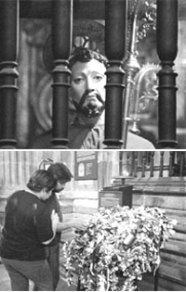 Officially he’s the patron of difficult childbirth (he was born posthumously — thence his name, which translates as “No-Name Ray”) but in the Metropolitan Cathedral the shrine to No-Name Ray is covered in padlocks. Reminders not so much of Ray’s mouthiness, but a request that the saint — who learned his lesson — put the holy hex on those who don’t speak only the word of God.
There is a nice prayer to San Ramon, that basically translates:
Oh San Ramon —
You preached the word of God,
and were martyred with a padlock through your lips for your trouble.
Please ask God to tell people to mind their own business and tell the liars
to shut the fuck up!
Now, if we could just find a patron saint to invoke against spammers.
This is the end, my friend. This is the end…
Burrohall said it succinctly:
NAFTA…once certain provisions finally kick in on Jan 1, is going to ream Mexican farmers like a freight train full of proctologists,
 As of today, U.S. and Canadian corporate farmers — and their genetically modified seed — will be entering the motherland of corn and beans. Outside of a few internet sites that preach to the converted (maybe including this one), no one seems to have taken much notice. What’s frustrating is that we all knew this was coming, and now that it’s here, we’ll be shocked, shocked to discover that Mexican farmers are fucked.
I haven’t heard anything from any of the U.S. presidential candidates on what’s probably our biggest foreign export issue (and import — you think some of those Mexican farmers aren’t going to turn to “alternative agriculture” — specifically to the few products the U.S. does not grow competitively? Like, oh… marijuana?”), even though they’re all running around an agricultural state right now.
Oh, a few warning signs appeared just before Christmas. An Associated Press article out of El Paso talked about the rise in tamale prices — which it blamed on the U.S. press’ favorite culprit, ethanol.
Once and for all, ethanol is made from yellow corn (used for animal feed), and what people eat is white corn. The jump in tortilla prices had more to do with speculation by U.S. producers than a shortage of white corn (Mexican white corn producers were doing well as late as last May).
With U.S. and Canadian subsidized agriculture competing against the “un-subsidized” Mexican farmer, who do you think is going to “win?”
We’ve known for a while what the results will be… more immigration to the United States. And, unlike what we’ve seen so far, this is not going to only affect the subsistence farmers. Even the large and middle-sized farmers can’t compete against cheap, export credited corn. By not negotiating a revision to NAFTA (as the “alternative president” had suggested), the Mexican government is creating a whole new class of underemployed, bankrupted — and potentially rebellious — campesinos. And these are the better educated ones. Some will emigrate to the U.S., some to the cities, but they are all going to be very, very pissed off.
I’ve been contemplating a return to D.F. — “inside the periferico” seems to be the place to be… though maybe the REAL story about U.S./Mexican relations is going to be written in Talyfulanotlan over the next year.
2007: Up in smoke

Manuel Peleáz took this photo of 23 metric tons of Colombian cocaine being destroyed (“decommissioned” is the preferred bureaucratic term) last October in Manzanillo. Transporting cocaine from U.S. ally Colombia to U.S. consumers probably is about as dangerous as mining or logging, but industrial accidents in the narcotics industry tend to grab your attention. The military option favored by the Calderón administration, and its fallout, has led to the death of 2,500 Mexicans this past year.

As of July, restaurants and bars had to provide non-smoking sections in the Federal District. Given Mexico’s libertarian streak (and the fact that 20% of Mexican adults are smokers), it’ll be a while before we see any results from this initiative. More practical anti-pollution measures like new bus and Metro routes — and the once a month biking bureaucrats rule are more likely to have an effect. Question… can a bureaucrat still smoke while he’s riding his bike to work?
 Gay marriage became a reality in February, when Coahuila finally got around to legalizing them. Nothing much happened as a result: no whiff of brimstone, no rain of hellfire. And no nonsense about “Defense of Marriage” and “states’ rights” in Mexico. One state’s marriage laws are as good as another. The Federal District passed a domestic partnership law late last year, but D.F. is not — yet — a state.
 Panamanian-born Miss USA managed to alienate everyone in Mexico. When she was boo-ed after falling on her ass during the beauty pageant, right-wingers in the U.S. tried to make it a “racial” issue. The Mexicans liked Miss Japan (the winner) and the issue never caught fire.
And Oaxaca continues to simmer.
The fire this time is gonna be after the first of the year, when corporate grown, U.S. subsidized corn will be allowed into Mexico.
The perils of writing history
DAMN! I just got the proofs of my Mexican history off to the publisher and some archeologist has to butt in:
The uncovering of an 800-year-old pyramid built by the Aztecs in what is now central Mexico City seems to indicate that the ancient settlement is at least 100 years older than was previously believed.
The 36-feet-high ruins were discovered in the Tlatelolco area, which was once a focal point of Aztec culture. Historians had long believed that the Aztecs founded Tlatelolco at the same time as its ancient twin city, nearby Tenochtitlan.
However, the newly discovered pyramid suggests that the Mexico City area was being developed by the Aztecs as early as 1100. “The (Aztec) timeline is going to need to be revised,” said an archaeologist who participated in the research.
I’ll wait til the first edition comes out before I start a second one… Porfirio Díaz was right — again:
Pissing (your money away) into the Rio Grande
I don’t think there is such a thing as an “objective” news story in the real world… we all have our biases, and that includes reporters and news organizations. Most of us buy corporate capitalism (and news organizations are no different than any other business — which means they are going to make their decisions pretty much the same way McDonalds, or McDonald-Douglass for that matter, makes theirs). Even writing for hick town papers, I couldn’t pretend to cover “all” points of view on any given issue. Covering contracts to upgrade sewers, for example, maybe I could talk to a a couple of different factions in a city administration, the loudest complaintants and the engineering firm. Everbody has an opinion, and my job — which reflected my biases and those of my employers — was basically to sort out which opinions were “valid” and which not worth the ink.
And so it goes. The biases of those of us on the border, when it comes to “border security” are different from the rest of the country, even the sane portion of the electorate.
Although the “beauty contest” known as the Iowa Caucus hasn’t even been held yet, (I lived in Iowa for a couple of years, and did vote in a caucus… belive me, they’re a joke). the dozen-plus wannabe candidates have made us down on the border pay for their political ambitions.
The lead editorial in today’s New York Times reads:
Even by the low standards of presidential campaigns, the issue of immigration has been badly served in the 2008 race. Candidates — and by this we mean the Republicans, mostly — have been striking poses and offering prescriptions that sound tough but will solve nothing.
True enough, though I don’t see the other corporatist party (the Democrats) as any better. At least the Times recognizes that all the yakking point from all the candidates have the same flaw. Nobody has talked about the financial costs.
I don’t know if anyone’s done a “cost-benefit analysis” of the heavy-handed approach we already take down here, but Robert Fantina’s “The Sham of Homeland Security” (Counterpunch, Dec 29/30, 2007) suggests that we’re paying quite a bit of money to allow these politicians to posture:
For example there is one Eleuterio Mosquera, a 56-year-old mechanic who had lived in the U.S. for seventeen years, during which time he had committed no crime other than remaining in the country after being told to leave. At 5:30 on a recent morning, Mr. Mosquera was leaving his Newark home for work at the recycling plant that had employed him for seven years, unaware that the two SUVs parked across the street contained a total of seven, heavily-armed federal agents.
…Now it is certainly admitted that Mr. Mosquera, who came to the U.S. from Ecuador in 1991 and had been ordered back to that country that same year, did not do so. But it must also be admitted that he had lived quietly, working, paying taxes and minding his own business for nearly 17 years. He purchased and renovated a house in Newark, an area in desperate need of such attention. Yet despite his innocuous, productive and totally non-threatening life, seven federal agents were required to arrest him. One has difficulty understanding this. If the government was not going to leave him alone, why not quietly arrest him? How much does it cost to send seven federal agents after such a man? And, as the the old cliché asks: ‘Can’t they find some real criminals to arrest?’
And, down in my neck of the woods — THE Border (the one crossed by recycling plant employees like Eleuterio Mosquera, not the one crossed by guys like Ahmed Ressam and Al Qaida gang-bangers.
Instead, the government — for the benefit of voters in places like Iowa (ot at least those who’ve bought the bullshit about “protecting the borders” from recycling plant workers) — is hiring those seven agents in New Jersey and a shitload of agents here… to make us LESS safe, not more.
“Illegal aliens” don’t commit that many crimes down here, though their corpses — when they’re unlucky enough to end up out here “thanks” to Federal policy — are expensive to deal with. But, with seven agents needed to take down a New Jersey junkman, you can imagine how many agents we’d need here to “stop the illegals” that … shop and buy and do business and server our meals and fix our plumbing… my way. Shitloads of BP agents… at a heftier pricetag than anyone wants to admit.
José Borjón of the Brownsville (Texas) Herald presented the bill:
Brownsville Police Chief Carlos Garcia is used to spotting trends as part of his job, but there’s an increasingly common practice within his department that’s starting to worry him: officers resigning to work for U.S. Customs and Border Protection
“There is nothing much that we can really do to try to (keep) officers from leaving the department after they have been here a couple of years,” he said.
A rookie patrol officer with no experience and straight out of the police academy will earn $28,131 annually. After two years of patrol experience they are bumped up to $35,328.
Rookie Border Patrol agents, on the other hand, start off quite a bit higher than their counterparts on the police force. Those straight out of college, or with no prior law enforcement or military experience, start off at $35,595 annually, said Oscar Saldaña, spokesman for the CBP’s Rio Grande Valley Sector. “With our incentives they can make up to $44,494.”
Those with military or law enforcement experience start off at $40,519 per year. “With the incentives, agents can very well make up to $50,649. It’s worth it,” he said.
After three years on the job U.S. Border Patrol agents can make up to $70,000, not including overtime.
South Texas and New Mexico border counties include some of the poorest people in the United States. Seven dollars and hour, without benefits, is considered a decent income where I live. Even retirees with pensions often live in trailers. So… we’re — or you (none of us make enough to pay the taxes y’all do) are shipping in very highly paid civil servants who live better than the rest of us to protect us from… our customers?
Our local police — the people who do the real crime prevention work out here — chasing cattle rustlers, breaking up bar fights, arresting drunk drivers and tracking down drug smugglers (ok, the BP and Customs Service does their part on that… but they’re looking for exporters, not the importers), nabbing poachers — can earn a heck of a lot more driving around at night stirring up dust on access roads (no joke — BP agents drive Chevy Tahoes dragging old tires behind them on the access roads along the border to make it easier to find footprints. Gas in Alpine is “only” 3.00 a gallon), or resonding in force to pick up some farmer from Coahuila who is sending money back to his mom.
Oh, and did I mention Alpine’s spanking new 17 million dollar Federal Courthouse? Or the Judge’s salary, or…
I’ll bet if we totalled up the costs of “border protection” it might be a hefty percentage of what the “illegal immigrants” pay in taxes. Or more.
Coming Home in Sinaloa
No wonder it’s taken so much trouble to get the “big media” to pay attention to the real cost of the War Against Iraq. Those guys are sitting in Washington or New York, wringing their hands over the price of gasoline, or looking at statistics. None of their kids are there, and no one they know — it’s poor country kids, and kids from places no one ever heard of that are being buried around the country. Or fleeing the country. It’s hard to recognize what the war really means in New York. It’s a different story in a town of 4300… especially when the town is Sinaloa.
My translation isn’t the best — I plead constant interruptions — but for those of you who can’t read Spanish, here is Juan Veledíaz in today’s El Universal.
GUASAVE, Sinaloa – When Idelfonso Ortiz Cabrera received a “invitation” from the United States Army to visit the Luke recruiting station in Phonenix, Arizona where he had been residing at the time, he pack up his belongings, crossed the border at Nogales and returned to the north Sinaloa town of Burrión, where he was born 18 years ago. .
In this community six kilometers south of Guasave it is difficult to find a family who does not have at least one family member who is a legal resident or citizen of the United States. Not only has the community been a departure point for migrants for the last several decades, but many of those living in the U.S. maintain a residence here, or come back regularly to visit relatives.
Idelfonso stands 1.80 meters high, with a mustache and “cholo-syle” haircut. His corpulence belies his shyness, especially when talking about talking about the reasons he returned to Phoenix after he, and other young Mexicans began receiving “invitations” from United States Army recruiters.
First, there were fliers seeking recruits being handed out to Latino-looking youths at shopping centers. They originally offered citizenship in return for a year’s service in Irak. That was then… now, they are requiring a year and a half in Iraq.
Idelfonso said he was not going to fight in a war that was not Mexico’s war. It has nothing to do with him, or his country. He packed his bags, took out his car keys and drove back to live with his parents in El Burrión.
He is not the only one in this small town. Carlos Mario Perez came back two years ago, as the the conditions for American soldiers in Iraq got worse and then, as American citizens rejected the war and stopped enlisting, the recruitment campaign began focusing on residents.
The first to be “invited” was his older brother Orlando, 34 years old and the father of two. Orlando turned down the offer, but it was obvious that immigrant recruit were much more likely to be put into a conflict zone.
“We lived near the base of the Air Force in Phoenix, newspaper we saw how they took off two airplanes Hercules with all the boys who got ready. They were recruiting like in the war of Vietnam, they said to you that they were going to you to train during a month and that after signing the contract in a citizen year or eras, as soon as he put himself the more difficult raised a year and many means to him and or better not even they were wanted to enlist “.
Carlos Mario related something his brother Orlando told him a few days ago in El Burrión, to the effect that the same sort of recruiting effort among Mexican residents can be found in communities all around Phoenix.
He pauses to recall that in March 2003, when the Americans first invaded Iraq, invitations to the Mexicans to enlist began arriving at his work center. He feared harrassment by the recruiters, who said that military service was obligatory for regularizing his residency. In July, he returned to Sinoloa.
Siblings Martín and Lorena Sandoval, who are also from El Burrión, were convinced to sign up. However, after a traffic accident in which her legs were injured, Lorena, 23, received a deferred enlistment. convinced him not to enlist. Lorena, 23, was planning to take the Army up on its offer, but he enlistment was deferred after a traffic accident injured her leg.
Martín, 26, received a letter telling him to show up at the Marine recrutinging center in Phoenix. Martín resplied that an eye disease prevented him from serving. Both Sandovals were convinced to return home, said Carlos Mario,.
The majority of 18 to 30 year olds in Arizona with family ties to Gunsave are either legal residents, or were born in the United States, making them citizens of that country. Carlos Mario was surprised to learn when his children were born that they were assigned a number that can be used to track their military service when they come of age.
“I have two kids, imagine that. When they grown, they’ll be cannon fodder in some war, and that’s when I came back. There are another 1500 children in Phoenix whose parents are from here.”
The Wedding That Wasn’t
When Ramón Romero Soto, a 19-year old local boy, who used to spend his vacations in El Burrión, was killed in Falluja on August 22, 2005 during an attack on a marine patrol, his relatives put up an altar in his house, in his memory, and in memory of all the boys in the community who every thought at one time of fighting in Iraq.
Ramón was born in San Diego, but his family are from this part of Sinola, He was a citizen of the United States, and had finished high school and had signed up for reservist training. From the time the Iraq invasion started, he had the idea of preparing to go to war, said his aunt, Fabiola Soto Parra.
Ramón conviced his mother, María Sota Parra to sign a letter authorizing him to join the Marines when he was 17, and still a minor. His aunt said that if his mother had not signed, Ramón would have joined up as soon as he was 18, anyway.
At the start of his training, he had no idea of how tough the preparation would be, and was out of communication with his family before leaving for Bagdad. Perhaps that’s the reason that at the first opportunity, he gave an engagement ring to his girlfriend, Tania Martínez, a Sinoloa girl whose photo also appears on the family altar.
Before leaving, Ramon told his mother and his fiancèe that if someday a military policeman came to their door, it mean it had been wounded in combat; but if two Marine officers showed up, it meant he was dead. After leaving, he was only able to speak to them for a few minutes every eight days. He talked about the packaged food that you had to heat up in the sun, said he had trouble sleeping, and expected to go into battle in a few days.
His mother had gone to visit his aunt in Tijuana for a few weeks. When she returned, there was a message on the telephone from the Red Cross. A few hours after returning the call to the Red Cross, the two Marine officers showed up at Ramón’s mother’s door.
Ramón had left for Iraq on the fourth of July and was killed by an IED in a Falluja street on the 22nd of August, 2005, after only a month and a half at the front.
The last time he had been in El Burrión had been the summer of 2003, when he was 17. He spent his time with friends at a beach near town and people had expected him to move down with his girlfriend when he came back from Iraq. Instead, he was buried in Rose Hills Cemetery in San Diego, California.


