What to see in Mexico City this week
Looking for something else, I ran across this neat photo of Panteon San Fernando taken by Abel Briquet some time between 1885 and 1895. It’s part of the Andrew D. White Architectural Photographs Collection at Cornell University.

I’ve always been facinated by this cemetery, as much for being the final resting place of Benito Juarez (who has the space originally meant for Maximiliano and Carolota), as for the mysterious grave (if anyone is buried in it at all) marked “Isadora Duncan.” Juarez, as far as anyone knows, was the last person buried there. Isadora Duncun is buried in Pere LaChase in Paris. My guess is that it’s a bishop or mother superior buried anonomously during the Cristero War under the name of the well known atheist and all-round rabble-rousing dancer.
The connection between the presigious Mexico City cemetery and the holidays is that Ignacio Zaragosa, the Texas-born hero of Cinco de Mayo is also buried here, in a space originally meant for the losing Mexican general, Miguel Miramon. The Miramons supposedly didn’t want their relation buried next to Juarez, “that damned Indian”. General Miramon was executed by firing squad next to Maximiliano and another Indian, Tomas Mejia. Mejia, interesting enough, IS also buried in San Fernando, along with a score of historical footnotes from the era.
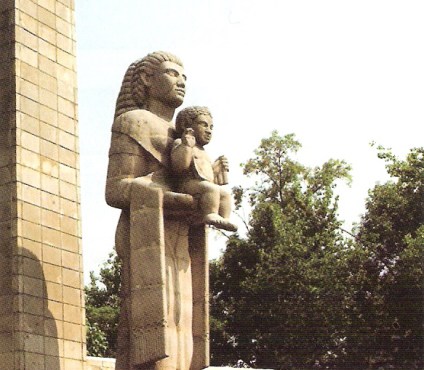
A newspaper campaign inaguarated by Excelsior in the 1920s led to the creation of a much more widely celebrated Mexican May holiday, Dia de las madres (Mothers’ Day), on May 10. The newspaper raised the money for the Monumento a la madre, which was inaguarated 10 May 1949.
This is a very Mexican mamí standing in Parque Sullivan — she is wearing a rebozo and her features are decidedly indigenous.
Canadian journalist Quade Hermann published this photo of the Veracruz campesinos who are camped around the Monumento right now. These guys lost a lot more than just their shirts in what was billed as “land reform” 20 years ago:

(UPDATE: I should have immediately recognized that this photo was NOT taken at the Monumento de la madre, but very nearby. Shame on me for not catching it before I posted. Extra credit if you know the street intersection*. The tip-off is in the lower right-hand corner. And, if you were wondering… the guys are wearing the photo of Dante Delgado Rannauro, who was Governor of Veracruz when the ejitals were broken up)
* A block down from the Monumento a la madre is the recently refurbished Monumento a Cuauhtemoc at Reforma and Insurgentes)
Good question
Kelly Arthur Garrett, the Mexico City Herald’s political writer, also is their book reviewer. He reviews a non-academic history of Cinco de Mayo and the Battle of Puebla (Cinco de Mayo by Donald Evans), and asks…
How is it that Cinco de Mayo, an entirely home-grown Mexican holiday, is celebrated more broadly and intensely in the United States than in the nation that created it? …Cinco de Mayo observances in the United States have served various agendas— a recognition of the Mexican heritage of certain regions, a rallying point for Chicano pride and political activism, a stimulus for community self-determination, a pan-ethnic celebration of all things Latino, a commitment to anti-imperialism, a marketing bonanza for the commercial sector, and an excuse to party.In Mexico, on the other hand, Cinco de Mayo naturally competes with a lengthy line-up of patriotic and ecclesiastic holidays, settling in somewhere near the middle of the pack.
…
It’s useful, for example, to remind us that what we take for granted today — that the French eventually retired from Mexico, that the North eventually won the U.S. Civil War — was anybody’s guess as events unfolded in 1862.
It’s also thought-provoking, if not entirely convincing, to suggest that had the Mexicans not won the Battle of Puebla, which delayed the French advance, “the United States would never become the significant world power that it is today” and “the nation we know as Mexico would probably still be dominated by France.”
But this effort to make Mexican history “relevant” by connecting it to U.S. concerns — rather than recognizing its value in its own right — caters to the stereotype of U.S. readers’ attention being limited by their own borders.
That the stereotype is probably true (as it is for residents of most countries), doesn’t justify feeding it.
Which doesn’t mean I’m not gonna enjoy Alpine’s Cinco de Mayo party.
WTF???
Is this Oaxaca or Los Angeles? The lady interviewed at about 4:40 into this 10.30 minute video — with the very “American” accent (if you need to ask) — makes more sense than anyone.
XP at ¡Para Justicia y Libertad! has tapes from Fox News 11 (Los Angeles) and Telmundo (both “Liveleak” which may be a problem for some. There is a copy of the FOX tape at http://www.youtube.com/watch?v=UFdNkXJMH9A.
I’m waiting for the Fox spinners to claim this is something from the leftwing, mainstream media. On the Channel 11 tape, the announcer does his best, talking about the police “needing to break up the crowd.” Why? The Fox tape includes attacks on a Univision crew, and some of the footage is from that Spanish language network.
Univision and Telemundo… maybe the Fox spinners could make something of that… but Univision, Telemundo AND FOX?
Rites of Spring in Oaxaca
In the Big Bend we know Spring is coming when the retirees in their buses and RVs start flocking north and the buzzards return (looking, I supposed, for whatever RVers are left behind). In Oaxaca, it’s the return of the teachers to the Zocalo:
I translated this short notice from yesterday’s Grafíco:
Teachers from Seccion 22 – the dissident Oaxaca chapter ofthe Sindicato National de Trabajadores de la Educación (SNTE – the National Teachers’ Union) — and backers of the Asamblea Popular de los Pueblos de Oaxaca (APPO) again came to the Zocalo of Oaxaca for a march this May Day.
In addition, students took over the University of Oaxaca radio station, broadcasting support for the movement which calls for the resignation of Governor Ulises Ruiz.
They encouraged the people to participate in the march and announced road blockades around the state.
Ezequiel Rosales Carreño, of the the 13 members of the Seccion 22 Political Commission, said yesterday that the democratic teachers’ union had presented a list of demands to the Secretaría de Gobernación.
Bootsnall had an on-site report:
International Workers Day is traditionally a big holiday in Mexico with workers getting the day off to celebrate. Oaxaca had a huge march…thousand walking to and out of the Zocalo. The APPO contingent showed up about noon…a few speeches and songs…not a lot of interest. But observers say things are heating up.
But you know those nice pretty newly painted walls that the Governor paid for? They are now all full of graffiti again…
Today there is supposed to be highway blockades and strikes. I will definitely not be taking my car out today
I guess Oaxaca IS back to normal — though this year, there’s a NEW AND IMPROVED “threat” to the Gov’ner: an email on a Spanish website. I’m kind of dubious about how seriously though to take cyber-guerillas
The Southern People’s Revolutionary Brigade (BPRS) claimed that it is the armed wing of the Oaxacan People’s Popular Assembly (APPO). This group took the lead in running the huge strikes and protests that took control of Oaxaca City from May to October 2006. The BPRS said that one of its goals is to remove Oaxaca’s governor, Ulises Ruiz, from power. Is the group for real? It used to take a fax machine and one or two “armed incidents” to be a guerrilla group. Now it takes an email letter. The Mexican government, however, cannot dismiss the group out of hand. The Oaxaca “occupations” were a major political embarrassment for the government of former Mexican president Vicente Fox.

Cyber-guerrilas are coming! Call out the Robo-cops!
Damn clever those Chinese
Mexico’s former Ambassador to the People’s Republic of China, Cecelio Garza Limon write in the Latin Business Chronicle that Mexico needs a China Policy.
…
The recent evolution of economic relations between Mexico and China brings considerable new challenges for Mexico. Mexico’s foreign trade has been its major engine of growth since the end of the 1980s, but this edge has been eroding, to a certain extent, as a result of China’s active integration into the world markets. The competition of Chinese products, in Mexico, the United States and other major markets, is an issue that affects Mexican development prospects.
…
In the early 1990s, when NAFTA was being negotiated, the Mexican negotiation team inadvertently placed Mexico within an economic strategy which was more Asian in nature than American. Mexico embarked in consolidating an export platform that ultimately assigned more importance to geographic advantage than to productivity. This put Mexican exports in a direct collision route with those that would be more effectively produced by the Chinese economy.
In 1994, few analysts understood the dire competition within NAFTA that would come from Chinese companies. Of course, the issue is not related to having opened Mexico’s borders to trade, but rather to failing to plan and foresee what it would mean to enter global competition without a broader strategy beyond North America.
At the onset of NAFTA, Mexico became an economy similar to China at the time: a kind of convenient platform for quick business returns. The Chinese realized this and they planned and acted in consequence, while Mexico continued opening its economy through an array of free trade agreements, but looking mainly toward the north.
…
China’s capacity to focus is amply evident. When I presented my credentials as Mexican Ambassador to China, President Jiang Zemín surprised me by telling me about his long stay in Mexico at the beginning of the 1980s. Neither our Embassy nor the Mexican Ministry of Foreign Affairs knew anything about this. As a prominent engineer, he was commissioned to analyze the border situation with the United States, between Ciudad Juárez and Tijuana, due to the unique similarities in asymmetries between countries with such different levels of development and the parallel between southern China and British Hong Kong. This analysis would later allow him to be in charge of building the new city of Shenzhen, which took into account the experience faced by the maquila cities of the northern border of Mexico.
…
Mexico needs to understand that export orientation is not sufficient for growth and development, particularly when based on a relatively cheap labor force. In the early 1990s, that condition allowed Mexico to integrate into the U.S. market through NAFTA. Currently, however, several Asian economies (including China) offer a cheaper labor force, but also long-term strategies and a variety of incentives for investors.
Jiang Zemín lived in TJ? WHOA! and I thought the stories about Chinese commies on the border were just updates of the Hearst publication’s old “yellow peril” hype.
Tête-à-tête: A citizen’s note on immigration
Lorena Diaz de Leon — though she still hasn’t been able to get this “wordpress thing” straightened out (she’s not the first one to have trouble with it) — sends this May Day missive along:
The view in our nation is at odds as to who should obtain the right to enjoy the liberties of our nation; these very laws are propounded by a democratic nation where the ambiguity of the path to citizenship and the non-existent immigration laws have left a bitter taste in Americans’ mouths. Who is right? Are the people, screaming of the strain immigrants place on the economy and the danger they pose as being “undocumented”, right? Or, are the people, hollering for legalization so that they could benefit from the privileges of natural citizen, right?
There is one fact amidst this burgeoning chaos. The twelve million illegal immigrants residing in our nation will not be easily hoarded on a bus, which is the current “raid” technique employed by the Immigration and Customs Enforcement (also known as ICE, a funny sort of acronym giving illusions to the recent, cold force if you will, of the heavily armed agents in the recent Chicago raid). Yes, I agree that citizens should be protected within our borders, but, by no means should inhumane tactics arise on the sole basis that one is “illegal”.
In the Chicago raid, for instance, was it really necessary to conduct the raid in a manner mimicking an army ready to conduct war? Those that disagree with the proposition of the raid’s purpose as an intimidation tactic could beg to differ, but, sorely lose when attempting to explain the logic behind the tactics applied. According to the National Network for Immigrant and Refugee Rights, raids do not impact migration patterns, rather they definitely violate constitutional and civil rights by utilizing physical, verbal and psychological abuse—and, evidently, have resorted to racial stereotyping. This data was compiled from the reports of 235 raids conducted in thirty one states, and these facts can be found in Jorge Ramos book, The Other Face of America
Jorge Ramos, a respected television correspondent for Univision, sees the immigration conflict in terms of “supply and demand”, in other words, as long as there are jobs in the U.S. and as long as there are willing immigrant workers, they will fill those positions. Ramos provides interesting particulars about American society: Immigrants in the United States comprise almost 11 percent of the population; this, surprisingly, has not been the highest peak in immigration for in the years 1870 and 1910, the percentage hovered around 14 percent. Let us remember: it is the eleven percent of immigrants that not only contribute to the economy but, who will as Ramos exclaims, “During a crisis, immigrants will defend the United States as if were their birth country…And, as has been the case in most wars America has participated in, a large percentage of soldiers are named Salinas and Perez and Rodriguez.”
In writing this piece, I tried to gain all perspectives of this controversial debate that has politicians boiling over with confusion. I sought the anti-immigration sentiment and came across (no surprise, of course) Lou Dobb’s commentary, Big media hide truth about immigration, posted on CNN’s website on April 25. Dobb’s is notable for his raucous attacks on immigration. His commentary left me on a desert island, without any fresh water to take refuge in, confused as if I were stuck on a bad episode of Gilligan’s island with other politicians.
The following is taken from his commentary:
Too often, the language of the national media describes illegal immigration as “migration” and illegal aliens as “undocumented immigrants,” even though many of them have lots of documents, most of which are fraudulent or stolen. Some media outlets have taken to calling illegal aliens “entrants.” Whether such language is meant to engender sympathy or to intentionally blur the distinction between legal and illegal, the mainstream media are taking sides in this debate. There’s no question this type of mass immigration would have a calamitous effect on working citizens and their families. Professor Carol Swain, professor of law and political science at Vanderbilt University and author of “Debating Immigration,” would like to see more people speak up for the sectors of society most affected by illegal immigration. To address the first point, no matter how you paint a word, whether one chooses to call them “undocumented”, “illegal”, “entrants”, the fact remains the same that they are immigrants, moreover they are “humans”— a shocking revelation, I know. The media is multifaceted, there is a venue for all sides, and whether a reporter chooses word A or B, probability lets us know that another will choose just as effectively another word to convey their point.
The second point is over-used and untrue. The National Academy of Sciences reports that immigrants add about ten billion a year to the nation’s economy; immigrants contribute more than they take! The only calamitous effect that would be seen is when immigrants stop supplying their workforce.
On a last note: With the spirit of American hope and diversification, thousands gathered across the nation to garner support for the reform of immigrant legalization. The rallies provide an outlet for unification and send a powerful message to our leaders: Immigrants need to be protected against racist tendencies seen in some sectors of our society. Immigrants should be granted a fair law to aide on their path to citizenship. And, the U.S. must work with the Mexican government to provide a consensus on immigration flow and safe border patrolling. The rallies also send a message to all citizens: We must embrace our commonality and what it is truly to be an American, a citizen of a multi-cultural society.
Endeavor to persevere…
T he cranky “comments” and emails I sometimes get from people — aside from the illiterates who seem to think I’m an agent of the Mexican government on a mission to drag “Dog the Bounty Hunter” back to Jalisco — usually are from folks that have already made up their mind, and don’t want confused with things like facts. Facts are hard, as George W. Bush might say.
Well, the facts are, immigration is FUBAR. Even for legal immigrants, it’s not the simplistic world of Pat Buchanan or Lou Dobbs. If they want to read fiction, they should stick to Kafka. Otherwise, they should be reading Laura Fern’s One Step Closer
I miss Fermin. I’m an independent, generally optimistic person, and I really believe not dwelling on our separation is best for me. It’s not denial, just coping. I stay busy, work hard, remain a productive member of my community and workplace. But some days, when all this stuff piles up, and there doesn’t seem to be any end in sight, and I don’t have a trip planned to Mexico, I just want to give a big middle finger to this country, quit my job(s) and move to Mexico.
This puts a very human (and very literature human at that) face on a part of the immigration “issue” we don’t often see. For Fern, and her husband, Ferman, this isn’t an issue… this is people. The absurdities of the immigration process mean Ferman is living and working in Mexico, Laura in Milwaukee.
Both are well-educated people, and work, but even they can’t quite manage the absurd immigration process. She writes (in response to a person questioning another separated couple’s situation, and the supposed “ease” of immigration):
Mr. Lopez is applying for lawful permanent residency (this is necessary before applying for citizenship) through his fiance relationship with Laura Braun. However, were he not involved with her (or another U.S. Citizen), there would be no avenue for him to legalize. Even if he had never been in the country illegally and been deported, he would have had to be an extremely educated or exceptionally skilled foreign worder to immigrate here legally. I appreciate your sincere questions on this issue, but I have to admit I am always shocked when I realize that there are still many who believe Mexicans (and other low-skilled foreign workers) have some legal way to immigrate to the U.S. They very simply do not.
Laura recommends “immigate2us.net” for people like her, and … I’m assuing… some MexFile readers might also find this a useful resource. Those of us NOT in this situation could learn something (but we have no business posting there). So could Franz.
“Absolute Idiocy” along the border
Molly Ivins died too young…
[Texas] Gov. Rick Perry told a Pittsburgh newspaper that some border-crossers with al-Qaida ties have been apprehended.
“The information that we have is that there have been individuals who have crossed, and some that have been apprehended, that have ties back to the al-Qaida network,” Perry told the Pittsburgh Tribune-Review on a trip to the city to speak at a Boy Scouts dinner.
“I don’t get confused that with the lack of manpower and the lack of resources that the federal government has made available that you can cross the border, and you can cross the border with enough frequency and with enough items to create a lot of havoc,” he said.
Perry spokesman Ted Royer said Friday the statement was a continuation of comments the GOP governor has made for years. The comments have been based on federal intelligence sources having “confirmed that al-Qaida and other terrorist networks view the Southern border as a prime point of entry,” Royer said, with people from countries where al-Qaida has a known presence having been apprehended not just in Texas but all along the border.
That presumably means the Iraqui Catholics who tried to enter the United States back in late 2001 (bad timing, that) and were eventually given political asylum in Mexico.
Secondly, doesn’t countries with a “known presence” of Al Qaida folks include Great Britain, not to mention a lot of places people are leaving, and who go to Mexico to enter the United States? Ah well… our Governor is better known for his hair than for what’s under it.
This has nothing to do with immigration, and everything to do with pandering to the 39% of Texans that voted for that moron. He didn’t get a lot of votes down in my neck of the woods, nor would he expect to. He appeals to what locals call “Yankees”… the folks from places like suburban Dallas (which is just a far suburb of Oklahoma City when you come down to it). The folks who panic when out of their comfort zone, and who see anything “different” as a threat.
Well, we’re not all that different down on the border… but don’t expect us to buy into THEIR solutions to THEIR problem:
MCALLEN — South Texas border mayors and economic leaders expressed anger and disappointment Monday after learning new details of the location of 153 miles of controversial fencing in and around border cities — including some downtown areas.
”I am totally disappointed,” said Laredo Mayor Raul Salinas, who heard Sunday night that 19 miles of fencing in his city would begin downtown. ”I remain steadfast in opposition to the building of a fence.”
”It is absolute idiocy,” said McAllen Mayor Richard Cortez, who contends that illegal immigration can only be stemmed with a guest worker program. “A fence by itself is only going to delay people from crossing.”
It’s our business, and farms and tax payers (and sheriffs) who are being asked to take care of THEIR problem. It’s our stores that close because the customers can’t get there. It’s our county that has to pick up the tab for autopsies when people drown crossing the river, or die out in the mountains. Heck, for that matter, we can’t afford a coroner (death certificates around here are signed by the radio announcer for local basketball games).
If the rest of the country needs workers, and drugs all we are is the crossing point. And, until now, a very minor one. Push people away from the cities, and they’ll be coming through the park. Because it’s easier to blame others than to deal with your own damn economic problems, THEY want to destroy our environment.
Better than facing up to what the real issue. Roberto Rodriguez nailed it:
In the minds of Americans, the U.S./Mexico border is brown. It is where potential terrorists can infiltrate because it is also where other brown peoples are waiting to stream in. Terrorists, immigrants, illegal aliens, drug traffickers: all brown, same thing. Close it down, put up a wall, deport them all. The American mindset.
And, in the process, destroy our tourism industry, close our businesses, raise our taxes and put us under surveillence. Good plan, little Ricky.
May 1… 1886, 2006, 2007

Last May 1, in Slate Magazine, labor historian Nelson Lichenstein wrote:
Democrats and some leaders of D.C.-based immigrant groups worry that the call to boycott work and shut down Latino-dependent businesses will generate a backlash. Republicans and nativists see them as un-American.
But all this is beside the point, a tiff that misses the marches’ transformative impact. These May Day demonstrations and boycotts return the American protest tradition to its turn-of-the-20th-century ethnic proletarian origins—a time when, in the United States as well as in much of Europe, the quest for citizenship and equal rights was inherent in the fight for higher wages, stronger unions, and more political power for the working class.
Because today’s marches are on a workday, they recall the mass strikes and marches that turned workers out of factories that convulsed America in the decades after the great railway strike of 1877, the first national work stoppage in the United States. Asserting their citizenship against the autocracy embodied by the big railroad corporations, the Irish and Germans of Baltimore and Pittsburgh burned roundhouses and fought off state militia in a revolt that frightened both the rail barons and the federal government. Hence the 19th-century construction of all those center-city National Guard armories, with rifle slits designed to target unruly crowds. The protesters wanted not only higher pay and a recognized trade union but a new birth of egalitarian freedom. Indeed, May Day itself, as an international workers holiday, arose out of a May 1, 1886, Chicago strike for the eight-hour workday. The fight for leisure—clearly lost today—was a great unifying aspiration of the immigrant workers movement a century ago with its slogan, “eight hours for work, eight hours for sleep, eight hours for what we will.”
Last May Day’s student walkouts caught me by surprise… I wish I’d saved the photo of the boycott and march in Kodiak Alaska (but apparently the original Jornada link is on strike). The March school walkouts surprised everyone, and the talking heads didn’t quite know how to cover them. CBS News still has a March 26, 2006 AP wire service story available: Immigration March Draws 500,000 in L.A .
The “spin” was that it was a Spanish language radio station in Los Angeles had started the walkouts. Okie-dokie, but how do you explain then the walkouts in places like Charlotte North Carolina or Carrolton, Texas? And, it does beg the question of why our media missed a major story if they had warning – and why – in the 5th largest Spanish speaking country – major news sources aren’t checking out what their colleagues are writing and talking about.
No… they missed the REAL story. The professional babblers couldn’t quite grasp that kids had used technology – cell phones and e-mails – to organize a mass movement without adult supervision. The kids made it real, and brought home the immigration story to everyone.
It was a little too real. Everyone forgets that even then, “more than three-quarters of Americans favor allowing illegal immigrants who have spent many years in the United States to apply for citizenship, according to a poll conducted for CNN by Opinion Research Corp.”
It looked like there might be real change, and the “responsible adults” — the human rights organizers, the Catholic Church, the Labor Unions, those Latino and Democratic Party officials Lichenstein mentioned – only hoped to make some vague point about how immigrants were part of America.
The Las Vegas strike (in a city that would collapse without immigrant labor), looked more like a Fourth of July parade than a serious attempt to close businesses down:
I don’t think the immigrants who rioted in 1877 or who started marching in 1886 were trying to appease the Lou Dobbs of their day. They were trying to get their rights. And, if they pissed a few people off — like the high school kids did the month before — that goes with the territory.
I never understood how a boycott, that was advertised as not meant to hurt business… or was only half-heartedly supported by it’s backers (the Mayor of Los Angeles insisted the students stay in school, and the Cardinal of the same city suggested people go to a special Mass instead… which may have pleased God, but wasn’t going to force economic or political change in the sinful world). At best, it was a symbolic event, and any impact was subtle at best.
While you’ll notice that the loudest congressional voices calling for anti-immigrant legislation were all defeated in the November 2006 elections, immigration raids have increased,
It wasn’t losing a day’s work that scared the right and the establishment – it was the strength of the labor movement. Or the startling fact that the U.S. still has – and needs – labor unions. The old mantra, “the immigrants are doing the jobs Americans won’t do” is more or less correct. The right-wingers had no real comeback, except to claim that native born workers WOULD fill these jobs if it wasn’t for the foreigners. Which makes one wonder why the first round of immigration raids was at unionized plants. Maybe to bring in native born non union workers?
The raid in New Bedford on the sweatshop only came after people started noticing that the raids were against union shops. And, given how sleazy the employers were, it was a safe raid. Not that any native born workers are going to fill the jobs that have opened up.
But, without May 1, 2006 to bring the issues up, would we be talking about Ritmo, or Hutto, or laughing at the whole ridiculous idea of a border fence? Would we still be taking the Minutemen as anything other than a pathetic bunch of overweight remnants of the Wenwe tribe (as in … “when we ran things…” — which they never really did, being pawns in the whole system all their lives)? Would the Mex Files have as many readers as it does?
What May 1, 2007 brings, I don’t know. Crowds will be smaller than last year, but there more people recognize the importance of the issues:
Last year’s May 1 boycott brought out more than a million protesters across the nation. But later rallies failed to produce large turnouts, as legislation stalled in Congress and bipartisan proposals for illegal immigrants to gain citizenship have become more conservative.
The developments have disheartened many would-be marchers, but organizers said the frustration with Congress also brought out new supporters.
“It used to be that Hispanic immigrants, those who came legally, were more conservative on the issue,” said Joe Garcia, a Cuban-American who heads the Democratic Party’s Miami-Dade County chapter.
“But now it’s become so wrapped up with issues of racism and identity, even Puerto Ricans and Cubans care about immigration,” he said.
It’s always been said that the secret to U.S. political stability has been the ability of the “establishment” to coopt change, and that the “business of America is business.” People aren’t going to boycott (though maybe they should), but hopefully, they’ll keep up enough noise and under the radar cyber-pressure to force business and the “establishment” to pay attention to the issue.
Montanto v Mexico… Montsanto wins
I can’t say it’s a complot, but I don’t think the corn shortage and subsequent jump in tortilla prices earlier this year were unrelated to the push to sell GM corn in Mexico, and to force Mexican farmers to become dependent on foreign agribusiness corporations.
According to the agreement signed earlier this month (18 April) by Mexico’s National Confederation of Corn Growers (CNPAMM) ― affiliated with the umbrella agricultural association National Campesino Confederation ― Monsanto will provide Mexican producers with GM seeds, as well as initiate activities to protect native maize, including setting up a maize germplasm bank.
Many environmental and indigenous groups oppose the introduction of GM plants, fearing that it may contaminate native varieties of maize in the country.
Maize originated in Mexico and is home to 3,500 native varieties. It is the main food crop in Mexico, its production employing almost 12 million people.
Mexico has found alternatives for some GM crops until now (like rice) but the interconnections between U.S. corporate interests and a Latin American market are too strong to assume political pressure wasn’t involved.
Expect further decline in Mexican agriculture, and growth in “alternative economic activities” (i.e. narcotics) as small farmers, who will be unable to keep GM corn out of their fields, or pay the higher prices necessary for cultivation turn to other ways of making a living.
Leave them kids alone
A Presidio friend of mine says, “I’d rather have educated neighbors” whenever the “problem” of Mexican students attending school in the U.S. comes up.
One of our sillier local publications thought they would get a good “scoop” out of writing on the number of Mexicans attending school on the U.S. side, but it isn’t a huge percentage of the students in border districts… and … as with the kid mentioned in this story, most of the students crossing the border to go to school are already U.S. citizens, living with Mexican relations.
And… while Mexican education is very good, in general, the schools never have enough supplies, the classrooms are crowded and the teachers are poorly paid. I don’t see much difference between the parents who send their kids across the border, and those that send their kids across school district lines to the “better” school.
Yeah, there is the funding problem. U.S. schools normally depending on local property taxes for support, which wouldn’t apply to those kids crossing to attend church schools or private academies (or the college students). And, around here, it’s not at all unusual for someone to have a business in the U.S., but their house in Mexico. Some of these “Mexicans” may already be paying property taxes.
This isn’t the big deal that some want it to be, but it’s worth watching, since it’s going to be the new, improved “border issue” for a while:
Growing Number Of Students Walk From Mexico To U.S. Schools Every MorningApril 30, 2007 8:44 a.m. ESTLinda Young – AHN Staff WriterEl Paso, TX (AHN) – The growing number of Mexican children who walk across the border every morning to schools in the United States has critics arguing that U.S. taxpayers shouldn’t pay the tab to educate them. Students walking across the border have become so common that last month officials opened a special walking lane for them. It’s an issue for local schools facing soaring costs. In El Paso, the school district is preparing for a $230 bond election to build new schools to accommodate an expected 10,000 new students in the next five to eight years. Although most of them won’t come from Mexico, the fact that many do is a thorny issue for taxpayers weary of soaring tax bills.
A local newspaper on Sunday reported that more than 1,200 people from Mexico used the new walking lane on a recent morning. Among them was Aaron Ortiz who walks his 6-year-old daughter Rachel from their Juarez, Mexico home to her El Paso elementary school every morning, the Houston Chronicle reports.
Ortiz and his daughter are both U.S. citizens, but her mother is not and after she lost her green card, the family moved back to Mexico. Ortiz owns a vacant house near Rachel’s school, which satisfies the residency requirement.
He said he considered sending Rachel to a Mexican school but didn’t because the classes have 40 students, who meet in two shifts during the day using outdated resources, including a string of alphabet letters with some missing. He grew up in the U.S. and attended U.S. schools.
“As a parent,” Ortiz told the Houston Chronicle, “it doesn’t matter if you don’t make it, just as long as your children do.”
That sums up the attitudes of many Mexican parents who send their children to U.S. schools. Many of them also cite violence in Mexican schools as a reason to send their children to U.S. schools. And while the Ortiz’s own a home in the U.S., other students use the address of relatives living in the United States.
That is one reason critics object to U.S. taxpayers paying to educate students who commute from Mexico.
But not all of the students are in public schools or in K-12. Some students are in private schools or attending college.
Copyright © AHN Media Corp – All rights reserved.
The Mex Files Society Page
Your tax pesos at work:
Life is a ball for 180 teenage girls from Mexico City who danced the waltz at a mass ‘quinceanera’ party in their honour.
The girls – all from disadvantaged families – posed in donated ball gowns as the city threw a big party.
Quinceanera parties are traditionally held on a girl’s 15th birthday and mark her passage into womanhood.
But girls from disadvantaged families often miss out on the tradition. The parties are held in countries across Latin America and often rival weddings in expense and fanfare.
Among the participants at the ball in Mexico City’s main plaza were juvenile offenders or shelter residents.
Some of the girls were given sashes to wear, each bearing the name of an area in which young people have rights: education, recreation, and a clean environment.
And Felipe Calderón attended a wedding:
President Calderón spent 66,000 pesos in public funds to attend the Feb. 9 wedding of a leading National Action Party politician, according to information released by the office of the presidency.
Calderón, his wife and a five-man security team traveled to Torreón, Coahuila, in a Gulfstream jet at a cost of 51,578 pesos, paid for by the public treasury.The wedding – between Jorge Zermeño, the president of the Chamber of Deputies, and Astrid Casale, a TV reporter – was billed as a private activity by the office of the president.
How many quinceanara dresses can you buy for 66,000 pesos? Well, I’m sure the wedding was a very nice affair.


