Situation normal?
Nothing changes in Mexico… until it changes
(attributed to Porfirio Díaz)
 Did the election change anything? I’m afraid my vantage point was my kitchen window (looking down into my neighbor’s garage, which was a polling station), PREP data (the official vote counts which started coming in about 8 PM, and I stopped looking at 1 AM) and various news reports.
My take-away… yes and no.
As Jan Martínez Ahrens reports for El País, the PRI is still in control of the federal legislature… although it has lost somewhere around a dozen seats, its ally, the Greens, has picked up around 14. In theory, this strengthens the PRI, but with the wide-scale scandals surrounding the Greens’ flaunting of the election laws (and growing demand that the party be stripped of its registration, or more severely sanctioned), the PRI risks losing even more credibility by its close association with the Greens, and individual Greens may defect to other parties, or be the find themselves the scapegoats for whatever the next scandal to be uncovered within the legislature might be.
PAN … which is in the middle of its own ideological fight over party leadership (between the Madero and Calderón factions) … returns to its normal 20 percent or so of the electorate. Where there has been the biggest shake-up is in the PRD, which has dropped from its normal 15 to 20 percent to a mere 11 percent. Picking up the slack on the left has been Morena (López Obradór’s new party) which looks to have about 10 percent of the vote, too.
While Morena is more a populist than a leftist party (in includes some on the far right, who simply are attracted by Morena’s calls for austerity in the budget and its nationalist vision), it has a claim to be the “authentic” voice of the Mexican left, and … assuming PRD will join with Morena (and Morena, more than likely with the Workers’ Party — which seems to have squeaked by with enough support, sometimes in coalition with PRD, to maintain its registry as a party) and the Citizens’ Movement (like PRD, originally a dissident faction within PRI, vaguely leftist, though led more by the rural middle-class than the PRD’s Mexico City intelligentsia), one can imagine another fractious left-wing coalition within the next Chamber of Deputies and Senate.
One of the surprises of the night… Social Encounter’s much stronger than expected showing looks like it means it will be registered as a permanent party, and will have a few seats in the legislature… will need to be a junior partner in one of the oppositions… that of PAN or the left is to be determined.
And, of course, with the PRD largely discredited in much of its traditional strongholds (like Guerrero), whether it would be to the benefit of a leftist coalition to have the more opportunistic pols from the old left joining the (not new, but re-newed) left is a problem to be resolved.
Within Mexico City, Morena did exceedingly well, though its candidates were, for the most part, just recycled PRD and other party switchers (our incoming Jefe de Delegación, Ricardo Monreal, was the governor of Zacatecas for PRD, then a Workers’ Party Senator for a six years, and now a Morena leader for Delegacion Cuauhtémoc), gaining five to seven delegacion leaderships and about a third of the District Assembly seats. PRD, or PRD in coalition with the Workers’ Party, gained most of the rest, a few remaining in PAN or PRI hands.
Always aware that the left here tends to form a circular firing squad, it does look as Mexico is back to where it normally is… with PRI (though now operating through the Greens and the Alliance as partners) with about 40-45 percent of the vote, PAN with out 20 to 25 percent, and the fractured left with about a third.
So… nothing changed. Until it did.
The foreign media has been somewhat gaga over “El Bronco” (Jaime Rodriquez) who blew away both PAN and PRI to win election as the independent governor of Nuevo Leon. However, with Rodriquez having spent his long political career as a PRI-ista, and his slick campaign (notable mostly for its saavy use of social media) whether he is really an “independent” as claimed, or simply notable (like Vicente Fox) for mastering a new campaign style, is something that has yet to be determined. It is notable that independents and minor party candidates (from Social Encounter) won municipal presidencies in Nuevo Leon as well. Soccer legend Cuauhtémoc Blanco was elected Presidentee Municipal of Cuernavaca on a local party ticket, overwhelming his PRI and PAN rivals. Another independent, Sinaloan Manuel Clouthier Carrillo won election to the Chamber of Deputies. Clouthier Carrillo is, of course, the son of PAN’s greatest leader (who turned what had been a cranky rightist party into a genuine conservative opposition), Manuel de Jesús Clouthier del Rincón.
The younger Manuel quit PAN (as did his sister) in protest against the party’s return to its far-right (as opposed to conservative business) roots and its willingness to make deals with PRI. I have qualms about “independents”… wondering if they aren’t beholden — if not to factions within their old parties (like “El Bronco”) than representing as much their own financial interests (Clouthier is a very wealthy man, and owner of the Noroeste media chain in Sinaloa) as the voters to whom they appeal. Still, a shakeup is a change.

Null ballot
Despite desperate pleas from the left and right to vote, if only to prevent the PRI from maintaining control of the political system, it’s becoming clear that the old system, even the so-called “reformed democracy” that has allowed for multi-party elections, is not meeting everyone’s needs. Turnout, while higher than was feared (probably about 45 to 50%) was relatively low for such a controversial and multi-candidate election. The percentage of “null” votes (ballots left empty or purposely defaced) was relatively high… polling better nationally than at least four of the ten parties. There were overt calls to boycott the election, and in a few communities it appears the elections could not be held, it looks as if the system is here to stay… until it changes. Which, it just might.
Whether the people are satisfied with the results of this election, there is growing consensus in the idea — as formulated by Juan Antonio Crespo — that Mexico is a multi-party state, but not a multi-party democracy: that the Greens are just the PRI under a different label; that the independent candidates are not independent of outside interests differing from those of the candidate’s constituents; that the cost of the elections with 10 parties and any number of independents is more an investment in political parties and political advertising than in doing the people’s business.
And that nothing has changed… until …
Sources: PREP data, El País, Proceso, LaJornada, Noroeste, Vice, El Universal, Televisa.
Peña’s overthrow?
Fair or not, (Proceso, 4 June 2015) sees Sunday’s election not so much as a rejection of the Peña Nieto administration as an admission by that administration of its own failures. And Mexico’s
My quick and dirty translation:
Sunday’s elections are anticipated to mark a defeat for the government of Enrique Peña Nieto.
The president and his government are reduced to mere by-standers to those who have challenged the electoral process, one marked by violence and illegality.
The immediate concern is organized crime in Tamaulipas, Jalisco and Michoacan, and radical and anti-government movements in Guerrero, Oaxaca, Chiapas and Puebla.
If the score of murders and threats to candidates and political operatives in Guerrero, Oaxaca, Michoacan, Tabasco, Yucatan, Veracruz, Puebla, State of Mexico and the Federal District, along with clashes in Sonora, just to mention the best known cases, almost half of the states have experienced electoral violence even before election day.
Particularly troubling was the incident in Tamaulipas last Tuesday (2 June) when a grenade was thown at the headquarters of the Federal Judiciary Council (CJF) in Matamoros, the first attack ever on the Federal Judiciary. Although the CJF is alien to the electoral process, the attack that left four injured is part of the atmosphere of violence and illegality surrounding the general election.
Even more serious for the country’s stability it is that illegal activities are being driven by the policial powers and the party system itself. The persistent challenges of the Green Party to the electoral law has been one example no one can miss.
With the backing of the ruling PRI — with which the Greens are presently allied — or with PAN — which has formed alliances with the Greens in expection of a coming victory — the Greens have devoted themselves to violating the electoral law to the point that they generated an organized social reaction intended to withdraw the party’s registration.
The brazenness of the Green Party can not be taken for just a campaign issue. There needs to be a continuing discussion of the circumstances under which a party should lose its registration and how to deal with such parties as part of political coalitions.
Although it was the most obvious law-breaker, the Greens were hardly alone. Beyond the accusations of the involvement of organized crime in the elections, itself a serious problem, candidates and political operatives acted as real criminals, organized to commit unlawful acts and cover-up their activities.
Wiretaps leaked during election campaign offer a collection of evidence of varied criminal activity by those seeking to maintain or gain power.
The desire to maintain or gain power has led to parties and candidates to violate as many laws as possible with the certainty that will not be punished due to a lack of accountability.
They know that beyond the scandal reported in the press, perhaps they will be fined and their (state-funded) resources questioned, but will seek to the monetary penalty, which they will pay with public funds.
What is ideal for parties is the worst possible deal for citizens, made worse by the failure of the head of state to exercize his authority. The electoral process has shown the transcendental weakness of Peña Nieto and displays to the world the depths to which Mexico has sunk.
Comrades
Speaking of repackaged old political groups, the Partido Comunista de México (not to be confused with the Partido Comunista Méxicano) recently held their Second National Conference in Mexico City.
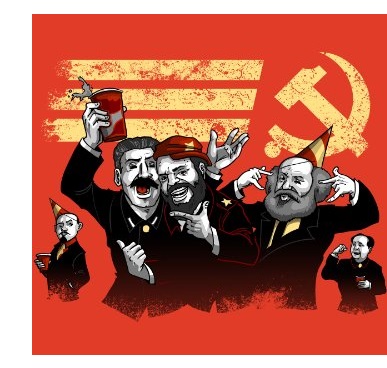 If you expected a bunch of senile Stalinists, you might be surprised. Party members quoted by Emeques were quick to defend old Uncle Joe (after all, it was a revolution) but senile they weren’t. While they have their eminences grises, the 8000 strong PCM’s membership is surprisingly youthful, with several party leaders in their early to mid 20s.
While debating Communism for the 21st Century, and considering whether voting was even an option for a revolutionary party (let alone applying for ballot access), the comrades weren’t all work and no play… but unlike our larger parties, the Communists were rather frugal… at least they served cookies.
(Comunistas mexicanos: volver al futuro, Emeeques)
My day of reflection
The “days of reflection! will soon descend in anticipation of Sunday’s mid-term elections. All campaigning will stop at midnight tonight (bliss!!!) — theoretically to give the voters time to sort through all the propaganda — and even Mexico City will go “dry” Saturday and Sunday. Whether the latter, as we have always been told, really does cut down on election day violence (and shenanigans) or only encourages them, is another story.
 The big worry among the politicos is not that independent candidates are likely to win a few elections (notably, the governorship of Nuevo Leon… which has the “usual sources” in the media, like The Guardian and The New York Times — and a few rare birds like The Sydney Morning Herald — all paying attention to a Mexican mid-term election), but that the voters will either stay home, spoil their ballots, or worse… violence usually being blamed on “radical teachers” in Guerrero and Michoacán.
In states like Guerrero, where the political parties, including the PRD (or especially the PRD) have been discredited, the left-wing media was generally supportive of calls to boycott the election, both as a means of expressing rejection of the existing parties and the party system, and as a way of de-legitimizing the entrenched “political class” (usually overlapping the economic powers — including gangsters) within those states. However, with the strong polling by MORENA (Lopez Obrador’s new populist front) in the Federal District, and the very real possibility that minor parties, and sense that the bums will be thrown out, the chattering classes and “pundits” are all now urging the voters to turn out and vote… in the words of one columnist for the generally unreadable Mexico City News … for “the candidate that least offends”.
I sense a trend in the hispanic world here. The strong showing by PODEMOS and allies in Spain, as well as the on-going scandal in Guatemala and the growing calls for President Lobos’ resignation in Honduras, as well as the stronger than anticipated support for new and minor parties here in Mexico, suggest that insurgency — and a rejection of the “same old-same old” — is growing, but at the same time, the political classes find themselves saddled with the “same old-same old” means to respond to citizen demands. That is, creating political parties, whose candidates are for the most part recycled from the mainstream groups, repackaged as something new (like El Bronco, a 30+ year PRI operative) or just rebranded as the smarter, cleaner kid-brother of the discredited elder party (the Greens as an alternative to PRI, or MORENA as an alternative to PRD).
I question whether political parties are not more a hindrance to democracy than anything else, and whether the 18th century method of voting by geographical district (rather, than say, social and/or economic interest) is necessary… and whether political parties can represent the people’s varied interests in any meaningful way. Since systemic change is not possible at this time, perhaps its all to the good that minor parties and individuals are seen as a valid option by the people… who — one hopes — will be able to throw the bums out when they become too entrenched or fail to adjust to meet the needs of the people at the next election.
Theft, of the cultural kind
“Free trade” has always meant the rich are free to exploit the rest of us.

High in the mountains of the Sierra Norte, the village of Santa María Tlahuitoltepec sits perched on a ridge top in Oaxaca’s Mixe region. The terrain is rugged and unforgiving; it took rescue crews ten hours, much of it on foot, to reach the municipality following a lethal mudslide at the end of an extremely wet 2012 rainy season. Eight months later, in May of 2013, when blogger buddy Chris and I ventured up there for their Fiesta de Mayo, we still had to detour around the remains of the slide.
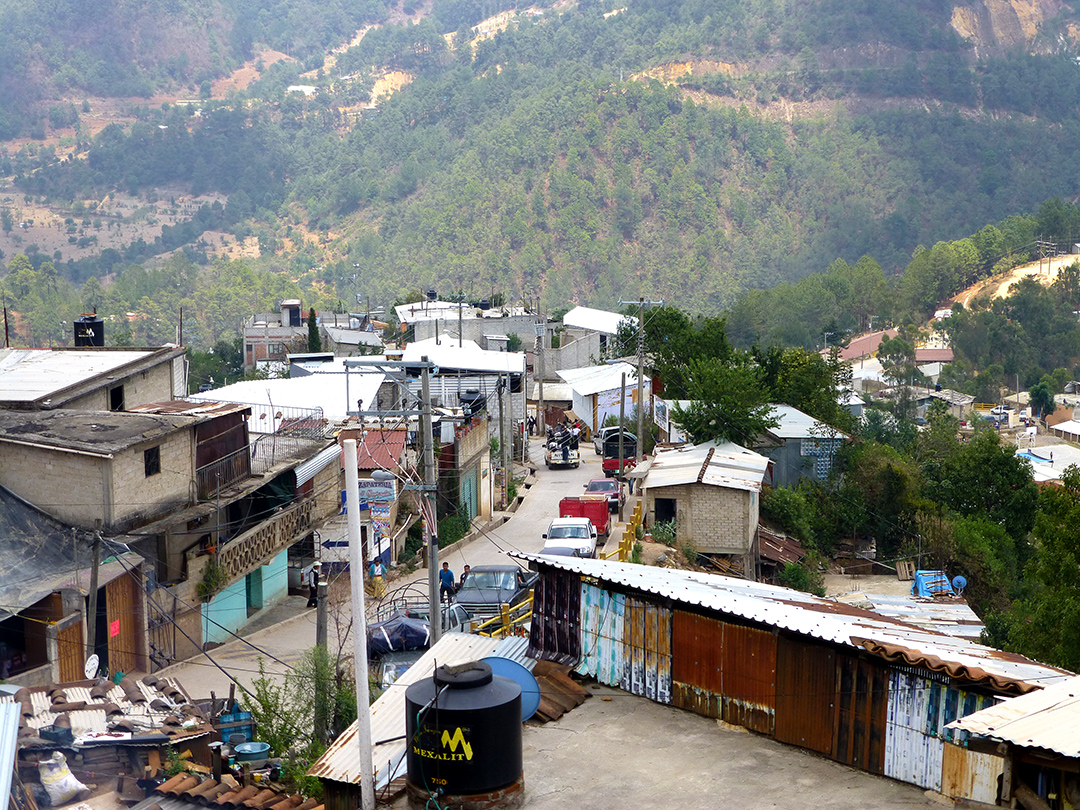 Santa María Tlahuitoltepec, May 11, 2013.
Despite the harsh conditions and its remote location, Santa María Tlahuitoltepec is home to the Center for Musical Training and Development of Mixe Culture and it is estimated that 70% of the population can read music and many who can’t, play by ear — a source of great pride.
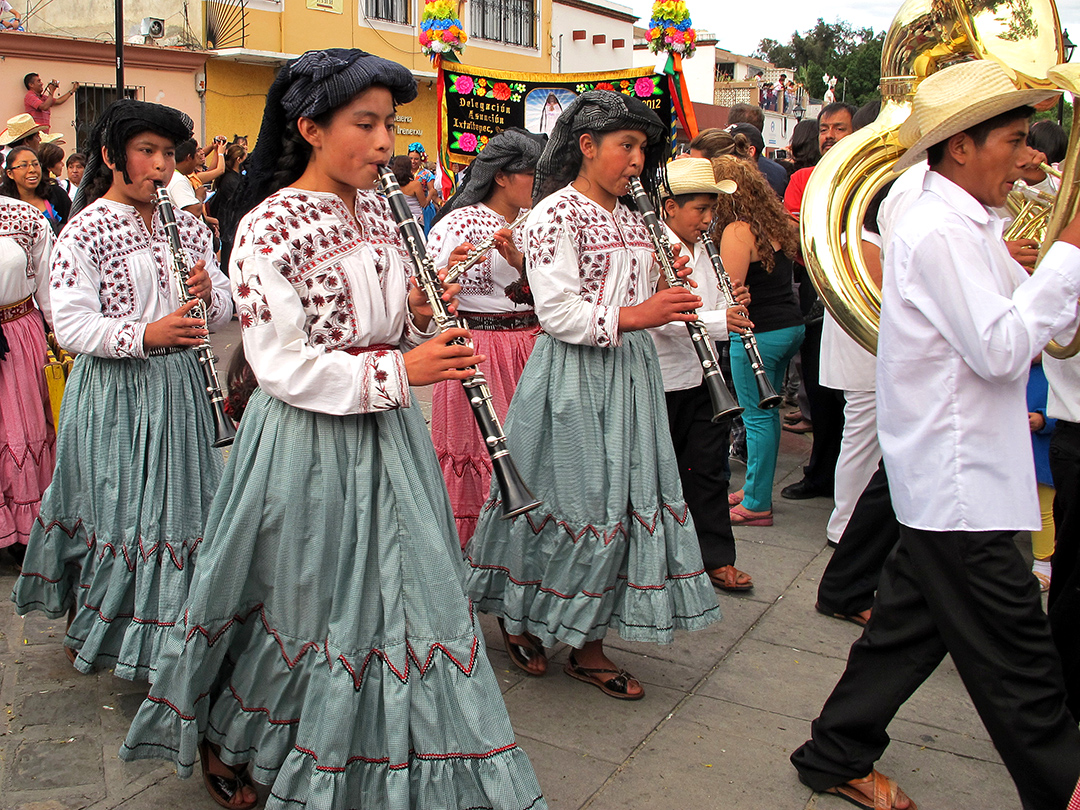 Guelaguetza desfile, July 28…
View original post 281 more words
Data dump
Apologies for not posting regularly over the last week and a half. I was busy with some personal business (my own wedding among other things), but hope to have an opportunity to comment (if only briefly) on some of the items in the news that … while not always “top of the fold” in the news cycle (dominated by the upcoming elections, and the latest massacre the government claims is not a massacre*)… are glimpses into the many Mexicos of today.
In the generally conservative to middle-of-the-road Milenio, Álvaro Cuevo asked in the Sunday edition (17 May 2015) “What the Hell is wrong with this country that we condemn teachers and praise gangsters“? Cuevo questions whether the attacks on “corruption” in the teachers’ union isn’t being used to justify vilifying what was an honorable profession here. Certainly there was and is corruption and feather-bedding within the union, but one asks who is responsible for that, if not the PRI, when they imposed leaders and tried to make the union an arm of the party? That the union leadership eventually moved closer to PAN, and bought into bad ideas imported from the north like teaching to the tests, and education for work, rather than education for the sake of an informed citizenry, are as responsible as anyone else.
There was a two or three day dust-up when tapes of a telephone conversation in which the president of the Elections Commission (INE), Lorenzo Córdova Vianello, used less than respectful language towards indigenous community representatives (“Me big chief Sitting Bull”). As politicians are wont to do, Córdova offered a non-apology apology (“If anyone was offended, I’m sorry”). While there’s some speculation that the thing was a set-up (the indigenous group apparently was a front for one political party, or, rather, a faction within a party), and discrediting Córdova — or forcing him to resign — would complicate the elections and/or open up one more vote for disqualifying the Green Party (as demanded by all but the Greens and the PRI, which dominate the elections commission), it’s one more reminder that Mexico still has a long way to go in coming to terms with its own indigenous community.
In Saltillo, a rehab center run by the Cristo Vive church was fined 250 salarios mínimos for discrimination against gays and lesbians. Coahuila always seems to be the odd man out in northern Mexico… despite our perceptions of el norte as conservative (the leftist parties barely exist in the states bordering the U.S.), it was the first state to have “civil unions” and now one of three jurisdictions (along with Quintana Roo and the Federal District) where there is no impediment to same-gender marriages. Even more head-turning, the discrimination suit was brought by the communidad San Aelred, a Roman Catholic Church organization.
A report on word-wide banking trends published in The Guardian caught my eye, mostly because Mexico was a different color on one chart than any other country. While 51% of all adults in the U.S., Canada, AND Mexico took out loans last year (a bit higher than most of the world, though about the same percentage as Scandinavians), while Canadians and USAnians borrow mostly for mortgages (32% of all loans in both countries), Mexicans borrow for healthcare and education expenses. While I haven’t seen the figures being discussed here… yet… it would seem to indicate we need to spend more public funds in those areas, which are already the largest portions of federal spending.
And, not to wax “Friedmanesque”, but having taken more taxis over the last two weeks than I normally do, I dipped into Thomas Friedman’s patented bag of one trick, and asked a taxista his opinion about the protests (and Tuesday’s taxi strike) against Über’s infiltration of Mexico City’s public transit . My driver was more concerned with “piratas” than Über itself … the legitimate taxis having not only to paint their cars a ridiculous color (pink and white) but to pay for medallions, insurance, inspection, replacement cars and… above all… special plates, the piratas (whether pink and white or not) are giving the legitimate drivers a bad name. Über, as he sees it, is mostly handling the airport corridor and the wealthier neighborhoods normally serviced by tourist taxis and limousine services, and probably just needs regulated the same way those higher priced private transport systems are. I’ve been fascinated though, by the foreign response… the “expat community” (i.e., the mostly white, north American and northern Europeans with money and living in the wealthier enclaves of Polanco and Condesa) are quick to condemn the taxis, often for carrying “those” people, while those of us (even if we are in Roma Sur) who are “those” people and depend on taxis and the Metro and the buses to get around aren’t likely to get hung up on a car having better seats than another or bottled water, and just want to get from point A to point B.
Politically, I think this is a no-brainer for the municipal government. There are a lot more poor voters, and a lot more voters with friends or relatives who drive taxis than there are people who use (or can afford to use Über, and which requires having a smart-phone and a credit card). And… stupidly, during the strike, Über doubled its rates.
* Both of which I’ll post about tomorrow
Plots against AMLO?
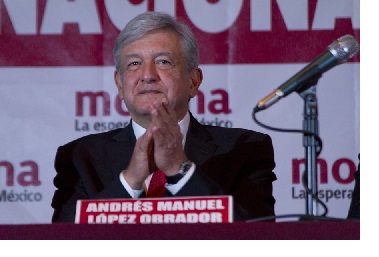
When in Mexico we speak of “mafias” we are not referring to gangsters so much as “special interest groups”, generally with an economic interest … say, taxi owners, or the inner circle of business groups, or political factions. AMLO famously uses the phrase “mafias del poder” to refer to his opponents — the entrenched establishment leadership, the “one-percenters” of Mexico.
Yet… if we are to take remarks passed on by Televisa evening news presenter and journalist, Joaquin López-Doriga, perhaps the Mexican “mafias” are considering resorting to a style more like that of old-fashioned ethic gangsters. Writing in last Friday’s Milenio, López Doriga passes on remarks he has heard in “business circles” (his phrasing) to the effect that the present government (presumably though political errors) is paving the way for AMLO to return to presidential politics, and that he has to be stopped, by any means necessary. Or, so López-Doriga hints, when he says it would be a grave error in a democracy to eliminate a presidential candidate, as happened the afternoon of 23 May 1994 in Lomas Taurina, Tijuana. Without spelling out what exactly he’s getting at, the date and place is the equivalent in US political writing of saying November 22, 1963 in Dealy Plaza, Dallas. In short… political assassination.
 As with John Kennedy’s assassination, the May 1994 assassination of Luis Donaldo Colosio, widespread doubt surrounds the official story. Moreover, while Colosio was “only” a candidate for the Presidency and not the sitting President, as the PRI candidate in the pre-reform system, there is a stronger sense of “what might have been had he lived” surrounding Colosio than there is around Kennedy. Colosio was expected to reform the political and social system, widely seen as another Lazaro Cardenas (our FDR), as well as a reformer who would put the brakes on neo-liberalism and … more ominously to the “mafias” … “break with the practices which have made (the Party) a rigid organization”. Two weeks and three days after saying this in public, he was dead.
And so, López-Doriga’s not so cryptic comment is being read as a warning to not just AMLO (who the journalist, as a Televisa employee, did his best to paint AMLO as a “danger to Mexico”) but to the “mafias of power” as well. López-Doriga points out that AMLO may not even be a Presidential candidate in 2018, and that the comments about stopping AMLO are more directed at what business leaders see as the mistakes of the last two administrations than at AMLO himself… that is, the business establishment seems to be saying “IF we don’t get our act together, AMLO will take over”.
Not that I think that’s a bad thing, and — as Ciro Gómez Leyva writes in El Universal — entirely plausible. Mexico is a multi-party state (in large part, due to the reforms that followed the shock of Colosio’s assassination) and the president is not, as in most Latin American countries, elected by a majority (50 percent plus one) which usually requires a run-off, but by simply plurality of votes. AMLO’s last two times out, he received a third, or a bit more than a third of the vote. The three main parties — PRI, PAN, and PRD are all losing votes, PRD … hurt by revelations of several of its office-holders having ties to organized crime, was the biggerst loser, but AMLO’s new party, MORENA, has been rapidly growing, polling (the last time I looked) a respectable 10% of the electorate… which is pretty damn good considering the party didn’t exist a year ago..
While the left is fractured among several parties, presumably in 2018, they would run a fusion ticket. Headed by AMLO, he only needs to do better than the PRI, which is also hemorraging members to minor parties, PAN — which, while not losing as much of its membership, is beset by infighting, and the sense that it is neither able to deliver on its promises, nor offers a real alternative to PRI. So, Gómez Leyva sees a real possibility of an AMLO presidency in 2018.
No friend of AMLO’s, Gómez Leyva does lay out a few scenarios that would stop AMLO, short of those hinted at by the businessmen. AMLO could die of natural causes. PRI or PAN could somehow discover a credible, popular figure to run for President in the next two years… something not on the horizon now. Or PRI and PAN (dismissed as “PRIAN” by the left anyway) could run a common candidate, as presumably the various parties on the left would do, all backing AMLO (as they did in 2006, when he may have actually won).
And, perhaps a back-handed sign that AMLO’s future candidacy is a very real worry for the establishment, Felipe Calderón was back in the news today… sounding like a broken record, he was warning that a vote NOT for the establishment is a vote for another Hugo Chavez, or… AMLO.
One nice thing about Mexican elections, though, is the candidates aren’t even officially running until 90 days before the vote. So… while all this is speculative, about April 2017, the U.S. media may again be full of stories about the “populist firebrand” and such-like nonsense. Only this time, maybe the “populist firebrand” will win.
Gómez Leyva, Ciro. “Quién puedo derrotar a López Obrador en 2018?” El Universal 15 May 2015
López-Dóriga, Joaquin. “AMLO es el blanco” Milenio 15 May 2015
“Felipe Calderón: habrá violencia si se ganan candidatos populistas” Proyecto Diez, 12 May 2015
¡Luz Elena Patricio García para presidenta!
“These fourth-rate politicians misuse tax revenues, squander what belongs to us for their personal benefit instead of completing public works for the benefit of our communities.
“Our country is being left crippled. . . .
“If you think that we young people are unaware of the problems, allow me to set you straight, because we are the ones most affected by corruption, and of course we know and we understand every move you make. Not all youths are ignorant, and we know that corruption continues to grow…”
… perhaps he was merely confused, or dazzled, or just chose to overlook the fact that she explicitly excluded politicians when she finished up her oration with a paean to the people … the honest Mexicans, not the politicians, who wish for health, happiness and prosperity.
El Pie Grande
 At Nooka (Alaska), the explorers ran into both Russians … which they sort of expected and a few things they didn’t. From conversations with the local nuu-cha-nulth people, Mexican naturalist Jose Mariano Moziño Suárez de Figueroa learned of a creature with “… a monstrous body, covered in all manner of rigid black bristles, with a head similar to a human’s but with larger, sharper and stronger fangs than a bear’s, very long arms, with its fingers and toes armed with long and curved claws. Its screams alone – they say – can topple anyone who hears them, and it can shatter any unfortunate body into a thousand pieces in a single blow.”
All your bases belong to us
I’ll leave it to Franc Contraras (presently with CCTV-America, China) to lay out the situation
So, let’s see. The US has “given” Mexico 2.4 billion dollars to allegedly “fight drugs”. Not mentioned, most of that 2.4 billion is already spent in the United States, not including the half billion spent buying new Humvees for the Army. The cost of all those Blackhawk helicopers is not included.
US. consumers purchase somewhere around 600 billion dollars in “drugs” every year, which I suppose makes it sensible that the US might want to “fight drugs” just to protect its own domestic narcotics traders, but doesn’t explain why Mexico then would buy US equipment.
Supposedly, the Peña Nieto government was going to de-emphasize the “drug war” of the previous administration, and while the Peña Nieto administration hasn’t been able to keep its promises, that excuse wears thin.
I don’t like to frame everything in terms of the “drug war” (there are drugs, there are gangsters, there is not a “war”… except maybe on the poor in this country), and I think there is a simpler explanation for the massive purchases.
The U.S. is an expansionist, imperialist power, whose economy largely depends on military spending. Mexico has never been expansionist, and has been cutting its military budget consistently over the last eighty years. Even during the Second World War, the Mexican military budget dropped as a percentage of overall federal spending.
However, with the United States now “over-extended” throughout the world (with bases in 180 countries) and despite pro-military propaganda (both official and unofficial… Hollywood films, TV shows, etc.) is having trouble filling its ranks. The US military has openly coveted using Mexican troops to swell its own ranks and serve its needs.
Making the Mexican forces dependent on U.S. equipment, the U.S. accomplishes two key goals. Not only does it bind the Mexican military to the United States as its supplier, it also lets the United States accomplish a long-range goal (one it never has given up) of direct control of Mexico. The Mexican military always saw the United States as the most probable foreign invader and, in the supply department, those items it had to buy from abroad, it bought from a basket of countries… Sweden, Germany, Russia, France (and in the past, Belgium, Switzerland and Czechoslovakia) … none of which (except France) have ever had any territorial ambitions in Mexico, nor been in a position to subordinate the country.
Using the premise of the “drug war”, the United States is, without formally invading, “conquering” Mexico. Given that if the US did invade, they’d win no matter what, the best defense … besides unilaterally ending the “drug war” and investing more in human resources and jobs would be to lessen cultural and economic ties to the U.S.
Don Porfirio was right about that, never putting all the import/export eggs in one basket… in the economy or in military hardware. For that matter, Santa Anna was right, though buying second hand British weapons (left over from the Napoleonic Wars) was a mistake. I’ve suggested before that Barack Obama is another Woodrow Wilson (not a good thing to Latin Americans), but in this matter, his administration is another James Knox Polk.
What a gringo-card costs
I’ve posted on this before, but being a permanent resident (and on my way to just getting naturalized), I don’t pay much attention to the costs of temporary residency. From a post on Mexconnect, I got this:
…my total fees for the 3year RT [three year temporary residency… which can then be turned over into a permanent resident certificate] were MXN $7154.00. This price included $1,000 pesos for my lawyer, and $6154.00 for the Mexican Government including the fee for change of address. In today’s USD that would be about 476.00…
The price for APPLYING for a Green Card in the US is $1,078 (in today’s USD, this would be… $1,078), and the lawyers’ fees would run somewhere upwards of several thousand more on top of that.
Adios, la India María
Maria Elena Velasco, QEPD.
The comedian’s “la India María” was one of the most brilliant characters in Mexican film… creating the classic “country bumpkin”: the innocent rural “Indian” who outwits and triumphs over the elites and sophisticates through her natural goodness and tenaciousness. While there are those who saw her character as perpetuating a stereotype, it was by using the stereotype and stock situations that she gently, and effectively skewered our class and racial assumptions about Mexico, laughing with, and not at, the absurdity and sometimes surrealism of a country where contemporary values and customs co-exist with the traditional and timeless.
From one of my favorites, the “haunted house” parody “El Miedo No Anda En Burro”:


 mexfiles.net