¡Feliz Panquetzaliztli!
 Panquetzaliztli, the most important of the Aztec holidays, lasted twenty days in the fifteenth month, commemorating Huitzilopochtli’s overthrow Coyolxauqui, his sister the moon, and his four brothers, Centzonhuitznahua, the southern stars. Some scholars also believe the festival was a celebration of the birth of Aztec civilization.
The ceremony included raising a figure made of roasted corn mixed with maguay syrup. The figure was brought to the temple courtyard by marriageable girls, dressed in their best feathers and wreaths, accompanied by young bachelors carrying corn. After wreathes, feathers and garlands were presented to the figure, the people bowed down, and ate dirt…
… as the people cleansed their palates with amaranth bread (the the marriageable girls and young bachelors paired off), a slave was sent running through the Aztec towns carrying the figure. In each town, there were human sacrifices, as there were in Tenochtitlán, where the running slave’s return was eagerly awaited. With his return, the party could begin in earnest, with hearts ripped out of waiting sacrificial victims, including the returned slave.
As the crowd no doubt sang classic Panquetzaliztli carols.
(Así era la ‘Navidad’ azteca, Chilango, 23 December 2014)
Prison reform?
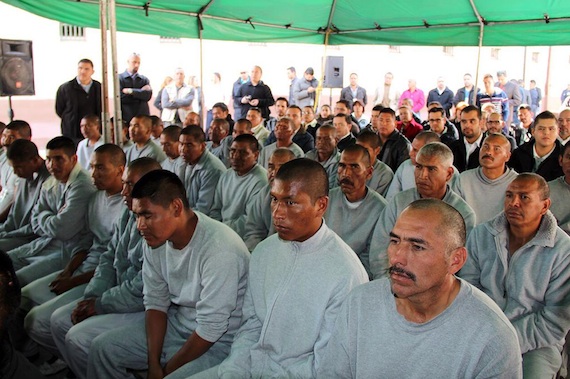 The State of Chihuahua has opened a special prison (er… “Center for Social Readaption” to use the Mexican bureaucratic euphemism) specifically for indigenous convicts. Located in Guachochi, an extremely poor, rural community, I suppose, like similar communities in the U.S., a prison is a boost to the local economy. Guachochi is perhaps the best place for an indigenous prison, the municipality being majority indigenous (Tarahumara and Tepehuán), and prison authorities claim that a special prison just for indigenous convicts (from various communities, not just the two in Guachochi) will allow for better services, easier family visits and maintaining the prisoner’s rights to constitutionally guaranteed practices according to traditional uses and customs.
How that will work out in practice, and how much is actual good will, as opposed to bureaucratic spin, I just don’t know.
Big Red
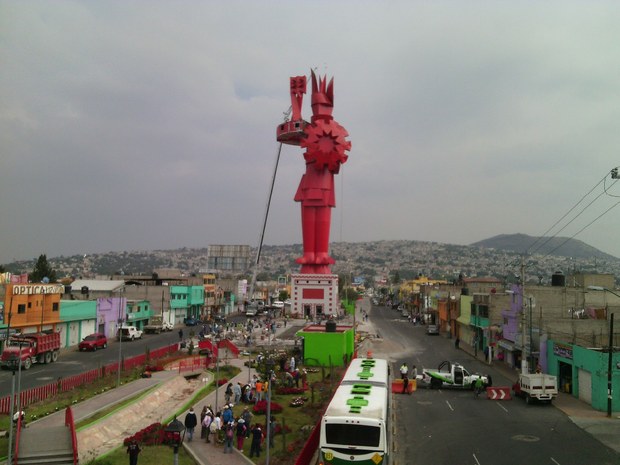
Looming above Chimalhuacán, Estado de México is the new 60 meter, 870 ton “Guerrero Chimalli”. Inaugurated 13 December, the Mexican sculptor Sebastían and the local administration who commissioned the 30 million peso project say the work commemorates the municipality’s progress, the warrior’s shield symbolizing the community’s protection against poverty and want.
Sebastían’s work has inspired creative types to propose alternative monuments for Chimulhuacán, which at the last census found 62% of its residents living in poverty, with 13% in “extreme poverty”.

Mexican Engineering
Even though there is no tuition at UNAM, it doesn’t mean the students get a completely free ride. To support himself, 18 year old Cristóbal Miguel García Jaimes, has been working as a night watchman and bricklayer in the Capital, and, when back home in San Miguel Totolapan, Guerrero, helping support his mother and siblings selling baked goods on the streets. And, in his spare time, the first year physics student invented and built the world’s most inexpensive particle accelerator.

The daughter also rises
Recognize this Paramount Studio actress? Although her debut, in the Paramount Studio musical “El día que me queras” (produced in Spanish, as a vehicle for the great Argentine/Uruguayan tango singer, Carlos Gardel) was promising, her Hollywood career was never to rival that of her father.

Celia Villa Peña (little seems to be know about Villa’s marriage to Librada Peña) or can I find birth and death dates for Celia. But, like her dear old dad, she had the acting bug.
Los Peces En El Rio
The classic villancico navideño from medieval Spain… while usually recorded today by children´s choirs, and slowed down to be “respectful”, I expect this version is more in the original style. What I always liked about Los Pesces is the very Iberian sensibility that accepts the facts of life as normal, even when the life is that of Jesus. What attracts the little fishes to the surface, where they glorify the “newborn king” is something so obvious that the Bible stories all missed it… his mommy had to wash out His diapers.
The Future of the Cuban Revolution
With the surprising break-through in U.S. – Cuban relations, the usual tendency of people in the U.S. to see everything in binary terms is likely to dominate any English-language media discussions of the Island’s future. That is, “we” assume this means more “capitalism” … on “our” terms. And that the surprise announcement that relations will be normalized (although, when I think about it, since its independence in 1898, “normal” relations have meant U.S. domination of Cuba, without even the fiction of mutual respect between sovereign nations), means the “dissidents”… i.e. the political right… will be vindicated.
Cubans have been discussing political and economic change for quite some time now, and not all dissidents are on the right. And not all critics of the prevailing system are outside the party, nor wish to be. Published last January in the U.S. based Socialist journal, The Jacobin, Cuban born academic Samuel Farber provides a run-down of possible scenarios for a “normalized” Cuba, and the wide array of competing political and economic positions laid out — from the right, left and center now discussing the future of the Revolution.
 In light of the role the Vatican played in yesterday’s announcements by Washington and Havana, more attention should be paid to the Catholic Church, and Catholic organizations in any developing any likely scenario of Cuba’s future:
… The church is among the most efficiently managed organization on the island, second only to the military. Strategically and tactically conscious of how to pursue its goals, it aims to become a formidable moral force on the island, as a “neutral” arbiter standing above every conflicting social and political interest in Cuba.
To that end, the Church is attempting to shape its identity as the long-time custodian of Cuban cultural traditions, emphasizing features of Cuban culture associated with popular Afro-Cuban religion, like the worship of the the Virgen de la Caridad del Cobre, the Patron Saint of Cuba known as Ochún in the Yoruba tradition (while at the same time seeking to distance itself from that “pagan” cult). In donning its “custodian” clothes, it has worked hard to dodge such thorny historical and political issues as its militant support for Spanish rule, particularly during the last War of Independence, and its ties to right-wing opposition during the early years of the revolutionary government.
The Future of the Cuban Revolution, Samuel Farber, Jacobin, 5 January 2014 is ESSENTIAL READING for anyone planning to say anything or even idly speculate about Cuba’s future, if they aren’t just blowing smoke.
On top of everything else…
Given the on-going political and social crisis that Iguala disappearances brought to a head, the scandals raised by both Primara Dama Angelica Rivera and Finance Minister Luis Videgaray’s inexplicably special deals for private homes with government contractors (who are themselves suspected of padding their state and federal building contracts), the continuing militarization of the police, and now the free fall of oil prices (and the peso) what are the prospects for Mexico?
Dan La Botz, writing in New Politics (Collapse of Oil Prices, Fall in Peso, Exacerbate Mexican Political Crisis), suggests that the prospects for genuine change are about nil, given U.S. interests:
What, then, are the prospects in Mexico, given the underlying social situation and the current political crisis? Well, first, there are several possibilities in Mexico that are precluded by the United States’ government: 1) the election of a left government; 2) a military coup; or 3) a total breakdown in social order. The United States must maintain a nominal democracy in Mexico or, if it cannot preserve democracy in North America and in its “own backyard” (as Mexico is always so disrespectfully called), it will lose credibility throughout the world. To say nothing of the billions of dollars of U.S. investments in Mexico that must be preserved.
The question, then, is whether or not there exist social forces that could create a unified movement for the genuine reform of the Mexican government. Reform, because the possibility of revolution in Mexico is impossible without a broad unified movement and a strong left party, neither of which exist at this time.
While the Mexican government seems in this current conjuncture to be facing serious problems, there is no strong political party on its right or its left that is prepared to push to see if the Peña Nieto administration can be forced to step down. The National Action Party (PAN) is too deeply involved in the political and economic system to risk a serious challenge that might go further than it intends. On the left, the situation is not so different where calls for change are not accompanied by the organization of mass action. Andrés Manuel López Obrador, head of the Movement of National Regeneration Party (MORENA) and the country’s leading left politician, has been calling for months for Peña Nieto to step down, but his call has found little response beyond his own party and others on the left, perhaps because so many Mexicans are cynical about all of the political parties.
I tend to think a military coup is unlikely… first off, one forgets that the military was removed from political life when the PRI was created out of the old Revolutionary Party in 1948 specifically because the officer corps was predominantly leftist (the last real threat of a coup came from the left, after the tainted 1988 Presidential election). In 2006, the left’s reaction to another tainted and dubious election was mostly theatrical, and the military kept out of it. While it would be foolish to suggest that the “brass” are leftist today, it would be difficult to imagine any scenario (even with covert U.S. support) in which a coup could count on widespread support even within the military establishment.
While the leftist PRD seems headed for extinction, that seems more a reflection of the party’s own acquiescence with the establishment parties as with anything else. Furthermore, with a healthy assist from the right, and from Televisa, a growing number of Mexicans seem to blame the left for “disturbing the peace”… meaning simply protesting and demanding change. Even those who describe themselves as “liberals” (in the U.S. sense) make excuses or justify crack-downs on protests that disrupt traffic or … as they claim… just go on too long. Not that the left here, as elsewhere, doesn’t have a tendency to form a circular firing squad, but the left isn’t dead, merely fragmented.
With political leaders, including AMLO, seen as increasingly out of touch, or irrelevant, I expect some realignment in the political structure. The major parties have made it increasingly difficult to form new parties, and the prospect of a left-right (PAN-PRD) coalition to bring down the PRI doesn’t seem to offer any particularly useful solution to the problem of making the parties relevant to the people. Other than some mild calls for unspecified reform from other institutions (like the Church), the existing institutional system just isn’t working. Pressure from student, guerrilla, consumer, workers, and even business groups will force the parties to propose changes that will continue to provide the facade of “democracy” of the sort the U.S. assumes is the only kind (with political interests filtered through parties, and elections… whether tainted or not being beside the point) while attempting to preserve their own perquisites. I can see some “opening” to new parties (the minor parties … the Greens [PVEM], the Workers Party [PT], and Morena [Lopez Obrador’s new party] have been gaining members at the expense of the three main parties) but the PRI, in one form or another, is not going to go away. At most, it will redefine itself to fit the interests of the country’s elites (as it did going from Socialist to Neo-liberal, and — under Peña Nieto — becoming more culturally conservative to form what the left dismisses as PRIAN… a PRI indistinguishable from supposed rival PAN).
That’s as much as the U.S. will “allow”. HOWEVER, what happens in the homes, schools, factory floors, boardrooms, in the mountains, and on the streets, is out of the control of the United States. While more violence and state repression is to be expected, and in some sense will be accepted (as has been true in the U.S. for the last several years), it doesn’t mean democracy by other means is not in the offing.
Have a Coke and … an amputation
Wow… what an ad! Mexico has a tax on sugary foods for a very good reason: it costs everyone, not just the user.
Thick as thieves?
I’m sure some are likely to reject this out of hand because it comes from the World Socialist Web Site, but Marc Wells is probably not wrong in arguing that the United States and the Obama Administration are not allies of the democratic and dissident movements in Mexico.
 The massacre [in Iguala] has received a noticeably muted response within US ruling circles. Asked about the Obama administration’s attitude toward the killings, State Department spokeswoman Marie Harf this week boasted about how administration officials “work very closely with Mexican authorities on a range of security-related issues,” while praising the Peña Nieto government’s handling of the affair.
Harf noted that the Obama administration had certified to Congress the Mexican government’s compliance with human rights standards required for military aid on September 19—one week before the Iguala massacre—and had no intention of “revisiting” the issue.
The reasons are obvious. Peña Nieto’s historic privatization of national oil company Petróleos Mexicano (PEMEX), which opened the floodgates to international speculation, and a slew of similar “reforms” affecting telecommunications, education and banking have been greeted with enthusiasm by Washington and Wall Street.
During a visit to Mexico last year, Obama declared: “I want to commend President Peña Nieto and the Mexican people for the ambitious reforms that you’ve embarked on to make your economy more competitive, to make your institutions more effective… But let me repeat what I told the President—as Mexico works to become more competitive, you’ve got a strong partner in the United States, because our success is shared.”
The partnership to which Obama refers amounts to over a century and a half of US domination and exploitation of Mexico, from the control of its railroad and mining industry since the second half of the 19th century to the infamous 1994 NAFTA agreement, which transformed Mexico into a giant cheap labor sweatshop for the principal benefit of US capital.
President Obama has been a consistent supporter of Peña Nieto from the moment the controversial 2012 Mexican election results were made public. They share common views on democratic and human rights…
Mexiko, Mexiko über alles…
As we all know, the Germans have the best teachers in the world. But who is Germany’s best teacher?
According to the 28,500 members of the University of German Universities, that would be the mathematician and economist who heads the Department of Artificial Intelligence at the Free University of Berlin… who has been fiddling around with robotics lately, creating cars you can drive from your I-phone, and … working on ones that can be controlled by brain waves alone. Pretty nifty German science, right? But not entirely just playful sci-fi.
“I confess to designing [the brain-driven car] on a whim. I just wanted to know if it was possible … We did it and now we want to develop a system for a wheelchair that can be conducted with the brain of a disabled”, said the good Herr Doktor Professor.
Of, did I forget something. Germany’s best teacher is not a German, but a Mexican migrant worker: Dr. Raúl Rojas González.

Photo: El País
Free access?
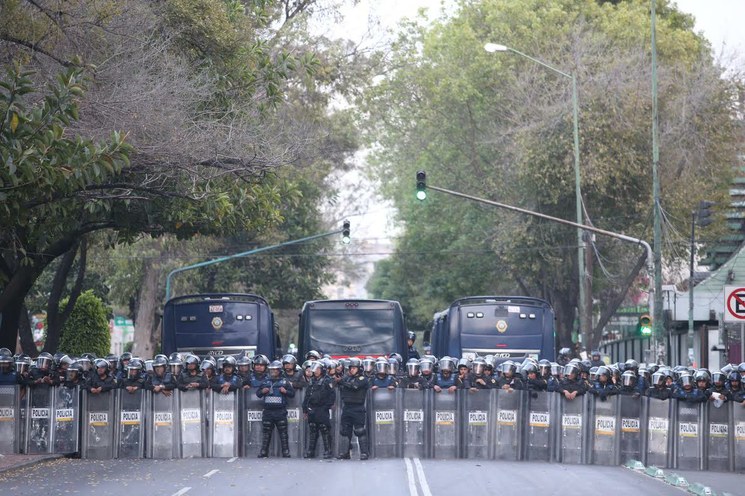
A proposed Constitutional “right of free access” bill was passed by the Chamber of Deputies, with the support of PRI, PAN, their allies and the Mexico City PRD leadership. Those cheering the bill obviously want their streets NOT blocked by ordinary citizens, trusting the officials to do a better job, apparently.


 mexfiles.net