¡COMO MEXICO NO HAY DOS! Mexico's hsitory and culture, the Real, and the surreal, Mexico. Politics, economic, news sometimes here, but regularly posted at mexfiles.substack.com. Copy and quote freely, but be respectful, and acknowlege the source. And, of course, monetary donations help keep the site going.
Europe’s heroin market could soon be in for a supply shock, and experts fear the gap could be filled by something much worse.
Almost all heroin consumed in Europe comes from Afghanistan, where the Taliban have imposed a ban on poppy cultivation that will take effect in the coming weeks.
The likely poppy shortage could make it more profitable for criminals to manufacture synthetic opioids such as fentanyl, to be sold to desperate addicts denied their hit of heroin.
Givcen what’s been said about the danger in the United States of fentinyl coming (allegedly) from Mexico (see post below), maybe it IS time to consider legalizing the opium and heroin trade. Harm reduction and less deaths from overdoses? Or… too logical?
If only people like US Member of Congress, for Georgia Marjorie Taylor-Green, echoing the ravings of Donald Trump had been suggesting the US needs to “launch airtrikes on Mexico“… ostensively in reaction to the inability of the United States to get a handle on its fentenyl and opiate abuse issues ., , this could be laughed off… but it isn’t.
Rerpublican Party member of Congress have been swift to join Taylor-Greene.
The Chair of the House Oversight Committee, James Comer, apparently suggested bombing Mexican “drug labs” during his previous position within the Trump Administration. Although Comer has refused to comment on the allegation, “The GOP chairman’s extreme pronouncements are part of a bigger push by House Republicans to appear tough on border issues”.
While such calls, mostly from Republicans, to “brand” (ill-defined) Mexican “cartels”(and, with the kidnapping and murder of US citizens in Matamoros… for reasons that are still unclear…the calls include powerful Senators, Lindsay Graham and John Kennedy) as foreign “terorists”. This would — at least from the United State’s (and several of the more powerful nations around the world) give the US a self-proclaimed right to use military force in Mexico.
Trump’s Former Attorney Geneval, Bill Barr, following his former boss in comparing the so-called “cartels” to ISIS, also speaks with open disdain of AMLO’s “abrazos no balazos” policies (best not translated as “hugs not bullets”, but “embrace, not erase”… basically provide the social and economic services to the population that makes criminal activity less attractive).
Which lends itself to the suggestion that fentinyl … in itself … is not what is really bothering US policy makers.
Simultenously… and probably not by accident… his has been coupled with moves by both the State Department and and various US “think tanks” and CIA cut-outs like the Natinal Endowment for Democracy to reframe the recent political reforms in Mexico (espcially in the electoral bureaucracy) as an “assault on Democracy” there is a very real sense that the US… Democrats and Republicans… are both attempting to stem Mexico’s move towards the international left.
Following the relatively large demonstrations in late February organized by the parties of the opposition (mostly PAN and PRI, though apparently the handiwork of Mexico’s one-man version of the Koch Brothers, Claudio X. Gonzales and his “Va Por Mexico” movement (or is it now Unid@s?… he keeps changing the name as his various sponored organizations fall apart, or fail to take off) ostenively in defense of the present structure of the Electoral Institute (INE for its initials in Spanish), tweeted out a message suggesting that the present government is somehow “undemocratic”… short-hand US diplo-speak for “We want to save you from yourselves — an argument picked up by neo-conservative “influencers” David Frum and Anne Applebaum in their house-organ, The Atlantic.
Perhaps those of you obsessed with “drug cartels” should be more concerned with the recent conviction of General Garcia Luna after an abbreviated trial… Garcia Luna’s protectors and promotors going back to the Clinton Administration’s Ambassador to Mexico, Jeffrey Davadow, and his support by every CIA, DEA,State Department since the Clinton Administration, there is every reason to assume the trial was cut short BEFORE Garcia Luna could testify about US connectins and tacit support for the “cartels”. There’s not much need to note that “cartels” couldn’t function without functionaries within the US (perhaps including the so-called “deep state”) to distribute the goods, and handle receivables.
While so far, the Biden administration has “poo-pooed” the simplistic “bomb Mexico” talk, one doesn’t need to put on a tin-foil hat to recognize a two-pronged attack on Mexican polical independence, with people like Greene and Lindsay Graham getting the attention while the overt support for the Mexican right by the US government is just overlooked… similar in ways the Obama Administration (and Sec of State Hillary Clinton) worked to undermine left leaning Paraguay… and justify a coup in Honduras.
Mexico’s adminstration has been firing back at the outrageous and frankly stupid “kill ’em all, and let the Lord sort ’em out” (as have others — here and here, for example) to much less publicity in the United States. And… perhaps… not publicized to let people overlook that fentinyl is something of a stalking horse for what the United States really wants from Mexico: backing away from nationalization of it’s resources, and the on-going “demand” that it buy corn from midwestern (and Republican leaning) exporters. Coupled, of course, with Mexico’s independent foreign policies, and the strong liklihood that the next Mexican adminstration will deepen and broaden the “Fourth Transformation”.
While no one doubts the seriousness of the “fentinyl crisis! in the United States, thw typical reaction has been… like that common to all addicts in dcnial.. to “blame others”. The “others de jour” being the old favorite, Mexico.. and China. Offically, both states reject US claims of flooding the United States with their new drug of choice, suggesting (not so subtly) that the US needs to figure out the reasons people feel the need to use the product in the first place. Probably too much to ask.
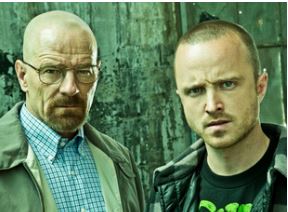
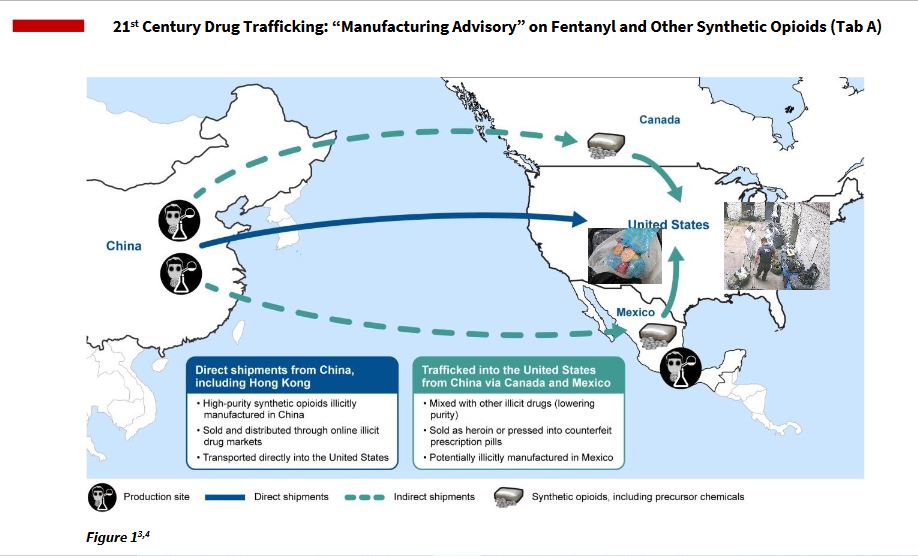
Instead, the US is going for prohibition of what is, or intended as, a useful surgical anesthetic and post-operative pain reliever. And, here, the Mexicans and Chinese are… while not in any sense lying… are in a bit of denial themselves. And letting the Canadians off the hook (though I’ve yet to hear of any US politicians suggesting drone attacks on Canada) So called “precursor” chemicals are shipped to Mexico and Canada, along with the United States. And it doesn’t take a rocket scientist to whip up a batch of the stuff. And even if one did cut off, and control, exports of 4-anilino-N-phenethyl-4-piperidine (ANPP) and N-phenethyl-4-piperidone (NPP), substitues are readily available. If one recalls Breaking Bad, the sad-sack Jesse Pinkman was already an estabilished member of the DEA … “Drug Enhancement Agency” … ong before Walter White came along to refine the process.
“The most common synthesis route for fentanyl uses two key precursor chemicals: 4-anilino-N-phenethyl-4-piperidine (ANPP) and N-phenethyl-4-piperidone (NPP). ANPP is a Schedule II controlled substance, and NPP is a List I precursor chemical. As common precursor chemicals come under tighter international scrutiny, illicit actors are exploring alternative methods of making fentanyl and buying chemicals to make their own precursors. These chemicals include propionic anhydride—a List I precursor chemical—piperidone, propionyl chloride, and aniline.”
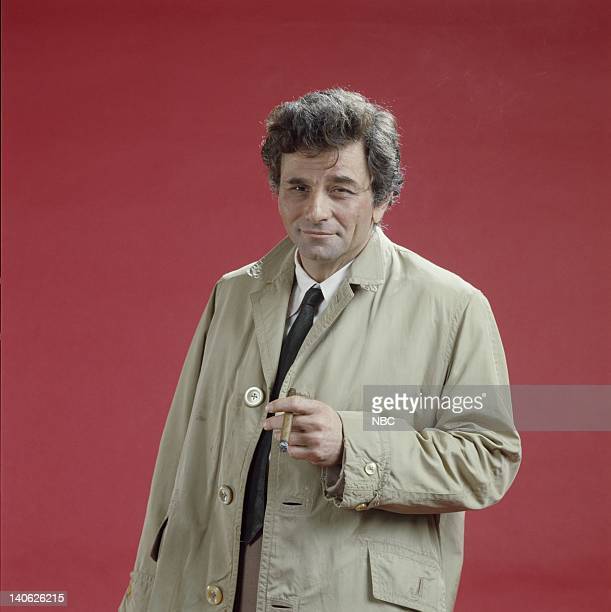
If there is one personage that the people of the United States might compare to Andrés Manuel López Obrador… maybe we shouldn’t look at “real” people but at some national icons… like Lieutenant Colombo, the , raspy-voiced, blue-collar detective of the 1970s television series, whose rumpled appearance,and seemingly naive “Just one more question” hid a lasar focus on bringing to heel the ich elite crimnals he invariably would trap by the end of the program.
So, Senator Lindsay Graham… one more question…
South Carolina Senator Lindsey Graham – who has strongly criticized Mexico for its perceived failure to fight “cartels”, which he blames for the out of control fentanyl abuse problem in his country, and — having thoughout his career, having looked to military adventurism as the answer to almost any domestic issue — not to mention his “Monroeist” mindset (as in Monroe Doctrine) that seems to buy into the bipartisan assumption that the United States must “guide” Mexico, whether it wants guidance or not — has pushed the not so bright idea of labeling Mexican drug exporters “terrorists” in order to justify intervention in this country
Which led AMLO to ask the Senator a ” a question, or two or three… a matter of interest to both nations.”
I would like you to answer yes or no: is fentanyl used in the United States?
Who distributes it in the United States?
Are there bosses, cartels that distribute it there?
Are those who distribute it Mexican or American?
Are they persecuted and punished in the United States?
Can you buy a machine gun or a high-powered weapon in supermarkets in the United States or not?
What programs do you have to support young people, so that they do not consume drugs?
What are they doing? What are you doing?
Are you guaranteeing your youngsters the right to study and work?
Why don’t you change this procedure of abandoning young people at adolescence and not keeping them at home? Don’t you think that this causes them unhappiness, misfortune, dissatisfaction, and is it a reason they are inclined to consume drugs?
th the United States incurbing fentinyl imports (
Despite only a quarter of US fentinyl passes through Mexico, and it’s not produced (in any quantity) here 8most comes thru canada or from Asia) , Mexican authorities will continue to collaborate with Washington not “out of fear of his interventionist threats, but because of humanitarian convictions, because we do care about what unfortunately happens in the United States, that 100,000 young people lose their lives every year due to its consumption. We are going to help, to cooperate in everything we can.”
Unlike Colombo, AMLO is not above helping some elite twit out of his predicament. SHOULD the Senator introduce and push legislation designed to find solutins to the questions the President raised, he’d be happy to help the senator in any way he could.
I don’t know whether they serve cocktails at Russian Security Council meetings or not, but one has to wonder what Nikolai Platonovich Patrushev, the former FSB head,and now Secretary of the Security Council was on when he spoke to the media about Latin America.
Patrushev predicted that, given emigration from Latin America through Mexico, it’s only a matter of time (not knowing any Russian, it’s not clear if he meant sooner or later… much later perhaps), Mexico would re-take the territories lost in 1848. Payback, apparently, for US intervention in Latin America going back to the Monroe Doctrine (its 200th anniversary being celebrated… or regretted… this year).
Patrushev’s odd prediction came on the heels of what might or might not be fair, saying (translated from Russian to Spanish to English):
“Tthe US acquired the status of a great economic power based on cynical actions — seizing territories and resources; exploiting peoples and benefitting from the war affecting other countries… Latin American leaders make no secret that awareness of the destructive role of the US has become widespread. The Guantanamo base is considered a direct theft of Cuban sovereignty. And this is just one of the many examples of the systematic usurpation of the independence of Latin America [at a time when]the US has become a champion of the violation of the sovereignty of countries, in the number of wars and conflicts unleashed and in the brutal and illegal repression of foreigners.”
Rubbing salt into the wound, Patrushev calls the United States ingrates… the Russians having saved the country during it’s own War of Independence and the Civil War. HUH? well, I suppose Catherine the Great gave Washington some financial support and during the Civil War the Russian fleet patrolled US harbors (to keep the French and British… both leaning towards the Confederacy) from blockades.
Most of the resporting on this I’ve seen here has been of the WTF? variety, only the nutty Alfredo Jalife-Rahim (who no can figure out why the old spinner of Jewish and/or gringo conspiracy theory is still given a column in the otherwise respectable La Jornada) taking this seriously. If I were to take Patrushev’s remarks as more than a “one-off”, I might look to the Zimmerman Note for a clue as to what he intended.
Whether the Germans were really serious about assisting Mexico in an attack on the United States back in 1915 has neally been established. Zimmerman himself later said it was a ruse that backfired… more an attempt to create a “border crisis” in the United States that would distract it from intervening in the European war.
Bloomberg, via El Financiero reports that a Russian oil freighter, Loukas II, is scheduled to deliver 145,400 barrels of diesel at Guaymas, Sonora about the end of this month. Russia’s main exports to Mexico are semi-finished steel and fertilizer, but with Mexico trying to hold down inflation by subsidizing fuel costs, and with the refinery shortage not yet resolved, Russia’s discounted fuel sales make perfect sense.
Keeping in mind that the US is trying to strong-arm Mexico into opening it’s electrical power market to its own “investors” (i.e., control the production costs… not the retail rate… for electricity in the US), what’s one more threat of “sanctions” (i.e, economic blackmail).?
Louka I… can’t find a photo of Louka II (photographer unknown)
What role did the Mexican Revolution and its legacies play in the development of the Good Neighbor policy?
Greg Grandin
The Mexican Revolution was the first revolt against US capital in what became known as the Third World. It resulted in the passage of the first social democratic constitution in the world, which established rights to education, social security, pensions, and so on. The role of the state in the Mexican economy greatly expanded, with more control over natural resources.The Mexican Revolution was the first revolt against US capital in what became known as the Third World.
For a long time, US governments were completely opposed to the Mexican Constitution’s definition of social property and its very robust understanding of eminent domain that gave the state authority to nationalize resources. But Roosevelt went along with it because he had no choice. He needed Mexico during the Depression and as an ally in WWII, so he didn’t oppose the nationalization of Standard Oil’s Mexican holdings and other US economic assets.
Mexico also became an inspiration for some of the more radical elements within the New Deal coalition. Rexford Tugwell and the Sharecroppers’ Union went to Mexico because they wanted to see what real agrarian reform looked like. They began suggesting that Roosevelt might follow a similar approach in the United States, although that was never going to happen.
The other day, I actually did see some US pundit-type still referring to Latin America as “America’s back-yard”. And I recall Biden … trying to sound progressive, I guess… say we weren’t the “back yard” but the “front yard”.
Either way you look at it, it still suggests the rest of the hemisphere is the US’s property. Maybe it’s better if we think of the Americas as a somewhat dysfunctional HOA…. with the USA as the neigbhor who wants to be President and tell the rest of us how to keep our properties up to their exactly standards. The Karen principle applied to international relations.
While it’s not de riguer in US media stories about AMLO to add “fiery populist” to any mention of his speeches (he gets down-right folksy in his daily morning press briefings) what’s often overlooked is her erudition.. his speeches peppered with historical and literary references (he has published well-received histories, and his wife is a scholar and professor of Spanish liteerature), not just parroted as populist memes, but in the context of his thesis, laying out the reasoning behind his argument. Honestly, if Woodrow Wilson was right that a “great” national leader is an orator, AMLO and perhaps (perhaps unfortunately) Vladimir Putin will be the ones mentioned by future historians as the “great leaders” of the era.
Lopez Obrador’s speech before an estimated half million listeners on 85th anniversary of the 18 March 1938 oil expropriation was at once a “deep dive” into the hisotry of what was a seminal event in Mexico and a explication of his administratin’s policies… domestic, and… perhaps more importantly… internationally (at least in reference to the United States).
One observation that might surpirse some probably not a surprise to anyone who has followed AMLO’s political trajectory for years, but the guy is a huge Franklin Roosevelt fan-boy.
The translation is by Pedro Gellert:
Long live Mexico!
Friends:
Unlike Francisco I. Madero, who, in order to realize his beautiful democratic ideal could not or did not consider it indispensable to strengthen his ties with the people, especially with the Zapatista peasants, General Lázaro Cárdenas did not hesitate to rely on those from below to make his transformation a reality.
The general’s strategy can be summarized in three important and consecutive actions:
First, he distributed land to the peasant farmers and helped the workers.
Then, he helped them organize.
And, finally, with this social base he was able to carry out the expropriation of the oil industry and other national assets that Porfirio Díaz had handed over to private interests, mainly foreigners.
The top priority of the Cardenista strategy was to attend to the economic and social demands of peasant farmers and workers. The president knew that the only way to gain the backing of the people was to act decisively in favor of their demands. Consequently, from the beginning of his government, a program of land distribution was launched; the peasant farmers mobilized throughout the country requesting that they be given land through the expropriation of large estates or providing them with deeds for state land.
In a short time, the distribution of land to peasant farmers transformed the structure of Mexican agriculture. The revolutionary importance of the Cardenista land distribution policies can be measured with a key piece of data. In the first three years of his administration, 9,764,000 hectares were given to 565,216 peasants, which vastly surpassed the amount of land that had been distributed since the Revolution.
By the end of Cardenas’ administration, 10,651 ejidos (1) had been established, comprising a total of more than 18 million hectares and benefiting more than one million indigenous families, impoverished peasant farmers, and rural day laborers.
The peasants unquestionably saw Cárdenas to be a faithful representative of the revolutionary cause. The agrarian reform ensured the loyalty of many people to the Cardenista government and from that point the alliance between peasant farmers and the State was established.
At the same time, during the Cárdenas years, workers felt that their labor rights were guaranteed. With strict adherence to the law, Cárdenas respected the economic struggle of workers for better wages and working conditions. His measures in this field consisted of making the formal content of Constitutional Article 123 (2) a reality.
From the beginning of his government, the labor movement began engaging in intense activity aimed at winning its demands; it was even able to freely exercise the right to strike.
By the middle of the president’s six-year term in office, peasant farmers and workers identified Cárdenas as the defender of their interests. The first part of Cardenas’ strategy had been successful; the President’s approach and solidarity with the most vulnerable social groups resulted in the support and adhesion of the majority to the government’s policies.
The political organization of workers and peasant farmers as a second link in the Cardenista strategy also developed with intensity and enthusiasm.
First, most of the national industrial unions were established. The Mexican Workers’ Confederation, the CTM, was founded on February 24, 1936. Although the organization’s declaration of principles stated, and I quote, that ‘the Mexican proletariat will fundamentally fight for the total abolition of the capitalist system,’ its leaders accepted the president’s proposal and agreed on the need to first achieve the country’s political and economic liberation. In accordance with these principles, the workers’ movement resolutely supported the government in its struggle for national sovereignty.
On July 9, 1935, President Cárdenas recommended that the organization of Mexico’s peasant farmers take place. With this in mind, the agrarian community leagues were created in all states of the country and their integration with the unions of rural wage earners resulted in the establishment of the National Peasant Confederation, the CNC.
The organization and political mobilization of the masses made it possible to advance in the aim of asserting our country’s economic independence, and thus with the expropriation of the oil companies, national assets and resources that had been in the hands of foreigners since the Porfiriato (3) began to be returned to the nation.
This strategy could not have succeeded without the exceptional qualities of a noble and just man such as General Lázaro Cárdenas del Río.
Politics is not only rationality, but also, like other activities in life, requires mystique and convictions. Political processes are more complex than what rationalist intellectuals assume; political processes also involve factors such as luck, the brilliance of leaders and the sentiments of the people.
General Cárdenas, unlike careerist or elite politicians, professed a sincere and deep love for the people. Just as there is no one with the democratic aspiration of Madero, neither has there ever existed in Mexico a president as close to the downtrodden or as convinced of the cause of social justice as General Cárdenas.
For example, in 1935, when he was already president, already in power, Cárdenas wrote the following in his notes:
‘To put an end to the miseries experienced by the people is above all other interests’.
And he maintained: ‘Living amid the needs and anguish of the people, one will easily find the way to remedy them’.
Although he also confessed that he had been able to see the true moral background of many public servants. ‘When I observe in their faces the disgust sparked by the poor peoples’ demand for assistance or justice, then I think more,’ he lamented, ‘of the endless tragedy of our own people.’
For young people who want to devote themselves to the noble profession of politics, what is most important is love for the people.
In addition to being a true humanist and possessing other virtues, General Cárdenas knew how to navigate his times with precision. Politics, among other things, is time management, a question that is usually essential and defining.
A few days before announcing the expropriation of the oil industry, he wrote in his notes that, on the highway near Cuernavaca, he’d walked and talked for more than an hour with his teacher, friend and compañero, General Francisco J. Múgica. I’d like to quote General Cárdenas when he says:
‘We considered the circumstances that could arise if governments such as those of England and the United States, interested in backing the oil companies, pressured the Mexican government with violent measures. But we also took into account that the threat of a new world war is already present due to the provocations of Nazi-fascist imperialism, and that this would stop them from attacking Mexico in the event that the expropriation was decreed.’
Among other reasons, and taking advantage of this circumstance, on March 18, 1938, the oil industry expropriation was launched. At eight o’clock in the evening, General Cárdenas informed his cabinet of this historic decision and, two hours later, in a radio address to the nation he announced the step taken by the government in defense of Mexico’s sovereignty, returning to the nation the oil wealth that, as the General himself wrote, ‘imperialist capital had been utilizing to keep the country humiliated.’
In four articles, the expropriation decree establishes that the following assets would become assets of the nation: machinery, installations and other fixtures and property of the foreign oil companies, for which compensation would be paid in accordance with Article 27 of the Constitution and the corresponding law.
The oil expropriation was supported by the majority of the people. Photos of the time show the presence of predominantly humble people, indigenous men and women, peasant farmers, workers, teachers, employees, and members of the lower middle class.
It was the common people who supported and cooperated with the government to raise the compensation due to the foreign oil companies. How could we forget that so many poor women donated goats and turkeys for this purpose and even got rid of the meager jewelry they owned!
In those days, from the city of Oakland, California, migrant worker Cástulo Prado composed the lyrics and music of the Corrido del Petróleo and sent it to the president with the instruction that the government allocate any royalties from the work to the compensation fund. One of its verses reads as follows:
‘Lázaro Cárdenas says, serene and carefree: in the course of 10 years, everything will be paid, I have the Mexican people of which I have no doubt. From the youngest to the oldest, they all offer me their help. In the Mexican woman there is patriotism and pride, she gives up her jewelry to offer them for coins.’
In addition to this massive and overwhelming popular support, the Cárdenas government had another favorable circumstance. At that time Franklin Delano Roosevelt, a great statesman and one of the finest presidents that country has ever had in its history, was governing the United States. Let’s recall that when Roosevelt entered the White House on March 4, 1933, the United States was experiencing one of the worst crises in its history and that, as president, Roosevelt knew how to deal with that crisis successfully and very soon restored hope to his people, which made him one of the greatest politicians of the 20th century.
As for his foreign policy, let’s recall that, in a memorable speech, which is the antecedent of the principles of the UN, on January 6, 1941, Roosevelt laid out four basic freedoms for the world: the right to freedom of speech, the right to freedom of worship, the right to live free from want, and the right to live free from fear.
Roosevelt’s presidency applied the ‘good neighbor policy’ with the countries of the Western Hemisphere. At that moment, the principles of economic and political cooperation were defined, the sovereignty of Cuba and Panama was recognized, and the U.S. military withdrawal from Nicaragua and Haiti was ordered. It is not by chance that the great poet Pablo Neruda called Roosevelt a titan of the struggles for freedoms, a tremendous president.
The authenticity of his good neighbor policy was most clearly demonstrated in the respect for the sovereignty of our country. During Roosevelt’s three presidential terms, relations between Mexico and the United States were exceptionally good.
In the days following the oil industry expropriation, General Cárdenas acknowledged Roosevelt’s role in a letter:
‘My government’ -wrote the general- ‘feels that the attitude assumed by the United States of America, in the case of the expropriation of the oil companies, once again affirms the sovereignty of the peoples of this hemisphere that the statesman of the most powerful country in the Americas, the most esteemed President Roosevelt, has been supporting with such effort’.
Cástulo Prado, the poet we have already quoted, a people’s poet, also left testimony of the upright attitude, the grandeur, and the respect shown by the president of the neighboring country. Cástulo’s verses read:
‘The millionaires asked for intervention. They went to the United States to lodge their complaint -it looks to us, it looks to us, it looks to us- they went to the United States to lodge their complaint so that from there they would move to protect their companies. Roosevelt told them: ‘Gentlemen, I can do nothing about it, the Mexican government has fulfilled its duty.’
The good results of this policy had much to do with the U.S. Ambassador to Mexico, Joseph Daniels, who acted with wisdom and skill in the most difficult years of relations between the two countries. His position on the oil conflict is summarized when he maintained that President Cárdenas was right in promoting the policy that the wealth of the subsoil should become part of the Mexican economy and that the oil crisis was due to the systematic refusal of foreign companies to modify their vision, since, Daniels pointed out, they felt that Mexicans were born to enrich foreigners and that God placed important natural resources in Mexico to increase the fortunes found in the coffers of the exploiters and concession holders.
But the companies were not as conscientious and respectful as U.S. politicians. The nationalization process had to confront the boycott, pressures, and acts of sabotage promoted and financed by the foreign oil companies.
I
In Mexico, the oil industry expropriation caused deep uneasiness among a minority, especially among the wealthy of the time, in middle-class sectors, and in most of the media.
It is interesting, and this is a lesson, to point out that historically the right wing always regroups when a democratic change is sought and becomes intolerant and even violent when it comes to social demands in favor of the people and the nation asserting its control.
Let us remember that the overthrow of President Madero, our Apostle of Democracy, was backed by the intervention of the U.S. Ambassador, but was carried out by domestic right-wing groups which had previously promoted a campaign of hate and discredit consisting of ridiculing the President, President Madero, in the newspapers to the point of treating him as a madman and a spiritualist.
The same thing happened when the expropriation, although it did not directly affect national private interests, served to bring together all the discontent of conservative groups opposed to the agrarian, labor, and educational policies of General Cárdenas.
In this climate, on September 17, 1939, the National Action Party was founded. It was founded as a reaction to the oil industry expropriation. I say this here in the Zócalo because I am not lying, I am speaking the truth.
In 1940, all these reactionary trends manifested themselves very strongly in the presidential election. The right-wing opposition was such that General Cárdenas had to act cautiously, and possibly that influenced him to support the candidacy of Manuel Ávila Camacho and not that of General Francisco J. Múgica, with whom he had more ideological affinity and who represented a greater certainty of continuity and deepening of the social and nationalist policy.
It has always been said that the general did not choose Múgica because of the risk of foreign intervention. However, as we have seen, at that time Roosevelt, who had demonstrated his respect for national sovereignty, was governing and World War II was about to break out, a situation that contributed to dissipating the threat of a U.S. intervention.
In my opinion, what most influenced the decision was the internal political circumstances, that is, the belligerence of the right-wing groups. Remember that, even though he’d decided in favor of the candidacy of Manuel Avila Camacho, who held moderate positions, the presidential election was complicated and violent.
The opposition candidate, Juan Andreu Almazán, had the support of important right-wing groups and a sector of the Army. Even the PAN, which did not run a candidate for the presidency, openly supported him.
At the end of the day, 30 dead and 127 wounded were reported. However, shortly after, Almazán gave in and his supporters, businessmen and right-wing politicians came to an understanding and made a pact for concessions and benefits with the new Ávila Camacho administration.
From then on, the authentic revolutionary ideal and actions for the benefit of the people began to be abandoned, although it must be acknowledged that this alliance between political and economic power perhaps avoided civil war and maintained social peace.
If under Porfirio Díaz, the peace of the graveyard prevailed, after President Cárdenas’ government, the peace of compromises and corruption was established.
In this brief history there are major lessons, the main one being that only with the people, only with the support of the majority, can a popular transformation be carried out to enforce justice and confront the reactionaries who oppose the loss of privileges.
For this reason, today we once again declare, we exclaim from the rooftops: no zigzagging, let us remain anchored in our principles, let us reaffirm the decision and the course we have taken since the administration began. No half measures: we in Mexico will never allow a minority to impose itself at the expense of the humiliation and impoverishment of the majority.
That is why, in our government, corruption is being fought. There is an austere government, without luxuries, and all the savings are used to finance well-being programs, such as pensions for the elderly, support for people with disabilities, single mothers, peasant farmers and fishermen, scholarships for students from poor families, Internet for All, housing improvement and construction programs, collateral-free loans, fertilizer, and guaranteed prices for the country’s small producers, the Bank of Well-Being, the promotion of education and universal and free public health care.
This year more than 25 million people will receive direct support totaling 600 billion pesos (4). In other words, out of 35 million households in the country, 71 percent will receive the benefits of at least one of the social programs.
With this policy of attention to the neediest, the most vulnerable, and especially to young people, we have also been able to reduce federal crimes by 33 percent, homicides by 10 percent, vehicle theft by 38 percent, general robberies by 20 percent, huachicol (5) by 92 percent, femicides by 28 percent, and kidnappings by 76 percent.
By the same token, the savings from not allowing corruption or budgetary waste have enabled us to avoid contracting more debt. We have not requested additional debt since we have been in office.
And at the same time, without increasing the public debt in real terms, taxes have not been increased, the price of gasoline, diesel, gas, and electricity have not risen. There has even been a decrease in the price of these energy resources.
There has also been an increase in public investment, as has not occurred in many years. This year we will spend more than one trillion pesos (6) on public work projects. That is, we will continue building highways, bridges, trains, airports, hospitals, universities, markets, sports facilities, seawalls, and natural, recreational, and ecological parks.
And we are carrying out something very important: an extensive project to recover and restore historical and archeological sites of our ancient and splendid cultures and civilizations.
Public finances are strong, the national economy is booming. Last year the Mexican economy grew even more than the economies of China and the United States.
There are an unprecedented 21,747,000 workers enrolled in the health system. This figure of 21,747,000 workers in the formal economy has never been reached before.
In addition, an average wage of 525 pesos (7) per day has been achieved for these workers in the formal economy, something that had never occurred before.
The unemployment rate last January was 2.9 percent, the lowest since 2005.
We are carrying out public work projects. Right here we are refurbishing the Metro line that collapsed.
We are, of course, building the Toluca-Mexico City train line, the Maya Train, the Transisthmic Train and many, many other public works projects.
What is happening?
After many years, we managed to get the United States to offer temporary work visas. Canada was already doing this and the United States did not accept it. Now with President Biden’s change of policy it was achieved, but they are taking skilled workers, ironworkers, welders, who are needed here for the works projects. We are going to make a small modification, because Mexico comes first and then foreign countries, but this shows how much demand there is for jobs in the country.
During the time we have been in office, the minimum wage has increased by 90 percent in real terms, and on the border it has more than doubled.
Do you remember what the lying technocrats used to say? That if wages were increased, there would be inflation. That’s all a bunch of nonsense. That is not true. Of course, we have to improve wages responsibly, to strengthen the domestic market, as we are doing, and thus achieve well-being for our people.
The stock market, corporate and bank profits are posting good numbers.
The Banco de México’s reserves have increased by 15 percent, 200 billion dollars in bank reserves.
Foreign investment has climbed to previously unseen figures.
This has also occurred with remittances from our migrant countrymen and women. Thank you very much, fellow countrymen and women. Last year these remittances practically reached 60 billion dollars; this year they are going to exceed 60 billion dollars.
This is very important, because this money gets to the most remote communities, to 10 million families who benefit from them, and with this money the regional economy, commerce and other economic activities are reactivated.
It is also important to emphasize that the peso is the currency that has most appreciated in the world in relation to the dollar, something that has not occurred for more than 50 years.
We have also directed our resources and efforts to achieve food self-sufficiency and energy self-sufficiency. In the latter, as reported here by the Ministry of Energy and the Director of Pemex, we can be certain that oil sovereignty is being guaranteed. Next year we will not be buying gasoline, diesel or other oil products abroad; we will be processing all of our raw materials.
The Federal Electricity Commission, the public company in charge of managing the electricity industry, has been strengthened.
And recently lithium, a strategic mineral used in manufacturing batteries for electric cars and storage systems for clean energy, was nationalized.
It fills me with pride to be able to recall -I apologize for taking so long, but I am about to finish- it fills me with pride to be able to recall today, March 18, that, despite the policy of granting concessions that prevailed before we came into office, we were able to remove a long chapter from the Free Trade Agreement that compromised our oil and put in its place a small paragraph, which I am going to read to you.
It says: ‘The United States and Canada recognize that Mexico reserves its sovereign right to reform its Constitution and domestic legislation, and Mexico has the direct, inalienable, and imprescriptible ownership of all hydrocarbons in the subsoil of the national territory.’
My friends:
I am convinced that we will continue to receive the support of the people to consolidate the first stage in the transformation of our country.
I am also convinced that whichever candidate wins the poll to become the candidate of our movement will apply the same policy in favor of the people and in favor of the nation.
Continuity with change is assured. There is nothing to fear. Of course, we have to remain united, always looking towards the future and the happiness of our fellow men and women. This means working from below and with the people, and without neglecting the strategy that we rightly call the revolution of consciences to keep advancing in the change of mentality so as to continue politicizing our people and thus have an increasingly aware population. In this we have made considerable progress, as Mexico is one of the countries with the least political illiteracy in the world.
With that awareness we will continue, with that collective consciousness we will continue to counteract the dirty war, the slander campaigns and the attempts at manipulation that will continue to be waged, because our adversaries and their media, sold out, rented or in the hands of the members of the conservative and corrupt block, have no other choice. But at the same time we must have faith in the wisdom and loyalty of the people, the people do not betray.
Let’s recall that the victory of the reactionaries, as Juarez said, is morally impossible. We are finding that the idea and practice of exalting Mexican humanism is electrifying and is reaching the consciousness of millions of people. I base my optimism on this.
And even though it is more dangerous to underestimate the strength of one’s adversaries than to overestimate it in politics, I maintain that no matter what they do, the oligarchs will not return to power; an authentic and true democracy will continue to prevail in our beloved Mexico.
Friends:
I cannot fail to mention that in the past few days some U.S. legislators, accustomed to seeing the mote in their brother’s eye, but not seeing the beam in their own, in a propaganda ploy -we would say here in colloquial language grilla or intrigue- and for electoral, politicking purposes, argued that, if we did not stop the trafficking of fentanyl to the northern border, that they were going to propose to the Congress of their country that U.S. soldiers occupy our territory to confront organized crime.
First, I want to make it clear that this is no longer the time of Calderón or García Luna, that this is no longer the time of shady links between the Mexican government and U.S. government agencies. Now there is no simulation, organized and white-collar crime is truly being fought, because there is no corruption, no impunity, and there are no complicit relationships with anyone.
But what is most important is that from here, from this Zócalo square, the political and cultural heart of Mexico, we remind those hypocritical and irresponsible politicians that Mexico is an independent and free country, not a colony or a protectorate of the United States, and that they can threaten to perpetrate any offense, but we will never, ever allow them to violate our sovereignty and trample on the dignity of our homeland.
There is more to say about this, but somehow haven’t posted, but after several calls by U.S. politicians to intervine in Mexico (to “help” wipe out the fentenyl suppliers to willng US customers), AMLO is getting a tad testy. Not having seen anything in the “mainstream” US media yet, I’m relying on Sputnik, via ElComunista.net.
In a massive event held in the Zócalo of Mexico City, President Andrés Manuel López Obrador warned that his government will never allow the United States Army to intervene in the Latin American country to supposedly combat organized crime.
At the insistence of various US legislators that the Armed Forces of the Univted States would be permitted to operations on Mexican soil to fight against fentanyl trafficking, the Latin American president was emphatic in stating that this strategy does not even exist as a possibility.
Speaking to tens of thousands celebrating the 85th anniversary of Mexico’s expropiration of oil resources (18 March 1937), the President said: “From this zócalo, the political and cultural heart of Mexico, we remind those hypocritical and irresponsible politicians [of the United States] that Mexico is an independent and free country, not a colony or a protectorate of the United States, and that they may threaten us with committing any outrage, but we will never allow them to violate our sovereignty and trample on the dignity of our country,”
On the occasion of that oil expropriation, Great Britain — which was still a relevant power in those days — broke diplomatic relations,and threatened reprisals, which were ignored. Likewise, although there were calls for intervention by the United States . . . including sanctions, , . . the Mexicans were able to stand firm, in large part simply by threatening to work with the other foreign powers of the time.. the Soviet Union and (alas) if the US and Britain really wanted to play hardball, Nazi Germany. Whatever one may say about the morality and ethics of this or that state, when it comes down to it, states are going to protect their own interests first.
Is this right? Morphine was invented to replace opium, and prevent the scourge of opium addiction. Then herion, to lessen the dependence on morphine. Then Fentinyl. And… so… with a nudge from the United States, Mexico is going to cease using fentinyl (for pain relief, mostly in treating persons with terminal illnesses) and replace it with…. ? What, we’re not sure.
Fun fact. In February 1940, on the advise of his health ministry, President Lazaro Cardenas legalized herion… not that there was all that huge a population of addicts While addicts were still socially ostracized, and pharmacies in “reputable” neighbnorhoods were unwilling to keep heroin in stock, it did provide a safe and legal outlet. Users were less likely to commit crimes and, absent legal problems, will more willing to seek treatment, or at least hold down regular jobs.
Which, of course, the United States took a dim view of. At the time, most pharmaceutals dispensed in Mexico were US imports, by “sanctioning” medical exports to Mexico, Cardenas was forced to reverse course, and again criminize production and distrivution… Just in time for the United States to enter the Second World War when… cut off from its usual Asian supplier, there was a crying need for opium deratives for military needs, as well as a sense that it was better to keep illegal drugs available on the black market, rather than have addicts turn to “enemy agents” who had access to opiates thru Japanese control of east Asia and Nazi control of the Balkans (the other major source of the time).
And, so… Mexican planted (illegally. with the connivance of both US and Mexican authorties) more opium poppies, that after the War, without a domestic market had to go .. somewhere.
Perhaps that excess opium production can be used to replace the small market in Mexico for pharmaceutal fentenyl… though… given the opium to morphine to heroin to fentinyl story… unless it’s a step back to good old-fashioned opium or even heroin … one assumes whatever comes on the market next will lead to stories about the dangers of XYZ, said to be more deadly than fentinyl by a factor of… oh… 10, or 100, or a thousand.
And, the US… rather than look at why it has so many users, and why they continuinally think just criminalizing the disagreeable will resolve a problem… will blame Mexico for supplying what it is they crave.
Sandra Cuevas, the “mayor” of Cuauhtemóc (the most populous of Mexico City’s 16 “alcadias”… or municipalities) apparently is one of “those people” who’d have made a better obnoxious HOA board president than … having been elected from the conservative PAN party, makes her home in the (admittedly gentrifying) working/middle class Colonia Santa Maria de la Ribera. Right across from the colonia’s popular Alameda, not the big downtown park, but their own, smaller version, graced with a cnetral bandstand… built originally by the firm of Gustav Eiffel as the Mexican pavillion for the 1903 New Orleans Worlds’ Fair that somehow, after declining into a skater ramp a few years back, has become the centerpiece of one of the nicer, neighborhood centers in the city.
See seems to resent that the neighbors are not up to HER standards of decorum… how dare they enjoy themselves with a Sunday in the park…. and isn’t it undigified for grandparents to be out dancing the afternoon away? She though so… two weeks ago chasing out the local band, Sincelejo, that would play there Sunday afternoons… a variety of traditional dance music for the enjoyment of not a buch of skaters or other types usually the target of Karenic wrath, but… grannies!
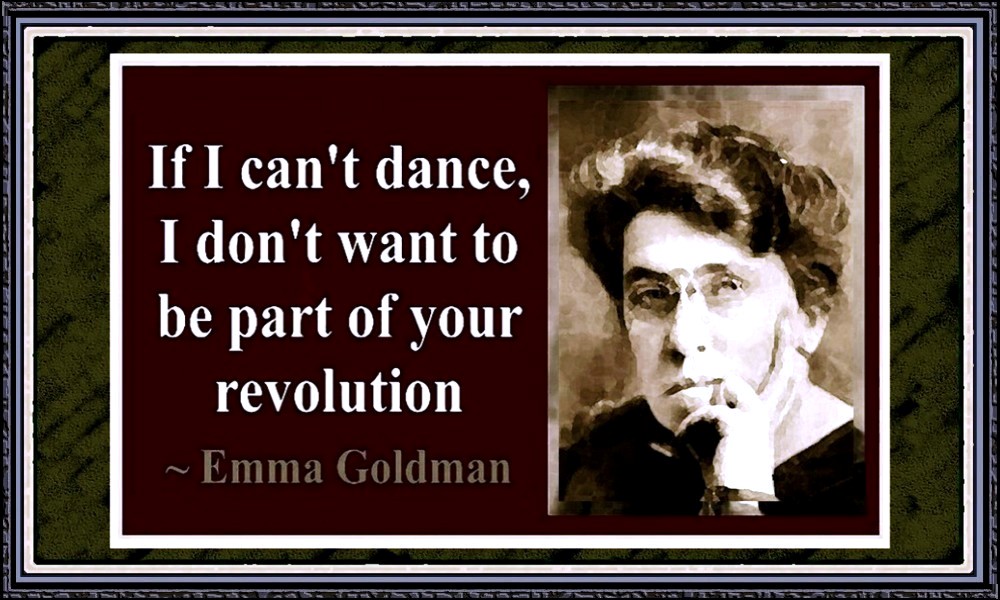
So… having called out black-shirts (literally…. municipal employees in black uniforms) … the grannies and grand-dads have, along with official complaints to the Human Rights Commission (the right to recreation is included in Mexico City’s Constitution, by the way) have launched a revolution that Emma Goldman would surely appreciate.
The dance returned to Santa María la Ribera, where a week ago “Sonido Sincelejo” was removed and several people were attacked by employees of the Cuauhtémoc mayor’s office, leading to complaints being filed with the Human Rights Commission.
The residents took advantage of the event to collect signatures on a petition to revoke the mandate of Mayor Sandra Cuevas and asked local deputies to formally being impeachment procedures against her for abuses of authority and violations of her human rights.
Another demand is to uncover the motives behind the forced removal of a band “which has been in this space for 12 years, providing seniors and families from different parts of the city to healthy fun, without selling of alcohol or drugs”,
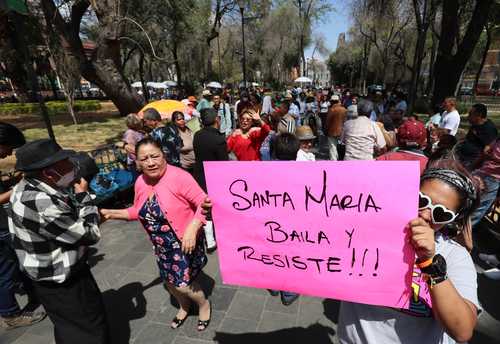
With speakers brought from home and cell phones, the protesters “played the music we like,” as people like Melao — the blind man who says he’s been coming here from Iztapalapa every Sunday for the last decade to dance to the rhythm of cumbia, salsa, huaracha and merengue,
Armando and Lupita, who travel four hours from the State of Mexico to Santa María la Ribera and … with 66 years of experience behind them are considered “one of the best dancing couples”, amazing the attendees with their movements.
Ángela, Lupita, Mary and José, among others, explained that this “peaceful demonstration is to assert our right to dance, to have fun and to express our support for the members of the Sonido Sincelejo, whose horns were taken away by the people of the mayor’s office and even their speakers”, which, they note, have not been returned.
With placards reading “Sandra Cuevas, let me dance!”, “My happiness is mine, nobody takes it from me”, and “More dancing and less repression”, the attendees of the until-now regular Sunday event expressed their disapproval of those who “have taken away OUR space”.
Human Rights Commission personnel who were on-site commented that were there as part of their investigation of complaints about the events of 19 February, while neighbors collected signatures to “demand the revocation of [Ms. Curvas’] mandate.”
Francisco Urrutia explained that the signatures — the 63 he gathered in the previous hour, along with the other 720 he’d already collected will be delivered to the Electoral Institute of Mexico City so they can proceed accordingly, and “so that they can return the space to us as neighbors, not as Sincelejo Sound”. Other residents considered that “the citizen’s demand has to proceed: not just for the band which suffered attacks last week, but for those of us who were victimized by people from the Cuauhtémoc mayor’s office on orders from their boss, Sandra Cuevas , and so it never happens again.”
Dancers of the world, unite. Or never mess with grannies!
The Mexfiles has never expected to turn a profit, but personal funds only go so far. Miscellaneous expenses (telephone, internet connection, subscriptions, spyware, hardware repair, etc.) run about 600 pesos (35 US$) a month, and donations are gratefully accepted. Please note that your donations are in Mexican Pesos (18 pesos to the US Dollar as of February 2019). A 25 US$ donation is 450 pesos.
The background of Mexican anti-clericalism and the "atheist" general who led the Catholic counter-revolution of the 1920s
128 pp., Editorial Mazatlán, 2012.
An oral history of the World War II experiences of Gilberto Bosques (1894 – 1997), Mexico 's Consul General in Marseilles, France, who saved tens of thousands from the Nazis.
36 pp. Editorial Mazatlán, 2007 $35 MXP (click the image)
While "The Mex Files" authorizes and encourages non-commercial use, such use must include a link including the words "Mex Files" hyperlinked to either "https://mexfiles.wordpress.com" or "http://mexfiles.net". Printed material must reference the original post.
Non-commercial re-publication is allowed for copyrighted material, provided it is "fair use" as defined in 17 USC § 107.
Commercial re-publication and all other use without the express written permission of the author is prohibited.
Information at richmx2 (at) live (dot) com





 mexfiles.net