Old whines in new bottles
A few years back there was a collective freak-out by the media when they discovered Mexicans were singing (and recording) “narcocorridos”. Except maybe to the legions of foreign media instant experts who covered the “drug war” (or couldn’t sell a free-lance piece unless it had something to do with drug exports), what was overlooked was that Mexicans have always been crafting upbeat musical numbers about the evil-doers and evil deeds of the day.
Tres Triste Tigres with “Mi Cuenta Nueva” (lyrics translation — mostly .. by Laura Martinez (Mi blog es tu blog)
I wrote you a WhatsApp but you never answered
And you Facebook status shows you with another.
Since I didn’t want to write to your Inbox
I’ll just upload on YouTube this little song.
I closed my account to live happily with you
And got rid of all the girls that you hated…
Because of you, I lost all my friends
and nobody liked my ‘status’ any more.
Sometimes I weep upon my keyboard,
Thinking over all the grief you have brought me.
I would love for you to follow me on Twitter
Even if I don’t really understand how that thing works
I have an new unlimited upgraded iPhone,
With a brand new account, different from any that you know
My profile pic shows me and my new girl-friend
and you won’t be able to stalk me ever again
The devil is in the details…
Laura Carlsen, “New NSA Mexico Leaks Raise Questions“:
…”White Tamale,” dates back to 2009, when the NSA managed to hack into the emails of high-level officials in the now-defunct Public Security Ministry. Der Spiegel reports: “In the space of a single year, according to the internal documents, this operation produced 260 classified reports that allowed US politicians to conduct successful talks on political issues and to plan international investments.”
The documents note that the spy operation allowed the NSA to gain access to “diplomatic talking points.”
What does this mean? Wouldn’t using ill-begotten private communications in negotiations be something akin to blackmail?
In any case, it seems to have fulfilled its purpose because during the subsequent period U.S. intelligence, military, police and drug enforcement agencies achieved an unprecedented margin to operate in-country, effectively breaking down any remaining nationalist resistance to their activities on Mexican soil.
The Der Speigel article states that in spy operations in Mexico, “the drug trade” was given top priority level, while the country’s “political leadership,” “economic stability” and “international investment relations” received number-three priority rankings on a scale of five. This latter category gives credence to charges from Brazilian President Dilma Rousseff that the NSA used its apparatus for industrial spying, seeking advantages for U.S. transnational corporations….
The bigger question, right now, is why the Mexican response has been so muted. Mexico has traditionally, for the most part, gone in for quiet diplomacy which — surprisingly enough — generally works. Except when dealing with the United States where sometimes a bit more than a stiffly worded note is needed. Given the unquiet way the U.S. has interfered over the years (never mind invading the country three times and openly supporting the Huerta coup of 1913), its hard to think of what it would take to get the attention of the “Colossus of the North”. In 1928, when U.S. Ambassador Frank Sheffield was caught red-handed (or rather, “ham handedly”) plotting to overthrow the Mexican government (though, among other things, American football games!), Plutaro Elías Calles had to threaten to blow up the to country’s oil wells to get though to Calvin Coolidge exactly what Mexican meant by respect for one’s neighbors. Lazaro Cardenas, in 1939, had to threaten to sell oil to the Axis in order to get the U.S. (and the British, who were still a power back then) to back off from their own diplomatic efforts to force Mexican businesses to follow the dictates of the multi.national corporations that operated under U.S. or British flags.
I’m not sure what the Peña Nieto administration can do that’s on the scale needed here. While I think, and have thought for some time, that Mexico’s biggest economic and social problem is its too close economic ties to the United States (no reason not to do more business with Asia and Europe), the spying on behalf of U.S. businesses (presumably to the detriment of Mexican business interests) should be answered. I won’t … and obviously can’t … make any suggestions to the government, but something much stronger than a stiffly worded note is required.
Perhaps, given the U.S. rationale for the communications intercepts that the U.S. government was collecting data on narcotics exports, perhaps the response should have something to do with narcotics. Cancel any Plan Merida drug war “purchases” (paid for by the U.S. anyway)? Give every DEA agent 24 hours to leave the country?
Not that either of those options have even been raised, and I realize Brazil is supposedly Mexico’s rival, but in this instance, I would expect AT A MIMINUM, that Mexico would join with Brazil in demanding updates to international protocols and taking direct action (like working with Brazil on cable systems that by-pass the United States) to evade U.S. interference with internal communications.
 Recognizing U.S. corporate penetration of the Mexican market as being very likely the result of economic espionage, backing off from U.S. (and Canadian… one forgets the Canadians were spying on the Brazilians out of interest in Petrobras, and one can infer they are spying on Mexico to protect their investments in the mining sector) is the easy part. NAFTA makes it difficult to do much about it, but it could, at least, be made clear that Mexican communications (including cable television rights) and the oil industry are going to remain in Mexican hands. And, perhaps taking a second look at the questionable decision that allowed Citibank to retain control of Banamex, despite Mexican banking laws forbidding ownership of Mexican banks with substantial investments by foreign governments (as Citibank had, after the bailout).
Diplomacy by other means doesn’t always mean war… but it isn’t delicate either.
Things falling apart… Honduran election, part 2
I wasn’t the only one who started reading Hermano Juancito’s blogs back in May-June 2009 … when he became a minor celebrity thanks to a mention by U.S. conservative columnist Andrew Sullivan who admitted to knowing absolutely nothing about a country where the U.S. has long pretended was of strategic importance enough to its own security to warrant both a military presence and continual interference in the unhappy nation‘s internal affairs.
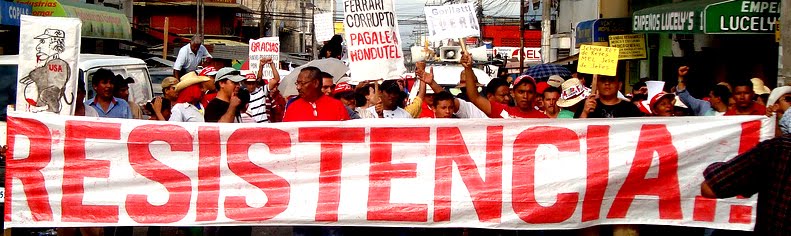 I read other Honduran sites during the coup… both those supporting the coup (including some ridiculous U.S. expat sites that when they weren’t parroting the propaganda of the coup-mongers, were buying the nonsensical justifications of the U.S. far-right with language that’s been retro since the fall of the Berlin Wall) and those opposed (who, often as not, also wrote in retro cold war cliches … although those said to be on the “left”, or commie symps, or … horror-of-horrors, Hugo Chavez apologists… writing mostly in Spanish, and who turned out to be the most reliable and honest reporters).
Although I haven’t been paying close attention to the unhappy situation in Honduras… where the coup was locked in, in good part thanks to crooked elections considered legitimate only by the Obama Administration and the Canadians (and no one else in the Americas), the continuing violence (Honduras has the highest murder rate in the Americas) and the continuing assaults on the few steps towards economic and social justice that the coup sought to roll back,.. I have kept up, largely through Hermano Juancito.
Although not a political site (the good Hermano is a lay worker in the Diocese of Copan,), it is impossible to ignore the political situation in the country, if does — as Hermano Juancito does — share the spiritual and physical agonies of his adopted country with the outside world.
Part One of his overview of the Honduran election looked at the two traditional parties… which are not the whole story. Resistance to the coup hardly ended with the imposition of an “elected” president. If there is a political solution coming out of the resistance — as well as the attempts to quash the resistance — it is unlikely to come from the traditional parties, but may (and one hopes it does) come through the traditional democratic system.
In Part Two, Hermano Juancito focuses on LIBRE, the best hope for a change within the electoral system:
Reading the news I sometimes feel as if I was back in May and June 2009, just before the coup.
The National Party is complaining that the LIBRE party will bring about the downfall of Honduras because of its socialistic tendencies. They claim that LIBRE hates the military (because LIBRE and another party are opposed to the militarization of the police.) There will be chaos in education, the military will be despised, and Honduras will become like Venezuela.
The American Enterprise Institute published an article, “Honduras Under Siege” that predicted dire outcomes for Honduras if LIBRE wins…<
[…]
I wonder if some are raising these issues to open the path to another coup if Xiomara Castro [LIBRE’s Presidential candidate, and the wife of ousted president Mel Zelaya] is elected.<
But worse is the violence that has been unleashed in the campaign.
Things fall apart, the center cannot hold: Honduras
A well-written overview of what’s happening in one American country — where people have just been too locked into two political parties (not all that different from each other) controlled by the elites… until the Conservatives used a supposedly legal method, but one hardly within democratic traditions, to prevent social changes supported by the people.
Hermano Juancito: Here come the elections: !:
During most of the twentieth century, except for military coups, political power in Honduras alternated between the two parties. For many reasons, the parties often ruled with a strong patronage system. Vote for me and I’ll see to your wellbeing. Tammany Hall had little on Honduras.But something happened in 2009 when the elected President, Mel Zelaya, was overthrown by a coup and escorted out of the country. Zelaya, a Liberal Party president, from a rich cattle-ranching family, move to embrace more populist positions which made him unpopular with the economic and political elites who ruled Honduras.Whatever you may think about Zelaya, the coup unleashed something that was unthinkable – the break-up of political system which assured the sharing of power between the two major parties.
“An unbreakable link…”
One of our favorite people, Irish President Michael Higgins (how can you not love a poet who looks like the Leprechaun … and in his Irish lilt spouts thoughts that could have come from Andres Manuel López Obrador, or Evo Morales?) is on a state visit to Mexico this week.
 Speaking at the monument to the San Patricios, Higgins spoke of the “unbreakable link” between the two countries cemented by the Irish Heroes of 1846-48. There is that, of course, but as two traditionally agrarian Catholic cultures exploited, overrun and occupied by English-speaking Protestants — and forced by the economic exploitation of those neighbors to become dependent on overseas workers … and victimized by “free trade” economics in recent years… not to mention our mutually bloody uprisings against the native and foreign exploiters in the early 20th century… yeah, we have a bond.
“White Tamale”?
Can we all drop the pretenses now? If Peña Nieto still trusts Obama to “investigate the accusations and to punish those responsible,” one has the feeling he’s going to be waiting as long as Fox did for Bush to push through an immigration bill… i.e., ain’t gonna happen.
The revelations, published by Der Spiegel (English version here) are shocking… not in the sense that it’s a shock that the U.S. was spying on Mexican elites (they’ve been doing that since the 1820s) and that the U.S. maintains “collection centers” on Mexican data… within Mexico (right next door to the U.S. Embassy on Reforma, if you are looking for it), but that the purpose is so nakedly mercenary…
Just how intensively the US spies on its neighbors can be seen in another, previously unknown operation in Mexico, dubbed “Whitetamale” by the NSA. In August 2009, according to internal documents, the agency gained access to the emails of various high-ranking officials in Mexico’s Public Security Secretariat that combats the drug trade and human trafficking. This hacking operation allowed the NSA not only to obtain information on several drug cartels, but also to gain access to “diplomatic talking-points.” In the space of a single year, according to the internal documents, this operation produced 260 classified reports that allowed US politicians to conduct successful talks on political issues and to plan international investments.

“Crawling Back To You”, © 2012-2013, “Shadowglove, DeviantART.com
Trade Partner… HAH! To “plan international investments” sounds like the U.S. was (and probably is) looking not at Mexican issues related to its own national security (which one would think was the mission of something called the “National Security Agency”) but to spin leverage U.S. financial investments to their own advantage, and the disadvantage of Mexico. U.S. and Mexican interests may coincide from time to time, but any claim that the United States is a “partner” with Mexico is only true if the partnership is that between a dominatrix and her “slave”. And “White Tamale”? Stereotyping anyone? Unless Peña Nieto is a masochist, there needs to be something more than “demanding an investigation into the matter”.
No prodigy is an island
A nice reminder.
U.S. culture, with with its individualist bent (or perhaps tolerance for anomie) overlooks the important fact that none of us gets where we are without connections. And none of us are every alone.

The Hills bring alive, the scams of bigots.
The rich are discriminated against too.
The Hills Institute, a high priced private school in Monterrey (which, incidentally, requires that a student “Speaks English on campus at all times”) used to talk about promoting “diversity” on its mission statement, which — unfortunately for all concerned — Alex and Pepe took seriously, when they enrolled their daughter Alexandra, and paid the pre-school tuition up front.
You see… while I very much doubt anyone really expects a high-priced private school to have much of “diversity” among their student body (it means, they cater to gringos) it apparently did not mean parents who do not fit the upper-class norms of Monterrey.
Three days after starting school, although both Alexandra’s fathers (who are legally married) had met with the administrators, school director Patricia Durán decided THAT kind of diversity is not exactly what the school meant. Calling in Alex for an interview, Durán claimed the owners of the school had a problem with their student’s family situation, but would allow Alexandra to remain in the school. IF… Alex presented himself as a “single parent”, and Pepe never appeared at any parents’ activities, nor was ever seen in his daughter’s and spouse’s company at any place where other Hills Institute parents might be.
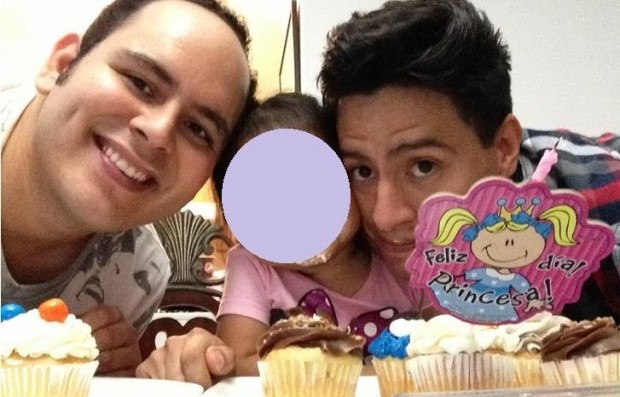
As a minor (and presumed crime victim… human rights violations being criminal actions in Mexico) Alexandra’s photo can’t appear in the media. Her, and her fathers’ surnames are not reported for the same reason.
That’s an unenforceable contract, to be sure… and also an impossibility, so the couple of course refused. Alexandra was unceremoniously yanked out of her class and sent home. Alex and Pepe returned the next day to get their money back. They were refused entry to the school, and — although they were refused a meeting with Director Durán — she DID send a security guard to tell them they weren’t getting their money back.
Alex and Pepe sued for fraud. Hills Institute must have expected this, since they quietly changed their “mission statement” to drop the “diversity” statement. Which… and the advantage of being wealthy guys who have the kind of money to enroll their kid in a snooty private school… the couple’s competent attorneys picked up on, and also filed civil rights charges.
You see, the Mexican Constitution — while often more honored in the breach than in the practice — does guarantee two rights that one would not expect to find. First, equality before the law regardless of gender preference. and second, the right of children to an “adequate” education. Both the State of Nuevo Leon’s Human Rights Commission and the Federal Secretariat of Education have both started looking into Hills Institute.
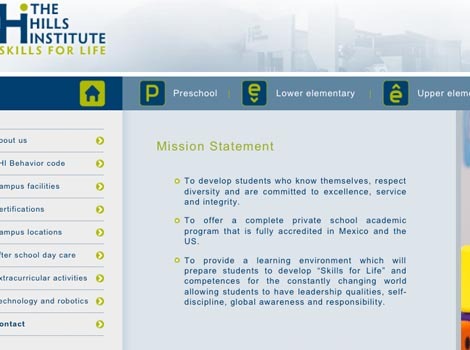
Mission statement… before
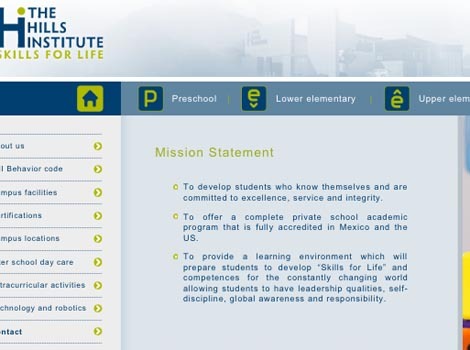
…. and after. Dropping two words is ok, right?
While media attention has been focused on the gender preference discrimination — which is important — little has been said about the rights of the child. Although several Monterrey private schools have said they would welcome Alexandra and her two papís (and their tuition payments, por supuesto), the issue is out there: what is an “adequate” education? One doesn’t realistically expect a two year old in a public pre-school with one working parent to have the educational experiences offered to a child with two highly-paid parents living in one of the wealthiest communities in the republic, the interesting issues is whether or not a school can put conditions on the parents that make it impossible for the child to receive their education.
While Alex and Pepe have several options less wealthy parents do not have these kinds of options. Private schools have long enforced conformity through “parents’ associations”… membership in which may be a condition of enrollment. Even public schools are often controlled by these parents’ groups,
Parents’ Associations have been a source of complaint when, for example, the association mandates a certain uniform at the behest of a powerful member who happens to have the contract to supply said uniform… and may or may not be giving a kickback to the school administrators. More seriously are “special fees” the parents’ associations assess their members, sometimes for the simple purpose of benefiting the children of the more active members.
The “educational reforms” being implemented here give more “responsibility” to the parents … which in poorer neighborhoods is being spun as meaning the parents are going to have to fix the plumbing and repaint classrooms themselves. A very real possibility, Is the child whose mother (and sole caretaker) is working 12 hour days, then expected to go and clean the school toilets as a condition of providing her child’s education? And what if the child is gay (U.S. private schools — receiving public funds — are notoriously discriminatory in this regard)?
Although it’s normally difficult to work up much sympathy for the rich, this is one of those incidents where you are glad the rich guys fought back. Not only does it force even the wealthy gringo-centric Mexicans that they are not immune to abuses to human rights, (something wealthy gays are sometimes a bit shocked to discover) but … much more importantly, that there are no “special rights”. If an institution is going to deny the rights of one type of family, it can deny rights to any type of family… “and if a family is going to demand an adequate education for one child, one presumes all children deserve an adequate education. And demand they should.
Sources:
Sandra González, Telediario: Se ofrecen 10 escuelas para menor expulsada de The Hills Institute (24 September 2013)
Daniela Mendoza Luna, Milenio: Tener dos padres fue la falta imperdonable de una niña en NL (20 September 1013)
Alex Morris, Rolling Stone: The Hidden War Against Gay Teens
Rafael Roma, CNN: The Hills Institute day care controversy: Dads say daughter expelled from care because they’re gay (1 October 2013)
SPD Noticias: Padre gay de niña expulsada de The Hills Institute acude a mesa redonda en TV de Nuevo León
Maria G. Valdez, Latin Times: Mexican Student Expelled For Having Gay Dads From Prestigious The Hills Institute (26 September 2013)
Paloma Noyola
Twelve year old math prodigy Paloma Noyala is from a working class family and attends public school in her native Matamoros, Tamulipas.
One certainly hopes she grows up with a better values system than Steve Jobs had,

Indian drums… and piccolos and violins and french horns and…
The Banda Filarmónica del CECAM (Centro de Capacitación Musical y Desarrollo de la Cultura Mixe) of Santa María Tlahuitoltepec, Oaxaca is playing at the Palacio de Bellas Artes in Mexico City next Monday and Tuesday evening.
The Palacio is Mexico’s answer to Carnegie Hall, and like the joke says, the way to get there is “practice, practice, practice”.
Which the Banda Filarmónica has been doing for the last thirty years. CECAM is a educational program for Mixe speakers, but opens its music school to any indigenous student in Oaxaca. With a quarter of Oaxacans a monolingual speaker of any one of the State’s sixteen indigenous languages, the musicians often are unable to understand each other’s… words. Not that they can’t communicate.
The man who changed everything
While working on his doctorate in Chemistry at UNAM, Luis Ernesto Miramontes Cárdenas (born 16 March 1925, Tepic,Nayarit) took a job with a small Mexican pharmaceutical company, Syntex, which was working on synthisizing extracts from the North American wild yam (Dioscórea mexicana) which had been used for centuries by Husataca and other indigenous Mexican women to prevent unwanted births.

On 15 October 1951, Miramontes succeeded in synthizing noretisterona, the chemical equivalent of the naturally occuring substance in yams that prevents ovulation. While his supervisor Carl Djerassi, assisted with Miramontes research, and along with Synex director, George Rosenkranz, shared in patent rights, Miramontes was the guy who unlocked the formula that permitted low-cost, effective, and mass-produced birth control — radically altering not only the lives of Mexican women (where the right to family planning was enshrined in the Constitution) but the lives of all women.
So… what did you do in grad school?


 mexfiles.net