The OTHER Colorado gun news…
Did anyone else catch the story that popped up in the media last Friday MORNING?
A 35-year-old Colorado man avoided a jail sentence on Wednesday even after pleading guilty to conspiring to sell more than 30 machine guns with optical sights, five pounds of C4 explosives, grenades and 14 semi-automatic pistols smuggled into the country from Iraq.
Richard Paul, of Durango, brokered a deal for five years of probation and eight months of home confinement by pleading guilty and agreeing to testify against his co-conspirator, 34-year-old former Navy SEAL Nicholas Bickle[…] Paul reportedly sold 12 AK-47s and five pistols in two separate transactions in 2010 to an undercover investigator that openly expressed a desire to move the weapons to Mexico.
Colorado does not prohibit the possession of assault rifles, though the state requires background checks are required for purchases made at gun shows and all sales must be completed with a detailed record of the buyer and seller. The state doesn’t limit on how many guns can be purchased at one time and nothing to stop buyers from transferring the weapons to a third party immediately after sale.
The U.S. keeps claiming they’re actually doing something about the weapons trade with Mexico (and Mexican gangsters), but they aren’t doing much to control their own domestic trade (see any other news story out of Colorado involving weapons this past weekend).
Sure, as Vanguardia (Saltillo) noted, a dozen deaths in Colorado did what 60,000 in Mexico couldn’t do (get the whole world talking about the insanity of U.S. gun laws), but what I have seen so far have been blatherings about how one might account for the killer’s mental state, or the effect on U.S. politics, or how the media covers the media covering the media coverage of the politics of the tragedy… and the weak responses by otherwise competent officials, like the President of the United States (“…in a briefing with reporters who were travelling with President Barack Obama as he met with the victims and their families in Colorado on Sunday, Press Secretary Jay Carney signaled that the administration would tackle issues of gun violence within the confines of current legislation“) assurance the U.S. that nothing substantial will change.
One would ask where the U.S. equivalent of Javiar Sicilia is. But then again, I doubt anyone in the United States listens to poets anyway. Poets won’t get through, but maybe violence will.
Maybe Mexico would be better off, as I’ve suggested before, just launching drone strikes on suspected gun dealers in the United States — the same way the Obama Administration has given itself the right to launch such strikes on anyone it considers a threat to U.S. national security anywhere in the world (except, perhaps, domestically) — and consider any male between the ages of 16 and 65 who happens to get killed in the process as a presumed enemy combatant. That, however, might put some trade issues at risk, and perhaps — in the name of good relationships between the two countries — the Mexican government could just make a deal with some of the more cut-throat of our various gangster bands to send their hitme off on an assignment north of the border. They seem to accept an occasional slaughter as normal in the arms trade(though normally conducted off-premises), so that shouldn’t unduly ruffle any fearthers.
The right to collateral damages
Five or ten or twenty or more are shot down at a bar, or on a bus or in a drug rehab here in Mexico, we are expected to suck it up: it’s a rational outcome. The cost of doing business with the world’s largest narcotics importer is a lot of “collateral damage”.
But when a mere dozen or so are gunned down in a theater in Colorado, there’s a scramble to find some “rationale” — anti-depressants, or economic/social pressures or political ties or … well… anything will do but the most obvious: it’s the cost of doing business in the world’s largest domestic arms bazaar.
From today’s Jornada (translation by Esther Klein Buddenhagen):
Events such as yesterday’s demonstrate […] the devastating effects of the anachronistic [lack of] regulation of arms and the destruction which prevails in the United States and which represents on a national scale the law of the jungle which the governments of Washington have sought to impose on the world. The lack of ability or will on the part of the Obama administration to regulate and contain the sale of arms not only casts a pall periodically over the society of the US, but also affects other nations such as ours. It reminds us of the massive quantity of contraband arms that traveled from the US to Mexico in Operation Fast and Furious: more evidence that the present US government has been defeated by the devastating inertia which prevails in politics, in the economy, and in the culture of this country which claims to be a champion of civilized behavior to the rest of the world, and which finds itself brought to a halt, instead, in a situation of backwardness marked by a systematic propensity to violence and barbarism.
Fidel and I… two degrees of separation
Simply reading these news items shows the possibility and the necessity we have of enriching our knowledge which today is fragmented and scattered. Perhaps it takes us to more critical positions on the superficiality with which we deal with cultural and material problems. I have not the slightest doubt that our world is changing much more quickly than we are capable of imagining.
(Fidel Castro)
Writing in Counterpunch, Nelson P.Valdes refutes the new popular meme that’s been popping up lately to the effect that 86-year old Fidel Castro is gaga. The evidence of gaga-hood is apparently that Castro isn’t going in for record-breaking discourses on Marxist-Leninism or anti-imperialism so much as publishing shorter, pithier published observations on — well — everything from global warming to baseball to yoga. The “problem” — if there is one — is that Castro isn’t quite used to the idea of twittering (and although I’m a few decades younger, neither am I ready to reduce complex ideas to 120 characters) and even blogs are not meant for lengthy, complex arguments (I know… I get lost in them sometimes,but I see this as more a draft for potential future writing, or just random pointers on Mexico and Latin American news that otherwise gets missed than as the final word on… anything).
And, as Valdes points out, the guy is a retiree with the time to read about, and comment on, things that wouldn’t have fallen under his old job description. Which is something I can sort of comment on from (in)direct experience.
The latter observation isn’t new. I had worked for a “Business English” service in Mexico City that went belly-up when the owner 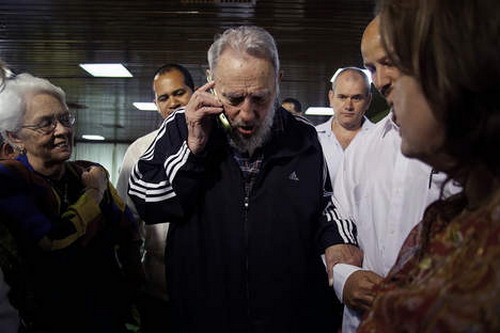 took off with the school’s funds (and those of a couple private grade schools she owned) for her native Cuba (we think). Besides the gringos and Mexicans, a couple of Cubans and an Argentine were stuck with out a job. Trying to turn lemons into limonada, a few of us got together and contacted our better paying clients (the ones that absconding Cubana hadn’t totally pissed off, and/or robbed), and tried to start our own company. One of the more prestigious clients even providing us office space for a time, as long as we agreed to have an on-site person to assist the client with their routine English-language customer inquiries. Our on-site person, another Cuban, had a more interesting work history than most of us. She’d been one of an office full of translators working for el Comandante.
So… I got to hear some office gossip from inside Cuba, about 10 or 15 years later: when word came down that Fidel was heading down the hall, if you weren’t quick to go on break, or suddenly remember that important meeting that you just had to attend, you were likely to be stuck translating something like a Ford ad for new pickup trucks or a couple of paragraphs out of Vanity Fair> or Car and Driver. It wasn’t so much that it was a hard assignment (usually it was just that Castro didn’t recognize some English word in an article, or wasn’t quite sure he understood something correctly), but that having done work for el Comandante, there was a lot of national security restrictions on people who are privy to personal communications with a head of state anywhere, and the paperwork is a pain in the wazoo to fill out.
I don’t think the guy is anywhere near gaga, and — though I think making himself Cuba’s “indispensable man” for several decades was a mistake — it does confirm my sense that great leaders are not narrowly focused people, but are those with insatiable curiosity… and that Castro is a more creative thinker than we want to give him credit for. That, and while geezers don’t always completely “get” or avail themselves of all the new technical doo-dads (heck, I can’t figure out what all the features are on my latest cell phone) they aren’t around the bend, just because they’re over the hill.
It’s not if you win or lose…
Perhaps the most critical moment in establishing the credibility of the Parliamentary process happens before Parliament even opens: namely, the people’s participation in a free, fair, inclusive electoral process.
Aung San Suu Kyi, in a speech to the British House of Commons (21 June, 2012)
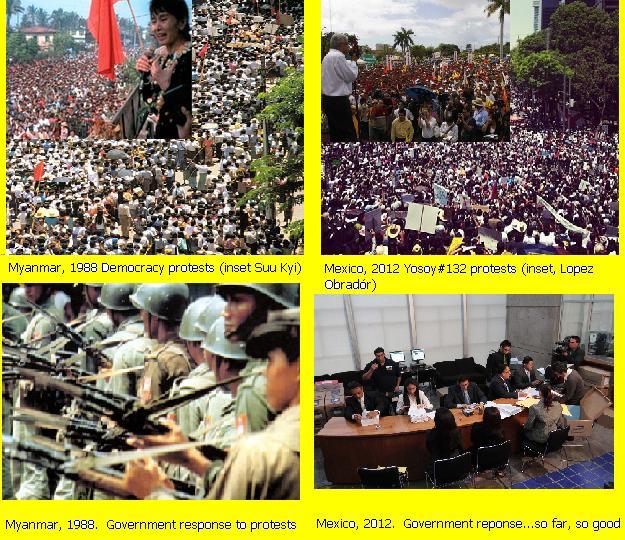
 Reading the foreign (and much of the Mexican) press, one gets the sense that what is going on here is an attempt to annul the election of Enrique Peña Nieto or to install AMLO in the Presidency. I don’t say that isn’t a goal among some of those making complaints, but it seems a secondary goal to something much more important: the credibility of the electoral process itself.
While representative parliaments chosen by geographical region and an elected chief executive are not the only possible forms of democracy, that is the system under which Mexico is governed. The issue right now is less which candidate received the most valid votes for the chief executive position, but whether the people participated in a free, fair, inclusive electoral process.
If not, people will consider alternatives.
Maybe not so minor a change
While no one was looking, there were a few minor tweaks to the Constitution, that we’re being told is just coincidental to whatever is going on in the TEPJF hearing room.
Gonzáles Morfín for Prez?
The minor revisions (approved by 17 of the 32 states) allow a President Elect to take his or her oath of office EITHER in the Chamber of Deputies OR before the President of the Supreme Court. If you recall, there was a movement to prevent Felipe Calderón from entering the Chamber and being sworn in on the First of December 2006, and he took the oath of office in Los Pinos before television cameras … something that the wonkiest of the opposition could add to their list of reasons that Calderón was an illegitimate president (overlooking the fact that AMLO, during his theatrical “alternative presidency” wasn’t sworn in according to the strictest protocols either).
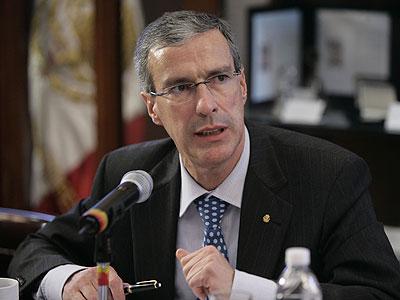
One perhaps more important, and which may factor into however the TEJPF rules, is that there a line of succession, and provisions for President-Elects NOT taking the oath of office for one reason or another … dying (as Obregon did in 1928 before he was sworn in) or if there is no President-elect, or an election was invalidated. In that case, the Senate President becomes acting President, until a joint session of Congress can appoint an Interim President. By that way, that individual is a dentist named José Gonzáles Morfín, a plurinomial PAN Senator.
Otherwise, the Secretarío de Gobernación becomes Acting President. Spelling that out is of some importance, since it had always been assumed that the Sec. de Gob. was acting president (he or she ran the cabinet and the executive branch when the President was unavailable( but Calderón for a time (and he went through a Sec. de Gob. per year) had a Sec. de Gob, Juan Camilo Mouriño, who was born in Spain… and on top of everything else, the last thing needed in figuring out who the next president is, is questions about a birth certificate. That would be silly… right?

Cinema vérité…
Ah, well… at least they try to get with the program a little more than some of our customers here in Mazatlán.
Bishop of Ecatepec… easy act to follow
With rogue Bishop Onésimo Cedepa Silva having managed to retire without the scandal of seeing him dragged off to the slammer (as was a very real possibility any number of times), the Diocese of Ecatepec probably will find Oscar Roberto Domínguez Couttolenc, a welcome change. While Bishop Cedepa was known for hanging with the rich and famous, and his “creative” financing (including, it appears, a weird pyramid scheme involving pre-need burial plots), Bishop Domínguez was the Bishop of Tlapa (Guerrero), the poorest Diocese in Mexico.
A former missionary priest in Kenya, Domínguez was his order’s financial director for a time, so one has to assume his fellow priests trust him with the collection box. Even if he has collaborated closely with Opus Dei in Guerrero, I’ll just take a wild stab in the dark and say the 56-year old native of Puebla is going to be a tremendous improvement over his predecessor.
A short but trustworthy, loyal, helpful, courteous, kind, obedient, thrifty, brave, clean and reverent history
Whenever a crime is horrific enough to make headlines north of the border, there is an inevitable mention of narcotics activity in the area. What narcotics traffickers had to do with attacking and raping girls on a camping trip isn’t clear to me, but the reports also mentioned that the girls were from a “religious group” without giving any details. Fox News unhelpfully referred to the group “Chains of the Holy Trinity.”
The worst possible way to learn about something is through a crime. But, having written the violence that religious disputes have caused in this country, when I run across mention of crimes that might be rooted in religion, I try to at least identify the denomination. It’s not the best way to get into history, but one Mexican news story mentioned that the victims were with the Movimiento de Juventudes Cristianas which was easy enough to track down… north of the border they would have been called what they were… “Girl Scouts.”
But, being Mexico, just identifying a group as “Girl Scouts” opens up a whole slice of Mexican history I didn’t know… or rather, one I should have expected. The history of Mexican Scouting, like so much else in modern Mexico it seems, is one of a foreign social movement co-opted by the revolution, adapted (by the Catholic Church) to reactionary forces and managing to emerge as a mainstream, if quirky, Mexican institution.
Although the British social ideas had a following in early 20th century Mexico, the first Scout group in Mexico were attempts to set up a German Pfadfinder group, which went in more for war gaming than Lord Baden-Powell’s Boy Scouts — which only makes sense, the first scout group being organized at the German High School (Colegio Alemán) in Mexico City in 1913. In 1914, a second scouting group was formed in Merída, this one closer to Baden-Powell’s own vision. General Salvador Alvarado — seeking to destroy the “Divina Casta” of rich landowners and wipe out what he called “fanaticism” — certainly had a different idea of what boys needed to become productive citizens than the imperialist titled British gentleman, and the Cuerpo de Boy Scouts de Yucatán (note they used the English name). The Cuerpo was in some ways revolutionary, throwing together Mayan, mestizo and “divina casta” boys as equals and — much more like the Mexico City Pfadfinder group — instilling a sense of military values.
With the U.S. influenced Rotarians also starting to sponsor scouting groups, President Venustiano Carranza (always suspicious of the gringos) put all scouting groups under the direction of the German school teacher Federico Clarck, in the Asociación de Exploradores Mexicanos. Carranza got a little carried away, trying to create a “Directorate for the militarization of youth”, apparently meant to develop some sort of junior special forces unit, which was quickly abandoned when Carranza was overthrown. However, the idea of the project never really got off the ground, but under the Obregón and Calles administrations (both of whom had been school-teachers, and both of whom saw education as a means to consolidate the Revolution), scouting was viewed positively. It was seen as a means to inculcating revolutionary discipline and ideals… which in the 1920s, meant creating a new model for the nation… a physical fit, hygienic, politically aware young Mexican.
Of course, the Catholic hierarchy, being no fools, and not at all adverse to using the tools of the Revolution to fight the Revolution. Based on the U.S. Boy Scouts, and the Catholic Youth Organization (which had been formed to create an alternative to the Protestant led YMCA), Archbishop the various organizations were finally brought together in the early 1920s… just in time for the Catholic Church to decide that to fight the Revolution, they needed to use the tools of the Revolution. Through the Knights of Columbus and Liga Nacional Defensora de la Libertad Religiosa, various quasi-military youth organizations were set up. Both the K of C and the Liga were active in the Cristero War, so it wasn’t until the 1930s that the various youth groups were somewhat reluctantly allowed into the larger Scouting community.
There were scouting groups for young women, rather less organized (and, perhaps not surprisingly, given the odd situation in post-revolutionary Mexico it was often in conservative movements where women first emerged as leaders in their own right), mostly under Catholic Church auspices. While all were eventually brought into the Asociación de Scouts de México A. C . it was a somewhat awkward fit between the militantly secular and militantly Catholic organizations. In 1962, the Movimiento de Juventudes Cristianas went their own way. They have maintained gender segregated groups… that “Chains of the Holy Trinity” being a rather clumsy translation of “Cadena” … the term used by the MJC for their girls’ groups. In other words, it was Holy Trinity Girl Scout Troop that was attacked. One difference between MJC and the other Scouting organizations is that MJC has no direct adult supervision, which may have factored in the recent tragedy.
Typically Mexican, every progressive act is going to annoy some traditionalist. The Asociación Traditional de Scouts de México A. C (in their logo, the “Traditional” is in gold lettering, and the “T” is a point size or two larger) was formed in 1981 in response to the decision by the Asociación de Scouts de México A. C . to do away with gender segregation.
But then too, what’s any movement in Mexico without an intellectual avant-garde? The Agrupación Scout Mexican, A.C. might go in for camping and knot-tying and wearing uniforms too, but they have their own manual, one that borrows more from John Dewey, María Montessori, Jean Piaget and Paulo Freire than Lord Baden-Powell’s “Scouting For Boys”.
In other words, Mexican Scouting is just… Mexican: Revolutionary in its roots, vaguely idealistic and egalitarian, diverse in tradition and expression.
The wheels of justice grind slowly… meanwhile…
MoReNa (the Lopez Obradór side) had submitted it’s evidence to the TEJPF, and PRI supporters have filed their counter claims. Today the tribunal begins 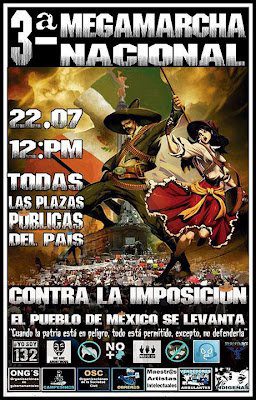 hearing the arguments and considering evidence from now until the end of August. The Electoral Tribunal also has to consider down-ballot elections complaints, and has until 6 September to issue a ruling.
Although the United States government seems to be of the opinion that Enrique Peña Nieto IS the incoming president, and you’re not going to see much about the court procedures, what has got to start weighing on people’s minds is that its not just the usual suspects … even when those suspects include a heck of a lot of people (students, unions, indigenous groups, the intellectuals and artists, the anti-drug war people, one of the three main political parties and another that seems to be sitting on the fence) … but when opposition spreads to those who would be charged with imposing what is said to be an imposition.
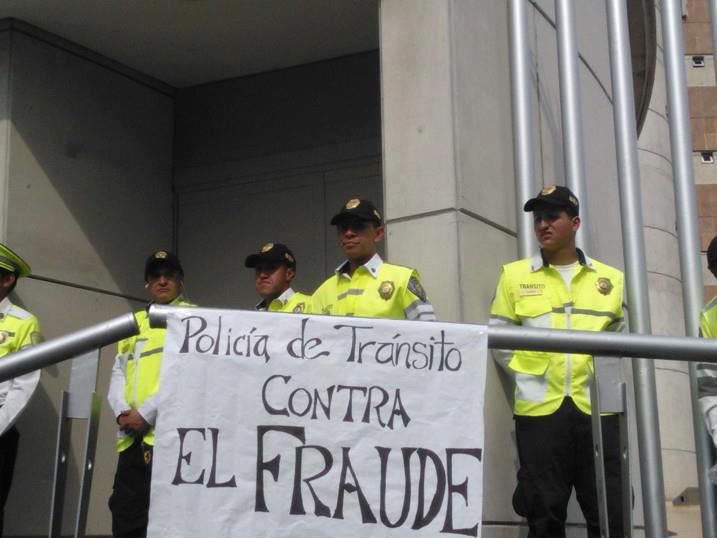
This is only some Mexico City transit cops… how many I don’t know. But they are absolutely the last guys you’d expect to be protesting against perceived corruption in the system. And if they see it…
16 de julio de 2002
I was living in Mexico City the day every newspaper in Latin America carried the headline “La reina ha muerto”… and ended up buying at least three Celia Cruz pirate CDs on the Metro.
From what I think was a Colombian or Venezuelan television show of the 60s, here is La reina with Sonora Mantencera singing Bernabe:
More than opinions
This was written by a naturalized Mexican in response to an American ex-pat who refuses to believe that there could have been any sort of fraud or corruption in Mexico’s 2012 presidential elections. He wrote regarding Pres. Calderón’s ‘opinion’ about vote fraud, saying nothing that has been written or said is ‘hard facts’.
____________________________________________________
Pres. Calderón is the leader of the country. No other sitting Mexican president has expressed this kind of ‘opinion’ about a presidential election.
You state that my concern is “about the PRI/PAN “ganging up” on the PRD this time”. Those are your words; that is not my concern. My concern is the extent of corruption and fraud by PRI in the general presidential election. Vote-buying (read about Monex, Soriana, and most recently, this: http://apnews.myway/…./DA00QS601.html) and influence peddling were rampant–yes, that is my opinion, but it is also the opinion of many people who are highly placed in Mexican government, intellectual circles, and who are much more knowledgeable than the man on the street.
Your statements indicate that you discount ‘opinion’ and will listen only to hard facts. The ‘hard facts’ of fraud and corruption in this election may never be proved, since it is against the best interests of the PRI for the allegations to be substantiated. However, store receipts from the use of the ‘gift cards’ from Soriana showing “Beneficios PRI” have been published online. The linked article makes allegations of vote-buying. Individuals from many states have come forward to admit that they sold their votes. No, I can’t quote chapter and verse: Fulano de tal sold his vote (in case you need a translation, fulano de tal means so-and-so).
You write about “major improvements in poll watching, ballot supervision and voter ID that have even drawn international recognition”. Poll watchers, ballot supervisors, and voter ID have all been alleged to be corrupt. No, not all…but enough.
The PRI is smart enough to appear transparent while being opaque and clever enough to hide its vote-buying in a cloak of ‘gifts’ to voters. On the other hand, on July 10, 2012 the San Diego Union Tribune’s Mexico section reported this: http://www.sandiegor…sa-de-valores/.
I offer links to two news stories from US newspapers. For more and deeper coverage of the allegations and opinions of thousands of people, I recommend that you read Mexican newspapers and watch Mexico’s news channels. Opinions, yes, but they just keep piling up.
You know the story about the little boy who was an incurable optimist? When taken into a room filled with horse manure, he enthusiastically dug in with a shovel. When asked, “Why in the world are you doing that!?” the little boy grinned and said, “With all this s**t pile up, there has to be a pony in there somewhere!”
The piled up s**t, in the case of the fraud in Mexico’s 2012 presidential elections, consists of the opinions of thousands and thousands of people, from the person on the street to the president of the República. Other people continue to search for ‘hard facts’, the non-existent pony in the stable.


 mexfiles.net