At least he left a tip
How Mexico dealt with unwanted foreigners trying to run things down here back in the good old days.
Showing that Televisa can sometimes do things right… the re-enactment of the events of 19 June 1867 was from the closing moments of the first of a three-series telenovela El vuelo del aguila, and agrees with the historical record.
Produced by Ernesto Alonzo. El vuelo — broadcast from 1994 to 1996 — followed the long career of Porfirio Diaz from his Oaxacan youth through his French exile and, even if hammy and over-the-top (but then that’s the way Mexican are… even wannabes like Maximiliano … he really did tip the firing squad and make a statement about his blood being the last shed for his adopted country) I have to admit that Televisa, has done some good work and occasionally covers stories relatively straight … at least when the news is over a century old, that is.
(By the way, Maximiliano is played by Mario Iván Martínez, who — being a white guy — gets somewhat stuck in an ethnic ghetto, playing foreigners a lot in Mexican productions. Ernesto Gómez Cruz, who usually is, if not the villain, than a sinister character, is cast against type here, playing Benito Juárez)
Adios, Mama Carlota
More evidence that history repeats itself, if only as metaphor.
Tropical Storm Carlota weakened into a tropical depression on Saturday after battering Mexico’s Pacific coast and killing at least two children whose house collapsed in a landslide…
It wasn’t the first time a furiously active, greatly feared Carlota came banging into our tropical shores, only to degrade into a depression, after getting a few people killed and leaving behind a mess…
And, in looking around for something snarky to use as a photo (I was going to use Bette Davis, as Carlota, going spectacularly nuts in the 1939 MGM “Juarez”, as Carlota did in 1867 — while calling on Pope Pius IX.
Allegedly, the only woman ever to spend the night in the Papal apartments (the Pope, who was in his mid 70s, spent the night in the Vatican telegraph office, trying to get in contact with her brother, the King of Belgium), Carlota was eventually judged to be incurably insane.
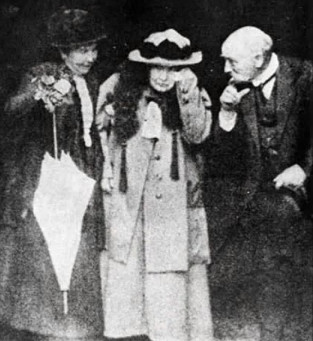
In 1879, Bouchout Castle in Miess, Belgium (now the National Botanic Garden of Belgium) became her home, or hospital or asylum. Never well, physically or mentally, this photograph of Carlota, accompanied by a “lady-in-waiting” and the Castle’s majordomo, is one of the very rare portraits of the former Empress dating from after the Mexican fiasco (The only other one I have seen shows her on her deathbed, and I found a reference to one of Carlota seated in a wheelchair).
The photo is said to have been taken in 1882. Although she was known to have shown signs of a physical and mental deterioration even when still in Mexico (I am not the only one who has concluded she was suffering from tertiary syphilis), Carlota was born in 1840, and the woman in the photo is more likely in her 70s than in her early 40s. Also, although Carlota spent most of the last sixty years of her life too debilitated to get out of bed, someone would have seen to it that she owned decent clothing (she was, after all, a member of the royal family). Carlota an her attendants, while not dressed fashionable, are in clothing styles of the World War I era. I expect the author of the site (which somehow ties the history of the Americas to the Biblical prophesy and the “end times”) which posted this photo made a guess as to the date … and so do it.. sometime after 1910, possibly as late as the 1920s.
Carlota lingered on , a ghostly presence in the castle, until her death, at the age of 86, on 19 January 1927.
Adios, Mofo
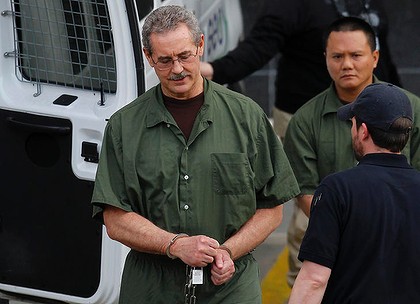
Financier and cricket mogul Allen Stanford was sentenced to 110 years in jail for a $7 billion Ponzi scheme, closing the book on the flamboyant ex-tycoon’s stunning fall from grace.
“This is one of the most egregious frauds ever presented to a trial jury in federal court,” Judge David Hittner said in handing down the lengthy sentence in Houston, Texas. He was also ordered to forfeit $5.9 billion.
“From beginning to end, he’s treated his victims like road kill,” Assistant US Attorney William Stellmach told the judge today before a courtroom packed with Stanford’s victims. “Allen Stanford doesn’t deserve anyone’s sympathy and he doesn’t deserve your honor’s mercy.”
(via The Age [Australia])
Perhaps Judge Hittner was showing some mercy in sentencing Stanford to sit in prison the rest of his life. When the scandal first broke in early 2009, Stanford was also under investigation for money laundering and bribery here in Mexico.
Back then, there was mention of Stanford owned planes flying cash (and who knows what else) in and out of Mexico. and U.S. officials spoke of bribes to unnamed “foreign officials”. There were allegations that among the clients were the Gulf Cartel. They really, really hate it when people lose their money, and had the U.S. government not nabbed him, the now former SIR Allen would have been a knight to dismember.
In search of Salvador Novo

Who, when, where?
Well, this is a tad embarrassing. I know this is was sure this was a portrait of the Mexican poet, dramatist (and over-the-top drama queen) Salvador Novo from the late 1920s, when he was young and good looking (he aged disgracefully). Seems I was wrong… it is a Mexican painting, but the subject (and the artist) is Emilio Baz Viaud … Autoretrato del artista adolescente, 1935, to be found in the Collección Andrès Blaisten, at the Centro Cultural Universitario Tlatelolco .
I know I swiped it from some on-line source (misidentified as a portrait of Novo) , but a search of that indispensable resource for tracking down obscure on-line images, tineye.com only turns up my original post on bullfighting, machismo, The Village People and Salvador Novo (the kind of posts that are much more fun to write, than yakking on about elections). But I did manage to find the same picture on the Colección Voces que dejan Huellas site, which lets you listen to (and download) recordings of various writers and poets. Never having actually heard Novo read before, it’s kind of surprise to find that his spoken voice doesn’t fit his image … but then again, as I wrote, Novo’s life work was subverting our perceptions of machismo and effeminacy.
I had an email today from Casey Kittrell, at the University of Texas Press.
The University of Texas Press is publishing a translation of Novo’s autobiography, La estatua de sal, next year and we are searching for possible cover images. You posted a terrific piece a few years about Novo and machismo that included a portrait of Novo that I have not seen before.
I’m flattered of course, that the editor read this site, and that he liked what I had to say about Novo (… and The Village People… and bullfighters… oh, and Ernest Hemingway, too). But more to the point, he is considering this apparently obscure portrait of Novo as cover art. It’s a little frustrating in the best of times to be trying to work on preparing books for publications from out here in Mexican provincia. But at least I’m somewhere within the reach of civilization, not out in the barbaric backwater of Austin, Texas (ok, I’m kidding… I’ve been to Austin… it’s almost civilized). Still, it’s not like I just can’t walk over to the Palacio de Bellas Artes or Museo San Carlos, or take the metrobus down to UNAM (or up to Tlatelolco, where I would have seen this hanging on a wall) from Mazatlán.
There is a fairly well known portrait of the young Novo by Manuel Rodriguez Lozano (Retrato de Salvador Novo (El taxi), 1924… the on-line image is not for download) at the Museo Nacional de Arte and ask who the OTHER artist who did a portrait of the then-controversial and “morally dubious” poet as a young man. But this one? Apparently it’s not completely unknown, just unknown to me, to the University of Texas and to the Internet.
Which doesn’t mean someone out there doesn’t know who the artist is, or where the original of this portrait might be. Help!
Many thanks, and a doff of the sombrero, to Professor Stephen Dove of Centre College (Danville, KY) .
Another sign of the Apocalypse… AMLO and FeCal align
I was surprised yesterday to see Felipe Calderón saying he didn’t know who would win the Presidential election. The wording was such that he didn’t just seem to be defending the so-far pathetic performance of his party’s candidate, Josefina Vasquez Mota, but that he thinks it really is too close to call. Given that the “conventional wisdom” all along has been that Enrique Peña Nieto would be moving into Los Pinos in December, coming from the current resident of the Presidential compound, who has much better sources of political intelligence that I do, it was somewhat* unexpected.
Salvador García Soto, a widely read political columnist, while no friend of Peña Neito is hardly an AMLO-ista, but admits that the election may be very close, and that the left might very well win. My translation from the column published in 24 Horas:
Andres Manuel Lopez Obrador’s political death certificate was written too soon. He is not only alive, but in a race for presidency, and, moreover, is the biggest threat to the long-anticipated return of the PRI to Los Pinos.
Supported by numerous surveys the idea has been spread that the advantage is overwhelmingly Enrique Peña Nieto’s, with polls anticipating a PRI victory of somewhere in the neighborhood of six and eight percentage points, or about three million votes. But other surveys, stubbornly claim this election will be close and that closure has begun, placing Lopez Obrador anywhere from eight points behind to a virtual dead heat with Pena. Aanything can happen and there is no sure winner.
The Lopez Obradór team’s internal surveys, and the most recent polls by Berumen and Associates, are anticipating that in the closing days of the campaign, that along with a fall in support for Pena and growing support for Lopez Obrador , Josefa Vasquez Mota has gained in support, especially after her performance in the second debate. This sets the stage for a nearly equally divided electorate on the First of July, meaning any of the three candidates, including PAN’s candidate, could win.
That was the what President Felipe Calderon meant when he said at his Tuesday Los Pinos press conference that the election “is yet to be decided” and “either candidate can win.” Calderón’s diagnosis is perfectly consistent with that from the Lopez Obradór headquarters, and Andres Manuel himself has defended the President, and his “right to free expression.”
For the first time in six years, almost by a miracle, Lopez Obrador and Felipe Calderon are in agreement and united in a common cause. The President was out to give mouth-to mouth resuscitation to Josefina and put her back in the fight, which is exactly what the lopezobradoristas strategists are looking for. They do not want to deflate Vazquez Mota because it suits them that the PAN candidate’s support is growing, creating a three way race, and not a narrow two-man contest between Lopez Obrador and Pena.
And there is a second and striking coincidence between Calderon and AMLO reading of the election polls: the youth factor. The President said not to underestimate the voters, especially the young voters, as a factor that could change. And it precisely on the young voters that lopezobradorista are concentrating their strategy in the last 15 days of the campaign season.
Lopez Obrador’s performance in the # 132 Debate on June 19 will be one step in the candidate of the left’s attempts to “lock in” the young voters support. If they really go out to vote on the First of July, it could alter the results. Never in the history of the country have there been so many young people registered and eligible to vote: nearly eight million of them, three million first-time voters.
So Andres Manuel Lopez Obrador arrives at the end of this contest with one thing certain and one big question hanging over Mexico. The certain thing is that he is not dead, and will keep fighting up to the final count. The big question is what will happen if there is a close election where the estimated three to five percent advantage anticipated by Lopez Obrador from the youth vote, is not in his favor? Will a narrow defeat unleash a post-election conflict?
* Whether it has changed its polling methodology since 2010, but I did remember that Consultas Mitofsky, the most quoted of the polling organizations (and the one used by most foreign press reports), vastly under-estimated support for PAN-PRD coalitions in the 2010 elections. Whether there is a built in bias towards the PRI in the way polling is done I can’t say, but the polls mentioned by President Calderón and the Lopez Obradór team show their respective candidates in this election having about the same level of support as their coalition candidates actually did in the states where there was a joint PRD-PAN ticket in 2010. That is, IF Mitofsky and similar polls are overcounting PRI by the same level they did in 2010, Peña Nieto would have been polling about 5 to 10 points and PAN and PRD together polling 10 to 15 percent more. Depending on how that split works out, any one of the candidates could be in the lead.

Fear and Loathing in Aguascalientes
Kent Patterson (Frontera Norte/Sur) suggest what I also think… that the leftist alliance, even if it doesn’t win the presidency, will make impressive gains in the legislature, and any president is going to have to negotiate, and not dictate, his (or her) policy.
Insisting that he is at the head of the pack, Lopez Obrador is maintaining a grueling, two state tour each day before June 27, when he plans on closing his campaign with a massive march and rally in Mexico City. This week, the former Mexico City mayor touched down in the drought-stricken state of Aguascalientes, where he delivered a long speech to hundreds of supporters gathered in the capital city’s main plaza. Rural and urban residents, young and old, professionals and students, all formed an enthusiastic audience that was draped in the yellow, orange and red colors of the Progressive Movement parties and kept on its feet by the cumbia sounds of Lopez Obrador´s Morena movement anthem.
Under a blazing, mid-day sun, Lopez Obrador countered criticisms that he is a dangerous radical. He repeated a controversial pledge to implement an austere government by slashing the salaries of high federal officials, some of whom he claimed make about $50,000 per month and earn even more than their Brazilian counterparts, while cutting back on foreign travel by officials.
“We aren’t going to lower the salaries of the majority of government workers, who earn little. This is not the problem,” the candidate said. “It’s shameful when you ask for (an official) and are told ‘no, he’s in Brazil or at a congress in France’..”
The undisputed leader of Mexico’s electoral left, Lopez Obrador reiterated that a frontal attack on government corruption and wasteful spending will provide the funds necessary to pay for new programs to rescue the countryside, lower energy costs, increase pensions, support students and generate jobs. “If there is no work, it affects everyone,” he argued. “The principal problem in Mexico is employment.”
After listening to the presidential hopeful’s promises, Aguascalientes mother Andrea Martinez said she liked the proposals for more educational grants and state provision of school uniforms. “It’s a good thing to support students and young people so they don’t fall into delinquency,” Martinez said.
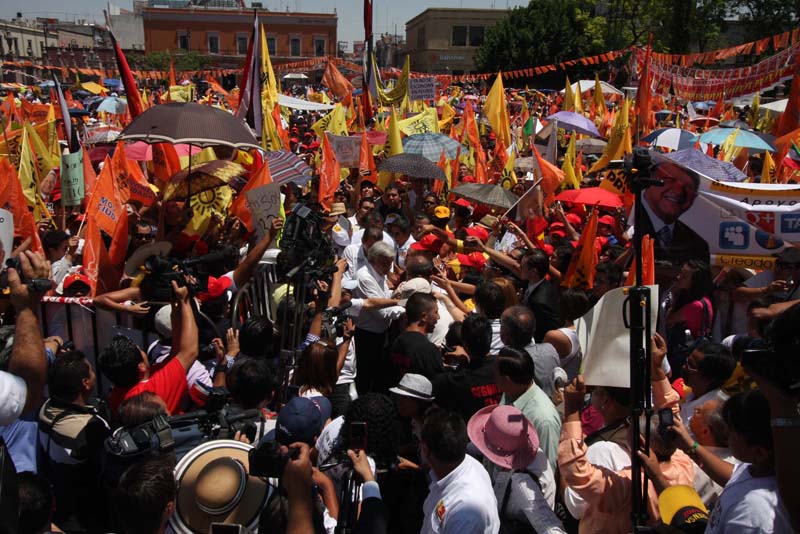 In terms of the campaign’s final stages, Lopez Obrador warned of the intenstification of negative campaigning and attempts to buy the election, specifically by means of trading budget-busting household supplies, construction materials and farm animals for votes. Expressing confidence that the Progressive Movement in Aguascalientes had its bases covered, Lopez Obrador nevertheless urged his supporters to carefully monitor the voting booths on July 1.
“If we don´t take care of the polls, we leave open he possibility that the will of the people won’t be respected,” he said. Sprinkling his speech with references to revered Mexican President Benito Juarez, Lopez Obrador almost completely refrained from attacking his opponents and only made a brief mention of Pena Nieto.
“This movement for transformation is historic,” he declared. “We have the opportunity to change the direction of this country.” The unsuccessful 2006 presidential candidate was accompanied on stage in Aguascalientes by local candidates for the federal Congress, which turns over its membership this year, and by Labor Party founder Alberto Anaya and Citizen Movement party leader General Armando Lopez.
In Aguascalientes at least, Lopez Obrador faces an uphill battle. Currently governed by the PRI, the state administration of Governor Carlos Lozano de la Torre has been particularly active, helping to revitalize the capital city’s downtown and presiding over the announcement of the planned opening of a second Nissan factory and its thousands of new jobs.
“They are betting everything on Nissan,” said analyst Rivera. “If another tsuanmi hits Japan, it will affect the whole state.”
Standing in the shade off to the side of Lopez Obrador´s speech, two young women acknowledged that the candidate had his share of supporters. But they quickly added that the other parties had even more people on their sides. Both said they would vote for Pena Nieto. Local resident Erika Rosales cited Pena Nieto’s positions on senior pensions, comptuer education for children and insecurity. “I like his proposals and his ideas,” Rosales said.
The day after Lopez Obrador spoke in Aguascalientes, the PAN’S Josefina Vazquez assembled thousands of supporters in the same city, according to media estimates.
Lopez Obrador´s opponents are taking his challenge very seriously. Only hours after he departed Aguascalientes for the neighboring state of San Luis Potosi, a woman dashed into a popular downtown restaurant and distributed free copies of a glossy newspaper splashed with expensive color print. Usually going for four pesos, the weekly tabloid Ahi contained gaudy print attacking Lopez Obrador and comparing him with the late popular comedian Cantinflas. The same publication included positive pieces about Pena Nieto, featuring a center-fold of the young-looking candidate with his soap opera star wife Angelica Rivera and press chief David Lopez.
Yet Lopez Obrador has managed to shift the bulk of media attention to his campaign-for better or worse. In an often critical manner, the networks are focused on proposals emanating from the standard-bearer of the center-left, but the discussion is undoubtedly gettting the candidate’s platform out to the public. And in a possible media coup, the Lopez Obrador campaign is running an unprecedented television spot that has popular Mexico City mayor Marcelo Ebrard pledging to bring “serenity” to the country when he becomes Lopez Obrador’s Interior Minister.
Fernando Rivera predicted a very close race to the finish between Lopez Obrador and Pena Nieto. Yet the victorious candidate is unlikely to have either a 50 percent-plus ballot majority or control of the new Congress, he added. “Whoever wins will have to be a great negotiator and have a good team of lobbyists,” Rivera said.
More, more, more…
Ciro Pérez Silva in La Jornada (my translation):
More than two million Americans visited Mexico in the first half of the year, 11 percent more than in the same period in 2011, this in spite of repeated warnings against visiting Mexico because of drug-related violence, from that country’s government.
Information provided by the State Department notes that the number of expected U.S. visitors to Mexico will be 4 million, despite warning about the dangers of travel in the country, and reports from the Mexican authorities themselves that violence has increased and spread to 18 cities in recent months.
The State Department adds that the violence that plagues much of our country, has not intimidated Mexico-Americans from visiting family members in Mexico.
“Although the number of U.S. citizens killed in Mexico by Mexican criminal organizations has tripled in the last five years, from 35 recorded in 2007 to 120 recorded in 2011, that country (Mexico), remains the main U.S. tourist destination, partly because it is near-by and economical to visit in a time of financial crisis,” says the document.
Even at 35 killings of U.S. citizens in 2011, that’s still a statistically insignificant number and people in the U.S. find random violence — something nearly unknown here — a tolerable risk. And I wonder if at least some U.S. tourists aren’t attracted by the idea of narcotics… or the vicarious thrill of believing themselves engaged in something dangerous and exciting.
Two things that might drive tourism up this coming year. If the left wins, or if there is a close election, and the expected political disturbances as a result, I can’t see it scaring tourists off, but rather bringing us more tourists. Really, street demonstrations are an art-form here, and it’s a shame the tourism officials don’t advertise them more when selling the Mexican experience.
It’s not anything I can verify from any sorts of studies, or polls, but the right-wing types who mention Mexico on the Internet either seem to never travel, or are usually complaining about “that third-world shithole” they claim to have visited years ago: generally meaning they got lost looking for Boy’s Town in Juarez, or found Boy’s Town. And right wingers are usually cheap bastards, so no loss.
One exception would be conservative Catholics, who — thanks to the Cristero movie — might come down looking for signs of anti-Catholicism, or to visit the Cristero sites. And maybe buy books about it.
And if, by some chance, the left does win (which I think is within the realm of possibility), two kinds of American tourists will be coming down. There are those who’d always wanted to go to visit a Marxist country, and — even though our left is pretty middle-of-the-road Keynsians — a trip to Mexico is a lot cheaper and easier than heading to Venezuela (and less of a hassle than going to Cuba).
Secondly, we’ll get the “Occupy-curious” types… people who follow the news, but generally put Mexico out of their minds (except for the drugs and violence and immigration issues everyone else in the U.S. talks about) except when it does something they wish they could do… like mount massive protests, and at least simulate a sea change in the political and economic system. And, these are the kind of people who generally read up on foreign cultures and political history … which would be good for me.
Anyway, they’re really unlikely to get shot… unless they’re drug dealers or hanging with drug dealers, same as always.
Mexico… how do you like it, how do you like it?
If Mexico were Twitter, Lopez Obrador would be President: the president of the Digital Republic of Mexico. But the country obviously is not only inhabited by Internet users.
Carlos Acuña in Emeeques
Much as I depend on cyber-reality, I recognize that what happens here often as not stays here, and may not be reflected in the real world. At the same time, I contended that traditional polling isn’t likely to reflect what voters will do at the ballot box either. The ways in which Mexicans communicate (and receive electoral information) has changed dramatically, just since the last Presidential election, when cyber-propaganda and various forms of instant messaging were novelties, and not a major media source. While Mexican internet users are still a minority and most people get their news and propaganda from television, the cybernauts are not only a growing minority, but a growing minority of informed potential voters.
As Carlos Acuña notes, the cybernautic propaganda war is as open to manipulation as any other media propaganda, but what’s surprising is that the “old guy”… 58 year old Andres Manuel Lopez Obradór, whose political strength has been old style politics — pressing the flesh and in-person campaigning … is the clear master of this game. Whether, though, AMLO’s cyber brigade is reaching voters and whether the AMLOistas in cyberspace will go to the polls is something we don’t know… nor how many there really are.
Rough estimates of the cyber voters (like this from Jornada) might be a rough guide to… something… but then the traditional polling methods (which overlook these voters, assuming they are voters) aren’t all that likely to reflect the kinds of respondents who click “Like” and “Dislike” on Facebook posts, either.

A few thoughts:
— At first blush, one assumes computer users are better educated, younger and wealthier than other voters, and they probably are. But, the younger, better educated and upper middle class voters were said in the previous two presidential elections to trend towards PAN… not the left. Except in Mexico City. There is a presumption that the cybernauts are mostly students, specifically students in Mexico City. That too would work in AMLO’s favor… his power base said to be “only” Mexico City, but an ideal ground zero for the spread of viral messages from the left.
— The cybernauts, as voters, might instead be a new demographic that seems to cut across traditional social categories. Given that cyber communications is becoming a normal means of communications, cyber messages may not reach everyone, but they reach every community. Outside of small rural hamlets and isolated linguistic minority communities (where AMLO has used his “press the flesh” and “meet and greet” strategy to some success), cyber propaganda is getting through. How effectively we don’t know.
— Traditional communications networks may not be as effective as we think. While I wonder if it isn’t a tactical mistake on “the Yo Soy #132” movement’s part — as it suggests in its second (on-line video) manifesto — to withdraw from traditional Mexican political acts like street demonstrations, but that may be a concern for later. For now, the protests continue, and what is more important, they force the media to confront issues that had been overlooked until now. Like media biases.
With only about two weeks of electioneering and polling still ahead of us before the “days of reflection” blackout of political propaganda and the election itself, the movement has already done something extraordinary… making the issue of how candidates present themselves (or are presented) as important as the candidates themselves.
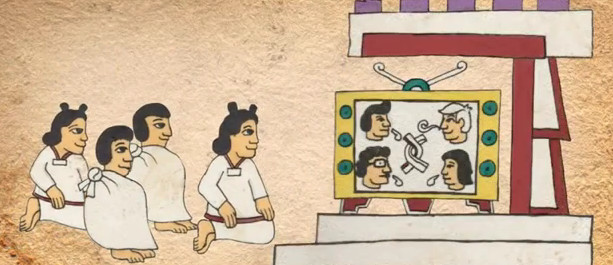 — That “boring” debate (“boring” being the word used by several commentators) was much better received than the first debate, but given that television presentation is itself a contentious issue, is not likely to change voter perceptions all that much.
BloggingsbyBoz had the right feel for how the candidates acted, but got the perceptions totally wrong. AMLO spoke slowly which bothered Boz. Traditionally, Mexican politicians since Porfirio Diáz was first recorded by Thomas Edison speak slowly for effect. The “polished, charismatic and telegenic” style favored by Enrique Peña Neito and praised by Boz was seen by viewers as too slick by half, and reinforced the image Peña Nieto’ss detractors have of a “plastic” candidate. He did, indeed, come across as “a politician” — a TV politician just the thing the Mexican voters (if we are reading the cyber-messaging correctly) are rejecting in favor of “authenticity”. On that score, the seemingly hyper-caffinated and over-prepared Gabriel Quadri would be the “winner” (though his looks, let alone his platform and his party, made his participation seem more a time killer than anything else).
Neither José Merino nor Miguel Carbonell (both writing for ADNPolitico.com) were much impressed by Peña Neito’s performance. Merino slyly notes that Josefa Vásquez Mota was the only one who seemed to think the debates were about debating, so considered her the “winner” for bringing up the PRI’s sordid history as a means of attacking her two real opponents. Seeing the two didn’t take the bait, and launch into a debate (the rules governing responses would have prevented this anyway… and at the very beginning of the debate, moderator Javier Solórzano had to explain the ground rules to Ms. Vasquez a second time) … Vasquez Mota only succeeded in making the exercise a “compare and contrast” contest between Peña Nieto and AMLO. Both analysts felt that AMLO… his “lazy” style and low-key, non-confrontational moderate pronouncements being exactly on target for convincing undecided voters that he is not the “radical” the PRI and PAN have tried to paint him as.
— Even if Peña Nieto wins the presidency, the left has made tremendous gains already. Although social issues haven’t been at the forefront of this election, I was suprised when Quadri brought up decriminalization of abortion and the three “real” candidates all were quick to agree with him. His mention of same-gender marriage didn’t elicit any negative comments, which I suppose is something of a good sign. More to the point, Peña Neito had to fall all over himself to claim he was not respected the right of groups like “Yo Soy #132” to their opinion (which doesn’t mean he, or his cabinet, would listen to them) but it does mean the cybernauts are forcing the establishment to take note of them, and — whether measured by pollsters or not — that they matter.
Jo… es #132³!
The Guardian‘s Jo Tuckman — and more power to her — has done more to change the dynamic of discussion about media and politics here in Mexico than anyone. And it was in front of us all the time, but sometimes the most important action is just paying attention, and actually reading what’s been said:
One cable, written shortly after US embassy officials were taken on a tour of Mexico State when Peña Nieto was governor, says: “It is widely accepted, for example, that the television monopoly Televisa backs the governor and provides him with an extraordinary amount of airtime and other kinds of coverage.” The document, which dates from September 2009, was titled: “A look at Mexico State, Potemkin village style”.
Another cable from the start of the same year emphasises the importance the then governor Peña Nieto was giving to securing convincing electoral victories for the Institutional Revolutionary party in his state in the upcoming midterm congressional elections that summer.
Peña Nieto, the cable says, “has launched significant public works projects in areas targeted for votes, and analysts and PRI party leaders alike have repeatedly expressed to [US political officers] their belief that he is paying media outlets under the table for favourable news coverage, as well as potentially financing pollsters to sway survey results”.
The cables leaked from the US embassy in Mexico contain frequent mentions of the power that Televisa, and the other main commercial network, TV Azteca, exert over the country’s political elite. The two networks control around 90% of free channels and are widely percieved to be political kingmakers.
We’re doomed! Bieberians at the gate
Earlier today, when the today’s much larger “Yo Soy #132” protests (which more and more are turning into anybody but Peña Nieto protests) reached the Zocalo, they were met by … pre-teen and teen-aged girls camped out in anticipation of Justin Beiber’s free concert (on a stage in front of the Cathedral) tomorrow evening.
“pOgue”, on the Lonely Planet’s Thorn Tree: Mexico message board caught the action and posted a video:
..the Bieber girls were going berzerk! A big encampment of them at the bottom of 5 de Mayo jumping up and down chanting with the marchers! Amazing!! Along with the Bieber posters taped all over the bank windows, they’ve got signs that say “132” and “Beliebers Conscientes Se Unen con Contingent” And my God, when they shriek… it puts the hammer and sickle crowd to shame. Gave me chills. This could be the beginning of something big…
Later this evening, with a jumbotron set up to show the Presidential debates for citizens who either don’t have TVs, or just prefer to watch their TV shows with a few thousand of their friends and neighbors found the Beiber-ians have an agenda of their own, not quite in line with the thinking of most “Yo Soy #132” sympathizers:
“Ni Peña, ni Peje, Justin para presidente”, [Neither Peña nor “Peje”… a nickname for Lopez Obradór… Justin for president!]was the phrase that grabbed the spotlight and annoyed those Capitalinos who came to the Zocalo to watch the second debate by the Presidential candidates.
The shout was picked up by about 900 adolescent girls between the ages of 12 and 15 who broke through security cordons erected by the Federal District Public Works Department surrounding the stage being built for singer Justin Beiber’s concert, scheduled for Monday for 10.30 P.M. (Irving Pineda, ADN Politico.com. My translation)
I don’t know which is more frightening… the thought of 900 adolescent girls run amok … or the prospect of Jusin Beiber as overlord of Mexico.
Hey, dudes!
A recent Freedom of Information request has forced the Department of Homeland Security to release the keywords a
nd phrases it uses to patrol the web for domestic and external threats. The list contains obvious terms like “dirty bomb,” “assassination” and “Al Qaeda,” but also includes such broad and ambiguous terms as “Mexico,” “agriculture,” and “wave”. (Salon.com)

Since I write about Mexico, and that means I write occasionally about agriculture, I probably get a wave of hits.
Best headline evah!

I’m not all that interested in what the gringos are doing around Lake Chapala (whining mostly), but some of the best English language reporting in Mexico is at the Guadalajara Reporter… and whoever it is who writes their headlines is some kind of poetic genius.


 mexfiles.net