Things you learn editing other things
One of the dubious benefits of editing is that one learns a lot of not-particularly-useful, but still interesting, trivia. I ran across this factoid adding a footnote for English speakers to a translation of a book on Mexican sex workers.
See if you can figure out what these three guys have in common (and the answer has nothing to do with Mexico, or sex workers):
WalMart… always low prices?
With the WalMart scandal only surfaced last Saturday (and in a foreign publication, the New York Times), so it’s still filtering through the Mexican media and the meaning (if any) it will be given is still a work in progress.

Artwork by Ramona Creel
In both the U.S. press, and in the Mexican based English-language web community, there are two quasi-defenses of WalMart, which attempt to relegate the scandal to a non-event in Mexico, or simply dismiss it as nostagia for a Mexico that no longer exists.
Leaving aside comments of the “WalMart sucks” variety, and the question of WalMart’s effects for good or ill on U.S. retailing and manufacturing, the U.S. (and English language) commenterati were heavy on claiming that a “culture of bribery” in Mexico means that nothing is going to be done about the actions of WalMart de México S.A.B. de C.V. True enough, on Monday, the Federal Prosecutor’s office said they weren’t prosecuting or investigating WalMart… at this time.
That was taken by some to mean no prosecutions or investigations are likely, but with AMLO (who has made government honesty a campaign issue) and Peña Neito (who tries to present himself as an honest politician) both already demanding investigations, there is likely to be pressure to at least investigate. After all, one is shocked, shocked to discovery bribery… when it reflects badly on one’s opponents.
Of course Josefina Vásquez Mota has avoided the issue… so far… given that it is her party (and that of the present administration, PAN) that controlled the federal government during the time frame of the bribery (2002-2005). There is little likelihood that PAN will control the legislature after the elections, and every chance they not even be the main opposition party.
At the state level and municipal level (where one assumes most bribery took place), I expect new administrations will be looking for scapegoats, and will find them.
 These investigations will happen, even if one accepts the idea that Mexico has a “culture of bribery“… the favored “meme” of the U.S. media in downplaying possible Mexican reaction. Even if that were true — the U.S. media mistaking “gestoría” for some sort of … in the words of the usually wrong Mark Stevenson of the Associated Press… “shadowy facilitators”… instead of just the facilitators we are (although I’m certain some are “shadowy”) — it ignores two things.
First: “shadowy facilitators” exist in the United States under all kinds of names… lobbyists, consultants, promoters, lawyers, agents… who push through projects, and skirt the law. The point is that WalMart knew they were paying bribes, and laundered the payments through their facilitators (or gestors). The gestors were just the bag-men. WalMart executives were the guys doing the bribery.
Second: Bribery in the United States is often of the “legal” variety… political campaign contributions (and a candidate in any single large statewide election receives more in what would be considered bribes in Mexico than all Mexicans supposedly pay in illegal bribes in any given year), being the most obvious example. We have no idea at this point who was bribed, although a good guess would be municipal planning officials. Without comparison to the actions of WalMart compared to other companies — like Soriana or Chedrui or Ley or Comercial Mexicana (all Mexican owned “big box store” companies) there is no basis for saying this was a widespread, acceptable practice in that industry, or that it’s an accepted business practice in general.
The second “defense” — or excuse — we read, is that nostalgia for the old patterns of commerce is causing faux-outrage.
I admit I prefer the mom-n-pops — as much because they create middle-class values (although not always middle-class consumption levels) — and seed people who have a stake in the survival of their community into every neighborhood and ranchito in the country. They have owners… where the big box stores have workers and consumers, and no real stake in the community beyond their own property line. But even assuming turning a society of small-scale capitalists into proletariat (which is what consolidated shopping does, to put it in Commie terms), it doesn’t let WalMart off the hook.
Soriana, Chedrai, Comercial Mexicana, Ley have yet to be heard from. Were they locked out of markets because of WalMart bribery? Comercial Mexicana went into bankruptcy trying to compete with WalMart and is in reorganization? Was it driven into bankruptcy because of unfair competition? Even corporate apologists have a hard time justifying things like that.
One thing not well explained in foreign coverage of the WalMart scandal is that Walmart de México S.A.B. de C.V. is not just WalMart stores and Sam’s Clubs … it is several smaller chains of supermarkets like Bodega Aurrerá and Superama, clothing shops like Suburbia, and VIPS restaurants (think Denny’s or Tim Horton’s for those of you north of the Rio Bravo). Some of these existing chains were bought, and others acquired through hostile takeovers.
One of the few initiatives the Calderón Administration pushed through without significant opposition from PRI or PRD or both was new anti-trust laws. Of course, the administration has been going through contortions to avoid taking on the biggest monopoly of them all (Televisa), which openly backs Enrique Peña Neito, preferring to go after Carlos Slim who is quite capable of defending himself (and smart enough to diversify and could divest himself of more market percentages without any substantial losses… a few billion here isn’t going to hurt him one way or the other). WalMart may be the largest single non-governmental employer in the country, but it doesn’t have the political clout of Televisa and the Azcárraga clan, nor of Slim.
 With competitors, WalMart isn’t quite a monopoly, but it might fit the definition of a trust that needs busting. And, let’s not forget Mexican nationalism. There’s some pride in having the Latin America’s most powerful communications firms under Mexican ownership. WalMart is considered a foreign company (never mind that Walmart de México is, at least on paper, Mexican)… in the public mind, it’s a gringo.
There may not be immediate effects from the WalMart scandal, something the foreign press and English-language commentators seem to presume should follow; there might be SOME effect on the national elections; but there will be repercussions. Porfirio Diáz supposedly said, “In México, nothing ever happens… until it happens.” Exposure of the WalMart bribery scandal happened, and now that it has happened, what happens next is still to happen. But it will happen.
22 de abril de 1992
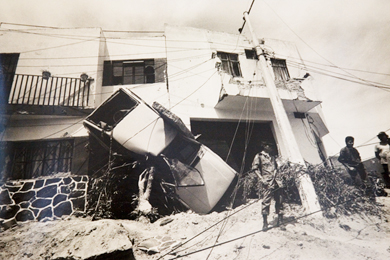
The Guadalajara Reporter has two articles, by Michael Forbes and Duncan Hunter, on the day that changed Jalisco (and much of Mexico) forever…
Duncan writes:
Just after 10 a.m. on that fateful day, a series of explosions ripped through the Guadalajara sewage system (thousands of gallons of gasoline had seeped into the pipelines), destroying 13 kilometers of streets in the city’s Reforma district.
Jose Hernandez Claire, as much as any single person could be, who brought about the change. At the time, simply a photographer for Siglo 21, when Hernandez arrived on the scene, he was torn between providing assistance and recording history. He chose the latter.
Although the explosion killed over 200 people, it was initially downplayed by the “mainstream media” and the “powers that be”, in good part because those 200 people (and 3000 destroyed homes) were “unimportant” people, living in a barrio popular (or, in English parlance, the wrong side of the tracks). Only much later (ten years later) was it revealed that PEMEX workers had shut off the values from the Salamanca refinery without informing the refinery operators. The pressure build-up ruptured pipelines, and gasoline poured into the sewers. Without waring the populace, the municipal authorities had simply tried to flush the sewers the night before.
Hernandez’ photos — published world-wide — ignited popular anger, forcing out the then dominant PRI at both the municipal and state level, and generating a new public consciousness in Mexico’s second city, While Guadalajara and Jalisco remain a bastion of conservativism, they would never be the same.
Maybe we need to add to the list of new world gifts to the old world, punk rock.
Although they were aware of the British Invasion of the time, Los Saicos front man Erwin Flores (who later emigrated to the United States and worked for NASA) claims the musical style developed in his dad’s garage in Lima back in 1964 was indubitably Peruvian. And there are musicologists who will tell you Los Saicos’ 1964 hit, Demolición, was the first real punk single.
Since he asked
Bloggings by Boz, being a military analyst kind of guy, doesn’t quite know what to make of a separate peace in El Salvador:
Last Saturday, El Salvador had its first murder free day in three years. It was symbolically important for one of the most violent countries on earth, but it also wasn’t much of an outlier this month.
Murders are down about 50% since the unannounced truce took hold in early March. Initial official statistics say there were 411 murders in January, 402 in February and 230 in March. In the first 12 days of April, there were 70 murders. That’s a huge decline. It’s fair to say that the first month of the truce resulted in about 200 fewer murders.
We can and should have academic, philosophical and political discussions about this. What does it mean for society to negotiate with gangs and organized crime? What did the government give in exchange? Shouldn’t the government be more transparent about the negotiations? What are the tradeoffs? Is it sustainable over the long term?
Of course, one doesn’t have the luxury of “academic, philosphical, and political” discussions when one is fending off violent attacks. Dead men and women can’t negotiate anything, and not being dead would seem to be a pretty good place to begin any sort of social reconstruction.
While Boz had to end his comments a few years back, and this isn’t meant to be snarky, I have to ask when the United States stopped making deals with criminals, and criminal gangs? One doesn’t have to point to isolated cases like World War II, when the U.S. government made deals with mafia boss Lucky Luciano to keep shipyards working, and the Sinaloan poppy growers and gangsters to provide opium to the U.S. black market . It’s fairly normal for governments to tolerate a certain amount of criminality, and expect organized crime to be involved in certain sectors of the economy. Who built Las Vegas?
Perhaps it’s academic… or political… or philosophical… to ask why states criminalize the production of some goods and provision of services, but permit others that may be equally pernicious? Why is it legal for British Petroleum to poison the Gulf of Mexico and face only financial sanctions when management of the heroin trade can earn one the death penalty in the United States… and why can the United States demand the extradition of heroin traders, but Mexico or Cuba not demand the extradition of British Petroleum executives or other parties? For that matter, why was the opium trade legal and honorable when it sales were controlled by imperialist powers and sold to the non-white, but illegal when the sales and consumer groups switched?
“What does the government give in exchange,” Boz asks. Not dealing with organizations with any legal basis to begin with, I don’t see how the state cedes anything, merely recognizing the status quo. Not killing people, and not getting people killed, though, puts the gangsters into a position where they have to justify their legitimacy, or face retribution.
Is it sustainable? Does it need to be? … it’s those wars that aren’t sustainable.
I represent that remark!
I have one complaint about the New York Times story on el escandalo de WalMart.
Mr. Cicero … spent hours explaining to Mr. Torres-Landa the mechanics of how he had helped funnel bribes through trusted fixers, known as “gestores.”
Gestores (pronounced hes-TORE-ehs) are a fixture in Mexico’s byzantine bureaucracies, and some are entirely legitimate. Ordinary citizens routinely pay gestores to stand in line for them at the driver’s license office. Companies hire them as quasi-lobbyists to get things done as painlessly as possible.
But often gestores play starring roles in Mexico’s endless loop of public corruption scandals. They operate in the shadows, dangling payoffs to officials of every rank. It was this type of gestor that Wal-Mart de Mexico deployed, Mr. Cicero said.
My job title with Editorial Wisemaz S. de R.L. de C.V. is “Gestor de proyectos”. I should be offended. I am not a “fixture” in any byzantine bureaucracy that I know of, but I spend a hell of a lot of time on the byzantine task of tracking down writers, and distributors and reviewers and translators … and facts… and the correct spelling of obscure place names. And going to book fairs and writers’ conferences and making telephone calls, and e-mailing people (and now and again having to shop for office supplies).
A gestor just is a representative, and someone who physically goes places on behalf of the employer. On the application for my work visa, the job title had to be listed as “edecane” — which derives from the French military term, “aide-de-camp” but has the legal meaning on work permits of “consultant or business assistant”.
Or “personal assistant”… Alas, in the want ads… and in the popular imagination… “edecane” is often understood to mean a VERY personal assistant… the kind of personal assistant that in Colombia, may ask as much as $800 US for a night’s worth of personal assistance, not 30 bucks, as some Secret Service agents seem believe.
I donno.. what the Secret Service agent wanted to pay is about what I get for about 12 hours of work a day, but I suppose it’s better to be tagged a bagman than a whore.
21 April 1912
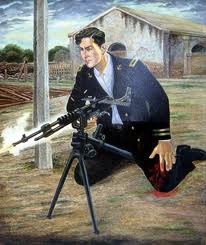
I almost forgot what today is.. and I live in a naval town too.
Lieutenant José Azueta Abad, the 18 year old dorm monitor at the Naval Academy in Veracruz, organized a heroic, and doomed, defense of the city when the United States Marines occupied the Port on 21 April 1912. Wounded, he refused treatment from U.S. medical teams, and died just after his 19th birthday, on 10 May, 1914.
The “Veracruz incident” isn’t much known in the United States (I wrote about it at length in my book, Gods, Gachupines and Gringos, and posted an early version of my chapter on the invasion here), but looms larger than U.S. policy makers realize in Latin American thinking. It’s inevitably brought up any time some “well-meaning” (i.e., uninformed) policy wonk suggests “helping” Mexico with “it’s” problem (whatever the “it” of the day is… usually a problem FOR the U.S.: oil exports then, narcotics exports today) with “boots on the ground”.
Azueta happened to be on the “wrong” side of the Revolution, and his family were supporters of the usurper, Victoriano Huerta. Not that it mattered. The Constitutionalists, the Zapatistas and Huerta’s government all rejected the U.S. “assistance” and recognized Azueta for the national hero, and Latin Americans recognize him for the anti-imperialist hero, he was.
¡Wikiruta se difiende!
I’ve written on the Wixárikas before… the people we used to call the Hustaca, whose homeland is the Wikiruta. Their culture and existence threatened by everything from corporate agriculture and mining concessions to hippies (living in the desert, corporate agriculture and mining are a huge strain on the water resources in Hustaca region, and — known to the outside world mostly for their religious peyote fueled vision-quests, they’ve been besieged over the years by tourists who tear up the fragile environment searching for the sacred cactus buds). Having learned to adapt themselves to their harsh physical environment, it should be no surprise that they have also learned to adapt to the unforgiving cultural one. Besides sending their youths to law school, they’ve picked up some allies… from around Mexico to get out their message.
¡Wikiruta se difiende! (AHO Colectivo)
Pistolas para mí general
Justice is not served by killing evil bastards. I’m fully aware that the prohibition on the death penalty in this country gets overlooked by the army when they’re going after some narco (or alleged narco), and can’t help wondering if they don’t survive long enough to get into court for some reason. Even if the evil bastard “gets off on a technicality”, I’d rather have him or her still around until they answered a few questions… or twenty-two questions.
I don’t think many are going to shed any tears over the assassination of General Mario Acosta Chapparo who was gunned down in Mexico City yesterday. In August 2000, Acosta Chaparro and another General, Francisco Quirós Hermosillo, were detained on suspicion that they had been actively assisting the Juarez Cartel for several years. Both were tried by a military tribunal and sent to the military prison at Campo Militar Numero Uno.
General Quirós died of cancer in November 2006, which ended a second military trial, on murder charges stemming from his and Acosta’s alleged role in the deaths of twenty-two civilians in Guerrero State during the 1970s.
Of course, it’s a “might have been”, but with Quirós’ death, prosecutors were unable to ever prove his, or Acosta’s role in the crime. At the time, Acosta refused to talk, and now we’ll never learn the truth.
Acosta Chaparro was freed in 2007, after a civilian appeals court ruled that the military tribunal had not found evidence to definitely tie Acosta Chapparo to the Juarez Cartel.
There was an unsuccessful attempt to murder Acosta two years ago, by “unknown assailants”, which — at least as of late yesterday — are the suspects in this killing. And the motives? It could have been some act of revenge (by narcos, or Guerrero peasants, or — who perhaps soldiers wanting to restore the tarnished honor of the Army) or it could have been to prevent the truth from ever being known… or karma.
While America giggled
Absolutely the best precis of the Summit of the Americas is not from the “usual suspects” like the New York Times, or Washington Post, nor from the policy and political blogs, but from the snarky Wonkette:
From the US perspective, the Summit of the Americas was super awkward this past week, and that’s not even counting that Secret Servicething (goodness gracious!).
No, it was also awkward because everyone disagreed with us, about everything, ALL WEEKEND LONG. It was like they don’t even think we own the place!
Latin America is enjoying some kind of golden age or something. Each country has its own socialist leader, just about, and their economies have thrived the past several years while everyone else’s sucked a giant fat one.
That even the conservatives (including Calderón) were in agreement on narcotics export reforms (I don’t know how to tell people north of the border this, but we don’t much use that shit, but if you want to buy it, we’re gonna sell it), trade with Cuba (why not, when the U.S. does so much business with the much more repressive regime in China?) and the Malvinas.
Yeah, I guess you’d rather talk about hookers, but if you want to have any clue as to what is going on in Latin America, you should read this.
More like the U.S.A. every day…
… we finally have our first shirtless politician sending cell-phone photos scandal.
Xóchitl Tress de Barradas is a PAN candidate for the Chamber of Deputies from  Veracruz State. She’s been a public figure (and a rather controversial one) as the “Merry Widow”: her husband (who had just been elected as a municipal president) was gunned down last November, and Tress de Barradas almost immediately launching a very public affair with another local politician, Rafael Rodríguez.
Ahí esta el detaille: Rodríguez has a wife… who allegedly found the photos and leaked them to the press. While politicians have always been expected to engage in hanky-panky there is still a double-standard when it comes to female politicos.
And, by the way, did I mention that PAN is the “family values Christian” party?
Cassandro — mucho, macho man
I see I’ve been remiss, not having posted anything on cross-dressing gay luchadores since Christmas Eve, 2004. A sombrero tip to Jason Dormady… from the Las Cruces [New Mexico] Sun-News:
Cassandro is one of the best-known exóticos — cross-dressing luchadors, or wrestlers — in Mexico, with nearly a quarter-century of high-flying grappling under his belt and a résumé that includes tours of the United States, Europe and Japan. He was also Mexico’s first openly gay luchador, a brave move in the theatrical but overwhelmingly “man’s man’s” world of professional wrestling.
Born and raised in El Paso, of Mexican descent, Cassandro (Saul Armendariz) learned the ropes just across the border in Juárez. Now 41, he has been wrestling professionally since he was 17.
Although he performs around the world for various promotions, Cassandro is a proud proponent of the daredevil Lucha style — wrestlers of generally smaller stature than their U.S. counterparts, with an emphasis on skill and breathtaking dives over power or physique.
Entire article on chiropractor, licensed massage therapist and luchador exotico Saul Armendariz here.


 mexfiles.net