Clueless gringos: exhibit “A”
I won’t turn the person in, but, my God, this actual post, on a real English-language Mexican message board, confirms my faith in the enduring bone-headedness of clueless gringos:
I must admit that I have little understanding of current Mexican politics, so I read these threads with great interest. Not that I can vote with an FM3, mind you, I just like to know what’s going on around me, and try to stay situationally aware. Plus, I am an admitted and unrepentant political Junkie.
As an aside, the lamp post directly outside my front door gets plastered almost everyday with new political posts. Because I am selfish and hate the flapping sounds these great plastic posters make, I get out the scissors and cut them down everyday.
Bad me. But honestly, these politicos do stay ON the job! They are replaced every day!
The thread in question was about a governor’s race… one in which dirty tricks (like destroying each others’ signs… not to mention lobbing molotov cocktails at one of the party’s headquarters) have become a regular feature on the local news. One would assume a “unrepentant political Junkie” might know something about politics … and the taboo on foreign interference — which is not so much illegal (although it is, and can lead to immediate deportation), as it is just plain stupid: given Mexican (and Latin American) history, rife with U.S. and other interference in internal matters, any hint of political interference by foreigners is going to be played up by the opposition for all it’s worth.
But, never assume… it makes an ass of “U” and me, as the saying goes. Taking down some candidate’s sign hardly amounts to the type of political activity that got this legal restriction added to the Mexican Constitution… little things that have rather annoyed the Mexicans over the years,… like the U.S. intervention of 1848, or the U.S. financing of Porfirio Diaz’ coup in 1874, or Henry Lane Wilson’s “Embassy Pact” of 1911, or William Buckley and friend’s financial support for the Cristero terrorists, or the CIA assistance given to Diaz Ordaz in 1968, or the U.S. Republican Party’s “aid” in the 2000 and 2006 election campaigns, or, for that matter, the “embedded units” of U.S. intelligence services in the Mexican military and the U.S. financing of the narcotics cartels. Maybe because I’ve lived in Texas, where stealing yard-signs from the opposition is a time-dishonored sleazy political ploy (and usually the sign of a desperate candidate), it’s hard to imagine anyone thinking that robbing party propaganda is acceptable behavior.
Let me see if I understand the logic: because a “flapping sound” bothers the person, she goes around destroying other people’s property, and at the same time, claiming to be an “unrepentant political Junkie” but demanding whatever it is that lifts her luggage (floats her boat, gets her off, rings her chimes…) occur without any inconvenience, however slight, to herself. Would she think of destroying other people’s properties, especially when admitting not a clue as to what it means, or whose property it is in her own country? I don’t think so. I certainly hope not.
There is no more interest in Mexican politics at work here than there is interest in Mexican folk-ways by those gringos who say they are looking to live in a “quaint Mexican village” — and expect to find not just a furnished apartment (over the internet), but one with an all-electric kitchen within a fifteen minute drive of a with a WalMart stocking Cheerios and a Starbucks. And — if it interferes with others — fuck ’em.
And, consider the tolerance level. The “flapping sound” has to be destroyed… daily. Election day is less than a month away, and, those cute little “elections” interfere with what the “unrepentant political Junkie” wants, and wants NOW. So, expecting… demanding… instant gratification, she turns to vandalism.
The arrogance of the “unrepentant political Junkie” is breath-taking. What these kind of people want is not to live in Mexico, but to live OFF Mexico. That is, the Mexicans and Mexico exists only to satisfy these people’s own selfish ends. Oh, they can have their cute little “elections”, but not if it means annoying “flapping sounds”.
I will give her credit for two true statements: “I have little understanding…” and “I am selfish…” The rest of her post was extraneous.

Q.R. — can it get any stranger?
The PRD-Convergencia-PT (but, not PAN, although originally it was going to be an all-anti-PRI ticket) candidate… after somebody went to the trouble of finding an out of state judge to accept a investigative report denied by a Quintana Roo judge, is sitting in the slammer in Nayarit, and his political rights have been suspended. i.e., he’s off the ballot.
So, the PRD, etc. coalition has until Monday to come up with a new candidate for the July 4 elections, who won’t campaign, and if s/he, will ask that the elections be annulled.
Then, the front-running PRI candidates entire election team was wiped in a plane crash on Sunday.
I’ve been reluctant to say anything about Quintana Roo’s messy election (we have our own messy election here in Sinaloa), not knowing who to believe and… besides… I’m not about to write on every political issue here in what I still try to keep a historical and cultural site.
The PRD, etc. candidate is sitting in prison because of his alleged connections to the Miami Cuban gangsters (aka, “Freedom fighters”) who smuggle people, guns and narcotics through Cancún. Gangsters aren’t all that interesting to me. The PRD, etc. candidate (er… ex-candidate, candidate-in-custody, whatever) is much more than that. He was and is also an Evangelist of note and — being used to right-wing preachers veering into politics — a preacher reinventing himself as a left-wing populist is much more interesting.
But, that’ll wait. If this plane crash was an “act of God”, there might be more to Greg Sanchez than we knew. Yikes!
David Agren has a good overview of the bizarre situation.
Healthy Friday Night Video
Health News:
Mexico City, June 7 (IANS/EFE) Some 2,000 obese Mexico City police officers are attending weekly psychological counseling sessions and following strict diets that limit daily food intake to 2,400 calories in an effort to lose weight and improve their physical conditioning.
The officers are participating in the programme on a voluntary basis, Federal District Public Safety Secretariat officials said Monday.
The 2,000 officers, members of the capital’s 33,000-strong police force, receive individual medical attention and have access to psychological counseling because “each one has to be treated in accordance with his own problems”, Federal District Public Safety Secretariat medical services director Alfredo Peniche told EFE.
In Santa Cruz, Bolivia, meanwhile, the police are being encouraged to get plenty of fruits and vegetables:
Do not disturb…

A bridge in the desert
 One of my favorite novels is B. Traven’s “Puente en la selva”, the heartbreaking and excruciating story of a 12-year old boy’s funeral, the boy having drowned when he slips off a bridge, wearing new, “gringo” shoes. Are the gringos responsible for the boy’s death? No. His brother who brought the shoes back from his stay north of the border? No. The death simply happened, and is accepted as such.
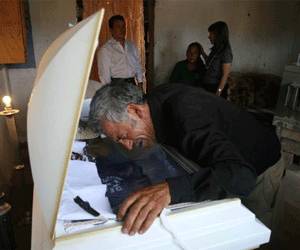
Photo: El Heraldo de Chihuahua
Sergio Adrián Hernández Güereca was buried yesterday. He was barely 15 years old. He too died at a bridge… Puente Negro across the nearly dry Rio Bravo del Norte/Rio Grande River in the Chihuahua Desert. We have to accept that he died… but unlike the boy in the jungle, this death did not simply happen. The gringos were not the accidental, but the active agents of this death. The question of why — and how — Sergio Adrián Hernández Güereca ended up shot in the head under a pillar on the Mexican side of Puente Negro in Juarez is something the United States government is not going to be easily laid to rest.
Some confusion over the boy’s name and age are normal when a story like this is initially reported… and are expected and forgivable. What was unforgivable were the attempts by “an unnamed source” to suggest that the boy “was on a ‘most wanted’ list of juvenile smugglers compiled by U.S. authorities in the El Paso area.” Leaked only to Fox News and with a name that wasn’t even close to correct (Huereka), the rumor appears not to have legs, although, of course it is being spread on right-wing U.S. websites as justification for shooting the boy across the international border.
Mark Qualia, of the Customs and Border Protection service (the Border Patrol) was identified by CNN as the probable source, being quoted as saying “Hernandez Guereca, had been

Latin American Herald-Tribune
apprehended by U.S. officials on more than one occassion but was never criminally charged.” Fox claimed “Huereka” as on some “most wanted list” — something I’m not sure exists officially or otherwise. However, when confronted with the videotape later shown by Univision and CNN that showed Hernández was shot on the Mexican side of the border (and it’s unclear he was even throwing rocks, let alone had crossed the river into the United States) had a very different statement.
CNNMexico reports (my translation):
Mark Qualia, a spokesman for Customs and Border Protection, said he could not comment on it because he had no knowledge of the Mexican government sources.
But Qualia was able to say that there had been 799 assaults on border agents from October 2009 to date.
Lethal force, said Qualia, is permitted “when an agent is imminent threat of physical violence or bodily harm that can result in death or injury to himself or a third party.”
The assessment of when to use lethal force depends on each agent, he added.
From October 1, 2009, U.S. agents have used their weapons 31 times.
“Rock attacks can be considered dangerous attacks. They aren’t just throwing stones.”
F.B.I. spokesperson, Andrea Simmons also made statements that were later, as they said back in the Nixon Administration, inoperative.
This agent, who had the second subject detained on the ground, gave verbal commands to the remaining subjects to stop and retreat. However, the subjects surrounded the agent and continued to throw rocks at him. The agent then fired his service weapon several times, striking one subject who later died.”
Neither Simmons, nor Qualia, had any explanation of how a small 15 year old — on the other side of a river bank, behind a pillar, was a threat to the agent… or agents as the video evidence seems to indicate… who shot him in the head.
Statements given in Mexico to authorities, by boys who were throwing rocks across the river, say that Sergio Adrián never attempted to cross the river. Despite the “spin” by Fox News, it appears this was just a good kid fooling around, and he may have been the proverbial “innocent by-stander caught in the cross-fire”… assuming that there is any way to justify shooting into a foreign country.
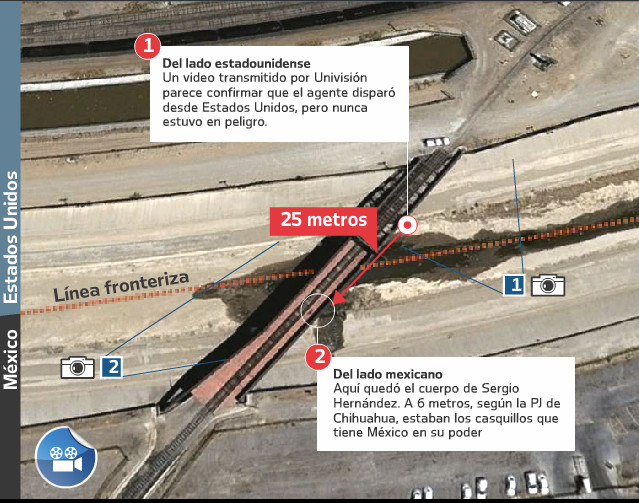
El Universal
Initial U.S. reports also suggested that Mexican police crossed the river and retrieved “something”, another story that seems to have faded away (given the false statements given by authorities — either based on bad information or maliciously — any information coming from the United States officials is going to be questionable anyway), while the possibility remains the opposite — that F.B.I. agents attempted to retrieve something (perhaps the three shell casings found near Hernández’ body?) but were turned back at gunpoint by Mexican police. While not confirmed, the action would seem perfectly reasonable. A Mexican had just been shot by U.S. armed agents, and U.S. armed agents were attempting to enter Mexico.
Federal officials in Mexico have moved relatively rapidly. Roberto Rodríguez, the Mexican Consul in El Paso hired attorneys to bring legal action on behalf of the Hernández family in the United States. The Deputy Prosecutor for northern Mexico, Alejandro Pariente, personally filed a criminal complaint, opening the way to a federal murder investigation (the death occurred on federal property, and the State of Chihuahua’s prosecutor’s are not known for their investigative skills).
It is not an unquiet ghost of Sergio Adrián Hernández Güereca, so much as the unearthed — and unmentioned — restless spirits that the Calderón and Obama Administrations had kept at bay that are haunting us.
Of course, immigration issues, narcotics (anything that happens in Juárez is immediately assumed to involve narcotics) and racism. Juan Gonzalez, at Democracy Now! attempted to drag NAFTA’s effects on rural Mexico into a discussion of the shooting, but the interviewee (in El Paso, not Juárez) said only “I think we have several problems in Juárez. … We have the inability of the police to actually contain the violence in Juárez. At the same time, we have a very deep economic crisis where people are being pushed out of the country.”
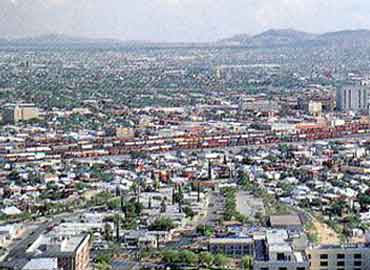 NAFTA had something to do with social problems, and with the unease in the United States over immigration, but it’s more complex than that. I’ve made the point several times that social dissolution seen in Juárez is extreme, but then, it has a lot to do with the city’s unique demography — half Detroit and half Deadwood. What I mean is that it was an industrial center with good paying blue-collar jobs hit by a massive economic downturn, AND a frontier town. Where the displaced in Detroit could try their luck elsewhere within their own country, and the middle-class could flee to suburbia, there aren’t comparable jobs elsewhere in Mexico, and suburbia is across the border. Very few Detroiters moved to Windsor, Ontario although Detroit, as the big city in a binational urban area is something Juárez also shares with the Michigan city. And, in the 1970s, it was “drug crimes” that gave Detroit the reputation as the most dangerous city in the country, and was the rationale used by middle-class residents for moving.
At any rate, there’s no indication that the Hernández family was from a rural background. More germane might be the issues raised by commentators on coverage of the shooting in the U.S. “liberal” websites, like Huffington Post and Salon.com, who tend to see everything in terms of how it affects the Obama Administration. To them, the problem is either the Border Patrol in general, or the extra 1200 agents being promised to the states on the Mexican border. I had a brief e-mail exchange last night with someone with Border Patrol ties.
The people I talked to last night tended to agree with something that had bothered me when I was living in west Texas along the border. At that time, the Bush Adminstration was ramping up the Border Patrol and sending in soldiers as backup until more agents could be brought into the field. The Patrol recruited heavily, and not just in the border region. Where the older agents I knew were cowpokes and tejanos (or both), the younger guys were outsiders… new to the border and new to the culture. Also, talking to the older and retired agents, you got the feeling that the Border Patrol was a less a military unit, and more a rural police force. A lot of the older guys looked like old west lawmen, and the romance of the old west was one factor they’d had in originally signing up.
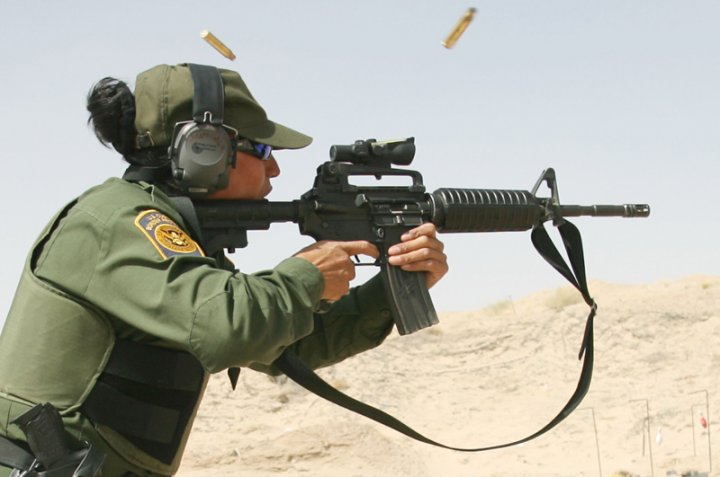 With more outsiders, who aren’t acculturated, and accept the border for what it is, you have to add the problem of a paramilitary organization, with is trained as such. To a military unit, the other side is the “enemy” — and military units have only one response to enemies: kill or be killed.
Not that there isn’t a threat to the United States. Leaving aside the over-blown rhetoric on a theoretical “terrorist” infiltration (by kids?) and the racist idiots who “want their (white supremacist) country back” there really are a lot of narcotics coming across. In a sense, that’s a NAFTA issue related to agriculture (alas, Juan Gonzalez didn’t make the connection), but in a larger sense, it’s a self-perpetuating rationale for militarization and whistling past the graveyard of missed opportunities to resolve social issues on both sides of the Puente Negro.
First they came for the Mexicans…
… but because I don’t wear Mexican shoes, I didn’t boycott Arizona.
Then they checked the soldiers undies, but because I don’t wear “lacy drawers”, I still didn’t boycott Arizona…
So when they came for guys in polo shirts …
Is there something in the Arizona constitution that requires their elected officials to be morons?
¡No mas sandwich!
The problem with fighting well-funded corporate types when you’re trying to tell people what’s good for them is that you usually have to rely on dull things like logic and common sense, instead of a slick advertising campaign. Usually, but not always…
Sombrero tip, La Convencion Sinaloa
Tales from the crypt
You might say Onésimo Cepeda Silva, Bishop of Ecatepec, was just performing one of the Corporal Works of Mercy — burying the dead. You might also say (and Proceso does say) that his behind the scenes control of the funeral service contractor, Grupo CIF (run by his half-sister and his nephew) has more to do with a slightly older, more universal theological concept: thou shalt not steal.
With the accord between the Vatican and the Mexican state signed in 1992, and the resulting changes to Article 130 of the Constitution, churches could own cemeteries, which they hadn’t been able to do since 1859. In 1995, the Catholic Church created a new Diocese of Ecatepec, naming Cepeda as its first Bishop. Cepeda ambitiously built a new Cathedral with a big roomy basement. The technical term for a church basement is “crypt” which means it isn’t exactly designed for a rec room, but is meant for permanent storage. Well, at least til the Second Coming.

Reaching for his gun, or having just robbed candy from a baby? Photo of Bishop Cepeda by Eduardo Miranda, Proceso
So, the Bishop went into the burial plot biz… or rather set up his relations in the biz, supposedly not profiting from but perfect for storing stiffs, set his family up. The… er… plot thickened, when the business expanded from just selling burial space in one crypt to offering pre-paid full-service funeral and burial arrangements. Cepada’s personal and political connections to the PAN administration are said, by Proceso, to Grupo CIF signing contracts with federal agencies and the Office of the President.
Alas, something smells. Like the company’s auditors can’t even find Grupo CIF’s real offices, and what funds the auditors can locate don’t begin to cover the costs of funerals, let alone burial space, for which they have contracted. Either it’s a Ponzi Scheme, in which somebody is going to get stiffed (but, they’ll be stiffs anyway, which makes it just about perfect), or money is being siphoned off.
The latter looks possible. His Grace is under investigation by SIEDO (Subprocuraduría de Investigación Especializada en Delincuencia Organizada — the organized crime bureau of the Federal Prosecutor’s Office) for money laundering.
Under Article 130 of the Constitution, the clergy cannot receive inheritances from non-relations, but there is nothing staying they can’t be the executor of an estate. The money laundering investigation grows out of complaints by the super-rich Azcárraga clan (as in Televisa, etc.) which claim Cepeda, as “spiritual counsel” to the late Olga Azcárraga, convinced her to make him the executor of her 130 million dollar art collection, which has been offered for sale as the personal property of the Bishop.
Grave robbing is creepy …. and money laundering tacky. Now, art theft — that’s the kind of classy delinquency one expects from the higher clergy.
Let the chip fall where it may: Jefe Diego
It’s kind of Zen, but the big news story is what is not reported… donde est Jefe Diego?
Gancho reports that the missing Jefe’s microchip has been found. Sort of like show-dogs (and seed bulls), high level right-wing politicos made a big deal a few years back of having RFC chips implanted in their arms. That was supposed to assure us that the Fox Administration was one the ball, and looking out for our safety. Well, for the safety of their own anyway.
Back on May 24, when I wrote about the alleged photos of Jefe Diego in captivity floating around the internet, and before there was some kind of quasi-official news blackout — there was speculation on the bloody scissors found in his car might have been used to cut out the chip:
The “bloody scissors” found at the scene (with no indication of the amount of blood nor the size of the scissors, which could have been anything from a beard trimmer to the big honkers used in the market for quartering chickens…. or anywhere in between) were supposedly used to remove the microchip the Jefe — and several other “high visibility” kidnapping targets — had implanted in their arms a few years back.
The other non-new news is that nobody is sure who nabbed him — some powerful interest is the best guess? I’m betting on one of his shady legal clients . I wouldn’t be quick to just focus on Chapo Guzman or Jefe Diego’s narco-clients … the Legionnaires of Christ have the means and motive, too. Besides, the Legionnaries need the quick cash more than Chapo does. The government itself remains a plausible suspect.
Ah well, gone, but not quite forgotten … Diego Fernández de Cevallos was forced out of his car by … somebody… on the night of 14 May. Now, on 9 June (only 26 days later), someone finally tracks down the chip, forty kilometers away? I guess Mexico either really does need to beef up its satellite communications or some other powerful interests really don’t want to talk about him.
Funny money
I’ve got wazoos of old bookmarks that I just have to toss away every day, but wanted to mention in passing the several articles I saw on the supposed 19 to 29 billion (thousand million) U.S. dollars supposedly laundered in Mexico by narcotics exporters.
These figures are wildly at odds with the United Nations Office on Drugs and Crime, “Addiction, Crime and Insurgency: The transnational threat of Afghan opium” (Vienna, Austria: October 2009), p. 7.(2009)
“Of the US$ 65 billion turnover of the global market for opiates, only 5-10 per cent (US$ 3-5 billion) are estimated to be laundered by informal banking systems. The rest is laundered through legal trade activities (including smuggling of legal goods into Afghanistan) and the banking system.”
Since supposedly some figure less than fifty percent (usually reported at 75 to 90 percent) isn’t banked, we’re talking about somewhere between 9.5 billion (thousand million) and 26.1 billion (thousand million) dollars in unaccounted-for cash. That’s not only much, much higher than the international estimate for opiates. Unless Mexican marijuana is much, much, much more valuable than the international opiate trade (and the Mexican figures include opiate, or Mexican gangsters are somehow different than other gangsters in their investment strategies, the figures make no sense.
Mexicans are different — at least from people in the United States — in that most prefer not to use banks. People pay for even large purchases like houses and cars in cash. And often in dollars.
But, as Aurora Berdejo wrote in her 4 June 2010 El Sol column, Vanguardía Política, it’s a bit rich that the United States — doing nothing to stop arms trafficking, or violence against Mexican immigrants, or responding to other Mexican requests — now is making demands that Mexicans be inconvenienced. Besides, if there are all those “dirty dollars” floating around among the criminal classes, the criminals are going to find a way to use them.
The so called Binational Study of illicit goods”, jointly developed by both countries, was presented by John T. Morton, Deputy Secretary of Homeland Security’s U.S. Immigration and Customs Enforcement… accompanied by Carlos Pascual, U.S. ambassador in Mexico, who explained that 90 percent of illicit resources from drug trafficking into Mexico in cash: “75 percent of economic transactions that take place in Mexico are with cash, hence we can see why it will be important to have restrictions on using cash or require large purchases to be accompanied by notarial certificates and reported to the Secretariat of Hacienda.
This… is rather an imposition. In a previous column, I stressed that … restricting dollars was likely to result in a currency black market, opening another opportunity for organized crime to profit.
From bad to worse…
The latest U.S. based reports I’ve seen are fudging on where 15-year old Sergio Adrián Hernández Guereca (or Huereca) was when he was shot and killed Monday evening in Juaréz.
Raw Story, where I first heard about this confuses the issue by using the headline “Border agent shoots and kills 14-year-old boy on US side of international bridge: report” but you have to read down a few paragraphs in the Associated Press story that follows to get the sense that the border agent shot FROM the U.S. side and killed the boy… who had either been in the United States and returned to Mexico from the U.S. side of the river, or never left.Or, possibly, was killed in the United States, and the body dragged back into Mexico (which makes a spent shell found in Mexico rather hard to explain). Radio For
The Mexican press reports (and I got home too late to see the television news) are all fairly preliminary. Jornada mentions THREE shells being found, not one. All reports mention that the Border Patrol claiming they had been attacked by rock throwers, but the boy’s brother, interviewed by Radio Formula says he was hanging out on the Mexican side, visiting the brother (who works at the border crossing) and was shot while playing. the Mexican government seems to accept that rocks were being thrown. The Foreign Relations Secretariat released a tepic statement “reiterating that the use of firearms to respond to rock throwing was a disproportionate use of force.”

Photo: El Paso Times
Teenagers have thrown rocks at U.S. border agents before, and there has been an increase in deaths at the border, and bullets have crossed the border (during the Revolution, a few people in El Paso got winged watching the various battles of Juarez from rooftops) but this could not come at a worse time, for either the Calderón Administration (which, especially in cities like Juárez is being blamed for its inability to protect citizens from firearms violence) or for the Obama Administration, which is seeing what good-will it garnered in Latin America by being not-the-Bush Administration rapidly evaporating.
It’s deja vu, all over again
Another military strike against a dissident, independent union, carried out in the dead of night, with the government claiming it was a peaceful operation, and the union telling a different story:
The Interior Secretariat informed public opinion that on Sunday public security forces peacefully took over the Cananea mine in Sonora, to put an end to a miners strike that had been going on since July 2007, and which the Labor Secretariat had declared illegal in January 2008… The secretariat said that no one was hurt in the operation and that it was legally backed, by the Federal and State Public Prosecutor’s Offices.
++ But miners had another story to tell. A spokesman for the miners, Antonio Navarrete, said that the federal police raid at the Cananea mine left two miners wounded with bullet wounds, two miners went missing and children and women were also hurt in the melee.
SDPNoticias reports that outside thugs (“porros”) were also brought in to attack the dissident miners.
The Cananea strike is a bit complicated, having gone on for such a long time (the strike issues, being — as they were in the 1906 Cananea strike — miner health and safety concerns). In January 2008, the arbitration board (JFCyA for its initials in Spanish) declared the strike “non-existent” as a caravan of scab replacement workers were brought in, with a thousand state and federal police officers as protection.
The Union General Secretary, Napoleón Gómez Urrutia, not atypical for a contemporary Mexican union leader, was never a worker, but inherited his job from his father. Gómez Urritia is an Oxford educated economist, whose tenure was marked by several strikes (there were few strikes under his father’s long reign) did not endear him to management, nor to the present administration. Indicted for supposedly pocketing management contributions to the union funds, Gómez Urrutia fled to Canada and sought political asylum. The government has been trying to force the union to accept a new election, which the Cananea miners rejected, along with proposed settlements.
In April, the Supreme Court declared the strike illegal, and sided with the owner, Southern Copper Company and Grupo Mexico.
The same claims of union corruption and economic disruption were made when the SME (the electrical workers’ union) was dissolved following the forced merger (at bayonet-point) of Luz y Fuerza del Centro (the union-managed Mexico City area electric company) with the CFE (the state run electrical provider). While in both cases, a good argument can be made that operational inefficiencies and union corruption existed, the counter-argument, that such problems also exist in pro-government unions (such as SNTE, the main teachers’ union), but are less subject to be put down by armed intervention.
While largely out of sight, out of mind, in the Sonoran desert, Cananea looms large in Mexican history. The 1906 strike, which was put down with U.S. imported “Arizona Rangers” brought in to massacre strikers and their families after a riot in the mining town, is credited with turning the northern workers and much of the elites against the Diáz government, and towards considering a revolutionary solution to the problem of foreign ownership in the extractive industries.


 mexfiles.net