SHE who must be obeyed
Tempting as it is, I’ve yet to indulge in the obvious sexism of drawing a comparison between the Governor of Arizona and female canines of the domestic variety. I like dogs. And, anyway… with the big –er — guns rolling into Phoenix today to rally opposition to SB 1070, the gov is likely to be getting her comeuppance from a female canine… in disguise.
Scoundrel time?
Some of the tolls received this afternoon on the highway paved with good intentions…

With the tourist season winding down here in Mazatlán, those of us whose income largely depends on the tourists are starting to take stock of our seasonal takings and figure out how we’ll survive until October.
This time of year, our second hand book suppliers — hotel cleaners and chambermaids — are showing up with bags of paperbacks left behind (and some are “Left Behind” books). Our suppliers can’t use them (very few of them read English, and have no interest in American murder mysteries anyway), but they can use a couple of pesos per book to cover bus fare and whatnot. It doesn’t always make business sense to buy some of these books but more or less have to buy whatever they have to sell… even if, two minutes after paying them, we’re throwing the book away, or adding another half dozen Nora Roberts novels into the boxes piled half-way to the ceiling of other unsold Nora Roberts novels.
In this kind of business, public demand is fickle: it’s not like there aren’t readers of Nora Roberts, and a run on Nora Roberts is always within the realm of possibility, so we’re pretty much committed to buying whatever comes in… both to guarantee inventory and to keep our suppliers bringing in the treasures and trash we need, even if we take in more loss leaders than I’d like (there’s only so much shelf space for Harlequin Romances, and how many copies of Dan Brown’s Deception Point does any bookstore really need?). And, with the off-season upon us, we’re all in this together. The book sales are to our mutual advantage.
Not really to our advantage, but simply because no one else will, we will buy the otherwise worthless U.S. and Canadian coins tourists leave the maids under the impression they are doing them a favor, or providing them with an extra income. They’re not.
Most of the service businesses here will take U.S. and Canadian dollars as payment… but certainly not at the exchange rate. Like other small businesses, we’re not set up to handle it. We can’t spend it, or use it to buy anything here (except maybe meals in a tourist restaurant) and have to take it to the bank — which, for a small business, means closing during the day, and standing in line. Obviously, we wait until there’s time and enough foreign currency to make the exchange worthwhile — in the meantime, pictures of the Queen or Abe Lincoln sitting around not as inventory, and not as income. Not knowing what the exchange rate will be when we have the time to close the business and do banking, of course, we aren’t going to give the daily exchange rate, and are going to build in the hassle factor and carrying on the books what has to be considered potential sales.
But that’s not unusual for small businesses here. The coins and small bills are another story. We can’t exchange them at the bank (I can’t think of banks anywhere set up to handle foreign coinage) and turning them into currency means taking them to their country of origin. As far as I know, we’re the only business that does take coins (and only from the hotel workers), and turning them into “real money” is an an ad hoc, informal thing depending on somebody with a pickup truck heading for the WalMart in Nogales Arizona (which might not be so common any more) or willing to haul a couple coffee cans the 4000 Km or so back to the Great White North. And who knows when that will be, or what the exchange rate might be?
It just doesn’t do to screw your neighbors, friends and fellow toilers for the touristas over… nor one’s suppliers, but no way we can give approximating the exchange rate for the coins. Even at about 60 percent of the (theoretical) exchange rate, we’re not making any money off the deal, just doing a favor for people who have been — unintentionally — screwed over.
It bothers me that some north of the border types still have the idea that because they can spend their money in places like mine, I can spend it at my local grocery, or use it to pay the bus fare. I have no use for it. And neither do the chambermaids. What really sucks is when people leave tips in totally unredeemable coins. There’s nothing at all I can do with One Pound, or 1.25 in Euros. And how do I tell my neighbor that 20 West German Phenning or 10 South African whatevers from the early 1980s aren’t worth anything. Not even part of a bus ticket.
Tips for those in the service industry are always appreciated, but they should be in the form of something a person can use. Leaving foreign coins (even in a rare situation like ours) may be well intentioned, but thoughtless. And leaving coins in a currency that doesn’t exist… downright cruel.
French Foreign Legion to Mexico! Really
I know there are those who think foreign troops SHOULD be sent to Mexico for one reason or another, and those who say Calderón is a little too eager to please foreigners, but this isn’t what it sounds like. The armed legionnaires — and their band — are coming to parade in Camarón de Tejada, Veracruz the 30th of April, in commemoration of the Battle of Camarón, 30 April 1863.
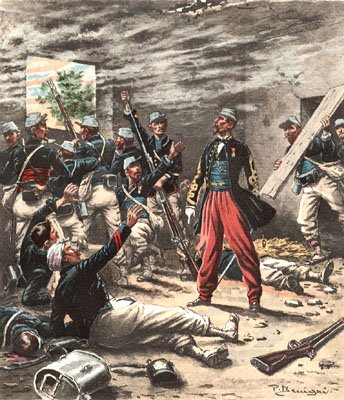 Steven Wilson, at Military.com has a fine, relatively even-handed review of the battle, which basically came down to a bunch of very irate local farmers armed with old shotguns and pitchforks and machetes squaring off against a bunch of Italians and Poles and Serbs and others, fighting to install an Austrian monarchy in Mexico for the greater glory of France. The Mexicans cornered the invaders in a barn, burned it down and slaughtering the survivors.
While it was sort of a French version of Custer’s Last Stand, with the Mexicans as the Sioux, the commemoration is taken quite seriously by the French, who give the event a quasi-religious feel, including the veneration of relics… specifically the prothestic hand of the Legionaires’ commanding officer, Adjunt Major Jean Danjou.
From the Mexican point of view these guys were hardly fighting for a noble cause, and they were, after all, just a bunch of cut-throats, ne-er-do-wells and international troublemakers, but the French worship them for dying bravely. It might be churlish to make a joke about the French penchant for putting style over substance, and celebrating a military loss… but I love a parade.

Papers: please, thank you — and you’re welcome
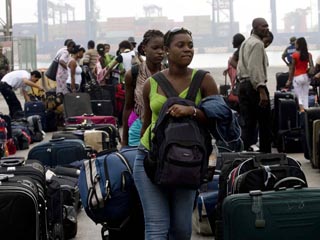
250 Haitians arrived by sea in Veracruz yesterday only to encounter naval, Instituto Nacional de Migración and Foreign Secretariat officials upon their arrival. Although the Haitians — made homeless by the 12 January 2010 Port-au-Prince earthquake — lacked proper documentation, they don’t need to worry too much.
The officials were on hand to present the refugees transported from Port-au-Prince by Mexican Naval Vessel Usumacinta with immigration documents admitting the refugees as legal resident aliens free to seek employment, study, use medical services (several of the refugees were badly injured or crippled in the quake) or travel — and to apply to citizenship.
Presiding genuises?
Presidents, real and fake, ex-presidents, potential ex-presidents and presidential wannabes all in the news lately.
- Real president of the United States Barack Obama praised fake President of Honduras, Pepe Lobo “for his leadership in his first
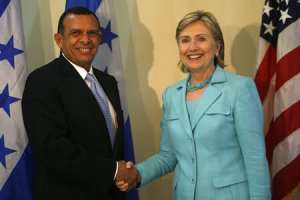
Fake Prez and Blondaleeza
months in office in promoting national reconciliation and restoring democratic and constitutional order in Honduras.” Fake President Lobo is so well-respected he was given a fake award “that is given only to personalities such as former U.S. President Ronald Reagan, Mikhail Gorbachev, Henry Kissinger and personalities over the years to highlight his struggles to achieve peace in the hemisphere.” In other words, anyone who speaks to the World Trade Association of New Orleans.
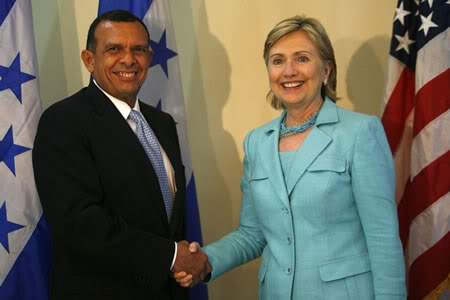
It appears President Lobo’s means of “promoting national reconciliation” and “his struggles to achieve peace in the hemisphere” mostly take the form of no news (reporters) is good news.
-
Y'all are in my power...
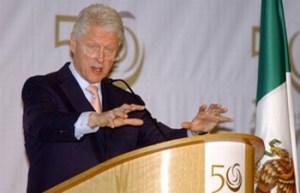
Real ex-President of the United States Bill Clinton (a.k.a. Mr. Blondazeela) managed to undermine further any good feelings Mexicans have about the United States by telling an audience at Universidad de Valle that the United States needed to intervene further into Mexican affairs and model a “Plan Mexico” on his much vaunted Plan Colombia, which led to the deaths of an estimated 60,000 Colombians. Secretarío de Gobernacion Fernando Gómez-Mont Urueta (more on him later) called Clinton’s remarks “unacceptable.”
- In Colombia, Alvaro Uribe, who managed to somehow ram through a quasi-legal way of allowing him to run for a second term (which, when done by referendum and constitutional process in neighboring Venezuela is labeled a “dictatorship) but couldn’t quite pull off stacking the Supreme Court to let him run for a third time, hand-picked Defense Minister Juan Manual Santos as his successor to both the Presidency and the continued “war on drugs (and the Colombian people).” Against all expectations, the Colombians are looking at an unlikely alternative, former Bogatá mayor Antanas Mockus. Most polls show Santos in the lead, but not by enough to prevent a run-off election and Mockus winning a run-off. And Mockus’ polling numbers keep going up.

Lula wears a beard, Lugo wears a beard, why not...
Mockus is an intriguing candidate. A child mathematical prodigy, Mockus — the son of Lithuanian immigrants was a Mathematics and Philosophy Professor who made his political bones as a university rector (and became a national figure when he mooned an unruly campus audience). As Bogatá’s mayor, he used the massive funding thrown at the city to create an illusion that all was well in the country to… well… create the illusion that all was well in the country. Still, it did make for a better quality of life and his Green Party candidacy is about as close to a viable leftist alternative to the present regime as you’re likely to find in Colombian electoral politics.
Hmm... wonder how I'd look with a beard. Might work.
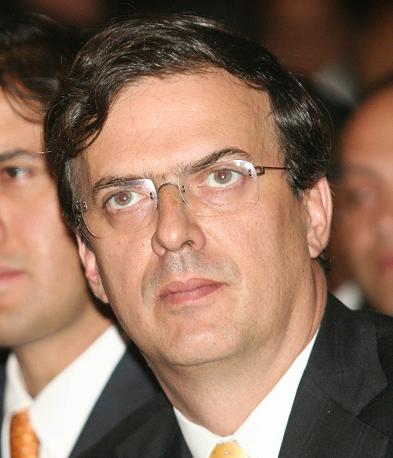
Back in Mexico, or rather in Chicago, Presidential wannabe (and another capital city mayor known for “quality of life” and crating the illusions that all is well — although not for showing his butt in public), Marcelo Ebrard, zeroed in on the United States’ failure to control the arms trade to Mexico. Tying the “drug war” and border problems into his own urban programs (he was specifically talking about scholarships and assistance programs for high school students) — in a speech to other North American urban leaders — is plain good politics. It puts him just enough in opposition to the United States and the Calderón Administration to open the discussion of alternatives without being as confrontational as his political mentor, Andres Manuel López Obrador was. And is.

Decisions, decisions...
Which brings me to Gómez-Mont. I can’t vouch for this, and sometimes trying to figure out the Mexican political leadership is like trying to determine who was up or down in Stalin’s cabinet by their position on the May Day parade stands back in the late 194os, but something seems to be going on. Gómez-Mont broke with PAN, but not with the government a while back, and seems to be open to criticizing the United States for their failure to control the arms trade in much the same terms as Ebrard. He’s started to suggest the need for more “social services” in cities like Juarez, and is starting to express some doubts about the militarized approach to the “War on Drugs”. I could see him as a fusion candidate in 2012 if the left-right fusion tickets do well in this July’s governor’s elections and PAN — which doesn’t have any particularly viable candidates in the offing — were to back him as a candidate for one of the smaller parties, like Convergencia.
The other possibility, and one that is total speculation, is that the movement to force Calderón from office is larger than I’ve thought. I’d assumed the “Renuncistas” were mostly underground, or just on-line, but I’ve noticed that opposition to the “drug war” has grown spectacularly — not just from the usual suspects like PRD deputies .. but from the PRI and even the military. Fierce criticism of Calderón himself — for the rising bloodbath resulting from the “drug war”, the stalled economy, the mishandling of public statements, are starting to be aired even by the generally pro-administration television news casts. With the United States starting to also admit that the Calderón approach hasn’t worked, it could be a signal that an administrative changes that didn’t result in economic or political change would be acceptable to them. If Calderón were forced from office, Gómez-Mont, being a rightist, but technically not a PAN member, would be a logical interim president.
Latin American elections (especially in U.S. dominated countries like Mexico and Colombia) are never a sure bet. About 2004, it was assumed that Andres Manuel Lopez Obrador would kick Santiago Creel’s ass to the curb in the 2006 election. In Colombia, Anteus Mockus — while promising to continue the “anti-drug war” may be insufficiently pro-U.S. and I expect all kinds of charges that he’s pro-Chavez or a dangerous lefty to start circulating. Here in Mexico, not really expecting a surprise like an interim presidency to shake everything up, the safe assumption is that the presumptive PRI candidate, Mexico State Governor Enrique Peña Nieto will be the next president.
At this point he is sort of the default candidate, no other strong PRI candidate being mentioned. However, Peña Nieto was damaged by the negative publicity surrounding the recent Paulette Gebara murder case, and I’d expect both PRD and PAN leaders to start attacking the governor. And, over the next two years anything can happen.
Marcelo Ebrard seems to be losing support from the far left, but may be holding onto the middle. Ebrard, one needs to remember, came from the PRI originally, and — if there is a right-left coalition ticket, could be fighting with Gómez-Mont to lead it. Or, as the default leader, a PRD-PT-Convengenia ticket, similar to the Lopez Obrador’s “Benefit of All, First the Poor” movement. If Lopez Obrador (who is still has a sizable following and powerful political machine) goes along with it.

This look just doesn't work
I can’t see Gómez-Mont getting back into the good graces of PAN. One possible candidate, that no one seems to notice, is Margareta Zavala, Mrs. Felipe Calderón. If you think about it, it makes perfect sense. She’s not controversial, nor hated by any particular wing of PAN. She’s anti-abortion and conservative Catholic, which makes her

I lost 70 kilos! Ask me how!
acceptable to the social conservatives, would be expected to follow the same economic policies pushed by the business wing that backed both Vicente Fox and Felipe Calderón… and, unlike Marta Sahagun de Fox doesn’t bring a lot of negative baggage (except her husband, but there’s no getting around that one) like crooked sons from a previous marriage or shady “charities” with her. She’s getting a lot more press than usual, and I don’t think it’s just because Michelle Obama dropped in for a chat.
A lawsuit waiting to happen?
Via Arizona based The Cyber Hacienda :

Death by chocolate
I’m somewhat taken with Thomas Gage’s “Travels in the New World“, as much for its place in history as the first English-language book on Mexico as its notoriety (among those of us who are students of such things) for setting so many of the stereotypes and the anti-Mexican biases that underlie most English-language books about Latin America.
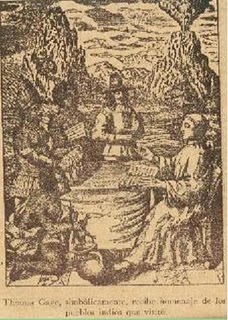
From the 1645 Edition, graphic from Alex Engel's Guatemalan website, Enchiel (enchiel.blogspot.com)
Born about 1597 into the English Catholic gentry, at a time when religion was — like economic theories in the 20th century,– something nations killed each other over and tortured their own people for holding the wrong opinion about.
In England the religious fights were particularly nasty, with a Catholic Queen burning Protestants at the stake, followed by a Protestant Queen who did unto the Catholics as they had done unto the Protestants. And, to make things even worse, the Puritans — sort of the religious “teabaggers” in that they were protesting the Protestant establishment, attacking the Church of England as still too Papist.
Thomas and his brothers were sent to France as boys to study under the Jesuits, with the goal of returning to England as Jesuit missionaries and undercover agents for the Catholic Church. Thomas, for unknown reasons — though given that Catholic priests caught in England were subject to having their guts ripped out, their arms and legs chopped off AND hanged (in that precise order) before they were killed, it’s not hard to figure out his reluctance to buy into the paternal plan — skipped off to Spain when his education was completed to become a Dominican monk.
Claiming he was drunk at the time (or rather, was convinced by a monastic drinking buddy), he signed on to a mission to the Philippines in 1624. The real reason seems to be that English Dominicans in Spain were also being sent to England — and his father had disowned him when he’d skipped out on the Jesuits. Sent to Mexico for basic training before heading to Manila, and having second thoughts about heading further (and not wanting to be sent back to England), he went AWOL from the Filipino Dominicans. Fleeing his missionary superiors, he eventually ended up in Guatemala where priests (especially those like Gage, who was a Latin scholar) were hard to come by, and where runaway would-be Manila-bound clerics weren’t unusual — the local Dominicans regularly dealt with the situation by arranging for retroactive reassignment of their AWOL Filipino clerics.
By scamming, scheming and squeezing his Mayan and Spanish parishioners in first Mixco and later Amatitlán over the next sixteen years, Gage amassed a sizable fortune. He slipped away, overland to Nicaragua, Costa Rica, across the straits of Darien to Portobello — then the largest city in Panama. Then, as now, Panama was a natural hangout for all manner of rogues and pirates. In 1637 — in good part thanks to those pirates, Gage made his way back to Europe, thence to England where he reinvented himself (or, who knows, maybe actually converted) to Puritanism.
As a defector, he proved his value by turning in a number of Catholics and secret priests (including his own brother, who was ripped, shredded and hanged) and — like many a defector since — made a good living writing and lecturing on the evil ways of his former controllers. This was enough to get him into the good graces of the Puritans, who having overthrown the monarchy, found Gage a more appealing job than the Puritan preacher of a country church, taking him into the government as the Spanish-Main adviser to Oliver Cromwell’s “Protectorate”.
Gage was responsible for the English attempts to conquer Hispaniola (today’s Dominican Republic and Haiti) in 1655 and the successful invasion of Jamaica (where the echoes of Puritanism still linger today), where Gage died in 1656. Originally, he was pushing Cromwell to invade Guatemala — something rejected because the English had better naval than land forces, and islands were more their style). And why Guatemala? Revenge — or a desire to wreak vengeance on former colleagues probably played some part — but a bigger reason was that Gage simply wanted to drink chocolate again before he died.
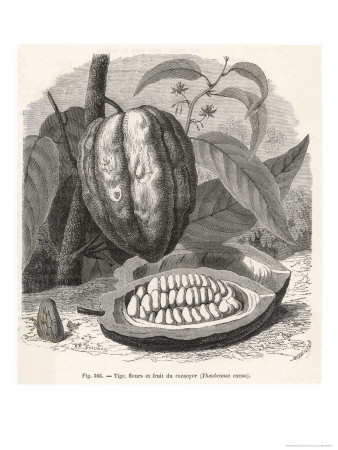 Chocolate is indigenous to Mexico and Guatemala and — at the time — unknown outside of Spain except for Spanish-controlled parts of Italy and some of Holland (Dutch pirates having figured out what the English threw overboard thinking it was cow manure really was). Gage’s one positive act in history (besides writing an entertaining, if scurrilous, book) was introducing England to chocolate.
The guy was obsessed with chocolate, devoting not just an entire chapter of “Travels in the New World” to the preparation and what he believed were the medicinal and health benefits of chocolate, but — at every chance he got — throwing in a chocolate-flavored incident into his story. A bon-bon, if you will.
The women of [Chiapas] … pretend much squeamishness of stomach, which they say is so great that they are not able to continue in the church while a Mass is briefly huddled over, much less a solemn high Mass (as they call it) is sung and a sermon preached, unless they drink a cup of hot chocolate… For this purpose, it was much used by them to make their maid bring to them in church in the middle of Mass a cup of chocolate, which could not be done at all, or most of them, without a great confusion and interrupting both Mass and sermon. The Bishop perceived this abuse and gave fair warning for the omitting of it, but all without amendment. Consequently he thought fit to fix in writing upon the church’s doors and excommunication against all such as should presume at the time of service to eat or drink within the church. This excommunication was much taken to heart by all, but especially by the gentlewomen, who protested if they might not eat or drink in the church they could not continue in it to hear what otherwise they were bound unto.
Bishops of Chiapas have a tradition of fighting with the upper crust, and in this instance — if we trust Gage (I wouldn’t, but it’s too good a story not to follow) — lost. The ladies took to attending Mass at outlying churches, to which the Bishop responded by extending his ban on food in church to the entire Diocese and — for good measure — requiring the ladies to attend Mass in their own parish. His.
This the women would not obey, but kept to their houses for a whole month. In that time the Bishop fell dangerously sick… Physicians were sent for… who all with a joint opinion agreed that the Bishop was poisoned, and he himself doubted not of it as his death…
A gentlewoman with whom I was well acquainted in that city, who was noted to be somewhat too familiar with one of the Bishop’s pages… was said to have prescribed such a cup of chocolate to be ministered by the page which poisoned him who so rigorously has forbidden chocolate to be drunk in the church… And it became afterwards a proverb in that country: Beware the chocolate of Chiapa; which made me so cautious that I would not drink afterwards of it in any whose where I had not very great satisfaction of the whole family.

Perhaps there’s a reason chocolate cake is called Devil’s Food.
So it begins: Razing Arizona
The “papers please” law isn’t even in force yet, but it’s already being used against U.S. citizens (and, in this case, citizens by birth!):
I certainly hope that this law is tossed out by the Federal courts (which it probably will within a week) for the sake of people who live or travel to that state regularly, or those of us in Mexico that do a small, but necessary, bit of business with Arizona companies (like Editorial Mazatlán: our book designer is in Phoenix. The contract for design work — and all but the final indexing — on our latest book, Revolutionary Days, was done before this law was signed). It’d be a hassle, but small Mexican companies can find other suppliers.
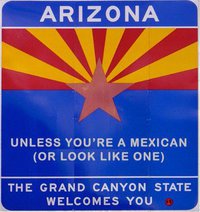
Image shamelessly stolen from Laura Martinez: Mi blog es tu blog
But if push comes to shove, Arizona is going to lose, and it may in some ways provide some benefits to Mexico. Trade between Mexico and Arizona brings 8 billion U.S. dollars a year to Arizona, and five billion to Mexico (that includes remittances by north of the border workers and Mexican tourism, as well as some agricultural products, none that Mexicans can’t buy from Mexicans). In other words, much of the Mexican spending is optional — adios Nogales Walmart and Frontier Airlines.
Based on U.S. Census Bureau data, the largest Arizona exports to Mexico are:
Aircraft engines and parts (already down 15 percent between 2008 and 2009), computer equipment (broken out between processors, down 62 percent and other equipment, down 25 percent). How much the drop in these figures between 2008 and 2009 is due to the general economic downturn and how much to shifting purchase patterns I can’t say, but Mexican suppliers can acquire most of items from other suppliers. Honeywell is the third largest employer in Arizona, but they are not the only manufacturer of process controllers. And the Mexican computer industry could use a lift.
The Arizona export that has shot up (pun intended) has been what the Census data labels as “Bombs, mines, other ammunition projections, etc. and parts” — which, er… rocketed up… 76 percent between 2008 and 2009. I’m assuming that is legitimate purchases… mostly “Merida Initiative” funding.
Patricia Espinoza, the Mexican foreign secretary, said that while
… the [Mexican] government recognizes the sovereign right of every country to decide public policy to be applied within its own territory… it cannot remain indifferent if a measure potentially affects the human rights of thousands of Mexicans.
She added that the Mexican government will used all resources available to defend the rights and dignity of Mexicans in Arizona. That includes, presumably, not buying those “bombs, mines…” from Arizona suppliers (adios Plan Merida — which may not be a bad thing) and moving Mexican federal and state funds that are now in Arizona banks out of the state, or even — if they really want to play hardball — out of Arizona’s fourth largest employer, Wells-Fargo.
Those who want to “thank” the Arizona Governor, Jan Brewer, for her fine work in promoting Mexican independence from U.S. markets can phone, email or fax her at the following:
http://www.azgovernor.gov/Contact.asp
Telephone (602) 542-4331
Toll Free (U.S.) 1-(800) 253-0883
Fax (602) 542-1381
(And, yes — I know I said I wasn’t going to post on weekends, but thought some might want a head’s up for making their calls Monday morning).
Clothes make the perp? Friday Night Video
Of course, United States Representative Sanchez is sane and correct and all, but her wacky colleague Representative Bilbray isn’t completely wrong: I have heard Border Patrol Officers claim they can tell the Mexicans from the Mexican-Americans just by politeness… the Mexicans are politer. And, I admit that in Mexico I can tell foreigners from Mexicans by their shoes (Mexicans polish theirs) and the state of their clothing (Mexicans make lousy hippies, insisting on ironing their jeans). But that tells me nothing about the legality of one’s residence in the country.
Probably the only real way to tell is to look at the label in the clothing. Mexicans generally wear cheap clothes made in Mexico. In the U.S. people wear cheap clothes made in China. And are rude.
An oldie, not particularly a goodie, but if the song fits, post it…
¡Hasta lunes!
Amores Perros
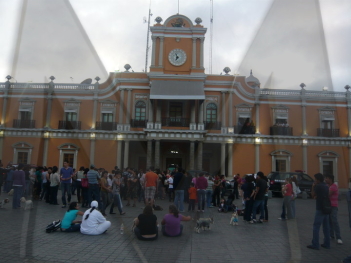 Maggie’s Madness mentioned a study by the Direccion de Juventud (Youth Bureau) of Baja California. “Miquel Angel Torres Cabral, the Director made the announcement of the findings which included the disclosure that it has become increasingly common for teenagers to commit violent acts against their peers and to record these and place the results on the internet because it seems ‘funny’ to them. ” Perhaps they’re right.
In Tepic, it wasn’t against their peers, but against a dog. A couple of delinquents, classmates at CONALEP #169 (CONALEP are federal career and trade High Schools), thought it was “funny” to put up a video on Facebook of them siccing pit bulls on a helpless street dog, and killing it.
300 students, housewives and professionals — with their dogs — marched on Tepic’s Palacio de Gobierno demanding the State of Nayarit take legal action against the delinquents. Jocelyn Fernández, the state under-secretary for judicial matters, agreed to investigate. Tepic’s Presidente Municipal, Roberto Sandoval Castañeda, ordered the Municipal Police to determine what changes can be brought against the youths involved and the State’s Human Rights Commissioner, Huicot Rivas Álvarez, was quoted as saying that the CONALEP students needed to be prosecuted for their cruelty and brutality, if only to prevent further acts of violence.
Although Milenio, in writing about the protests, only named the idiot who put the video on his Facebook page, Blog de Narco posted the names, photographs, home addresses and class schedules of every one of the boys in the video. Blog de Narco, which — as its name suggests — normally posts about the cruelty and brutality of human on human behavior (and seems to be read by some of the participants in those actions) — normally might get four or five comments on a “snuff film”. By my last count, the story on the dog torturer video had 547 comments… some of which indicate the Nayarit prosecutor and the Tepic Municipal Police may be the least of these kids problems.
Justice reform — mañana
Staving off the inevitable for another few months, the administration has finally agreed to promised reforms to military law… but only in the next Congressional session. Constitutionally, the use of the military as police on the scale being done today is illegal, a situation even recognized by the military leaders themselves, and a factor in the U.S. insistence that Mexico “regularize” the situation. What the U.S. apparently didn’t mean was what the opposition proposed, taking the military out of civilian law enforcement and — if applying civilian law to military personnel when acting in a civilian capacity.
While the military leaders do not want to be policemen, while they are, they do not want to be held to civil legal procedures. However, military law doesn’t seem to be much use in holding individual soldiers accountable for human rights abuses, nor are survivors of “collateral damage” able to seek justice under the present system.
La bloga loca
Yesterday, the number of hits shot up… not because of anything I wrote recently, but because back in October 2008 I wrote about a Mexican immigrant in the United States who actually supported John McCain’s presidential bid. Of course, I knew that there are Mexican-American Republicans, but the contradictions in the career of Eduardo Verástegui seemed worth noting.
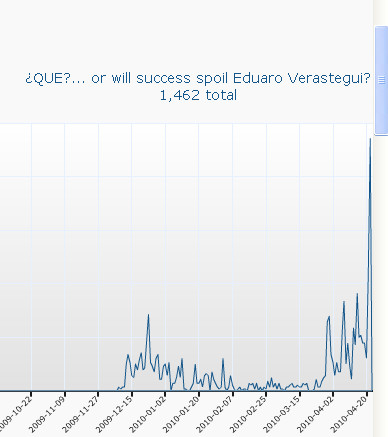 As a telenovela hunk and pop singer, Verástegui had been a gay beefcake model… not that there’s anything wrong with that… but as an ardent supporter of a California initiative to ban same-gender marriage it cost him much of his Latin American and Latino fan base.
Other countries, other mores: he was making a name for himself as the spokes-Hispanic for a politically conservative Evangelical Christian group. And — based on his identify as a devout, but hunky, Roman Catholic — for anti-abortion groups as well.
There was a blip in my “hit list” when Ricky Martin came out, mostly because a minor part of the non-story was that Verástegui was the biological father of Martin’s twin boys. But nothing like yesterday. It wasn’t that Verástegui — the beefcake model turned the Evangelical spokesman and inseminator of gay parentage — was at the Pope’s birthday party (write your own snark about blowing candles), but the power of Mexican journalism at its … not finest… but most influential.
TV y Novelas de México magazine is claiming Ricky Martin and Eduardo Verástegui’s relationship extended beyond the donation of sperm cells. Er… maybe I can word that better, but then again, maybe I shouldn’t.



 mexfiles.net