12 April 1919

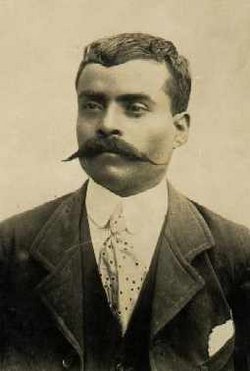
Perdono al que roba al que mata, porque quizá lo hacen por necesidad, pero al traidor jamas
(Emiliano Zapata, killed by the traitor Jesús Guajardo 10 April 1919).
Ray Acosta’s Revolutionary Days managed to uncover even the time of Emiliano Zapata’s funeral:
Zapata was buried in Cuautla, Morelos at 5:00 PM.
(El Universal, 13 de abril de 1919)
It was important enough to be filmed:
Jesús Guajardo’s burial was not as noteworthy. Having gotten close enough to Zapata to murder him by pretending to betray the Constitutionalist government, he was promoted to General, but no one ever trusted him again. In July 1920, he was sent to Durango to fight the remnants of Pancho Villa’s forces, but with his men deserting in droves (Guajardo’s own soldiers despised him), the treacherous little weasel tried to stop the desertions by claiming he was joining the De la Huerta revolt against the then-established Revolutionary government of Alvaro Obregón. The soldiers basically told him to take a hike. He got as far as Monterrey before he was arrested. He was finally shot as a traitor on 3 July 1920. If he even had a funeral and wasn’t just shoved in the nearest hole, no one bothered to tell the newspapers or to film the event.
No one cared.
Somebody’s watching me?
Wednesday, for the second time, I stopped at Sanborns to see if Proceso had FINALLY show up here in Mazatlán. The Sanborn clerks know me… I’m the only foreigner who regularly buys El Chamuca, and thinks its the best Mexican opinion journal around. I just buy it for the pictures… but then, it’s a comic book –sort of a Mexican version of The Nation is it was put together by the “usual gang of idiots” over at MAD Magazine.
Proceso hadn’t shown up Monday, and was told it would be in the next day, when the clerk told me and the other guy looking for it Proceso was expected in by Wednesday. On Wednesday, the magazine counter manager and the four or five other customers who were all equally anxious to read Julio Scherer’s interview with Sinaola’s second-most notorious exporter, Ismael “El Mayo” Zambada, kind of appreciated it when I was quoted the famous line Andres Manuel López Obradór used when faced with frustrating out-of-his-hands situations: “¡Es un complot!” It was a joke, but the Sanborns manager said he thought it was plausible.
We may not have been wearing tin-foil hats:
When I asked Malcolm Beith (who had the common sense to read the article from the on-line version), who has a good overview of the El Mayo interview for those who can’t read Spanish if he was able to pick up a copy, he said there were problems getting the magazine elsewhere in Mexico. Still, with armed commandos walking into the Sinaloa distributor and buying up the entire state supply, you wonder what’s going on. Who ever heard of “rmed buyery”?
El Mayo doesn’t say anything all that damning — or even surprising — in his interview (except maybe that his friend, Chapo Guzman, is nowhere near as rich as Forbes Magazine seems to think) : he basically thinks of himself as a businessman and family guy (with five wives!) and, like a lot of other Sinaloans, thinks the “drug war” is unwinnable. If he and Chapo aren’t running things, someone else will pick up the slack. Like I said earlier this week, he seems to think the narco leaders could just be bought out.

Clikity-click to read
But, I’m the guy with the weird accent asking about it, here. And who walks home from Sanborns via a short-cut through the fraccionimento where the mid-level “powers-that-be” — local politicos and gangsters — are said to live. And is known to write about Mexican affairs. So finding the letter at the left under shoved under my gate yesterday would set off at least a twitch of paranoia.
It’s a copy of a letter dated 6 April 2010 from Mauricio Razo Sánchez writing on behalf of CISEN (el Centro de Investigación y Seguridad Nacional), the Mexican national security agency (i.e., the secret police and spy agency) to Jesus Vizcarra Calderón. Vizcarra, presently the Presidente Municipal of Culiacán, is the only pre-candidate for the PRI nomination for this year’s governor’s election in Sinaloa.
Which makes one wonder if the Proceso readers with guns weren’t more interested in ANOTHER article in the same issue, Jorge Carrasco Araizaga’s Narcopolitica en Sinaloa (“Narco Politics in Sinaloa”), the lead translated by me as:
Cisen has been investigating links going back more than twenty years between businesses run by Jesus Vizcarra Calderon, the PRI gubenatorial candidate in Sinaloa, and major drug lords. Vizcarra, associated politically with Enrique Peña Nieto and Elba Esther Gordillo, was paradoxically fostered by Vicente Fox and former Secretary of Agriculture Javier Usabiaga. He now defends Felipe Calderon’s war and endorses the militarization of the fight against organized crime.
I assume that the letter — in which the CISEN bureaucrat says the Proceso article is based on open records — is being distributed by opponents (or potential opponents — the official campaign not having stated yet) of Vizcarra’s run for the governorship. But that raises two more questions… first, how did the opponents get the letter, and second… who slipped it under my front gate?
Right turn on red hat?
José Horacio Gómez Velasco was born 26 December 1951 in Monterrey. Like a good regiomontaño (native of Monterrey) should, he went to Mass regularly and studied at TEC. Unusual for a conservative, he transferred to UNAM in the early 197os, obtaining degrees in accounting and philosophy without turning lefty, or even anti-clerical, let alone secular. Instead, he pursued a doctorate in theological studies in Spain, and was ordained in 1978 by Austrian Primate Cardinal Franz König, one of the most progressive church leaders of the time. What makes this so incongruous is that the new Father José was ordained as a member of the Priestly Society of the Holy Cross. In common parlance, Opus Dei.
 Without venturing into Dan Brown territory Opus Dei is controversial, even in Latin America. With its rituals rooted in the most ultra-montane forms of Spanish Catholicism, and a top down, hierarchical structure demanding unquestioning obedience to ones superior, it gets a creepy reputation for secrecy. The reputation is enhanced by the unusual structure of Opus Dei, which unlike other religious orders, is neither communal, nor do its members wear any identifiable garb. It has conservative theological views, there is some controversy about its role in secular political affairs. Having been founded, and prospered in Spain during the Franco era, and appealing to social conservatives and the wealthy to begin with, its members are more likely to be active in rightist politics than otherwise and to be prominent within rightist social movements.
In Latin America, where the more conservative (and sometimes creepy) traditions of the Spanish Church still linger, we are fairly used to Opus Dei priests and even Opus Dei bishops. In the United States, a country with a more individualist tradition, Opus Dei is seen as it is in Dan Brown novels — a weird, shadowy and sinister movement. Gómez, a resident of the United States since 1987 and a United States citizen since 1995, is the vicar of Opus Dei in Texas — a place also known for weird, shadowy and sinister movements of its own.
Gómez was elevated to the post of Bishop of San Antonio in 2004. The previous Bishop, Patrick Flores, was something of a legend in Texas — having been a ranchero singer as a teenager, and come from migrant worker stock, he was beloved (not just by Catholics, and not just by Tejanos) for his common touch and avidity to work with all factions in the wider Texas community on issues of common concern.
Gómez — who as a Bishop cannot be a member of Opus Dei (whose members answer to the order’s superiors, while diocesan Bishops have to answer directly to the Pope) has not been a bishop in the Flores mode. He immediately took the Diocese in a rightward direction, disbanding a Diocesan Commission that opposed a ban on same-sex marriage (as opposed to Raul Vega, the Bishop of Saltillo, supported Coahuila’s “civil union” bill) and threatening to cut funding to a Catholic University that had invited Hillary Clinton to give a speech, on the pretext that Mrs. Clinton (then a United States Senator and not a Catholic) did not oppose legal abortions.
Earlier this year, he was named Coadjutor Archbishop of Los Angeles. This means, come next February when Cardinal Roger Mahoney turns 75, Mexican born José Gómez will be the Archbishop of the largest Roman Catholic Diocese in the United States. Normally, the Archbishop of Los Angeles is a Cardinal, and it is expected that Gómez will receive his red hat.
This will make for an interesting situation. Gómez has closely worked with Cardinal Norberto Rivera, the Primate of Mexico City, for a number of years. Both are extremely conservative in their theology and Rivera has been skirting the line on the very strict separation of Church and State in Mexico. In the United States, where clerics can, and do, make political pronouncements, José Gómez will have a huge bully-pulpit (as well as a regular pulpit in the Cathedral, of course). The Archdiocese of Los Angeles is overwhelmingly Mexican-American (who like other demographic groups in the United States are more regular church-goers and to heed their priests much more than Mexicans do) and should Gómez be seen as the “voice” of a sizable ethnic minority (as he was in Texas), could cause problems for progressive Latino groups.
The Archdiocese of Los Angeles is in serious financial trouble, as a result of court-ordered settlements stemming from lawsuits involving pedophile priests (one scandal dragging in Norberto Rivera, because the priest was bounced back and forth between Los Angeles and Mexico staying one step ahead of the law). I suppose being an ex-Opus Dei Cardinal could have one advantage for Los Angeles. The order is famous (or infamous) for its skills at fund-raising. Maybe two advantages. Sexual abuse among Opus Dei types seems to confine itself to opposite gender adults.
Time for some honest hypocrisy
(slightly edited 17-October-2010)
A post on the only “expat” message board I bother reading any more was from someone who just discovered Jean Meyer’s The Cristero Rebellion. The poster apparently never heard of this reactionary movement (which cost the lives of some 80,000 people) of the 1920s and thought Meyer’s 1974 book was something new. The Cristero Rebellion is a very good book on this period in Mexican history, and the best known work available in English translation on this subject, but the poster was mistaken in believing Meyer’s work was the definitive word on the Cristeros. Hardly.
Let’s just say that I don’t accept the MexConnect commentator’s contentions that the Cristeros have been unfairly treated by Mexican historians (supposedly mislead by Soviet propaganda), nor that the war is “forgotten” because of some shame on the part of the Mexican state.
I don’t think the Cristero War was all that unique, in either the history of the world, or in the history of Mexico. Peasant and lower class rebellions are fairly routine in history, as are reactionary religious/social movements during times of radical social change. Think of Padre Hidalgo leading out the peasants to slaughter the gauchupines, in the name of protecting the Church from French atheism, or revolts that broke out during the expulsion of the Jesuits in the 18th century, or the War of the Reforma, and the Cristero movement just seems like a better organized, twentieth-century version of a sort of rural violence that has always reared its ugly head in Mexican history.
That the historical consensus on the War isn’t kind to the Cristeros is not the result of some Soviet propaganda machine. While of course Soviets commented on the event, that assumes Mexican historians can’t think for themselves, and that the counter-propaganda (my 90 year old mother can remember being told about anti-Catholic “Reds” in Mexico by the nuns in Pittsburgh) wasn’t just as over the top. Of course, when Meyer’s book was written in the early 1970s, knee-jerk anti-Communism and the assumption that Soviet sources indicated Communist infiltration of intellectual thought, was not remarkable, especially among conservative scholars like Meyer.
Finally, given that the intellectual and financial leaders of the movement generally moved on to Falangist and Fascist political movements after the failure of the rebellion, it’s hard not to see it as I do… simply a modern reactionary movement, not all that different from the Taliban or Al Qaida.
It’s not out of any sense of shame that the war isn’t well known… rather a consensus to put the thing behind them that it’s not front and center in Mexican historical studies. Without going into the causation of the revolt, consider the way it was ended. It wasn’t so much U.S. Ambassador Dwight Morrow’s intervention (Morrow only prevailed upon the U.S. apostolic delegate — neither the U.S. nor Mexico had diplomatic relations with the Vatican at the time — to name an American priest, Father John R. Burke, to act as the Church’s negotiator with the Mexican government) that ended the senseless slaughter. It was that economic and social change was going to happen no matter what, and that with a little “honest hypocrisy”, the people could continue to find what solace they could in religion as the changes happened. As I wrote in my book, Gods, Gachupines and Gringos:
The Church was allowed to function and to maintain control over religious facilities (under license from the state) in return for staying out of politics. The petty restrictions on religious activities could be overcome with a little creativity on both sides. In many places, religious processions — religious activities off church grounds were technically illegal — usually included making arrangements to pay a nominal fine to the local authorities for holding a parade without a permit. Or village fiestas in honor of the local saint, which were often disguised celebrations of an indigenous god to begin with, were rechristened as “folk festivals”.
Perhaps, had the Cristeros been defeated (at a huge cost in lives and production), Mexico might have had different history. As it was, the die-hards either drifted into fascist politics (and incorporated into PAN) or joined the newer religious movements like the Legionaries of Christ (founded by Cristero saint Rafael Guizar y Valenzuela‘s nephew, Marciel Maciel). Perhaps Mexico would have been better without these movements (and the human race would have been better without Maciel), but without an imperfect settlement, peaceful development of any kind or even a normal civic life would have been impossible.
I think of that now with regard to the “Drug War”. While not ideological, it is basically being fought by people trying to hold on to a way of life — rural agriculture and/or caught in the economic changes of the 21st century. It is bloody and neither “side” can win. The underlying suggestions behind U.S. offers of “assistance” are likely to escalate the war. It’s alarming to read in the same week of U.S. insistence that its experiences occupying Afganistan and Iraq are relevant to Mexico and of “mistaken” attacks by the United States on journalists in Iraq (as if “errors” aren’t already a problem with the “Drug War”).
To quote Argentine President Raul Alfonsín, “No president has the right to endlessly demand sacrifices from his people” … and no people have the patience to keep sacrificing, especially for a problem not of their making. Most people in Mexico have no more to do with the narcotics trade than they did with the Cristero terrorists of the 1920s, and the administration then realized it.
This is where the “honest hypocrisy” is needed. The United States government seems to expect the Mexican PEOPLE to put up with with random roadblocks (and their occasional “collateral damage”) and shootouts in the streets and — going the Iraq/Afganistan route — the odd air attack on perfectly innocent people, while at the same time loathe to do anything similar to its own users, money launderers and gun runners. The cost of continuing down that route is too high for the Calderón administration now, and for any future administration.
Rural Mexico is going to change, whether there is a marijuana crop or not. Under the rubric of “social development”, the Bolivians legalized growing coca, but subsidize the crop. The government buys it and controls the small legal market, and tries to find some alternative use for the rest. The just destroy a lot of it, but by slowly developing alternative economic prospects for rural Bolivians, have given themselves breathing room for peaceful imperfect progress.
If the United States is willing to continue pretending to “do something” about their narcotics habits, Mexican can continue pretending to “do something” about its exporters. It doesn’t have involve violence, although I expect the United States will continue to demand a sacrificial victim now and again. Just not a busload of tourists sited by a helicopter gunship or a couple college students caught in cross-fire between narcos and the police.
Ghost story
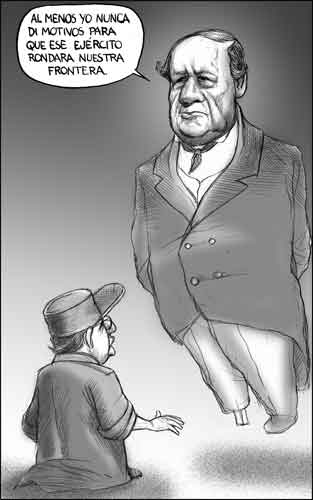
Rafael Barajas Durán, el Fisgón, has long been my favorite Mexican political cartoonist. Working for Jornada, he can probably count on a better than average educated audience, but he is typically Mexican and very much part of the Mexican mainstream in his assumption that one recognizes the past and the weight of the past in today’s headlines. North of the border, we think of the “drug war” — and the interest of the United States in “assisting” Mexico with “problems” on the northern border as something going back, at most, to Richard Nixon’s presidency. In Mexico, as Fisgón not so subtly reminds us, to understand ourselves, we need to look beyond our own immediate lives, and think in terms other than the narrow concerns of today’s headlines.
Not so subtly, Fisgón has the ghost of the General Santa Ana — the disastrous and devious “Napoleon of the West” of the early and mid- 19th century — looming over Don Felipe, shown as a little boy playing soldier (notice the uniform shirt trails down to the ground), lecturing the living President like an angry and disappointed parent. “At least I never had to explain why the Army patrols our border”, says the President best remembered for losing nearly half the country to the United States.
The new paradigm of the drug war is that a purely military solution — more troops on the border — has been counterproductive. Even George Friedman at Stratfor, the military-industrial complex’s favorite spokesman, has finally cottoned on to this, and it’s suddenly being presented as if there were a new and startling observation. I’d like to think Friedman stole the idea from me, but I stole it from Noam Chomsky, Naomi Klein, Laura Carlesen, Andres Manuel López Obradór, Carlos Montemayor, Jorge Casteñeda, Ernesto Zedillo Ponce de Leon and many, many others… including Antonio Lopez de Santa Ana.
What I see Fisgón getting at is not so much that Don Felipe just doesn’t measure up to the ghost of Santa Ana, but that he’s playing — and playing badly — at a game that for Santa Ana was life and death. It was his attempts to create a centralized state that led to the Texas Revolt, and — in attempting to control that border situation — sparked the United States invasion of 1846-48. He didn’t wipe out the Alamo, nor put troops in the field just for show… something our smaller, less-inspiring, less-flamboyant, less-threatened (and less threatening) President doesn’t seem to understand.
Santa Ana’s eleven presidencies ranged across the Mexican political spectrum of the early 19th century… his governments ranged from reactionary to reformist, under varying forms of government from federal republic to a centralized state. He tinkered constantly with the means of governance. While there haven’t been, and we are well beyond the days of, wrenching changes in the form of governance, the present Administration keeps trying to change the rules… first to denationalize our energy producers, then to consolidate the electrical system, then to decide monopolies need to be broken up… all within a few years. As in the Santa Ana years — in a small way — we are seeing a government with no real agenda other than its own preservation.
But Santa Ana was consistent in one area — preserving Santa Ana. His tenures in the Presidential chair generally were constitutionally irregular — in a large and public way. He depended on the military to defeat and break up any organized opposition to his rule and to support the elites who only wanted the state to bolster their own economic interests. And never felt the need to explain or justify that. Felipe Calderón’s accession to Los Pinos wasn’t as dramatic as some of Santa Ana’s (his best being when he resigned as President, so he could overthrow his government, and try out a weird system of four branches of government), but it was — in the eyes of many — at the very least constitutionally dubious: a Santanizadoito.
Klein, Chomsky, et. al. have pointed out that an emergency — real or feigned — is used to force unpopular changes on a society. The “drug war” keeps the military in the streets and along the border, allows the government to label potential opponents as an enemy (think of the claims Michaocán politicians were all in the pockets of “cartels” only to have charges dropped after the elections) and to distract the populace from moves designed to shift power away from the workers back to the old elites (as in the proposed radical changes to the Labor Code, which effectively makes it impossible to form a union without an employer’s approval).
Santa Ana had one advantage over Don Felipe. In the 1840s, the border was sparcely populated, and there really wasn’t all that much demand in the United States for Mexican products. And his emergency was real.
Today, as George Friedman notes:
The United States consumes vast amounts of narcotics, which, while illegal there, make their way in abundance. Narcotics derive from low-cost agricultural products that become consumable with minimal processing. With its long, shared border with the United States, Mexico has become a major grower, processor and exporter of narcotics. Because the drugs are illegal and thus outside normal market processes, their price is determined by their illegality rather than by the cost of production. This means extraordinary profits can be made by moving narcotics from the Mexican side of the borderto markets on the other side.
Whoever controls the supply chain from the fields to the processing facilities and, above all, across the border, will make enormous amounts of money…
From Mexico’s point of view, interrupting the flow of drugs to the United States is not clearly in the national interest or in that of the economic elite. }
What would Santa Ana do? Of course, he would back the elites with the Army. Or would he?
In 1847, as the Winfield Scott moved in on Mexico City, Santa Ana’s agents approached U.S. asking for a cash payment in return for which the Mexican Army would only feign resistance. Scott fell for it, and Santa Ana — honest for once in his life (well, dishonest in an honest way) used the money to pay his troops, who did not feign their resistance. Santa Ana’s final downfall was in 1853 when he sold the 76,800 km2 Mesilla Valley to the United States — it was, after all, of little use to Mexico and Mexico (or rather, Santa Ana) needed the money.
Bribery now is more subtle — and more complicated — than in Santa Ana’s day. And the border, unlike it was in the 19th century, is a busy place, with huge United States investments. And, unlike the times of Santa Ana, we like to think we are a more democratic and open society, in which the people have rights too.
Who are the elites? The narcos? The United States business interests? The United States narco business interests? The United States government? The people?
Felipe Calderón, let us remember, approached the United States government with the idea of the Merida Initiative. While the funding is not, as with the Mesilla Valley deal, a matter of just making a cash offer, skimming off as much as possible and sending the remainder to Mexico (er… Santa Ana), but an investment in goods and services that will be used to supposed allow the Mexican Army to fight… whom? And for whom? And against whom?
And so the Army is on the border. As confused as to their exact role as anyone. And with only a ghost of a chance of a cogent, adult explanation.
Our mystery man revealed
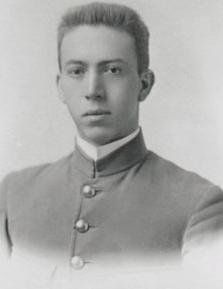
Do you know this man?
The Mexican Revolution was a largely do-it-yourself affair, and called for inventiveness. This Mexican hero was the first person in history to do something that has since changed the course of history. Who is he and what was it he did?
A free copy of the soon-to-be released Revolutionary Days: A Chronology of the Mexican Revolution to whoever is the first to guess… or properly identify … the man and his deed.
A must for any Latin American studies department, Mexican scholar or researcher, Revolutionary Days: A Chronology of the Mexican Revolution is NOT a “today in history” type time-line, but the ONLY guide to the daily events of the Mexican Revolution that includes the references and sources needed for scholarly investigation. Revolutionary Days is timed to coincide with the Centennial of the Mexican Revolution, but as a basic reference, will never go out of date.
Two clues. First: The Battle of Midway.
Second: your answer must be received no later than 14 April 2010.
Send your responses to publisher@editorialmazatlan.com.
We have a winner… maybe winners.
The guy in the photo is Gustavo Salinas Camiña , who piloting the bi-plane Sonora in the battle of Topolobampo, became the first aviator in the world to attack a ship. With homemade bombs, he successfully attacked two Federal warships — Guerrero and Morelos — in support of the Constitutionalist warship Tampico. Ray Acosta, being the crack researcher that he is, found a report in the U.S. Naval Institute Proceedings of 1918 by J.H. Klein, Jr. who witnessed the battle from a U.S. observer ship. Ray found something interesting about Klein’s report. Klein mixed up the date of the bombardment with another event, and rather than assume the U.S. source was correct, dug deeper. He is able to confirm the aerial bombardment took place 14 April 1914.
Born in 1893 in Coahuila, Gustavo Salinas Camiña was Venustiano Carranza’s nephew. In 1913 the 19-year-old Salinas and four others were sent by President Madero to New York for flying lessons. On their return, they became the Mexican Air Force. His uncle’s best general, Alvaro Obregón, was the first to realize the potential of air power. Whether the naval air attack was Salinas’ or Obregón’s idea is an open question.
Twenty-one at the time of his historic mission, young Captain Salinas was quite the popular hero for his exploit. I cropped off the autograph (which would have made it too easy) on the photo which was given to one of his many groupie. Besides his distinguished military and aviation career, Salinas was famous as both an auto race car driver and competitive target shooter. He became the Mexican Air Force’s first Division General, and — during the Second World War — was influential in organizing Escuadron 201, the Mexican air wing in the Pacific War. At the time, he was also director of Mexico’s civil aviation authority. For his contributions to aviation and to military aviation, he was decorated by the Mexican, French, Belgian and Peruvian governments. He died in 1964.
“Fulano Conocido” was the first to send a correct answer. Aage Jorgensen not only identified Salinas, but managed to dig out an unknown (to us) interview with then General Salinas about his exploits, including his bomb-making recipe. Both will be receiving a complimentary copy of Revolutionary Days, which should be available in about six weeks.
Los ricos también lloran … demasiado tarde
 The huge outpouring of media attention on the disappearance of Paulette Gebara Farah as opposed to rather muted response to the murder of ten youths from an ejido in Durango, bothered some people here, but it’s hard not to be concerned when a four year old handicapped child simply vanishes. The story fed into every parent’s worst nightmare. If it could happen to a rich, well-connected family, with two nannies in attendance and living in a building with security cameras in the lobby, it could happen to anyone.
Or so it seemed. Paulette reportedly disappeared the night of 21 March. As the days went by, the strange behavior of the family, which — while holding tearful media interviews and garnering international sympathy and simultaneously putting up legal roadblocks to a police investigation — finally led, on the 30th, to the state prosecutor issuing órdenes de arraigo (basically, holding the family as material witnesses during the investigation: the family moved into a hotel in Toluca) while the premises were thoroughly searched. The next day Paulette’s body was found: she had been strangled and stuffed in the mattress of her own bed.
Paulette’s mother, Lizeth Farah, and what the media describes as a compañera de juerga — partying buddy — are the presumed killers.
Farah is, rightly being villified, while amateur (and professional) psychologists are having a field day and there are discussions throughout the media about issues relating to the way children are raised, and about the protection of special needs children . The bizarre case has raised other issues — having to do with social class and political power, which may change the projections for the upcoming 2012 Presidential elections.
IN THEORY, Mexicans have a much stronger right to privacy in their home than in the United States or most of the rest of the world. The Gebara family had every legal right to impede investigators… but try telling armed soldiers to stay out of your house, or tell that to someone who has undergone a “routine” police search of their house for possible connection to the narcotics trade.
On the one hand, people are asking why the Gebara family was the focus of so much attention (the answer being because they’re rich people) and on other hand, it calls into question the competence of the State of Mexico police that it took them ten days to find the body.
Secondly, the Gebaras were apparently allowed to prevent investigators from speaking with the nannies, and the nannies were also held in preventative detention. I’m not going to play amateur CSI guy, but the nannies had to know something. What’s more than troubling is the thought that employers can coerce, bribe or otherwise convince their employees into covering up serious crimes, or acting against their own interests.
And, with the statement by State of Mexico Governor Enrique Peña Nieto that “the truth will come out” and that he appealed to unspecified “international experts” to resolve the crime raises even more questions. Calling in “international experts” is seen as either an admission that his own police are incompetent, or that the rich are different than you and I, and somehow deserving of a governor’s special attention.
Secondly, and this may be more serious, it opens up speculation again over the somewhat unexplained death of Peña Nieto’s wife back in January 2007. Officially (and I have no reason to question it), she had an epileptic seizure and choked to death. However, at the time, it was also reported that Monica Pretlini’s death was a suicide caused by an overdose of anti-depressants. The family life of Mexican politicians seldom is newsworthy, but there were reports at the time that the couple had separated for unspecified reasons, and rumors that Peña Neito murdered his wife are openly resurfacing. One commentator in El Universal on the Governor’s taking a personal interest in Paulette’s murder asked if he was also going to look into “el caso en su casa.”
While I fully expect we’ll be seeing a couple of trashy quick “true crime” books about Paulette’s murder, and we’ll be reading every detail with salacious interest for the next several months, the nuances of this tragedy may be with us for years.
Agreed!
I’ve had my differences with Malcolm Beith, but I can’t argue with him here:
Narcos like El Mayo do not like living on the run. They don’t really even consider themselves outlaws; for decades, their business was all but legal. The government changed the rules of the game, not the narcos. El Mayo would probably even prefer to clean up his money and invest in something else that could prop up Sinaloa’s economy if given a chance to do so. So here’s an idea, Calderon administration: open up a dialogue. Replace the drug economy with something else that Mexicans could profit from. Can’t be a crop, that’s not financially viable. But there must be something Mexico could produce en masse with a billionaire backer like El Mayo.
I’ve been saying essentially the same thing for some time. The narcotics export business is in most ways no different from other Mexican businesses. It is an extractive business that returns very little to the Mexican producers: of the billions supposedly earned by the management of the enterprise, very little of it comes back to Mexico.
Sinaloan entrepreneurs like “El Mayo” and Chapo Guzmán are not quasi-mythic figures because of their business acumen, particularly. But there is a grudging respect (and even admiration) for “captains of industry”, even if the captain is a pirate. Nor, because they are major employers in this state, although speaking well of local employers is not unusual.
Obviously, El Mayo and Chapo can’t, like other businessmen who have made more than obscene wealth, polish their image through charities and good works. At least not overtly, given the sensitivities of the consumers of their products. But they do their bit, and everyone knows it. For some reason, Carlos Slim is celebrated when he endows an art museum, yet when a narcotics exporter pays for a local children’s party, or pays for a church bell, it’s “corrupting”.
The profitability of the narcotics export business depends upon it’s criminality, which does make the business unique. The money that does come back to Mexico (and you’re fooling yourself if you believe these guys are sitting on wads of cash or spending the loot on humvees and AK-47s, though the overhead is tremendous in that business … it’s in U.S. and European banks, underwriting those banks that are “too big to fail”) isn’t all that much, but is about the only LOCAL cash around in rural Sinaloa.
From that perspective, the criminality of the whole enterprise is, perversely, a good thing. Were it legalized in the United States, how long would local Sinaloan suppliers have control of the sales and marketing, and would the new bosses (presumably foreign mulitnationals) have the same concern for the local population?
And, no one is going to write a corrida about the adventures of Montsanto or Archer-Daniels-Midland.
More, when Proceso shows up on newsstands here in Mazatlán (said to be coming in this afternoon… I’m not the only one asking).
Elton who?
Perhaps the stage collapse at Elton John’s concert in Chichen Itza was no accident. Amadeo Cool May (Corresponsales Indígenas) with a local review of THE event last Saturday:
Peto, Yucatan.- In Tahdziu municipality, a 150 kilometers south of Merida, residents are more concerned about restoring their harmony with nature than with any harmonies by British concert pianist Elton John. While crowds awaited the European performer in Chichen Itza, on Saturday in Tahdziu the event of note was the pre-Hispanic huahil kool ritual.
After the service, presiding hmeen, Caamal Fidencio Noh, said in an interview that during his childhood these ceremonies were held in locations near the Muul within the Archeological Zone, but since the people had to move, so did the ceremonies.
He recalled that in his youth he worked in the fields, having no chance to go to school but knowing the goodness of the gods. Now, he said, the youth study hard, but God is forgotten.
He explained that this ceremony — performed during the dry season – offers up gifts of good made from corn, ground pumpkin seeds and beans, as well as seasoned beef – to invoke the presence of the forest and rain gods.
Demetrio Valle Cante, who coordinated the event, said that this ceremony is a contractual promise with the deities and held every two years whether you win or lose the crop.
As to the concert at Chichen Itza, the Supreme Council of the Maya President, Valerio Canche Yah, said the community opposes using sacred spaces by the present authorities in the State of Yucatan for the economic benefit of the “Casta Divina” (the descendants of the Spanish) and that such events do nothing to combat the poverty, social marginalization and unemployment suffered by the Mayas in municipalities near the archaeological sites.
This isn’t the first time the British performer has entertained the self-styled “best people” here in Mexico, nor the first time his appearance at a historical site has been seen as an insult to the Mexican people. I guess that’s why he calls out the boos.
Get well soon!
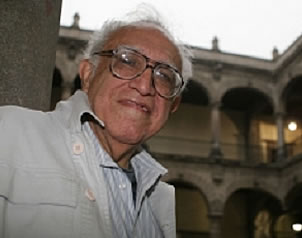
One of the great things about Latin American culture is that intellectuals and writers are taken seriously. When Carlos Monsiváis went into intensive therapy for a breathing problem, it was national news. As is the very good news that he is on the way to recovery.
Someone once said that if there was a Nobel Prize for Readers, Monsiváis would be the hands-down winner. Erudite and ironic, the septugenian writer belies his gentle image as an eccentric ivory-towered intellectual living with a houseful of books and cats. He reads everything and has something to say about what he reads, but regularly ventures forth (until his recent illness) to hang with the punkers and skaters and emos and Zapatistas reporting with wit and irony on the endurance and changeability of Mexican culture and thought.
His immense curiosity and boundless energy in his explorations of Mexican folk-ways led him to collect… well, everything. Algabría, a wonderfully impossible to define magazine (sort of a “Readers’ Digest” for intellectuals and linguists) — in a recent article on the Collyer brothers (reclusive New Yorkers killed in 1949 when they were buried under piles of stuff they’d collected in 1949) in a sidebar about obsessive-compulsive collectors, coined a new disease: “Monsiváis’ Disorder” — defined as
… while not pathological, is marked by a drive to accumulate all manner of accessories, whether artensanías, oil paintings, miniatures, models, sculptures, photographs, furniture, books, et centera, to the point where it doesn’t fit in your house, and just becomes part of a museum collection.
The Museo del Estanquillo being the collection in question.
As with most Latin intellectuals, he is of course, from the left end of the political spectrum, an important figure in any major political event. At demonstrations, if Monsiváis is front and center (as he often is), attention must be paid. And has been.
The author of more than fifty books, Monsivaís is a television personality — something you don’t find authors becoming elsewhere. One of Mexico City’s most recognizable residents, he is well-liked and well-respected not as a celebrity, but as a regular guy who has his breakfast at the Sandborn’s around the corner from his house, is an appreciated customer at weekend tianguis and who has been spotted in Metro stations handing out free books to passengers — bothered by statistics showing Mexicans read few books, he took it on himself to do something to correct the situation, convincing his fellow authors, and the Federal District, to try and change that.
We need him back and on his feet. Get well, Carlos.
A shaky start in life
The border takes another hit, and almost no one notices. A 7.2 Richter scale earthquake (about the same magnitude that wiped out Port-au.Prince) rolled through Mexicali and the surrounding region. Water and electrical services have been disrupted and there has been major structural damage, but — with only two reported deaths, has not grabbed the attention that say a couple of gangsters popping each other would.
Two deaths, and… at least nine births, according to the LA Times:
At Mexicali’s main hospital, windows were shattered, floors and walls cracked. Patients were evacuated from the seven-story building onto the hospital grounds, where they were gathered under a large plastic awning.
At a makeshift maternity ward on the hospital grounds, obstetrician Dr. Cesar Martinez said nine babies had been born since the quake struck, two more women were in the final stages of delivery and more women in labor were arriving.
“The shaking made the babies drop and the mothers to go into labor,” Martinez said. “We never have this many on a Sunday afternoon.”
Killing books and turkeys with kindness
There have been the usual parleyings about the brandy for the turkey — the guajolote, the Indians call him — the ancestral bird of Mexico. The Aztecs ate, and continue to eat, him. and good cooks have the habit of giving him the following happy death: on the morning of the day on which you are to eat him, you generally hear him gobbling about. Then there is the demand for whisky or brandy “por el guajolote, pobrecito.” The unfortunate (or fortunate) bird is then allowed to drink himself to death. This is the effective way of rendering him chewable, it being impossible to hand meats at this altitude. The flesh becomes soft and white and juicy. But try a gravel-fed guajolote that has not gone to damnation!
(Edith O’Shaughnessy, A Diplomat’s Wife in Mexico, 1916)
Research, and cooking, requires a certain about of destruction — slicing and dicing and pulling the guts out of, to find the usable and tasty nuggets.
I’m reading and making notes for a book on the English-language writers that have, for better or worse, defined our north of the border perceptions of Mexico. Besides “the maddening Mrs. O’Shaugnessy” (the snobbish wife of U.S. charge d’affairs Nelson O’Shaughnessy during the Madero and Huerta and twenty to forty-five minute Lascuráin presidencies), I’m reading Puritan spin-doctor and former Catholic monk Thomas Gage, British diplomat and traveler Henry Ward, Scots-U.S. diarist and wit, Fanny Calderón de la Barca and two American novelists: John D. McDonald and William S. Burroughs.
While most of these now somewhat forgotten writers are available on-line, one can’t make notes, or pull out the tastiest parts easily. One can cut and paste, but that’s not the same thing. I’ve appreciated the work of Kessinger Publishing in making relatively cheap reprints available… for the simple reason that I’m old-fashioned and my favorite way of doing research is to sit in bed with a pen and a marker and turning down pages.
That’s something you can’t do with on-line works, and I’m even leery of using “post-it” notes on something like my Spanish translation of Ward’s “Mexico in 1827” which is not an expensive book (I paid 150 pesos for it in Mexico City second-hand bookstore) but a very nice one that one hesitates to mutilate, even in the higher name of research… though I am tempted to cut out the huge inset map of Mexico in 1826 and frame it)
So, I’ve been happily mutilating a copy of Mrs. O’Shaughenssy’s gossipy letters to her mother. In between her carping at Woodrow Wilson (whose administration Nelson O’Shaughnessy supposedly represented, though he did his best to undermine administration policy and A Diplomat’s Wife was published in 1916 during Wilson’s campaign for a second term) there are those wonderful glimpses of the privileged lives of the foreign elites in Revolutionary Mexico, and a few tidbits on Mexican customs, as filtered through Mrs. O’Shaughnessy’s eyes.
 But I’m not sure Mrs. O’Shaughnessy quite understood her cook. I know parrots are sometimes given a drop or two of tequila when they’re being trained to talk (liquor loosens the tongue, right?), but the brandy may not have been to give the turkey a good time before his head was unceremoniously lopped off. A “drunken turkey” usually receives his liquor as part of the post-mortem ritual of apoethesis.


 mexfiles.net