Statutory notice
I guess this is the night the world is watching as a statue of a Mexican, made by Guatemalans and Mexicans is handed out in the United States. As usual, it’s the Mexicans that do the work, and the gringos that take home the loot.
A blond Condoleezza
The Inca nails Hillary Clinton –er, let me rephrase that. Otto, at the well-known Peruvian business site, Inca Kola News, unrepentant liberal capitalist that he is, has much the same reaction to Secretary of State Hillary Clinton’s tour of Latin American nations that one hears throughout the region, regardless of ones political and economic biases:
If Hillary is the yardstick, the US attitude to the region hasn’t changed one iota, both on a political/diplomatic level and on a public level. On the diplo side, Hillary is still trying to push the “good left/bad left” agenda of the Dubya years, which is naïve at best. It just doesn’t work like that round here, as she found out to her cost in Brazil. The pushback from the Brazilians was polite (because Brazilians are polite by nature) but on a protocol level the message translated as “Time for a nice cup of STFU”. She left Brazil looking nothing less than stupid and the Chávez quip about Clinton being “a blond Condoleezza” was to the point and wittier than his usual bludgeoning sense of humour.
On a public awareness level too, the song remains the same. Put into a nutshell, the US doesn’t give a crap about LatAm (if you watch US news channels you’d hardly know she was down this way) however LatAm does care a lot about what Hillary said and did, being the spokesperson of its rich, powerful neighbour that has a history of thuggish behaviour in what it still believes is its back yard. The verdict down here, even from those sympathetic to the US cause, was that the trip was a diplomatic net negative and stirred up more ill-feeling than it dampened.
Chile: call any time
Via Jochi (Noticias de Mexico y Punto…). My translation (and small addition from El Universal and others):
As is always the case, our country’s best known disaster relief group – los “Topos” – are conspicuous in not being noticed as they go about their heroic tasks.

Photo: Globovisíon
This time Chile. Cooperating with other rescue teams, the Red Cross and Chilean military units, they are pulling people alive from the debris.
Conscious that there were hundreds of people trapped in the rubble, Topos chief Ramon Flores immediately traveled to Concepcion, Chile from Lima, Peru, to rejoin his team of 3 or 4 people who immediate began providing assistance to one population most affected by the earthquake.
The moles will be in that country along with other Mexicans who are helping to purify water for human consumption and Mexican military personnel [as well as building inspectors and structural engineers from the Federal District’s public works department] to assist in recovery from this great disaster.
There is talk of several landslides in the Maule and Bio Bio regions of southern Chile, one reason the “moles” began work as soon as they landed on Chilean soil.
Ramon Flores reiterated his group’s readiness to be sent wherever and whenever they are needed. They are also working Constitución, which was ravaged by the tsunami following the earthquake.
Political coloration
About a week ago, the Mex Files started receiving an unusual number of hits from New Zealand — one or two a day being about the norm, eight was unusual. Curious what set off the exponential explosion of Kiwis, I looked up the site where the automatic link came from, Home Paddock: “news and views from a rural perspective, with a blue tint, that might also include musings on other matters which interest, entertain, amuse or irritate me”.
We both share a minor interest (or find entertaining, amusing or irritating) in the most recent dust-up between Great Britain and Argentina over the Malvinas/Falklands, but — from our differing political and geographical positions, are adding our own “color commentary” to our posts.
As Home Paddock’s writer, Ele Ludermann, kindly explained, that “blue tint” refers to Ele’s role as a regional chair of the National Party, the more conservative of New Zealand’s two major parties. For some reason, blue in the United States refers to the less conservative of the two main (and, for all practical purposes, only) political parties. The blueness of the Democratic Party may have to do with a fear of being even slightly considered left-wing. Usually it’s the Communists that are the “reds”, but in the upside down world of U.S. politics the “reds” are the conservatives — a website on the extreme right (which would be the Fascists — “black” in normal countries) calling itself “Red State”. And, anyway, in any other country, the Democratic Party probably would be the conservative party.
 In New Zealand, as with the rest of the planet, the conservatives are blue. Mexican politics, like Mexico, is relatively normal — just a bit more colorful.
Our conservatives aren’t just “blue”, they’re the “white and blues” in the press: albiazules. Incidentally, the blue in the white-and-blue is dark blue. PAN originally had a blue-green logo, but that’s the color of the Virgin of Guadalupe’s robes, and was a little too close to using religious symbolism in politics to pass muster by electoral officials.
The largest party, PRI, supposedly socialist (at least a member party of Socialist International), but more just the mainstream party (or the perpetual ruling party, as many say) uses the national colors, but “green-white-red” is a mouthful, so they’re just the tricolores in headlines (confusing, since we also refer to the national futbol team that way.
The “leftiest” of the major parties, PRD, is NOT red, or even pink (although it incorporated several parties that used to run under the “rose” coalition) are the “yellows” — amarillistas. Or, because the party logo is a black Aztec sun symbol on a yellow background, the solaztecas.
Of course, there are also Reds (PT, the Workers’ Party) and the Greens. And, if the color palette isn’t full enough, Convergencia is the orange party (maybe because they do relatively well in the fruit-growing regions). The other minor national parties, PANAL (New Alliance party), is usually a PAN ally, and perhaps they can be the baby blues, but so far, no one’s come up with a colorful nickname for them.
We have a crayola box full of political choices, which is where the fun begins…
The Greens have never made any secret of being allied with Tricolor… but green already is one of the three colors, so nothing clashes there. And PANAL (Nueva Alianza) is just a whiter shade of blue, so working with the white-and-blue PAN seems natural. The yellows, reds and oranges are all found on the same side of your crayola box, and on the left side of the political spectrum, so everything is logical (and color coordinated) so far.
But, on the one hand there’s a reform the legislature, which — like New Zealand’s — includes district seats and party seats selected by proportional representation. The reforms would limit or eliminate the proportional seats, raising the threshold for minor party participation. That would somewhat return Mexico to the situation it was in for many years where a single party (PRI) dominated all political positions, and within the Party, only a handful of leaders controlled the agenda. While there is, as in most countries, a “political class” that controls the parties, at least with minority parties and a multi-party system, there are alternatives for the voters.
And, make the political landscape much less colorful. In the meantime, both because the minor parties are desperate to gain support, and because both the albiazules and the amarillistas have been wracked by internal dissentions and did poorly against the tricolores in the 2006 elections, we’re getting some very weird color combinations.
In several states, the tricolor overwhelms — or is expected to overwhelm — everyone else. So, in Oaxaca, a former tricolor, now an orange is running as a blue-and-white-and-yellow-and-red-and-orange. Here in Sinaloa, a dissident tricolor wants to be blue-and-white, but will be the official candidate of the yellows, also running as a blue-and-white-and-yellow-and-red-and-orange. In other states, the baby-blues are trying to somehow not clash with the green-white-reds, while a new scandal has erupted with the resignation of Secretarío de Gobernacion, Fernando Gómez-Mont Urueta from the blue-and-white team over its decision to play nice with the yellow-red-oranges… and, in the process, revealing the secret agreement between the green-white-reds to cooperate with the blue-and-whites in return for a not competing against each other in several state elections.
It’s been said that our political leaders act like a bunch of kindergarteners. They haven’t mastered coloring within the lines!

Mexican political theory
Working for a living
There is plenty going on, here in Sinaloa (where the expected PRI candidate for Governor quit the party, and will probably run as a PRD-PAN fusion candidate… if PAN lets him, which isn’t a sure thing) in the Capital (where Felipe Calderón is rapidly losing legitimacy even among his own party) and throughout Latin America…
… but that doesn’t mean I can quit my day job, so I’m slacking off on posting here for the next couple of days.
The book we’re preparing for press — Revolutionary Days: A Chronology of the Mexican Revolution — which I had hoped to have to the printers by now — requires more than the usual amount of editing. Ray Acosta, the author did a MASSIVE amount of work, digging out and organizing the details of one of the most chaotic and confusing events in history. Revolutionary Days is a book that will stand as a basic research and reference book for Latin American Studies scholars for years to come.
The book would be about three times as long if we had used the full, conventional footnote form. There’s nothing wrong with short form reference notes… but it means they damn well have to be accurate. And double checked. And triple checked. And cross referenced in the bibliography.
Hey I’m not complaining, ’cause I really need the work…
Protest locally, think globally
CAPITALISTS UNITE! WE HAVE NOTHING TO LOSE BUT OUR CHAIN (STORES)
René López, in Corresponsales Indíginas (my translation):
Tlaxiaco, Oaxaca.- Indigenous merchants from several of the 36 municipalities in the Mixteca region around Tlaxiaco, held an open forum at the city’s bus station where they endorsed action against the arrival of a Wal-Mart store.
 At the forum the merchants signed an agreement to prevent the installation of the store, which, they say, denegrates regional products and crafts, as well as signed an agreement to fight the chain’s and similar stores, entry into the local market, which they say is unfair to regional produce and craft works on which the local community depends up for their economic survival.
They stated that no matter how severely the present economic crisis is now, a Wal-Mart store would lacerate their businesses and that these types of stores negatively effect the purchasing power of customers of limited means.
At the open forum participants agreed that not only grocery stores would be affects, but also to those selling bread, vegetables, fruit footwear. medication, hardware, telephones, appliances, meat, gifts and countless other items.
Miguel Perez Vasquez, one of the merchants´group’s leaders, said businesses like Wal-Mart have an unfair trade advantage over small and medium business, adding that a recent business survey in the state capital showed such stores negatively affected 70% of small retailers.
Operations like Wal-mart [the local merchants complain] generally pay low salaries to their employees and tangle the population in credit card debt, selling products which compete against local producers without providing any return to the regional economy and exporting the bulk of their financial returns overseas.
For his part, Palaemon Gregorio Bautista, the event’s coordinator, added that the products sold in these stores are low quality goods, produced in nations like China, Guatemala and El Salvador, where government policies allow the exploitation of producers, and of society itself.
Bautista also said that “Opening this store would only be hurt the economy and the well-being of our community, as well as not selling anything we produce, making us all poorer.” of our peoples as well not sell anything and we would be poorer.
The group agreed that at the next meeting they will expect Municipal President Mario Hernandez Martinez to explain why permission was given in the first place, ask him to retract the agreement and invite him to join in protecting the local economy and the people.
Copycats! A tale of two cities
Or, maybe imitation is the sincerest form of flattery. Washington, D.C. — the other North American Federal District — will begin issuing marriage licenses to same gender couples today. However, with a 3-day waiting period (sort of like buying a handgun) the earliest date for a same-gender wedding in the U.S. capital is Saturday.
Tomorrow, the Mexican Federal District’s marriage law takes effect. In preparation, the District’s Judicial and Legal Services Council (Conserjería jurídica y servicios legales) contracted with the Instituto Mexicano de Sexología to conduct workshops for the District’s 70 Civil Registrars to avoid any possible problems with discrimination in provision of marriage services.
To deal with the expected extra run for the Registrar (only weddings conducted before a Civil Registrar are legal in Mexico), the Federal District is sponsoring mass weddings March 13 and 21.
(er… make that THREE capitals now).
Plucking the rooster
“El Gallo”, Gerardo Salazar Tecuapacho, was arrested in his hometown of San Luis Teolocholco, Tlaxcala yesterday. Federal Police were able to detain him on charges of using a false driver’s license, and were able to — um — persuade him to admit he’s the guy the FBI and Houston Texas area authorities have been looking for for the last five years.
“El Gallo, as Dane Schiller writes in the Houston Chronicle,
… is accused of running a gang that specialized in using fancy trucks and full wallets to romance small-town women and teenagers in Mexico, then lure them to the United States as girlfriends.
What came next was beyond anything they could have imagined, Barnett said.
…
During the day, Salazar and his fellow gangsters kept them locked in apartments and homes, authorities say, and at night, they were taken to Houston cantinas and sold over and over to customers, sometimes for as little as $50.
They were beaten into submission, according to an affidavit filed in court by FBI agent Maritza Conde-Vazquez, and captors knew to keep the bruises in places that would not show.
Among the many allegations against Salazar is an instance in which he told a teenager she had to earn at least $3,000 a week and that if she ever thought about leaving him he would kill her parents back in Mexico.
Salazar offered a Federal Minister a 200,000 peso house and his red Trans-Am not to press for extradition. Which gave the Minister the perfect reason to turn him over to the Special Prosecutor for Bribery who could take him before a judge and have him locked up in Tlaxcala while extradition papers are prepared.
I know Texan and Mexican theories of penology are radically different. Texans going in for punishment and Mexicans for social readaption, but whether he’s rotting in jail in Tlaxcala or Texas, his fellow inmates are likely to split the difference and administer some combining the two… if the kind that will change his moniker to El Capón. And I hope it hurts… a lot… and they use a rusty spoon.
Do you have a receipt?
The Senate is considering a change in the tax code that might substantially lower some people’s income tax liability. If the bill passes, you would be able to deduct ransom payments to kidnappers from your gross income.
I have this image of families dickering with the kidnappers (and their accountants) over whether or not IVA (the value added tax) is included in the overall ransom demand. And, what sort of documentation do you need? For that matter, should a kidnapping gang issue facturas, or — can you just ask the individual kidnapper for an honoraria?
Of course, I wonder how many kidnappings now are just creative ways of inter-familial money transfers (as in a soon to be ex-wife arranging a settlement by alternative means) or other forms of financial transfers now, and wouldn’t be surprised if kidnappings went up among the higher income brackets if this makes it into the tax code.
Then again, didn’t Al Capone end up in the Federal Penitentiary for tax evasion?
What’s been drug up
The always scintellating annual “International Narcotics Control Strategy Report” from the United States Department of State was issued yesterday (at precisely 1 P.M. Washington Time). Malcolm Beith started reading though it before I did, posting soon after it’s official publication:
In 2005, the year before Calderon took office, Mexico cultivated 3,300 hectares of opium poppy. In 2006, it was 5,000 hectares. In 2007, it was 6,900 hectares. In 2008, it was 15,000 hectares. Figures aren’t yet available for 2009, but you get the sense of where this is going.
It’s the same story for marijuana: 5,600 hectares in 2005, 8,600 in 2006, 8,900 in 2007, and 12,000 in 2008.
And yet, the State Department manages to praise the Calderon administration. “Mexico’s aggressive campaign to combat drugs and confront major drug trafficking organizations (DTOs) continued at an ambitious pace in 2009.”
Alarming, yes. But probably not surprising. Consider this, from an October 2008 U.S. Government Accounting Office report on “Plan Colombia”:
Plan Colombia’s goal of reducing the cultivation, processing, and distribution of illegal narcotics by 50 percent in 6 years was not fully achieved. From 2000 to 2006, opium poppy cultivation and heroin production declined about 50 percent, while coca cultivation and cocaine production levels increased by about 15 and 4 percent, respectively. These increases, in part, can be explained by measures taken by coca farmers to counter U.S. and Colombian eradication efforts. Colombia has improved its security climate through systematic military and police engagements with illegal armed groups and by degrading these groups’ finances.
While the social conditions are different in Colombia — with a civil war having dragged on since the 1950s complicating what would be a simple “drug dealers are gangsters” scenario, it’s been clear since 2008 that the “systematic military and police engagements” were often a front for non-narcotics related state murder, and resulted in the deaths of thousands of innocent people (mostly teenage boys and young adults) killed simply to create the atmosphere of government action against traffickers and “terrorists”.
The erosion of civil rights and creeping dictatorship in Colombia has gone lately unremarked in the U.S. press. Although it was a pleasant surprise to see the Colombian Supreme Court deny Alvaro Uribe a third term (and to change his nation’s Constitution without going through a legal process), the result of “Plan Colombia” has been a return to Caduilloismo — the strong man rule, with or without a democratic facade.
Here, there has been less suspicion and less evidence that the government is using the “drug war” to target opposition groups, or has been inflating figures with “false positives” but that remains a danger. On the other hand, social movements have been accused of being in the pay of narcos. As it was, the Calderon Administration began using police and military force against social movements from the moment it began, with the anti-narco drive seemingly an afterthought.
Social movements, like the Zapatistas, were largely founded on the failure of the state to react to economic conditions and policies dating from the 1990s which even the United States have found to be counterproductive. The Calderon Administration has been slow (or reluctant) to implement changes, leaving the rural population especially vulnerable to hardship.
For Mexico, U.S. support for the “drug war” — and the present Mexican Administration’s continued fixation on this one issue — may have , as in Colombia, exacerbated existing social problems to a point where narcotics trafficking is a logical alternative means of survival for many.
Given the magnified effect of the economic downturn on the Mexican economy which has been slow to break its near complete dependence on U.S. trade, and the complete failure to implement meaningful rural development, naturally growers are turning to crops that earn them a return… or, more ominously…in the absence of any meaningful assistance from the State — turning to local caiques that offer some immediate relief to their problems. That these caiques are also narcotics dealers is beside the point when you’re trying to survive.
Pancho Villa supposedly said to Francisco Madero that he was just a bandit until Porfirio Diaz honored him by making him a revolutionary. So far, our narco-caiques haven’t taken on the role that the old cattle rustler did, but it points out a problem for the Calderon administration, and suggests one reason support for it (even among its own party members) is evaporating.
The success of the Revolution was in the State’s ability to co-opt social dissenters. From Obregón’s canonizado (“No general can withstand a barrage of gold pesos”) to Cardenás’ land reforms that codified the original agrarian revolutionary demands, to Constitutional reforms in the 1990s that changed the Church-State relationships to counteract the appeal of Liberation Theology, the Mexican establishment — even when it is contradictory to any political theory — managed to include the dissenters in some form.
Obregón, Cardenás and even Salinas faced situations that called for military action, but were ultimately resolved (or at least defused) by social changes. Unfortunately, Calderón seems to be reacting to the symptom — increased narcotics production and sale — and not the disease. And, while he may pay a political price, the Mexican people are paying a much higher one in terms of insecurity, erosion of their civil rights, and loss of autonomy to violent caiques with their own agendas.
It looks less and less like Mexico is a “failed state”, but as with Porfirio, a “failed administration” pursuing a “failed policy” that no longer worked to Mexico’s benefit.
The most trusted name in news?
Via Raw Story:
CNN host Rick Sanchez may have been trying to overdramatize yesterday’s earthquake in Chile by placing Hawaii off the coast of Ecuador for his more geographically-challenged viewers.
Or maybe he just doesn’t know where the South Pacific island state is located.
Shortly after yesterday’s 8.8-magnitude temblor, fears grew about a tsunami hitting Hawaii, and that’s when Sanchez displayed a map of South America.
“And this is Hawaii,” he said, pointing to the Galapagos Islands.
Mr. Sanchez was born in Cuba, but miseducated in the United States.
Chile update
As I write this Sunday night for posting Monday morning, the news from Chile is bad, but not hopeless. The death toll from the weekend earthquake was about 800 and expected to go higher, but given both the better structural quality of Chilean buildings and the better governance in that country, a repeat of the Haitian disaster is not in the offing.
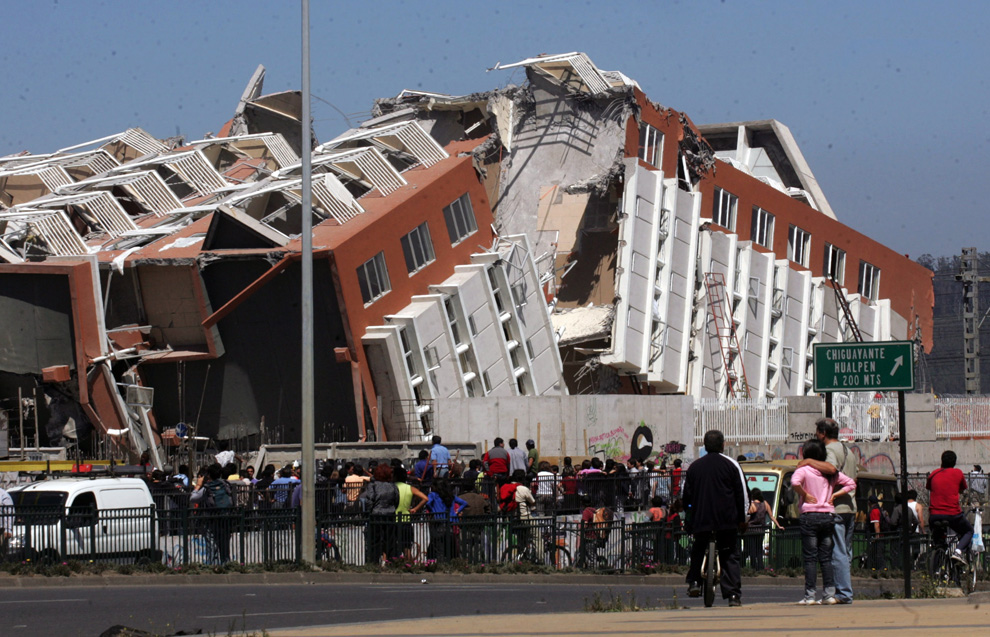
Concepcíon, Chile. Photo: Boston Globe
Given the lack of food in some places, the Army has been “assisting” (with full government backing) the organized “looting” of supermarkets, insisting only that people not grab things like televisions and stereos. People seem to be heeding President Bachelet’s call to conserve, but not hoard essentials like cooking gas until regular supplies can be resumed.
Still, things are not normal, and there remains the dirty work of digging out. Mexico’s favorite real-life super-heroes, the Mole Men have just returned from Haiti, and well-deserved thanks of the nation from the Chamber of Deputies (which also took the time to issue an official thanks of the nation to Sophía the corpse-sniffing dog) as did the Federal District Assembly on behalf of the Mole-Men’s hometown.
You think they’re going to sit back basking in the glory? Think again. Super-heroes don’t get a day off.


 mexfiles.net