Carnaval — Con fervor patria
I hadn’t really planned on a pre-Lenten fast, but my gastro-intestinal system and I have been at odds the last couple of days. Whatever was the source of the dispute seems to have passed (and passed, and passed) and — fortified with a couple of shots of Pepto-Bismol with a side of Pedialite — I managed to make the Carnaval parade. I always figure that with the tourists amusing and bemusing the Mexicans the rest of the year, Carnaval is the occasion for the locals to pull out all the stops and amuse the foreigners, and figured it was my duty to reconnoiter the event and bring back a report.
Well, yeah… this year, with it the independence bi-centennial/revolution centennial and all, it had a historic theme. Mexican history being an on-going affair, it wasn’t the conquistadors with their kumbia music, or the techno-pop boogying peruked 18th century ladies and gents that drew the loudest cheers, but the contingent representing the continuity of historic trends into our day… specifically, screwing over campesinos: in this instance locals losing their land to a dam (or maybe that’s “damn dam”) being built, ironically enough, in good part because the tourist trade has overtaxed the water and electrical systems here.
Of course, being a “history themed” parade and all, there were things like Conquistadors accompanied by Kumbia, and peruked 18th century ladies and gents dancing to techno-pop. And some lively grannies, decked out in “native costumes” who can still shake a leg when they want to. And, of course, the brewery float spelled it out — and the lads and lasses were giving their all, with great and patriotic fervor.

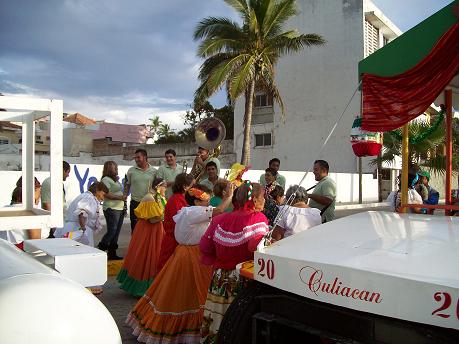
These grannies are just helping the band warm up

Az-technical adjustments

The warm-up protest to the parade protest. Hope they took first prize.

The Inquisition never looked this good before

See, it's patriotic

And features patriotic youth
Get out of town!
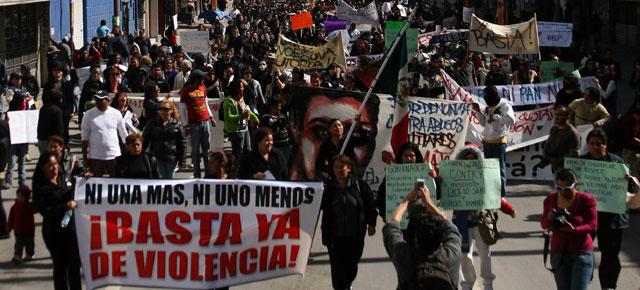
Led by Luz Maria Davíla (holding the large banner on the right), citizens of Juarez took to the streets to demand the army be retired from the streets, as well as the resignations of the city’s mayor, the state governor and Felipe Calderón. (Photo by Rubén García, Jornada)
Davíla, whose 19 year old and 16 year old university student sons were among the victims of the Juarez massacre, was among the family members PRI officials called on last week, not — as the families expected — to offer consolation or information about the crime, but rather to offer the party’s “assistance” in obtaining visas to live in the United States!
“Don Quixote” in a comment on a recent post about the Juarez Massacre told about a family friend who — tired of the shakedowns (in his case by the Army) moved his business across the river into El Paso. As “Don Quixote” himself noted, it’s a story I’ve heard time and time again. If I were of a conspiratorial frame of mind, I’d think that the “powers that be” are hoping to cleanse Juarez, and other border communities, not so much of criminals but of the educated middle class.
Speaking the languages Americans won’t
Laura Martinez (who has moved to fancier cyber-digs over in Chicago — change your bookmarks for the best in snark a la Mexicana) on yet another social problem the “hispanics” are unleashing on the United States. Native students — having grown up with one language — are unfairly handicapped when it comes to getting high test scores in other languages.
¡Qué barbáro!

Meow mix — Friday night video
Nothing really to do with Mexico but I had to put up this video of a performance by the Escolanía de Montserrat. The world’s oldest boys choir in existence (going back to the 13th century), the Escolaía choirboys are students at the school (which will begin accepting girls next year) run by the Benedictine monastery above Barcelona. Given the monastery’s historic role in preserving local culture, naturally the boys sing in CAT-alan.
Space Invaders?
Whatever (or whoever?) it was that crash-landed in Hidalgo State on Wednesday sure made itself known.
Windows were broken over five municipalities in Hidalgo and Puebla States, and a bridge reportedly collapsed following a loud boom and a fiery explosion about 3:30 Wednesday morning. Initial reports said there was a thirty-meter crater, suggesting a meteor had hit the earth. This is a rugged mountain area, complicating emergency response services which were overwhelmed with calls throughout a five municipo region over two states.
But… there doesn’t seem to be any crater, which has led to all kinds of speculation… everything from alien invaders (covered up and naturally a plot involving gringos) to guerrillas (a PEMEX pipeline is near the supposed impact site) to the more mundane explanations that it was either an old Soviet satellite (a Cosmos 2410 to be exact) — a theory favored by AEXA, the Mexican space agency — or a bolide (a fireball which doesn’t actually impact the earth).
Discovery has more, but as always, when it’s from outer space, or just bizzaro and it happens in Latin America, Inexplicata is the only source to turn to.
UPDATE: Inexplicata has tracked down the reports on exactly what it was:
…at 3:02 pm Eastern Time that the Mexican Space Agency (AEXA) has determined that “Cosmos 2421, a Russian naval reconnaissance satellite placed in orbit on June 25, 2006, broke up in February 2008 leaving 15 fragmetns. These fragments were catalogued by NORAD as space junk. An analysis of Fragment 33006 of Cosmos 2421 allowed its reentry to be predicted on February 10, 2010….
And, with a sombrero tip to Inexplicata, here is Mexican news coverage on the “space junk”
.
Dang, I was hoping it was a giant chupacabra. Maybe next time.
Sometimes a stupid notion
The BBC, among many others, have reported on the less-than-cordial reception Felipe Calderón received in Ciudad Juarez yesterday. Protesters were roughed up and arrested by riot police and even those in his audience were hardly in a mood to support what he now claims are “new initiatives” to resolve the sense of insecurity that afflicts the city’s residents.
The president promised improvements in health, education, welfare and infrastructure for the poverty-stricken northern city, but insisted he would not withdraw the 6,000 troops deployed there.
“I’ve promised the parents of the victims that we’ll find a new impetus for the fight against the violent gangs,” he said. “We have to have better co-ordination between the different institutions of government and the police forces to take on this challenge – a fight that we have yet to win.”
But as soon as he finished his speech and opened the floor to questions, the criticism started to flow, says the BBC’s Julian Miglierini in Mexico City.
“You come here one or two years late,” a local leader told Mr Calderon, while a woman shouted: “You are not welcome here.”
All those who spoke expressed their frustration about the level of violence, our correspondent adds.
They also complained about the lack of a proper infrastructure and alleged human rights abuses by the security forces.
The federal government’s perceived lack of efficiency in dealing with the crisis was another major grievance.
The BBC goes in forunderstatement. That’s the British way.
SDPNoticias (the “SDP” is for Sendero de Peje” — Peje’s Way, Peje being a nickname for Andrés Manuel López Obrador) has their own Mexican way of looking at the Calderón Administration. Given that these are people who don’t even recognize Calderón as President, you can’t expect them to be fair… but given the proposal, maybe they are balanced in their presentation. My translation:
Former PAN presidential candidate Felipe Calderón is trying to convince the citizens of Ciudad Juarez that simply by walking the streets and using public accommodations, they will “rescue” the city from criminals.
In his Ciudad Juarez public address, Calderon said that “when people use public spaces, they are rescued from criminals”.
He suggested that using the American football field, and mothers forcing their children to play sports will rescue these public areas from criminals.
Calderon made this statement in response to complaints from a woman in the audience who questioned how using the football field, as proposed by Felipe Calderón, could be considered a “solution” to insecurity about crime.
The address was a response to the recent armed massacre of several youths in their own homes while celebrating a party.
The party was held, ironically, because parents believe the city is too insecure to let their children out at night.
In other words, organized crime figures don’t care where the find people, either in public spaces or in their own homes.
It is worth nothing that prior to now, Calderon had admitted to being incapable solving the problem of insecurity.
¡Lo creas o no!
Via Latinlista:
… schools have made it their mission to be able to have someone on staff who can effectively communicate with the Spanish-speaking parents whose children form the majority in many public school districts across the nation.
It’s a no-brainer to have someone who can speak to these parents and act as the liaison between the school and home. At least, it used to be a no-brainer.
We’re told that was the original intent of hiring Ana Mateo as a bilingual secretary at Devonshire Elementary School in [Charlotte] North Carolina…
So, naturally, Mateo was fired for speaking Spanish at work!
More (non-downloadable clip) from WSOC-TV:
Mateo claims she was reprimanded several times and even told by an assistant principal that she empathizes with parents because “you crossed the border just like them.”
Within a month of the alleged new rule, Mateo was told the school accepted her resignation, even though she says she never offered to resign.
The former secretary filed a complaint with the equal employment opportunity commission and it responded eight months later by saying there is evidence that supports Mateo’s allegation.
El mega-crimen de Padre Onésimo
Federal District prosecutors failed in their attempt to obtain an arrest warrant for Onésimo Cepeda Silva. Cepada is suspected of having defrauded the late Olga Azcárraga of 130 million DOLLARS worth of fine art six months before her death in October 203.
The evidence against Cepeda includes a promissory note for a “loan” of the art works (including works by José Clemente Orozco, Frida Kahlo, Diego Rivera, Rufino Tamayo, Joaquín Sorolla, Marc Chagall and Modigliani) which he then appropriated as his own property.
The judge agreed with prosecutors that a crime has taken place, and that Cepeda is involved, but the degree of his culpability is in question. The judge has referred the matter back to the Prosecutor for clarification of the charges.
Olga Azcárraga owed her tremendous fortune to her family business… she’s was the matriarch of the filthy rich clan that owns Televisa, the telenovela people. Perhaps the family could recoup some of their loss by serializing their own story… about a seemingly saintly figure worming his way into the affections of the rich matriarch. That’d be believable, but they might have trouble with foreign serial rights (which is what has made telenovela’s so immensely profitable, allowing the family to have a few million in Modiglianis sitting around) because much of the drama revolves around a sticky and odd quirk in Mexican law: clergymen can only receive an inheritance from a near relation — mostly to prevent “telenovelesque” (if I can invent a word here) situations where rich old ladies are defrauded by their spiritual advisors. Which Cepeda was to the late Ms. Azcárraga.
I’m not sure how you’d fit it in, but I suppose if you also want to sell the broadcast rights to Christian Broadcasting Network, you might do something with our soon to be incarcerated villain’s name. Onésimo (“Onesimus” in English) shows up in Paul’s Epistle to Philomen, run-away slave and thief. And, for the Catholic run Eternal Word Network, you might add in that St. Onésimo is the patron saint of a good reputation.
Ah, we can work out the minor details, fudge the nuances and skip the irony… and still have one hell of a great scandalous tale. Cepeda is not just any man of the cloth, he is the Bishop of Ecatepec.
If the prosecutors can’t nail him, and the judge can’t quite bring himself to arrest His Grace for a crime, there’s something else to consider about defrauding an old lady’s rich relations.
Familiarity breeds tolerance
Esther (From Xico) has been experiencing technical difficulties with her website the last few days (please stand by). She hasn’t been able to put up the links to the original sources or go back and correct typos. But there’s enough information in her post for anyone who wants to do a little digging and confirm her data (or seeks to discredit it).
A December 2009 Consulta Mitofsky survey of attitudes towards abortion suggest one reason the wave of anti-abortion state laws passed by State Legislatures in light of the legalization of the procedure in the Federal District (and subsequent ruling by the Supreme Court upholding the District law) are unlikely to remain on the books very long. The better educated one is, the more tolerance one shows. And, the younger one is. Both unremarkable, but one finding that is rather eye-opening is that nearly 2/3rds (62.6 percent) of those surveyed in Central Mexico (the Mexico City environs) support legal abortion. Familiarity breeds tolerance.
I though of that this morning, when I was reading about a former federal prosecutor, Diego Valadés Ríos, now a law professor, urging his former employers NOT to go ahead with a planned challenge to Mexico City’s same-sex marriage bill. Valadés is concerned that the reaction outside the Federal District will be similar to what happened when the Federal District’s abortion law passed constitutional muster. Twenty-one states changed their state constitution to specify that “life begins at conception” and he expects legal homophobia (probably something along the lines of the popular “one man-one woman” definitions of marriage in U.S. states) to spring up in the state legal codes.
He is probably correct in that there will be a legal backlash — something I think is going to happen whether there is a court challenge by the Federal Attorney General or not. As I’ve said before, I don’t see the Supreme Court, even with two new more conservative ministers than were on the court when it heard the abortion law, upholding the challenge. But, what is also likely to happen is that — as with abortion — those most likely to be affected or more likely to follow the news are going to be the most tolerant, and the rest of society will rapidly fall into line.
In 2007, 73.9% of the population thought abortion ought to be a crime, but by 2009 only 41.1% of those surveyed held the same opinion. In other words, one third of Mexicans changed their thinking within two years as the issue was openly discussed.
With discussion of same-sex marriage now in the news, public attitudes are probably undergoing a sea change, with younger people (who are most likely to be affected by both pregnancy and marriage issues) and the well educated (with more access to information) leading the way, and those who see the effects of the change (or, rather, the lack of social disruption caused by the change) the first to embrace what, as for today, is defended only on the grounds that the people don’t like the idea. Maybe that was true only because the people weren’t really asked to think about it before.
Mexico’s Winter Olympics Team

Team Photo: Sayn-Wittgenstein Collection, Austria
Team captain, mascot, flag-bearer and pivot man on the alpine ski team (ok… the whole danged Mexican contingent) is Prinz Hubertus zu Hohenlohe-Langenburg. Ok, he’s got a weird name for a Mexican jock — unlike, say Cuauhémoc Blanco or Zudikey Rodríguez or Alfredo Xeque. “Prinz Hubertus” may not roll off the tongue as easily, but he’s as Mexican as they come.
The Hohenlohe’s weren’t all that different from other Germans who fled the Nazis for a secure new life in Mexico. Ok, so they left a castle behind, but c’mon, they still were expected to fit in and get a job and get on with their lives. Like immigrant families in Mexico before and since, the Hohenlowes eked out a living based on what they brought from the old country and adapting it to Mexico. Although, I admit, families that drop Prinz or Prinzessin in front of their names aren’t exactly the eke-ing kind, they at least did have to dirty their aristocratic fingers with proletarian commerce.
Like Jorge Tabe, the humble Iraqi food vendor of 1930s Puebla, whose native “donkerrey” became thoroughly Mexicanized as tacos al pastor within a generation, the humble little Volkwagen bug the Hohenlowes started selling in the 1950s (and then manufacturing), in Puebla were, within a generation, an iconic Mexican product.
Asked about the Mexican Winter Games budget (zero pesos), Prinz Hubertus said, “taking about money is so vulgar.” Come to think of it, even not-filthy rich Mexicans DON’T talk about money in public. It IS vulger. Besides, the guy has sufficient resources. His own, and from “sponsors” — a word he said in English. Dropping English words, is also very Mexican, at least for a “junior”.
A “junior” is a guy from a rich family — which Hubertus certain is — not a youngster. They’re usually dicks, but pretentious (and usually mispronouned and misused) English words and all, they’re Mexican dicks.
Hubertus is fifty-one years old and has bad knees. It’s all downhill from there, but he’s a skiier, anyway. Anyway, Mexicans respect age, and tend to disregard little things like physical limitations when they take on a job, and there’s something unMexican about retiring early.
And, then again, so is working abroad — there’s not much skiing in Mexico, so Hubertus has been training in Finland, Lebanon and Canada. ¡Muy Mexicano!
The war is dead, long live the war
A lot of attention has been suddenly focused on the “new” statistical data showing that the homicide rate in Mexico has dropped (and dropped dramatically) over the last several years… in spite of the so-called “drug war”.
It is certainly true, as the Washington Post reports that:
Mexico’s homicide rate has fallen steadily from a high in 1997 of 17 per 100,000 people to 14 per 100,000 in 2009, a year marked by an unprecedented spate of drug slayings concentrated in a few states and cities, Public Safety Secretary Genaro Garcia Luna said….Mexico City’s rate was about 9 per 100,000 in 2008, while Washington, D.C. was more than 30 that year.
Most of the actual decline, as noted by Patrick Corcoran (Ganchoblog) is due to a decline in violence in Mexico’s rural south:
… throughout Mexico’s southern region, rural killings have dropped off the charts since the 1990s. Given that the degree of the decline is such that a five-fold increase in drug killings in three years is more than offset, this is rather remarkable, a mini-Mexican miracle in the midst of the anarchy in Juárez and widespread violence across the North and in much of the interior of the country as well. I suspect that much of that is unrelated to Marcos, but I’d love to see a deeper explanation.
I offer no explanation, but note two additional factors that make these statistics worth more study.
First, as Malcolm Beith reported yesterday,
… the government, realizing it cannot possibly stop drug trafficking completely (both Eduardo Medina Mora and Genaro Garcia Luna admitted this in the past year or so) has been seeking other ways to frame its apparent quest for a more stable and democratic Mexico. It has decided to go after organized crime.
“Organized crime,” as Beith reports government sources saying, is human trafficking. There is validity to attacking “human trafficking,” but given that one unstated reason for the huge decline in rural violence has been rural migration. Young men without a good economic prospect are the most likely to resort to violence. Young men without good economic prospects in rural Mexico migrate, using the “services” of human traffickers.
Certainly, the “drug war” has occupied much more of the Mexican social and political consciousness than it needed, and been a drain on resources that could have, among other things, ameliorated the conditions that make rural migration (and drug smuggling, for that matter) viable. But, just redefining the “causa belli” as “human trafficking” doesn’t seem to jive with what the government officials are actually telling Beith.
As they change the war on drugs to the war on organized crime, the authorities are also changing their definition of the war. As one former PGR guy tells me, it’s all about how you look at it. (He refuses to call Mexico’s current state a “war” by the way.)
The authorities are starting to look at organized crime through a new paradigm. Instead of thinking of the enemy as crooks, and trying to put them in jail, the government is going to increasingly look at organized crime as a business. Not an illegal business, but as a business.
This is a policy I favor, and I don’t knock it. I’ve categorized “drug” posts under the “informal economy” tab in my index for some time. Still, I get the sense this is basically a Hail Mary pass. From the beginning, many have asked if the “war’s” entire raison d’etre wasn’t to neutralize questions about the administration’s dubious electoral legitimacy , and — incidentally — to weaken opposition to PAN. The result has been the opposite: PAN badly lost the 2009 legislative elections not just because voters tend to “punish”· the party in power during an economic downturn, but because of popular discontent with the “drug war” and the obvious heavy-handed attempts to paint opposition parties as mobbed up”; and the chances of PAN retaining the presidency in 2012 look increasingly dim.
But, never having defined a strategy, or a clearly obtainable goal, I suppose better late than never. If we must have a war, we need one with a relatively decent chance of success.
— More later —
If it bleeds, it leads
I admit, I don’t care for British journalist Ed Vullimy’s reportage from Juarez. From a 4 October 2009 article in The Sunday Observer (U.K.) one reads:
Next morning the courtyard was still full of the bittersweet stench of fresh blood congealing in pools. The killers threw a grenade into the first room on their right, occupied by a 16-year-old guard. They had soaked up his blood into the soles of their boots and stamped it around in footprints that anyone who cared to might examine. But no one did care to.
This is blatantly manipulative, and — while “bloody good” for a nota roja — misleading. One would expect blood and guts splattered around when a doorman (not a “guard”) is blown up by a hand grenade, and I assume he’s saying no one was searching for clues at the scene of the crime, when he’s actually saying he did not observe anyone searching this particular clue. Or, perhaps, that emergency response teams weren’t CSI guys… or just tugging our heartstrings.
In the Sunday Observer article, he claims “The quantity of drugs smuggled across the border is now dwarfed by that to supply catastrophic domestic addiction.” Addiction rates in Juarez are higher — much higher — than in Mexico as a whole (so is the murder rate, if we go by the official population figures), but from Vullimy’s writings for The Observer and The Guardian, one has to assume ALL narcotics are smuggled through Juarez, or that the Mexican drug user rates is anywhere near that of Juarez (and the United States).
As to the latter, Vullimy’s articles are valuable for their look at this particular “niche market” which is responsible for the out of control violence we’re seeing in pockets like Juarez and Tijuana. Places like Juarez, I’ve suggested before, are — while very much part of the “real Mexico” — also atypical in their demographics. They are literally “frontier towns” with a large floating population skewed towards the young and rootless… the kind of population where violence is more common than elsewhere. And, where drug use might expect to be higher (for all we know, given the problems with an accurate demographic portrait of a community that includes a high percentage of temporary residents, or people who have no intention of staying in the community, it might be within the same parameters as the general Mexican population).
Vullimy’s latest article, “Killing for Kudos — the brutal face of Mexico’s 21st century war” is an extended essay on the assumption that the “war” is about control of the domestic market. As I said, I question the premise, but “Killing for Kudos” is worth reading — not for banalities like the unsurprising factoid that criminals are ethically-challenged people motivated by status (aren’t most people?) and material gains — but for the reminder that:
Some would argue that all wars are fought indirectly over money and resources – be they 19th-century wars of empire, or of ideology or religion in the 20th century. But Mexico’s war has no ideological pretensions or window-dressing – its only cover is that it was originally fought, like other, lesser, mafia wars, over now diversified product lines that get America (and Europe) high.
Forrest Hylton, a Bogata academic and widely published writer concentrates on one “product line”, and one more associated with his own country, the the essential “The Culture of Cocaine“:
Cocaine is a central commodity of the neoliberal age; so, too, its re-processed form (“crack”) for the desperately poor in de-industrialized cities of the North and South Atlantic. First announced by Richard Nixon in 1971, the “War on Drugs” predates the rise of cocaine and crack by nearly a decade, but, in the 1980s and ’90s, the “War on Drugs” was redoubled in response to the explosion of the cocaine business. It now ranks as the U.S.A.’s longest running military-police campaign. Thus, if we look at cocaine as a social hieroglyph – not as a thing but as a complex relation between networks and organizations of people, as well as between states and bureaucracies – we may glimpse some of the distinguishing features of the contemporary world.
One doesn’t have to be a lefty (and Vulliney’s work appears for the “leftist” The Observer and Guardian) to recognize that there are indeed ideological reasons for the Juarez “drug war”. Just not directly:
The logic driving the War on Drugs has been chiefly ideological and political, not economic: domestic politics in the U.S. have determined policy abroad. One of the defining policies of Cold War liberalism, President Johnson’s War on Poverty – which had less than one-tenth of the lifespan of the War on Drugs – took for granted that federal and state governments should take responsibility for improving the plight of the poor in northern cities and represented a semi-coherent response to African-American riots and insurgencies. But what if poor black people in cities could be held responsible for their poverty? What if, as industrial jobs disappeared by the millions, they became addicted to selling or consuming illegal drugs, produced and/or distributed by U.S. government allies in Cold War counterinsurgent campaigns? Then African Americans could be locked up for nonviolent drug offenses and warehoused in prisons at an accelerated rate.
…
Such is the domestic context, without which it is impossible to make sense of U.S. foreign policy in producer countries in the Andes (Colombia, Peru and Bolivia) and transport countries in Mexico, Central America and the Caribbean (leaving aside Brazil, whose government does not respond to U.S. pressures).
Hylton reviews the history of the “drug wars” as they have moved from the Andes to the U.S. border. Narcotics are a commodity, and — as with any commodity — going to be exported or consumed locally. The producers (Hylton is talking about cocaine, which isn’t produced in Mexico, but the same can be said about opiates and marijuana) and transporters don’t have the same issues as the consumers. I don’t see the consumer demand Vulliney does anywhere outside the border regions, and — like Hylton — note that Latin American producers and transporters have been responding to consumption with non-violent alternative methods of control (legalization of personal use, and more rehabilitation). How the consumers deal with it is another issue entirely:
Rusty, a former narcotics officer for the Department of Corrections in Arizona: “When I talk about legalizing drugs, people say, ‘you can’t mean heroin and crack, right?’ But after 30 years of the drug war, spending a trillion dollars … the bad guys still control the price, purity, and quantity of every drug. Knowing that they control the drug trade, which drug are you going to leave under their control? Regulation and legalization is not a vote for or against any drug. It’s not about solving our drug use problem. It’s solely about getting some control back.”
“They” refers to drug barons, many of them large landowners, as well as warlords, in Colombia, Mexico, Afghanistan and Pakistan, but the problem with Rusty’s analysis is that U.S. government allies in such countries – the intelligence services, the judicial systems, the military and police, business and political elites – are either complicit with or directly involved in supplying U.S. and European markets with cocaine and/or heroin, generally in order to finance counterinsurgency wars.
Juarez’ problem is only incidentally related to consumption. It’s more colorful, and more like to sell books when one talks about shootouts and writes of blood and gore in loving detail. But the issues — agricultural policy, market control, and but — overall — even if we don’t completely accept “Rusy’s” analysis, that the consumers expect the producers and transporters to handle the problem — and pay with their own blood.
There’s some atavistic thrill in reading people like Vulliney, and for a superficial look at the issues, it has some value, but it gives no real understanding of the “drug war”. For that, you need people like Forrest Hylton.


 mexfiles.net