Movin’ on up… why?
Having promised to come up with some sort of response to demands that the State of Chihuahua do something… anything… about the security problem in Juarez, the state goverment has decided to (at least temporarily) move the Governor, state legislature and judiciary to Juarez.
I don’t see that the move particularly does anything to bring down the violence, and I imagine the funds needed for things like office space and moving vans and rentals could be spent in some other fashion, but this should have an positive impact on one sector of the Mexican workforce. Moving politicians closer to the crooks is a boon for comedy writers.
Sunday Readings 7 February 2010
Disunited Nations
Paul Roberts (Living and Working in Mexico) had a “relaxing” vacation in Peru, getting himself stranded at Machu Picchu during the recent flooding. and lived to tell the tale very well indeed:
Every nationality behaved in somewhat characteristic ways. The Brazilians and Uruguayans organized football matches with the local kids. The Argentinians almost rioted but also led the organizing process. The Chileans were super-super-organized with different people assigned to be responsible for food, accommodation and health. The English deigned to get themselves organized. The Mexicans left a big Mexican flag in the Plaza with a note for people to write their names. The names appeared but I never saw anyone there. The American government was said to be providing four small helicopters for just American folk. It was rumoured that when the committee of delegates from each nation were meeting and rejected the idea that these helicopters should only be for Americans, then the Americans never participated again in the meetings and did their own thing. The Australians celebrated Australia day on Monday 25th January and it was said there was no more beer left in the town the following day.
Distant neighbors
Esther (From Xico) has been more supportive of the U.S. President than I have, but even she has her limits:
There is no doubt in my mind that we are extremely fortunate that Obama, not John McCain is president. What we have in Obama, so far, is a president who is far from perfect but who lives in the real world. But I am no longer so favorably disposed to him. While his administration has done some really good things (see the FDA) he is a president who nonetheless deserves much criticism — what president wouldn’t under the current circumstances? What an impossible job! Nonetheless, no one told him he had to run for the office, so he should listen to the advice of others, especially when it comes to sources more informed than those who surround him.
The area of criticism that most interests me is how he and his administration are dealing with Mexico in three areas: e/immigrants, the trans-border drug situation, and trade. He is certainly showing no hint of enlightenment in these areas. I would be very interested to know if he is getting any information from his ambassador to Mexico, Carlos Pascual, a man who may know better than the people in Washington. I’m going to see if I can find any information on how Pascual has been doing his job.
Displaced persons
Clemens Höges (Speigel Online International) profiles Haitian seismologist Claude Prépetit, agronomist Bernard Etheart, who both independently see an opportunity coming with the latest tragedy:
“We cannot invest a cent in Port-au-Prince; it would be a waste of money,” says Bernard Etheart. “We can’t afford to lose everything once again. We must take advantage of the opportunity we have today.”
…
We cannot rebuild Port-au-Prince the way it was built before. We will have to resettle a lot of people, and we have to start thinking about other cities.” [Prépetit] wants to develop a new seismographic institute, but that will require prompt assistance from foreign experts. Prépetit cannot possibly accomplish this task alone.
At some point, the government and the parliament will have to decide whether to stay in Port-au-Prince. “We must consider the pros and cons,” says ¨[Public Works Minister Jacques Gabriel]. If the capital was in the interior of the country, he argues, “we would lose our direct contact with the port.”
Is it even possible to simply abandon a capital? Wouldn’t it be preferable to rebuild, using lighter materials and safer construction methods?
President René Préval is familiar with Etheart’s plan. The two men are old acquaintances, but the president is still skeptical. He calls the former professor “Dessalines,” a reference to Jean-Jacques Dessalines, once of Haiti’s liberators. In 1803, he defeated the French colonial masters with an army of escaped slaves, who eventually founded their own country. Dessalines made his capital at Marchand, a small town in the country’s interior.
Dessalines, who later proclaimed himself emperor of Haiti, using Napoleon as his role model, was murdered in 1806. Today, his statue stands in front of the ruins of the presidential palace in Port-au-Prince, which his successor turned into the capital.
Of course, the earthquake could also help Etheart press forward with his dream of major land reforms. The government is already sending thousands of people to rural areas. Initially buses and trucks left the chaos of the capital on a daily basis, transporting passengers to the countryside at no cost. The only catch was that no one was given return tickets. But now very few city residents are taking the government up on its not-too-subtle resettlement offer.
Dis-sention in the Church
Jason Dormandy (Secret History) a standoff between the congregation and their priest in one Mexican parish:
Catholics living on the edge of Toluca in San Cristóbal Huichochitlán are upset. It seems that somebody has been missing their history lessons on the Catholic Church in Mexico, and the priest in the area tried to mess with the customs and traditions of the congregation: He wanted to appoint his own fiscales and sacristanes. To put it in twenty-first century terms: Doh!
El Sol de Toluca has been covering the story since December, and it looked like the conflict might be coming to an end at the start of January. However, the priest with the backing of the bishop of Toluca has closed the church and moved to another chapel entirely.
So who cares? Well, aside from the folks in San Cristóbal Huichochitlán, this a great reminder of why the population of Mexico has a tradition of being Catholic and anti-clerical…
Adios, Chunko…
The headline in El Universal says it all:
El PRD expulsa a diputado racista
Federal Deputy for Chiapas, Ariel Gómez León, whining about his party’s request that deputies give up one day’s per diem of their already outrageously large daily allowance (which is on top of their over-the-top salary) to a Haitian relief fund, made a racist joke during his other job as a “talk-jock” radio host.
Threatening him with sanctions, it was suggested he pony up the donation… which he did… making the usual abject apologies stupid politicos are supposed to make on such occasions. And then — after letting him grovel — the Party purged him anyway. Within the Chamber, they’re trying to come up with some reason to throw him out, even sort of cheering on an investigation into election day hanky-panky from the state prosecutor’s office. Too bad there isn’t a good Mexican Spanish version of the old Texas saying, “don’t let the door hit ‘ya, where the Good Lord split ‘ya”.
The PRD may be form a common front with right wing PAN in several states, and it has its share of dubious associates, and a few outright crooks, but some folks are pendejessimo to the point where even Mexican politicians won’t put up with them.
¡Perdon!
One of the great paradoxes of Mexican culture — one of the politest people in the world can are also some of the biggest potty-mouths on the planet.
Protectionism for the U.S. tourist industry?

(full article at Raw Story)
Apparently, the U.S. government is saying they have the right to kill “suspected terrorists” living abroad, even if they are U.S. citizens.
I haven’t checked my renters’ insurance to see if it covers drone strikes or missile attacks, and don’t think I’m a “suspected terrorist” but what’s scary is that people think this is a good idea. What’s “suspected” anyway? (For that matter, what is a terrorist?) I suppose I suppose by this logic, the Cubans should start bumping off a bunch of geezers in Miami — some of whom are more than “suspected” terrorists.
And, Mexico would be justified in sending hitmen to do in your friendly neighborhood bank executive, who is laundering the money that keeps our “exporters” — sometimes called “terrorists” in business. And, of course, gun dealers.
And, on the other hand, there are some annoying gringos living abroad.
Holiday in Mexico
Sometime yesterday or last night, the Mex Files, on this wordpress platform anyway, received it’s millionth hit. Actually, counting “mexfiles.blogspot.com” and “mexfiles.wordpress.com” and “mexfiles.net” the the million mark was last week. But, hey, it’s Mexico and any excuse for a holiday will do.
The plot line of this MGM extravaganza has Jane Powell as the U.S. Ambassador (Walter Pidgeon)’s daughter, trying to get daddy’s attention and win the boy (Roddy McDowell) by pretending to be carrying on a romance with her music teacher (José Iturbí… in the role of “José Iturbí”). Somehow in there, the Ambassador’s birthday party is the excuse for some over the top musical numbers (with gypsies, chihuahuas and Xavier Cougat) and, in a small role, the first American president to have been a Hollywood actor before starting his political career (yeah, I know Dominican President Rafael Trujillo was in Casablanca, but he was already President by then). I mean, of course, the “great communicator”, Fidel Castro.
Collateral Damage
Ouch!
The Federal Prosecutor refuses to get involved in the investigation, and reports that neither the Army (which is supposedly protecting Juarez citizens) nor National Police responded to the massacre, and attempts to claim the kids were somehow tied to organized crime (earlier this week it was said one was a police informant… maybe he changed sides?) with still other other reports that the supposed leader of the killers just conveniently was killed by the Army last Monday, and then more reports that it was a former ministerial policeman that ordered the hits,, the victims’ families are blaming Felipe Calderón personally for the policies that have led to the tragedy.
Now that they are also receiving threatening telephone calls as a result of their victimhood, some are going so far as to demand assistance from the United States against their own government.
And… in a quick update (via Ganchoblog) , four witnesses (and survivors) of the massacre were abducted by people who either were Ministerial Police, or — as Excelsior claims — “disguised” as police. I smell “death squads”.
Workers’ Party delegate Gerardo Fernández Noroña may be going a little further than many in his address to the Chamber of Deputies, but the feeling is growing that the “drug war” has been a cruel hoax on the Mexican people, and they are angry.
A word
I really didn’t expect to write a second wonkish post on Mexican constitutional language in one week, but this just snuck up on me.
Sailing though the Constitutional Issues Committee of the Chamber of Deputies by a lopsided margin of eighteen to five, was a one word change to the Mexican Constitution which may have a major impact on politics, law and social change in this country.
Article 40 now reads:
Es voluntad del pueblo mexicano constituirse en una República representativa, democrática, federal, compuesta de Estados libres y soberanos en todo lo concerniente a su régimen interior; pero unidos en una federación establecida según los principios de esta ley fundamental.
(It is the will of the Mexican people to organize themselves into a federal democratic, representative Republic composed of free and sovereign States in all that concerns their internal government but united in a Federation established according to the principles of this fundamental law.)
The additional word is “laica” –officially defining the nation as “a secular federal democratic, representative Republic…”
That Mexico is a secular state, with a strict separation of church and state (and clear restrictions on the activities of religious bodies outlined in Article 130 of the Constitution) is a given in most circumstances and the word “laica” already appears in regard to the right to a “free, secular education … based on scientific progress, struggling against ignorance and its effects — servitude, fanaticism and prejudice” (Article 3). So adding the word “laica” to Article 40 isn’t that big a deal, right?
Think about it. When the Federal District legalized abortion enough states added “life begins at conception” clauses to their state constitutions to make it a eligible for inclusion in the Federal document. After passage of the Federal District’s same-gender marriage bill, there was every indication that both PRI and PAN hoped to benefit electorally from polls that showed wide-spread dissatisfaction with the bill.
In both the abortion and same-gender marriage issue, opposition is largely based on religious values and traditions, not on neutral secular concerns like medical practice or contemporary social conditions. In effect, the change would short-circuit attempts to cut off these reforms and make legal challenges based on subjective criteria (even when the majority holds the same opinion) more difficult.
I’m not at all surprised that every PAN member on the Consitutional Issues committee voted against the change. What does surprise me is that everyone else — the usual leftie suspects (PT and PRD) as well as every PRI member (and the lone Green) — all signed off on the change. PRI has been traditionally anti-clerical, but has been supportive of the church in areas (like Jalisco) where the clergy can still swing votes their direction. I can’t explain it. Certainly, there are “progressives” in PRI and, lately, PRI has been trying to distance itself from the PRD sneer that they are part of PRIAN (PRI-PAN presumably one and the same). It could be that, by backing the PRD in what could become a controversy with PAN, they hope to put the kibosh on the PRD-PAN fusion tickets in the PRI-dominated states.
Or, it could be, the Constitutional Issues Committee sees that it is the will of the people to organize themselves in a secular … Republic.
Don’t ask, don’t make out in the barracks
With the United States finally coming to its senses, and realizing that gay soldiers have been around as long as there have been soldiers, maybe it’s time to review the rules of military conduct for soldiers and sailors and air(wo)men here in Mexico.
While, as Christian Rea Tizcareño wrote in October 2007 for Letra S (my translation)
At present homosexuals in the armed forces of Mexico are anonymous and unquantifiable. Official pronouncements and military law does not take homosexuality into consideration, and the silence contributes to evading federal laws against discrimination. The hierarchy and hyper-masculinity that dominates military culture minimizes, excludes and is pejorative towards emotional attachment between persons of the same gender, while barracks life is rife with overlooked homoerotic expression…
… it’s equally true that what’s considered “gay” by officialdom is — as in a lot of countries — effeminacy. Mexican military people, like military people everywhere, try to go with the “kick ass and take names” image, and sometimes to resort to “filters” based on stereotypes. While of course there are “kick ass and take names” gays, military organizations are huge bureaucracies, and not every task requires Rambo. As one officer put it, “Look, we know the cook is a screaming fag … but everybody appreciates his cooking.”
In other words, if you are a “straight acting” healthy, well-knit gay lad — and are drafted (and Mexico has compulsory service) — you’ll probably not be a cook or a medic or a clerk — and, likely as not, just as appreciated or unappreciated as any other soldier.
I can’t speak for the Mexican soldier, but it doesn’t seem that the gay soldiers are in hiding. The very model of the macho Mexican soldier, Porfirio Diaz, had a villa in Cuernavaca villa that is a dance club now. It’s kind of an elegant place … attracting juniors, students and artsy types, as well as its intended clientele, gay men. And, being straight directly across the highway from the military base, it is full of soldiers on the weekends. They’re not all with girls, and guys don’t go on their own to gay bars looking for girls… and they are seen… and nobody seems to be upset about it.
Same thing with the gay clubs in Veracruz, but that’s a Navy town.
Anyway, it’s not a major factor in Mexican military thinking. The Army used to boot out HIV-positive servicemen (which is not necessarily an indication of sexual orientation), but that practice was ended by the Supreme Court in 2007. As it is, the only sexual restrictions on same-sex activity in the Mexican military code is that one can be busted in rank for moonlighting as a prostitute (given the low pay for the rankers, a bigger temptation than one might think) and nookie in the barracks can get you a day in the brig.
Notes from the underground
Talk about bringing services to those below! The first of the Metro “Cibercentros” opened last week in the Zocalo Metro Station. Additional Cibercentros are being placed in Delegacion offices and public libraries.
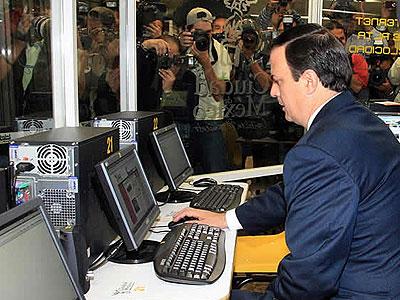
Photo: El Economista
While these are bare-boned cyber-cafes (minus the cafe part), the Cibercentros will be offering courses and training workshops for computer users, broadband Internet access, printing, faxing and document scanning, user support to small businesses, a job bank… and will help you with your homework!
While 25 computers per cibercentro, there may not be adequate equipment to meet complete demand, and I have a slightly troubling vision of tourists hanging out sending emails (or watching porn) while local kids are waiting to do their homework, it’s a good start.

What would Richard Nixon do?
Otto Guevara, the candidate for the right-wing “Libertarian Movement” in Costa Rica’s presidential elections (next Sunday), took a lie detector test on national television. He passed (or at least he did on TV, and that’s reality, right) when asked “Have you profited in any way while carrying out your duties for which you could be legally charged?” and “Have you lied to the media during your election campaign?”
Alex Leff, the on-line editor of Tico Times, writes in Americas Quarterly:
Guevara replied “No” to both, and the machine gave him a green light—Canal 7 told viewers he was telling the truth. The front-runner in the campaign, National Liberation Party’s (PLN) Laura Chinchilla, refused to participate in the televised interrogation. Guevara is in second place in the polls, hovering at or under 30 percent. Not to miss the opportunity to capitalize on the polygraph test, he bought a two-page spread in national newspapers that boasted he is the only honest candidate in the race.
This was partly an attempt to dispel controversy that has boiled over in recent months about the questionable source of the cash the Guevara campaign has been shelling out for propaganda, which reportedly had surpassed $1 million by December. Fingers even pointed at Ricardo Martinelli, Panama’s president and probably the region’s only standing libertarian, as a possible donor, an allegation which Guevara denies.
Couldn’t he just say “I am not a crook” and been about as believable?
Don’t ask Felipe Calderón and don’t tell the Supreme Court
In Tokyo for mettings, Felipe Calderón was asked about the claims that his Administration’s legal challenge to the Federal District’s new gender-neutral marriage law was politically motivated.
Of course, it’s hard to say it isn’t, but Calderón gave it his best shot, claiming it was simply a matter of defending the Constitution, which — he says — specifically defines marriage as being between a man and a woman.
Is there a secret article in the Constitucíon Politíca de los Estados Unidos de Mexicos that I missed? I admit, I only looked for the words “mujer”, “hombre” , “boda” and “matrimonio” but the only mention I can find of marriage in the constitution is in Art. 30, Section B-II, which allows the state to regulate the naturalization of foreign residents, male OR female who marry a male OR female Mexican citizen.
Either the Prez is trying to get everyone to study their constitution or he’s full of FeCal matter.


 mexfiles.net