Convergent interests?
49.4% of the 56,065 city and state police officers, as well as the new entrants to the Federal Preventive Police who were evaluated this year turned out “not recommended.” Breaking that into separate data, the President said that 26,163 members of city police agencies were examined and 61.5% resulted in being “not recommended.”
The reply to the Congress did not explain what happened to that percentage of agents.
Of the 11,276 “integral evaluations” of the new entrants program of the Federal Preventive Police, 51.3% were graded as “not recommended.” Likewise, the areas of the country with the highest percentages of “not recommended” results are Zacatecas (70.7%), Coahuila (69%) and San Luis Potosi (64.7%).
The evaluations were made by Mexico’s Department of Justice.
LIMA – Mexican traffickers are invading Peru’s cocaine trade, so President Alan García said Thursday he is inviting Mexican police to come and help battle them.
“We have a growing influence by those cartels,” García said, “and what we want is to help Mexico and help ourselves with this direct cooperation, the direct presence of police from other countries that have this problem.”
García said he suggested that President Felipe Calderón send police when the two leaders met last weekend in Lima, though he did not indicate how Calderón had responded.
Synthesis… is it that hard to figure out?

The Brookings Institution better think about the Friday Night Video
Jennifer Rose (“Staring at Strangers“):
The average Estadounidense doesn’t think about what lies south of its border very often, and when he does, he thinks of the border wars, Mexican immigrants, and some nasty business in Colombia, with a taco thrown in for good measure. Even the above-average, well=-educated Estadounidenses, the kind who’re respected by their peers and often even put into positions of great authority, don’t pay much attention to Latin America, tossing off gems like “Mexico doesn’t have a real middle class.” These folks desperately need to rethink Latin America, starting right here at the Brookings Institution’s report on Rethinking U.S.-Latin American Relations. Even if the report is plagued with platitudes, partnerships and dialogues.
You can read through the Brookings Institution’s report if you want to plow through the bullshit. But the problem and solution is much simpler. Benito Juarez defined it (Peace between neighbors and nations is respect for the rights of others) but Aretha Franklin said it better:
Illegal alien invasion!
Rick Casey, in the Houston Chronicle, on a previous wave of illegals in Texas:
Stephen F. Austin, who brought many Anglo families to Texas, is not numbered among the illegals…
He traveled to Mexico City to negotiate a pact under which he pledged to bring Anglo settlers into Texas according to rules set out by Mexican authorities…
He negotiated a generous deal. A head of an immigrant family would get 4,438 acres for farming and another 177 acres for livestock. For every 200 immigrants he or other impresarios brought in they would receive 66,774 acres.
There were a few rules. They had to pledge loyalty to Mexico. If they weren’t already Roman Catholics, they had to convert.
Despite Austin’s best efforts, Henderson says, Anglos came pouring in and most “had no intention of abiding by their end of the bargain.”
Mexican law, for example, stipulated that any slaves would be free as soon as they entered Texas.
Anglo immigrants “elected to assume that this referred only to the buying and selling of slaves and did not apply to slaves brought by colonists for their own use,” …
Some illegals came to escape debts or domestic obligations. Some were simply adventurers.
Some were fugitives from justice, “sporting brands on their faces marking them as miscreants.” (Think gang tattoos, only not voluntary.)
Some of these, not surprisingly, continued their criminal careers in Texas. Colonists who caught them at it considered the Mexican prohibition of the death penalty to be inconvenient and carried out executions.
These immigrants not only entered illegally or violated the terms of their legal entry, but rather than keep their heads down and try to fit in, they lived in active defiance of the law.
So much so that the Mexican government in 1830 passed a law barring all new American immigrants from entering Texas.
Among the illegals violating that particular law were David Crockett, William B. Travis and Sam Houston.
(Sombrero tip to Dos Centavos)
Massive police corruption?
Sounds like police corruption is endemic in this South American country:
Twenty nine packets of cocaine seized by Falkland Islands authorities from the fishing vessel “Ventura” on 30 October 2008 were secured as evidence in a double- locked police cell at Stanley Police Station pending the court hearing.
On 25 November a check of the cell revealed that 23 of the packets were missing.
According to the official release a search of the premises found evidence of one discarded bag and packaging from some of the missing packets….
What percentage of the Falkand Islands police and judiciary do you think are involved? Both of them?
That first Thanksgiving…
Not this one…

The one a hundred years earlier… Turkey, white men and Indians in an uneasy truce, arguments over religion and politics, the dysfuntional family… that all-American tradition didn’t start in Plymouth in 1620, but a 100 years earlier in Tabasco.
Gods, Gachupines and Gringos: A People’s History of Mexico ©2008 Editorial Mazatlan
Cortés had incredible luck off Cozumel. His ships were separated, and Pedro de Alvarado had arrived first. Alvarado, who turned out to be one of the greediest of the conquistadors, was stealing turkeys from the local villages when Cortés arrived. More importantly for Cortés, his crew had found two Spaniards. They were the last survivors of a shipwreck eight years earlier—the others had been sacrificed and eaten. Gonzalo Guerrero, a sailor, had married the local chief’s daughter. He had three children (these little Guerreros are probably the first modern Mexicans, mestizos – mixed bloods – part European and part indigenous), a responsible job as an advisor to his father-in-law and no intention of becoming a common sailor again.
The other Spaniard, Gerónimo de Aguilar, was a priest and carpenter. It was his carpentry skills that kept him alive; they made him a valuable slave. Father Aguilar was more than happy to be rescued. Slavery was bad and the human sacrifice worse,[1] but what terrified Father Aguilar were women. As a priest, he had taken a vow of celibacy and the indigenous people simply couldn’t comprehend a healthy young man refusing to take a wife. Eight years of temptation was enough. He considered his rescuers God-sent. He spoke fluent Mayan and was more talkative than Melchor.
Father Aguilar preached a sermon in Mayan, pouring out eight years of built-up frustration and anger. Though the people had treated their visitors kindly and fed them, the Spaniards insulted their hosts, destroyed the local temple and sailed north. Landing at the mouth of the Usumacinta river (near modern Frontera, Tabasco), they found much warier Mayans—they had evacuated their women and children and cautiously approached the Spaniards, sprinkling incense. The Spaniards thought it was a compliment, but the truth is that Europeans didn’t bathe, and the indigenous people were extremely clean. The Spaniards smelled terrible, but the Mayans were much too polite to say anything about it.[2]
These extremely polite people fed the Spaniards a turkey dinner and then nicely told them to go home, otherwise, regrettably, they would have to kill them. The smelly Spaniards asked to visit the Mayans’ houses. The Mayans, still polite, suggested the Spaniards had missed something in the translation. Cortés trotted out his lawyers, read the official document and turned his cannons against the Mayan stone clubs and obsidian swords. It was only a test to see if cannons, horses and war-dogs were effective weapons. The cannons scared people as much as killed them. Horses were unknown in the Americas, and the only dogs were small animals (ancestors of today’s Xoloitzcuintle – Mexican Hairless – or its offshoot, the Chihuahua) that were used for guard dogs, food and for pets. Melchor, the grumpy old cross-eyed fisherman, took this as his cue to exit history.
[1] When she learned of her son’s shipwreck and his probable fate, Aguilar’s mother became a vegetarian.
[2] Americans, north and south, in general bathe daily—one of the few indigenous customs adopted throughout the hemisphere. In Mexico City, the custom is so well engrained that “bath houses” are just that—places to clean up when there’s no water at home. This confuses some gay visitors, for whom a “bath house” has a different purpose, though such institutions also exist.
Saving the banks Americans can’t
Talk about your “man bites dog” story!
WIth the Bushistas prepared to bombard Citibank with cash (20 Billion — that’s a thousand million to everyone outside the U.S. — greenbacks), mostly to cover the losses from bad loans, mismanagement and over-buying… there is ONE profitable citibank property…
BANAMEX!
 According to a story in Tuesday’s El Universal (my translation):
In 2007, Banamex contributed near 19 billion (thousand-million) Pesos to Citigroup.
In the second trimester of this year, the Mexican bank’s assets were listed at 7,490 million pesos, and in September had mounted to 8,490 million.
Bank spokesmen described Banamex as the “jewel in the crown” of Citibank.
Despite rumors to the contrary (including an odd one that Carlos Slim — whose fortune rests on consumer sales, not banking) would buy Banamex, Citibank can’t sell off Banamex. To pay back the bailout, the U.S. government (and Citibank) is depending on remittances from Mexico.
Upside-down world strikes again!
According to the keepers of Quechua tradition, namely the Q’eros people who live in remote villages high up in the mountains in the Cuzco region of Peru, the world was turned upside down by the arrival of Pizarro&Co in the 16th Century. As a quick sidebar, I’m told translations from Quechua can always be disputed for idiomatic precision, but the message is the thing to understand. With that said, in the words of the Q’eros, pachakuti is the time that, “What became right became wrong; the logical became illogical, and the unreasonable became reasonable.” The word pachakuti is also correctly translated as “the great return”. So if you can grasp the concept of translating a single word as “upside down world” and “the great return” at the same time, and then look back at that little Q’eros description and note why the word was coined in the first place, you can begin to see where it’s coming from.
Legend states that Pachakuti would continue until this era; spookily, Pachakuti is supposed to have begun its reversion to the norm began in our year 1987 and the process will finish in 2012, at which time the world will be put back to normal. For those of you with a bit of Mayan pop culture, that people (unconnected with the Inca) also predicted their own “end of time” for December 21st to 23rd, 2012 using a very complicated and sophisticated calendar system, which is often erroneously interpreted by us heathens as the Mayans predicting the end of the world, doomsday and all that baggage.
Tradition… it’s a drag
BY MICA ROSENBERG
Reuters
JUCHITAN, Oax. – Attaching flowers to a ribbon headdress, pulling a lace slip under an embroidered skirt and draping a necklace of gold coins over his head, Pedro Martínez puts the finishing touches on the traditional costume of Zapotec women in southern Mexico.
“When I get all dressed up like this my father always says, ‘Oh Pedro! You look just like your mother when she was young,’ ” beams Martínez, 28, gluing on fake eyelashes in front of a mirror.
Martínez spent two hours in the hair salon he owns getting ready for this past weekend’s festival of the “muxes,” indigenous gays and transvestites in the town of Juchitán who have found a haven of acceptance in Mexico’s macho society.
The muxes (pronounced moo-shes), mostly of ethnic Zapotec descent, are widely respected in the southern town where a dance and parade that crowns a transvestite queen and celebrates the harvest has been held annually for the last 33 years.
Anthropologists say the tradition of blurring genders among Mexico’s indigenous population is centuries old but has been revived in recent decades due to the gay pride movement.
RAUCOUS PARTY
Several dozen muxes were blessed by a Catholic priest at a Mass before joining visiting transvestites and other townsfolk at a raucous party on Saturday night. The muxes wore either traditional local costumes or ball gowns and high heels.
The beer-fueled fiesta continued into Sunday at a parade through town.
Some of the muxes, a Zapotec word derived from the Spanish for woman, or “mujer,” dress as women year round and others are gays who only don women’s clothes at the annual party, or not at all.
The area around Juchitán, a laid-back town near the Pacific, has a history of women playing leading roles in public life.
“The legend here is that mothers pray for a gay son who can take care of them when they are old,” theater director Sergio Santamaría, 56, said over a traditional breakfast of iguana soup and sweet corn tamales.
DUAL-GENDERED GODS
Native people in the Americas with ambiguous gender were often regarded as wise and talented, said Rosemary Joyce, a professor of anthropology at the University of California at Berkeley.
“They were seen as having a kind of spiritual power that comes from being more like the ancestors who are mothers and fathers at once, and more like the divinities who may be dual gendered,” Joyce said.
Anthropologists have found evidence of mixed gender identities across Mesoamerica, from Mayan corn and moon gods that are both male and female and Aztec priests who ritually cross dressed.
The Spanish Conquest in the 16th century and the Catholic Church snuffed out much of that tolerance.
“The colonizing power was very rigid about sex. They came in and rapidly suppressed all these practices, which doesn’t mean they went away. It means they went underground,” Joyce said.
While homosexuality has long been accepted in Juchitán, it is only recently that muxes feel secure enough to cross-dress and they have taken on causes like AIDS education, since the region has one of the highest HIV rates in the state of Oaxaca.
“There have always been muxes, but before they would wear just a dress shirt with a feminine touch, like gold buttons. The transvestites are the new generation,” said Santamaría.
Workers of the world… are screwed in Iowa!
Paul Scott, Cedar Rapids (IA) Gazette:
POSTVILLE — After federal agents arrested more than 300 workers at the Agriprocessors plant in Postville in May, the company needed new employees to handle the slaughtering at the plant.
One of the places recruiters looked for help was the tiny South Pacific nation of Palau.
Palau is one of just three countries in the world — all of them part of a former American protectorate in the South Pacific — where citizens can enter and work in the United States without visas. That’s what made them attractive to Agriprocessors managers.
For the Palauans, the promise of a $9-an-hour wage with a pay raise to $13 an hour after three months was very attractive compared with working in their own country, where wages average $2 an hour. The offer of free housing for three months in Postville and a free round-trip ticket from Palau clinched the deal for about 170 Palauns.
But when they arrived in Postville, the promise of free housing disappeared, as did the promise of a pay raise after three months. A spokesperson for the Palauans said they were not aware of the potential problems at Agriprocessors, but said their recruiter in Palau should have known about them, About 100 of the Palauans left Postville for jobs elsewhere in the United States, but 70 remained in town.
Members of the remaining group were housed in four Postville houses owned by one landlord. On Friday when the water and heat to those houses was shut off and when Agriprocessors did not issue paychecks as scheduled, many of the Palauans had had enough…
The pay raise (and the job… and their heat and light) aren’t the only things to disappear. According to Barth Andrews of “Fair Food Fight“, so has at least one of Agriprocessor’s owners (who seems to have fled the country).
The local Catholic Church, St. Bridget’s, has exhausted its resources trying to provide for the Guatemalan and Mexican immigrants who were arrested, but released into the community and — unable to work — are dependent on the church for their survival. Donations should be made to:
St. Bridget’s Hispanic Fund
P.O. Box 369
Postville, IA 52162
I don’t have an address for the Decorah churches, but will post when I find one, though I’m sure the Catholics in Postville are helping out as much as they can:
Follow the money
Ronald Buchanan, in this morning’s The (Mexico City) News is shocked, shocked I say:
A counter-intelligence operation has led to the arrest of several very senior police officers who are alleged to have been receiving huge payoffs from the drug gangs. The operation was launched several months after what security sources say was a lucky break. A suspect told Mexican and U.S. officials how he had penetrated the upper reaches of Mexico´s criminal justice system and the law enforcement agencies in the U.S. Embassy in Mexico City.
Since then, the operation – almost certainly with U.S. help – has followed one lead after another, and there is no saying when the arrests will end.
The revelations are appalling. Senior officers at the level of heads of intelligence units were receiving as much as $450,000 a month from the drug gangs.
While no one is particularly surprised (except maybe Buchanan) that police officials can be bought, and what you hear in the way of controlling the narcotics trade either focus on production (the narocotics) or labor issues (the hitmen and their targets). What I don’t see, and what you’d see in any discussion of an industry this large, is their financing and executive compensation.
If the cartels can afford to pay a single consultant 450.000 US Dollars a month (5.4 million per year), we are talking about companies the size of Lehman Brothers or General Motors. That much money cannot be stuffed into mattresses or frittered away on ranches and Humvees. Gangsters, no matter how ostentatious their lifestyle, cannot spend that kind of money.
Where is it, and where is it invested? Although the narcotics industry creates a huge secondary industry — the prison-industrial complex if you like — this money is either “lost” somewhere in the economy, or it’s been invested somewhere. How much of the U.S. bank bailouts, and bailouts of the economy everywhere else is funded by the narcotics trade?
Latin Americans already die to prop up the U.S. lifestyle, usually in unglamourous ways like mining accidents, poor health from putting up with toxic waste exports, and environmental degradation caused by monoculture to support foreign consumption. They can’t be expected to put up with being shot or beheaded to support non-essentials like narcotics.
I don’t think any government (especially in the United States, which may be spending more to prop up the narcotics industry than it is on propping up the banks) wants to know where the money is, but it’s obviously being managed somewhere. “The law in its majesty,” Anatole France wrote, “punishes alike the rich and the poor for sleeping under bridges.” Until the law starts treating the rich — the financial investors and launderers — like the poor — the hitmen and couriers and users — and maybe letting a few heads roll down Wall Street, the narcotics trade is going to continue.
“Distasteful and aggravating…”
Roy Beck, the oberfuhrer of “Numbers USA” recently whined that it was soooo unfair that people got the wrong idea about the rhetoric he’s been slinging around for years. After a few punks in Long Island — taking Beck’s rhetoric to heart — set out to “get a Mexican” and went out and stabbed an American citizen of Ecuadorian (not Mexican) descent, Marcello Lucero, to death, Beck seeks to deny his culpability by blaming everyone but himself.
As much at fault as Jerry Falwell’s sermons laid the groundwork for Matthew Shepherd’s crucifixion on a Wyoming fence in 1998. Ten years later, you’d think people might have learned something. No. People like Beck — who purposely misuse the language (confusing acts which are “illegal”, or rather an administrative law violation, with the person, creating a dangerous creature called the “illegal alien”) to demonize the “other” and make them subhuman, expendable, do have a moral responsibility for the persons they persuade to act.
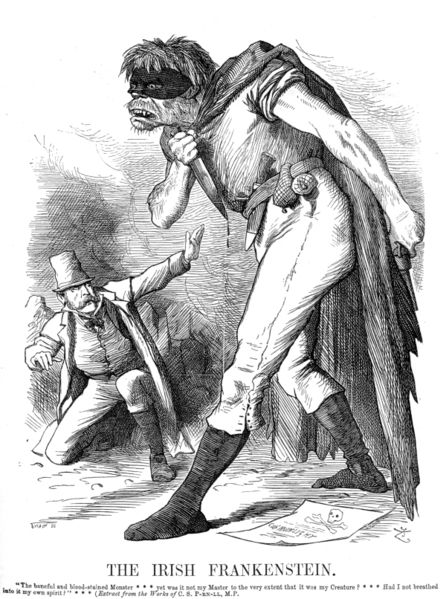
The Irish Frankenstein, 1886
Beck seeks to absolve himself — claiming HE has always been careful no talk about “numbers” not ethnicity (though I haven’t heard of anyone attacking the undocumented Irish lately), and claims “no legitimate member of our movement wishes physical harm on illegal aliens or immigrants…” So, the 35 percent rise in hate crimes against latinos between 2003 and 2006 was due to an outbreak of illegitmacy? Why did Beck not begin watching his language and speaking about this until now?
Beck claims his organization is not about preserving some mythical single culture, yet, “To whatever degree cultural and origin issues may be real, we believe they will be resolved if we get the NUMBERS down to where they no longer contribute to economic injustice and environmental/quality-of-life deterioration.” In other words, “nothing against ‘them’, but there are just too many of ‘those people’ for comfort. “They” aren’t monsters (or are they?) but they’re too different to be tolerated in any numbers.
Beckgoes on to blame… in no particular order, The New York Times (for writing bout the murder, though a juvenile death squad in suburban Suffolk County seems to be news fit to print), the Democratic Party, those who stick up for human rights, Latinos who don’t agree with his idea that there’s too many of “them”, and the United States Congress for not keeping people from being murdered by thugs who listen to his own bullshit. Anyone and everything BUT the “distasteful and aggrevating” truth that Roy Beck has neither the honor, wit or basic decency to take responsiblity for his own acts and deeds. Fuck him! (and if some unstable person acts out based on what I’ve written, I’ll fess up, but I won’t lose any sleep over it).
Execution of the day
“Executed Today” is not a site I’d normally visit, but ran across them because the Mex Files is referenced in “Headsman’s” post on the death o’ the day … the 23 November 1927 execution by firing squad of Father Miguel Pro Suarez in Mexico City:
Miguel Pro’s dying cry, “Viva Cristo Rey!” — “Long live Christ the King!” — was a refrain of Cristeros, anti-government guerrillas who in the late 1920’s fought the revolutionary Mexican government’s attempts to forcibly restrict the power of the Catholic Church.
That conflict had been brewing for years, an outgrowth of Mexico’s own complex history of colonization and development — measures to restrict the church’s size, wealth, and social reach had been mooted and sometimes implemented well back to the middle of the 19th century.
The article is worth reading, but it overlooks the “minor” detail that Pro Suarez was executed for his role in an attempted assassination and terrorism, not for his religious faith, per se. He was probably innocent although his two brothers were both involved in the car bombing that led to their arrest, which I wrote about at detail in a July 2007 post, “Car bombings, oil men and Heaven’s lottery“. Of course, to understand the execution within the context of Mexican history, you’ll have to read “Gods, Gachupines and Gringos“.


