Curious and incurious cats… mainstream media in Latin America
Studs Terkel, who died Hallowe’en at the age of 96 said he wanted on his tombstone “Curiosity never killed THIS cat”. Stefan Stern, in of all places, The Financial Times, wrote a fitting tribute:
“See it human,” urges Joe Keller in Arthur Miller’s play All my Sons. Studs Terkel did just that. He listened to ordinary Americans and faithfully reported their views over the course of several highly productive decades.
Terkel grasped the realities of everyday working life. His broadcasts and writings were PR-free zones. They were not neat and convenient summaries of the prevailing conventional wisdom. They were not nice, filtered or censored. They were not advertiser-friendly.
My only time in Chicago was when I filled in on a software project for a couple of weeks when the project administrator had a health emergency. Most of my work was just updating trouble tickets, which meant talking with the software engineers in various parts of the globe during their business hours. It was kind of a cushy job… I’d be finished by about two in the afternoon… it was early fall. I had time to get around — but not everywhere. I can tell you how to find the Uruguayan neighborshood, and where Frank Nitti is buried, but I don’t pretend to know Chicago. For that, I depended on Studs Terkel.
The gravelly-voiced racounteur (at one point in his checkered career, he was the voice of the “dumb gangster” in radio soap operas) didn’t so much talk to everyone, as listen to them. From knighted cultural figures like Sir Georg Solti to welfare mothers, street bums and gangsters, Terkel wrote of Chicago and kept us informed of Chicago — and the world at large — by listening to everyone. Certainly, having grown up in a residence hotel (his family owned it) helped, and Terkel’s natural inclination to lean to the left (he was blacklisted as a Communist sympathizer in the early days of television) made him receptive to listening to the “little guy” the “forgotten man” … even when we’d just assume forget we ever met the person — having once played a fascist on stage Terkel recognized that it wasn’t so much that people had evil or wrong ideas, but that they wanted not so much validation for their ideas, but validation of their own dignity as human beings. and a hearing. He trusted his own audience — his radio listeners and readers — to have the sense to reject the message, and not the messenger.
The son of an immigrant tailor and a circus performer, Terkel’s working class roots were genuine. I doubt that today, given Terkel’s lack of a Journalism or English degree, he’d be offered a job with any radio station, let alone sent out with a tape recorder by any “mainstream media” outlet. But, his childhood spent in a residency hotel (his family owned it), and his unusual career path (law student, statistician, actor, and always a curious cat, must have been seen as “experience in lieu of training”… and, was perfect for a reporter on our life and culture. And old radical like Studs, of course, loved to follow the amphorous, not always coherent, not always polished curious cats and ordinary voices that populate the internet. Some of us call ourselves journalists (and some of us actually work as journalists — at least occasionally) and our voices are what is worth reading — “not nice, filtered or censored…. not advertiser-friendly.” Real.
It was Hallowe’en — the same day Studs’ tape finally ran out — that I read Tracy Wilkerson’s October 26 article in the Los Angeles Times (may require subscription), “Negotiating a real estate mindfield” on her experience apartment hunting in Mexico City. Wilkerson is a good reporter, and I have no idea what her background is. For all I know, maybe her mother is a circus performer too. WIlkerson writes of her experience in trying to rent a “three-bedroom house in an affluent section of Mexico City’s Polanco neighborhood.”
The landlady is worried about renting to narcotics dealers, who — having the money — naturally prefer the posh parts of town. Polanco landladies are human beings, with the dignity of their opinions and beliefs, and their fears of narcotics dealers are genuine. The article is well worth reading…
BUT…
This illustrates the real problem with “mainstream media” coverage of Mexico in particular and Latin America in general. I don’t expect foreign reporters to live in hovels out by the city dump, and Polanco is a nice area, and I’m glad the Los Angeles Times pays reporters well enough to consider living there. Wilkerson is only looking at a very small slice of real estate when she writes:
Fear, and a desire for security — those are twin urges that govern much of Mexican life these days, as drug wars rage and common crime soars. The neighborhoods around my office are armed camps. Watchmen stand at almost every door; even the dry cleaners might have an armed guard.
And so do many homes. A small apartment building, neat but not luxurious, the kind you might easily find in Silver Lake or Mar Vista, is likely to have a 24-hour armed guard service loath to admit anyone without prior announcement. This takes some adjustment for those of us accustomed to coming and going freely.
I lived in a perfectly safe “cuarto ambuelado” for a couple of months. They are tiny “efficiency sleeping rooms” (much like Chicago’s residency hotels used to offer) and tenants might stay a week, a month or years. The whole room was concrete… even the bed (yes, it had a mattress on top)… all built-in and not at all bizarre when you think about it. When a tenant moved, the mattress came out to be aired and disinfected, and the room was just hosed down. A simple and elegant solution and perfectly normal. My apartment in Santa Maria de la Ribera (now a “hip” neighborhood) was not guarded, nor would it be. Most people don’t live that way. If there was a “guard”, it was the two Jehovah’s Witness ladies who offered up breakfasts and tracts in the morning to local construction workers from the local in the front of the building, or Caneno, the ancient chow who slept in front of the Farmacia next door at night and patrolled the streets by day… or Manches, the Jack Russell Terrier who lived on the roof.
“Many homes…” I give credit to Wilkerson for making this point, but given that, and the statement that “watchmen stand at every door, and even the dry cleaners might have an armed guard” makes me wonder (curious cat that I am) how much of Mexico City the “mainstream media” reporters actually do see. Many more homes and businesses do not have armed guards.
I once joked, sourly I admit, to a Mexican editor (who had worked as the Washington correspondent for his paper) that most U.S. reporters get lost three blocks off Reforma (most foreign media news bureaus are in the American Express Building). He didn’t think it was as much a joke as a statement of fact. A seasoned, Mexico-experienced reporter I know once wrote about “well water shortages” in a middle-class neighborhood (within walking distance of the Zona Rosa). His source was a maid who lived in a neighborhood with water pressure problems… not a resident. This was forgivable — the reporter was still finding his way around the Capital, and had been working in another part of the country and just didn’t know that the neighborhood was one of the more desirable (but still, luckily, off the radar screen of foreign yuppies) in the city. But, it indicates the problem.
Our assumptions — filtered, and advertiser-friendly — are not defined by the reporters, even if they do get out and talk to the people. One thing that finally turned me off to using Associated Press was the realization that the stories by-lined “Mexico City” too often appeared to be press releases from official sources, with maybe a few quotes and then turned over to a re-write person and an editor who was nowhere near the story… and wasn’t a “curious cat”. They seemed to drop in the phrase “the teeming slums of….”in every Mexico City story, unless it was in one of the neighborhoods (like Polanco) known to their reporters. My favorite “teeming slum…” happened in in a neighborhood I used to regularly travere by bus… it was teeming with dairy cattle.
I want reporters to live decently. I want everyone to live decently, though you can’t expect to go to Mexico City, or Bogata or Lima or anywhere outside of the United States and expect to find an apartment or a house the same as you might find in Los Angeles. And I want reporters to be safe. Mexico is a dangerous place for MEXICAN reporters (most of whom can’t afford those places with armed guards), and foreign reporters need to take reasonable precautions. But one doesn’t live in Latin America… and one certainly cannot pretend to know Latin America … from the protected environment of a compound.
In writing Gods, Gachupines and Gringos, in some ways, maybe I was influenced by Terkel. A doctoral student in another field of history was appalled that I wasn’t footnoting every sentence. While certainly I did include footnotes (perhaps too many of them), I wasn’t writing a thesis (though, in some ways, I feel I’ve done as much research as any doctoral student) and wasn’t writing for academics. And, more importantly, my research methodology was … to coin a word… “Terkelian”. My book is mostly looking at foreigners, and how we foreigners (both divine and mortal) are seen in Mexico. And how better to know that than to ask, and remember what I was told? Oh, sure I depended on the written histories, the documentary evidence, the “accepted sources.” But I’m not sure in trying to understand the Mexican point of view that soldiers, waitresses, market ladies, railroaders who remembered what their grandfathers claimed, taxi drivers, a nice little old lady in a ski mask, aren’t as valid a source as published “experts” — especially those filtered through their own (and my own) cultural assumptions.
In writing about Mexico… and about living in Mexico.. one needs to be a curious cat.
The Bird Man of Mazatlán
Whether Andrew Jackson Grayson should be included among the great artists who were only recognized posthumously, or as a 19th century scientist and explorer is hard to say. Whether being expected to work on a history of Mazatlán is a sign of faith in Gods, Gachupines and Gringos… or more proof that no good deed goes unpunished, I’ll leave to you.
But Grayson is a fascinating — and largely unknown — 19th century personage. Was it a tragedy that an artist had to toil in a shop, or was toiling in a shop what made him the artistic and scientific genius that he was?
This is a draft for the Mazatlán book. The original material is based on my translations from Oses Cole, Diccionario biográfico e histórico de Mazatlán (Mazatlán, Sinaloa:Cruz Roja Mexica, 2006) and information from Beyond Audubon: Andrew Jackson Grayson, Louisiana’s Forgotten Artist (Louisiana State Archives). The photo is from the Lousiana State website. Artwork from Andrew Jackson Grayson: Birds of the Pacific Slope (San Francisco: Arion Press, 1986).
Born in 1818 in Lousiana, the son of a prosperous plantation owner, Andrew Jackson Grayson had always wanted to draw. One glimpse of Audubon’s Birds of the United States was enough to set Grayson on his life’s mission – bird painting – and his frustrating, tragic career as a scientist and artist, whose importance is only now being recognized.
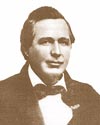 Already a recognized bird expert by the early 1840s, Grayson was hired as a field collector by the new Smithsonian Institution. This didn’t put food on the table, and Grayson, with his wife Francis and infant son, Edward, emigrated to California in 1846. In a career marked by bad luck and worse timing, whatever it was that forced the Graysons to drop out of their wagon train along the way was probably for the best. The Donner Party went on without the Graysons.
Financially, Grayson did extremely well out of the California gold rush, as a San Francisco retail grocer and real estate speculator. In some ways, he welcomed the end of the gold rush, which allowed him to move to rural San Jose, where he built “Bird Nest Cottage,” worked on his artistic technique and become more than an amateur painter.
 There, as the anonymous author of the Louisiana State Archives biography says:
He developed his own painting style and soon became a very competent artist.
His technique involved an initial sketch of the outline of a bird and the form of the background landscape and vegetation. The bird was then painted in minute detail in light pencil strokes then developed with washes in pale tones. He then progressed to filling in the detail of the background. He finished using a dry brush technique working in strong, clean colors.
In part because of the Donner Party experience, travel between California and the settled eastern half of the United States in the 1850s was normally done by sailing down the Pacific Coast to Salina Cruz, Oaxaca, crossing the Isthumus of Tehuantepec to what was then Puerto Mexico (today’s Coatzacoalcos) or Veracruz, and then sailing to New Orleans. On a business trip, combined with his part-time work for the Smithsonian, Grayson made the first of the paintings later included in his masterwork, Birds of the Pacific Slope, while travelling across the Isthumus in 1857. Although recognized as both an artist and a scientific writer, he was unable to completely support his family on by these activities, and finding the San Francisco retail trade not as lucrative as it had been during the early gold rush, Grayson moved his family – and opened a new store – in the then booming port of Mazatlán in 1859.
While his store never prospered, his artistic career matured during his time in Mazatlan. In his major works, Grayson’s technical skill exhibits a surprising ability to achieve dynamic compositions with brillliant color and exotic details.
Day of the Dead readings 2-November 2008
I’m dead… tired… the neighbors had a small family get-together– which meant only their close relatives…. which meant they didn’t have room in their house, so set up tables in the middle of the street. Not a problem, nor was the band (which played all night long) that set up right under my front window. But the band they hired to play all night long (literally) had to set up just in front of my house under my front window. All good, but I’m taking the day off.
“Mexicans don’t read”
Fred Reed on the supposed natural stupidity of Mexicans:
I am part of an internet list of people who take a very dark view of Mexico, in many ways justified, but in many ways not. In particular, members of the list, like most of America, cannot conceive that there might be any intelligent life at all in Mexico. A couple of my (slightly edited) postings:
“We [my wife and I] dropped the car off at the Toyota dealership and to pass the time we walked to Plaza del Sol, a minorly upscale shopping center in the suburbs of Guad. In it is one of the Gonvill chain of bookstores hereabouts. There are many.
Wandering around, I noticed a book called Fundamentals of Circuit Analysis—shrink-wrapped, but I’d guess about 600 pages of circuit analysis. Next to it was Elements of Electronic Design or something very close to that title, and many other such. A substantial pile of Differential and Integral Calculus was at eye level, both the height and pile suggesting that the store expected them to sell. Countless high school books—Biology I and II, etc at length—were there for kids going to private schools. (They feature purines and pyrimidines, the genetic code, and suchlike primitivism. Thanks to ex-president Vicente Fox, public school students get their books free.) I saw shelf sections labeled Physiology, Anatomy, Biostatistics, Surgery, etc. Wandering by the computer section, I saw many titles such as “Data Structures and Algorithms in Java,” and Network Design, as well as inevitables such as C++ and Visual Studio.
The store not being specifically technical, literature outnumbered tech stuff. Most of the lit you would find in a Border’s was there: Dusty Evsky, Twain, Kafka, all that, plus odd titles like Dracula in Acapulco. Authors were well-covered. For example, I counted 12 books by Mario Benedetti who, like a lot of South American authors, gringos have never heard of. There were Elements of Esthetics, biographies of Mozart etc, books of paintings of the Ashcan School and such, books of all the usual philosophers.
All of this was in Spanish. It was not a store for pale bwanas. There were plenty of people looking at the books. I was the only gringo.
Nothing changes…
… according to this left-wing Venezuelan site (written by U.K. and U.S. people):
… the real difference between the two candidates on the imperial question is that McCain, like Bush, is an aggressive and radical territorialist, while Obama, like his top adviser Zbigniew Brzezinski (author of The Grand Chessboard: American Primacy and Its Geostrategic Imperatives), is a collected and shrewd proponent of economic and institutional hegemony.
… With Chavez and his growing band of allies spending significant sums of money in alternative banking, media and other systems, they represent a potent threat to their U.S.-aligned counterparts.
Obama at the head of a sinking empire will not call off the millions of U.S. tax dollars that find their way into anti-Chavez organisations annually. Nor will Chavez budge on his grand ambition to inspire regional –and eventually world– socialism. What could a meeting between the two ultimately produce? …
Day of the Dead Kitty:
Bruno, a Los Angeles tabby decked out in (organic vegetable-based , non-toxic) paint.

© Heather Busch
SOME Juarez feminocides resolved?
I’m not convinced the string of murders of women in Juarez are part of any sort of conspiracy… or even as shockingly high a number as some want to believe. As I wrote back in June 2006 :
Maybe the murder rate is “normal” for an abnormal last-chance hard-luck boom town where the real population is significantly more than the officially recognized 1.3 million, and where transients of all kinds — and of all kinds of psychosocial kinks — change the dynamic from day to day. MAYBE… violence and casual murder is the “norm” in any lawless community in transition — whether the community is a gold rush mining camp (like in Deadwood), or a giant NAFTA spawned work camp, like Juarez, both brutal places where the brutality against the individual is only matched by the brutality by which outsiders (the State and the San Francisco mining interests in “Deadwood”; “maquilladora” plants and foreign corporate interests in Juarez) bring “civilization to a place.
In real terms, the actual murder numbers are not nearly as high as some would have you believe… more in the neighborhood of 30 or 40 a year, and those stories you read about hundreds of murders reflects a ten plus year span. It´s too simplistic to expect there to be one explanation for the crime rate, but “Satanic cult killers” have been a favorite for years.
Daniel Borunda, in Thursday´s El Paso Times reports on the latest claim of one of these “Satanic killers”… needless to say, Jose Francisco Granados de la Paz is most likely suffering from a severe mental illness, and — while he could be a serial killer on his own, or part of a thrill-kill cult — the story has to be taken with a huge grain of salt:
A man who confessed on Wednesday to slaying 10 women in Juárez told court officials a disturbing story that more bodies are buried in the yard of a home belonging to one of his alleged accomplices, Chihuahua state prosecutors said.
Jose Francisco Granados de la Paz, 30, confessed to being involved in at least 10 homicides of women in Juárez between 1993 and 2006, Chihuahua state attorney general’s officials stated in a news release.
Granados claimed that he helped other men kill women and that bodies are buried in a yard of a home in the 600 block of Armando N. Chávez in Juárez, officials said.
He has said the drug-fueled slayings were “offerings to Satan.”
Granados is on trial in the homicide of 17-year-old Mayra Juliana Reyes Solis, whose body was found along with eight others in a Juárez cotton field in 2001.
Granados’ family has said he suffers from hallucinations and delusions and was a drug addict…
Night of the living dead, Mexican Style
This has everything… a travelogue, midgets, lounge singers in scanty outfits… El Santo, Blue Demon AND Mil Mascaras! — not to mention plenty o’ luche libre and choreographed mayhem. And, as an extra bonus, there’s a groovy soundtrack!
I’m sure there is something culturally significant to be said about the great 1970 extravangza “Las momias de Guanajuanto” … but it’s worth just enjoying on Dia de los Muertos weekend.
AND … the grand finale!
Glow-cops

El Universal photo by Fernando Martínez
Mexico City has formally separated the transit police from preventative police, and is giving the transitos a different image. Besides the florescent green caps, the transito´s standard issue uniform includes glow-stick batons… as Manuel Mondragón y Kalb, the Federal District´s Secretary of Public Security told the press, so drivers can´t miss them. I think you´re supposed to NOT run them over, though they´ll be easier to aim for now.
Friday Night bad gringo video
THE classic tale of tourists gone bad… and of U.S. foreign policy towards Latin America since the days of Joel Roberts Poinsett.
A-shaman they can’t vote
In the United States, religion plays a bigger role in politics than in other countries, so whether the Shaman vote would be considered a good or bad thing, I don’t know. But — given the propensity for “dirty” politics, a little cleansing ceremony — like this held by Peruvian shamans — is probably a positive non-partisan event.
The Seattle Times reports that at the ceremony (which involved a llama fetus cooking over coca leaves):
The shamans whistled, chanted and rubbed both posters with Andean spirit totems, crucifixes, a statue of a dark-skinned Jesus and other idols to scare away bad spirits and negative energies they said might prevent a fair and democratic election.
“We are cleansing both of them so that on Nov. 4 the person that the U.S. really deserves wins,” [Shaman Juan] Osco said. “We have seen that if the election is not fair, there will be another global economic crisis, war and despair.”
Seems more civilized and straightforward than the other odd religio-political event of this week, the Wall Street “Day of Prayer for the Worlds’ Economies” involving a bunch of supposed Bible readers coveting their neighbors’ goods, and worshiping before what looks a lot like the golden calf’s big bronze brother.
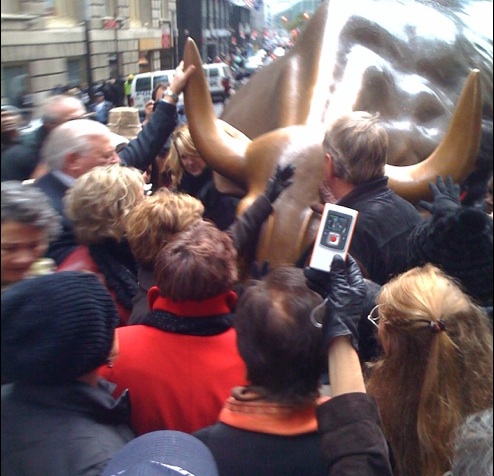
Who exactly are the pagans?
Oink! Of pork and pot…
From Grits for Breakfast:
Readers may recall that in 2007, the Texas Legislature backed Governor Rick Perry’s much-ballyhooed plan to give more than $100 million in pork barrel grants to border Sheriffs, splitting the funds equally (more than $6 million apiece) among sheriffs in the 16 counties along the border to pay for extra equipment and overtime for patrols.
Given that massive, recent state investment, I was surprised that no one in the mainstream media picked up on the fact that one of those Sheriffs recently was indicted and accused of working in cahoots with the Mexican Gulf Cartel(!), making him the second border Sheriff during Perry’s tenure to face charges for assisting Mexican drug gangs, along with many other law enforcement agents.
Though the MSM hasn’t yet linked Sheriff Guerra’s indiscretions to his border security work or probed how he spent his grant money, I’ve already wondered how the Governor could justify extending this expensive pork program now that it turns out some of the money went to a Gulf Cartel operative. The cost is even harder to justify since there’s no evidence it had any effect on border crime….
The new improved PEMEX
David Shields provides a clear “energy analyst’s” overview of the new energy bill passed yesterday by the Chamber of Deputies. Despite lingering reservations by the “Lopezobradoristas” over one of the seven bills that allows PEMEX to “fast track” specific service contracts and continued protests over some specifics, the bill is a win for the left.
In today’s The (Mexico City) News Shields writes:
Pemex will remain bureaucratic and still largely tied to the government. There will be no real competition in the industry, no Pemex equity on the stock exchange, no upstream joint ventures, no downstream deregulation and no production sharing, nor booking of reserves, for companies who help Pemex in the oil fields. Reform will not reverse declining oil output in the medium term, as most oil fields are mature and no new fields have been discovered.
However, the new procurement laws will allow Pemex and its contractors to agree on changes to projects as they evolve, based on information gained during the project, to take into account changes in the prices of raw materials and equipment required, or to bring in new technology. They will also allow Pemex to have fast-track procurement procedures for emergency work, such as accidents and oil spillages.
On the remaining objections Bilhá Calderón, writing in English in El Sendero de Peje Jalisco complains
… three of the main interest points remain vague in it´s structure and meaning. The interpretations of the three remaining issues, leave specific gaps where it could be possible to extend contract to foreign companies, private companies and investors, which by Mexican law is considered high treason.
The “lopezobradoristas” are also expected to continue protests against provisions that give the PEMEX workers’ union a stronger role in management. As they have been saying for months, there are three main points that need to be addressed:
1) Relief PEMEX from its high taxes 2) Allow the earning of the company to be reinvested into elements that would make PEMEX grow on its own (technology, perforation, exploration, oil refining) and 3) To diminish the PEMEX´s syndicate Union´s monopolic power upon the decisions made about the company´s spending.
Foreign investments — which the A.P. and U.S. business media reports suggest is necessary for Mexico to reverse falling production (which is going to fall no matter what anyone does… there is only so much oil in the world) — were rejected, and the left’s main objectives — management reform — were largely accepted. This is hardly the “cosmetic” change north of the border sources are reporting.
At last…
I´m still posting regularly, but will be leaving this “sticky post” at the top for at least the next week or two.
It only took seven years (though with significant breaks for other things), but Gods, Gachupines and Gringos: A People’s History of Mexico has finally gone to press. The limited run “Advance Review Copies” went out to those reviewers who requested copies this week. The publisher is waiting on what are hoped to be glowing ¨blubs¨for the back cover … and with the financial situation as it is, the peso price needs to be determined. There is every hope — but no absolute guarantees — to have the book in buyers hands in time for Christmas.
If you order Gods, Gachupines and Gringos: A People’s History of Mexico at the U.S. cover price ($24.95) pre-print, the publisher will absorb the shipping costs (U.S., Canada and Mexico). And, of course I earn a much larger percentage of the profits from direct sales than I do through Amazon or your local bookstore.
Pre-print orders are best made through paypal: mazbook@prodigy.net.mx .
If you want to pay be credit card or check, it’s possible, but we have only a virtual office in the U.S. and the checks will have to be forwarded to Mexico. If you need to do this, send an e-mail to the publisher (publisher@editorialmazatlan.com or mazbook@yahoo.com) for details. I can take paypal payments through my own account (richmx2@live.com) but it complicates the accounting process – and complicates my life … and my income tax filings in the U.S. and Mexico.
That corruption scandal…
The U.S. press is shocked, shocked to discover the cartels are bribing policemen. Er… yeah… but the headlines in the U.S. are all talking about “like this:
Mexican officials held for selling intel to drug cartels
… overlooking a few other country’s agents:
Interpol agent passed information to
Beltrán-Leyva cartel in Mexico
One of the most dangerous drug cartels in the world has infiltrated the US Embassy in Mexico and America’s top anti-trafficking agency, it emerged last night.
A captured informant codenamed Felipe admitted to Mexican prosecutors that he used his job as an Interpol agent working at the US Embassy in Mexico City and at the international airport in the city to feed classified information about anti-drug operations to the feared Beltrán-Leyva cartel.
…
“This doesn’t say much for US security — it’s as embarrassing as hell for this to come out and I suspect heads will roll within the DEA [Drug Enforcement Administration],” said Bruce Bagley, an expert in Latin American drug trafficking, from the University of Miami in Florida.
Nor, much about U.S. commitment to clean up their side of the border, when I find THIS from the Houston Chronicle:
BROWNSVILLE, Texas — A former South Texas police officer has pleaded guilty in federal court to illegally selling guns that wound up in Mexico.
Ramon Martinez, who at the time was a Palm Valley police officer, would buy guns from dealers and private citizens, often over the Internet, then sell them for a profit.
According to the U.S. Attorney’s office, guns found in Mexico and traced back to Martinez triggered the investigation.
Martinez, 37, faces five years in prison and as much $250,000 in fines for dealing in firearms without a license. U.S. District Judge Hilda Tagle set sentencing for Jan. 28.
News flash — gangsters offer bribes to cops. Cops take bribes…


