Not a guerrilla attack says expert
Doubts about the EPR “guerrilla attack” aren’t just showing up from the left. The conservative (some would say reactionary) Crónica de Hoy reports on one doubter of the “official” line
The original article was written by Adolfo Sánchez Venegas, and posted on the Cronica website at 1:15 Mexico City time today. (My translation).
The) EPR does not have technical or economic capacity to make and detonate simultaneous bombs. Furthermore, it lacks the social base to carry out attacks in Guanajuato, where several explosions at PEMEX facilities occurred, Jose Luis Piñeiyro, a specialist in Mexican and Latin American military and national security issues said. He recalled the “palomazos” (pop-corn attacks) on ATM machines in the State of Morelos and the Federal District a few years back, which were also intitially considered attacks by guerrillas. “They were isolated incidents carried out by someone with the ability to work with explosives,” he added.
If one carefully analyzes the official notice sent by the Revolutionary Popular Army (ERP, for its intials in Spanish), we see several odd things:
“First off, they claim to have support in Guanajuato, which is not credible, since the ERP’s influence is reduced and limited to the states of Oaxaca, part of Chiapas, Hidalgo and Guerrero, but in Guanajuato it is very rare to hear about, and has not been charactized as an organization with movements or having guerrilla commandos.”
Interviewed by Crónica, he said is second doubt i based on the mix of general and particular in the communique.
“They say that they are against the Government and the oligarchy in general, but at the same time, General because they say that they are against the Government, of the Mexican oligarchy and, at the same time, plan a war while some members stay under arrest or in prison.”
Then, he indicated, there is something even stranger. A guerrilla commando, supposedly fighting to better the conditions of the people detonates these devices to protest the rarified climate of discussion of fiscal reforem, which does not involve PEMEX.
As we are abundantly aware, the company is subject to a financial system that undercapitalizes it’s ability to aquire machinery and to moderize.
Therefore, he insisted, it wouldn’t be strange if gas ducts had accidents, caused by lack of maintenance or obsolesce in the facility.
Asked if this meant that there is little credible evidence that the EPRhad the geographic mobility, minimal social support and technical capacity to detonate explosives simultaneously in four places. According to PEMEX bulletins immediately following the explosions is there any mention of attacks.
“ In addition, Guanajuanto’s Secretary of Public Security of Guanajuato denies that there were attemped guerrilla actions.”
“Something important that needs to be added,” said the Universidad Autónoma Metropolitana researcher, “is that there has not been any technical investigation by APRA that would indicate whether there was an attack or not.”
“Expert investigators take days to do their work, yet the Secretariat of Interior nevertheless and the office of the President, both immediately issued statements condemning the acts and including official statements from the EPR.”
“The most probable explanation is that there was an accident,” he emphasized.
Jose Luis Piñeiyro makes several of the points I did earlier today (mentioning the ATM attacks for example), but leaves unanswered the question of who — or why — the Presidency is so anxious to make this a EPR operation. The Unapologetic Mexican has some thoughts about that.
The explosions may have been an accident (and one gas duct explosion will set off a chain reaction) that’s being spun to justify privatization of PEMEX. Blogotitlan’s Eddy Torzón thinks so.
Still sexy at 50…
They have forced mosques in the Ivory Coast to reschedule services, and led to an unofficial hour long daily truce in the Bosnian war. They earn more in foreign sales than the BBC does from all its products.
 It’s the 50th anniversary of the telenovela. Since Silvia Derbez starred in Senda Prohibida in 1957 (that’s Silvia in Senda Prohibida at the right), the Mexican telenovela has gone on to conquer the world… and make Spanish the most popular foreign language in Israeli high schools — Rebelde created a huge demand for Israeli Spanish teachers.
Forget Gorbachev, Reagan, Pope John-Paul II. Verónica Castro and  Rogelio Guerra conquered the Soviet Union. Los ricos también lloran introduced an alternative non-U.S., non-European bourgeois capitalist society to the Soviet Union. And the result was… dramatic, with a lot of plot twists!
By the way, the photo of Verónica Castro is from a Russian fan site… she is the most popular foreign actress in that country to this day (and was hired by Russian political parties to make pitches for candidates — never mind she can’t speak Russian and can’t vote there).
Having inspired similar productions throughout Latin America, Spain, Portugal, Africa, Eastern Europe, Taiwan, South Korea, Vietnam and Central Asia, how is Televisa going to mark the historic anniversary?
What’s the latest plot twist? Televisa is producing a historical telenovela … about telenovelas.
PEMEX, AMLO and EPR… it’s a blast
¡Para justicia y libertad! posted on this before I did, and Edmundo has most of what I was going to say…
Mexican leftist group, El Ejército Popular Revolucionario (EPR – Popular Revolutionary Army), is claiming responsibility for for a series of explosions that occurred this week and last week on Mexico’s owned natural-gas pipelines, PEMEX, according to La Jornada. Pemex is the third-largest oil supplier to the US.
…
The group said it will continue to carry out “surgical harassment actions” until President Felipe Calderon and the governor of the state of Oaxaca, Ulises Ruiz, release two of its members who were arrested back in May.
President Felipe Calderón has ordered a reinforcement of security measures in strategically important oil fields and other areas.
What makes EPR statement interesting, they said the bombings were the signal of the beginning of its campaign against the interests of “the oligarchy and of this illegitimate government.” The word “illegitimate” echoes presidential contender Andres Manuel López Obrador, who lost the 2006 election to Calderon by less than 0.6 percentage point, and uses the same term for the current administration. After leading two months of post-election street protests culminating in a self- inauguration, López Obrador continues his claim to be the rightful head of state.
The Calderón administration has stepped up security around oil pipelines, but seems to discount the ERP involvement. The Federal Prosecutor’s office says the explosions were deliberately set, and accepts the authenticity of the ERP communique.
At this point I don’t see evidence that Lopez Obradór is involved with the ERP, but that it is an independent action by a not-well-known indigenous group. About the only thing I can find about the group is that they were founded by Alberto Antonio Antonio, an indigenous resident of San Augustín Loxicha, Oaxaca (the municipal website lists him as a famous native son).
As far as I can tell this is an indigenous guerrilla organization from Oaxaca, and their specific demands (the resignation of Ulises Ruiz in Oaxaca, and release of political prisoners taken during protests in that state last summer) don’t suggest this is a national group, but only a local one.
And, given that there have been manufactured “terrorist” acts in the past to justify police crackdowns on dissent (last year’s bombing of the PRI headquarters in Mexico City, a dubious bank bombing — carefully designed to minimize damage — in Tlanapantla, Morelos following a stolen municipal election in 2005 — and an earlier bombing blamed on the Zapatistas — this one blowing up a trash can in front of a bank at 3 in the morning — again in Mexico City), I’d want more information before I draw any conclusions.
There are a lot of groups and individuals who think the Calderón administration is an “illegitimate presidency”, but aren’t necessarily connected to the PRD or AMLO’s “alternative presidency”. As far back as last December, there were newspaper reports of rejectionists taking to the hills (though the group in question was ironically taking up arms against the military budget and cuts in education funding).
There are a couple of other issues at work here. The Secretaria de Gobernacion (Interior Minister or “Homeland Security Chief”), Francisco Ramírez Acuña will be the one to watch. His original selection was called “A Grave Error” by CNN among others:
Ramírez Acuña, known for a “firm hand” on security issues but also accused of human rights violations, will be immediately responsible for finding a solution to six months of unrest in Oaxaca, where a large protest movement is demanding the ouster of the state´s governor. He will also be in charge of reaching out to opposition parties to seek support for Calderón´s reform agenda.
I’ll translate it later (today, I hope), but Blogotitlan has an article up by Jorge Carrasco Araizaga of Proceso, suggesting Calderón’s “drug war” has run out of steam, and the “de facto government” needs a new threat to justify it’s quasi-military control.
The target of the attack — PEMEX — is worth noting. ERP (which is usually only said to have a few dozen members) but attacks on oil pipelines in three states indicate broader action. ERP may be larger (or better organized) than we’ve been led to believe. On the other hand, nationalists, supporters of the alternative presidency AND the guerrillas all reject calls for privatizing PEMEX.
Pipelines are one thing that could be privatized without privatizing the oil itself. I could fall into the Mexican conspiracy mode of thinking and say it’s a complot to make pipeline management by outsiders more palatable to the nation, or… it could be what it looks like: ERP said they attacked the pipeline because it’s part of the oligarchy and corporatist power structure.
Whatever the reality, Edmundo is right… and not just because he thinks I’m right!)…
It would be wise to keep an eye on the activities happening in Mexico because it sure does look like the natives are getting restless down there.
Car bombings, oil men and Heaven’s lottery
Car bombings, religious extremists and possibly collusion by U.S. oil men… no, this isn’t Iraq, ca. 2007… but Mexico City, ca. 1927.
I’d known about the Pro Juarez brothers of course (everyone admits Miguel — now “Blessed Miguel Augustin Pro Juarez, S.J., Martyr” — was innocent, and a Mexican human rights/civil liberties organization is named in his honor), but the records are contradictory, with Catholic sources contradicting each other sometimes, and the historians unable to agree on exactly what — or who — was behind the whole thing.
I hadn’t known about the car bombing until I ran across mention of the only Catholic Saint to have lived in Texas (San Pedro de Jesus Maldonaldo Lucero, who studied for the priesthood and worked in El Paso from 1914 to 1918). “Borderlands” is a good source for Texas and Northern Mexican history, and while I don’t agree completely with the author’s perspective on the Cristero Revolt, she nicely summarizes the story.
In [1926], President Plutarco Elías Calles and the former president, General Álvaro Obregón, weakened the Catholic Church in Mexico by enforcing the Articles of the 1857 constitution included in the 1917 version. Article 3 called for secular education in the schools, thus outlawing parochial education. Article 5 closed all seminaries and convents. Article 24 forbade worship outside the physical borders of the church.
Article 27 prohibited religious groups from owning real estate, thus nationalizing all Church property. Article 130 prohibited priests and nuns from wearing religious vestments, but more importantly, it took away from the clergy the rights of voting and speech, prohibiting the criticism of government officials and comment on public affairs in religious publications.
The closing of seminaries began during the Mexican Revolution, leaving nuns and priests with no place to live or work. The government also ruled that only Mexican born clergy would be allowed to remain and participate in religious activities in Mexico. By 1917, hundreds of religious had been expelled from Mexico or had fled the country.
The Catholic Church did not want to retaliate violently against the government, so from 1919 to 1926, they obeyed the laws. However, in 1926, President Calles introduced legislation which fined priests $250 for wearing religious vestments and imprisoned them for five years for criticizing the government.
Archbishop of Mexico, José María Mora y del Río, declared that the Catholic Church could not accept the government’s restraints. On July 31, 1926, the archbishop suspended all public worship by ordering Mexican clergy to refrain from administering any of the Church’s sacraments.
By 1926, as many as 50,000 men, mostly campesinos, but from middle and upper-class backgrounds as well, had taken up arms against the government. There has always been speculation within Mexico and from outside researchers as well (Linda B. Hall’s Oil, Banks and Profits, U. of Texas, 1995 and others) that U.S. oil men may have been financing the rebellion, hoping to weaken the revolutionary state.
That the “rest of the story” is from a highly dubious source… the July 25, 2003 “Executive Intelligence Report” (Lyndon LaRouche’s magazine). Even though Larouche is said to have “”one of the best private intelligence services in the world,” the guy is nuts. If you’re not familiar with him, Larouche headed political parties ranging from far right to far left, and always far out in the 1970s through the 1990s (when he was sent to prison for fraud).
The author, William F. Wertz, Jr. (based on a quicky “google seach”) is a German translator and apparently a believer in esoteric Catholic conspiracy theories. He was mostly interested in attacking the Buckley family (William F. Buckley, Sr. is the the usual suspect when it comes to financing the Cristeros. He had been expelled from Mexico in 1921 for his role in the brief de la Huerta revolt, but still had interests in oil companies in the country) and Spanish Carlism and some other obscure scholars.
At any rate, Wertz’s article was the most straight-forward account I could find, even though I had to edit out chunks. Wertz is a conspiracy buff, and tries to imply that Dwight Morrow and Calvin Coolidge were part of the Carlist conspiracy (and pulls in some woman from Virginia for good measure), so I checked everything against other sources: Catholic ones — pious (SAINT PADRE MIGUEL PRO); academic (“Restoring Christian Social Order”: The Mexican Catholic Youth Association (1913-1932) The Americas, April 2003) ; and doctrinal (Presbítero MIGUEL AGUSTÍN PRO JUÁREZ, S.J.) — and scholarly: ones — the usual Mexican history sources, my own Mexican history notes and Enrique Krauze’s Álvaro Obregón: El vértigo de la victoria: Fondo de Cultura Economica, 1987):
After nearly two years of warfare, with neither the Cristeros, who lacked ammunition, able to overthrow the government, nor the government, which was badly damaged by the rebellion economically, able to completely suppress it, the United States intervened to pressure the Mexican government to resolve the interrelated oil, debt, and religious questions. Thus in 1927, Dwight Morrow, a college friend of President Coolidge and a partner at J.P. Morgan, was appointed U.S. Ambassador to Mexico. He arrived there on Oct. 23, 1927.
…
Within a month of Morrow’s arrival in Mexico, on Nov. 13, [1927] a bomb was thrown at General Obregón, in an unsuccessful assassination attempt. It was blamed on Father Miguel Pro… He had joined the Society of Jesus in 1911 and took his vows two years later. He then spent several years abroad studying in California, Nicaragua, Spain, and then Belgium, returning to Mexico City in 1926.
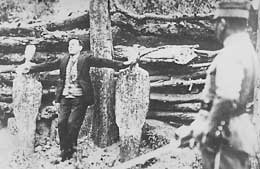
The person who constructed the bomb was Luis Segura Vilchis… During the attempt, two conspirators were arrested, Juan Tirado and Nahum Lamberto Ruiz, the latter of whom suffered a head wound, from which he later died. Two escaped, Segura Vilchis and José Gonzáles. The latter, … had borrowed the car used in the attempt from … Humberto Pro Juárez [other sources say Humberto had sold the car to Gonzales a week earlier]. This led to the arrest of both Humberto Pro and his brother Roberto… and to the arrest of their brother Father Miguel Pro, who himself worked with the League. Roberto was released, but Father Pro, Humberto Pro, Segura Vilchis, and Juan Tirado were all executed on Nov. 23, 1927.
Morrow later was instrumental in working out an agreement between the Mexican government and the Vatican (as a Protestant and a foreigner, he could act as a good faith negotiator), convinced the U.S. government (and the oil companies) to accept the Mexican Revolution and the new oil laws as a done deal — and financed Diego Rivera. As a result, he’s the only U.S. Ambassador to be remembered fondly in Mexico and to have a street (in Cuernavaca) named for him.
Although it’s not clear that Humberto provided the car from which the bomb was thrown at Obregón Essex’s, and Luis Segura told police the Pro brothers were not involved, Humberto and Roberto (who got a reprieve, and may have ratted out the others) were definitely involved in terrorist activities, and which sort of put them out of the running for canonization by the Church.
How much Miguel actually knew about his brothers’ activities is debatable. He had been out of the country until 1926, and following his arrest in October of that year for conducting underground religious services, was under police surveillance. If he had been involved (and the Catholic Church researchers and independent scholars both agree he was not), the likelihood is that either the detectives would have gotten wind of it, or the terrorists would have isolated him for their own protection.
The independents say he was executed for his family connections, the Church that it was for his religious beliefs.
By the way, many Mexicans accept Miguel Pro Juarez as the unofficial patron saint of the lottery. The conspirators were executed in the courtyard of the police headquarters, now the site of the Loteria Nacional. The pious sources all say Miguel’s last words were “Long live Christ the King,” but others say he said “Great, I win a ticket to Heaven!”
The ancient Romans never took mugshots before they fed the Christians to the lions. The Mexican police did take Miguel’s before they shot him. It’s rare to see a priest in clerical garb today, and unheard of during the 1920s… unless they really, really wanted a to win “Heaven’s lottery”… which in Miguel’s case, was also photographed

Welcome, tourists
I can’t take ALL the credit (I probably can’t even take one percent of the credit), but I see we’re finally getting people to actually take a look at the borderlands, instead of just mouthing off…
Dos Centavos reports that Congressman David Price of North Carolina came down
“to see the detention center (in Hutto, where immigrant families are being held), and border defense, and what form that’s going to take.”
The detention center question is easy: Close it down! Not only have we built a concentration camp that compares to the Japanese sites we had during WWII in South Texas, we are handing millions of dollars to a company (Corrections Corporation of America) who is known for ineffectiveness in corrections and mismanagment, not to mention low-quality inmate health care–a threat, especially to the children being held.
The view on the fence in South Texas is clear: No Fence!
Price conceded that while a border fence is favored in his own district, what seemed like a practical solution in non-border states — and inside the Beltway — could create significant problems where they are built.
Alfredo Corchado of the Dallas Morning News took a road trip out to the Big Bend…
In Presidio, the Bishop family once harvested 2,000 acres of land, growing onions and cantaloupes with the help of Mexican migrants. But stricter immigration policies have contributed to a diminished workforce and, by extension, production.
They’re decidedly against fences.
“We’re Texans,” farmer Terry Bishop says. “Here, even the cattle go across and come back.”
Adds his father, Bill Bishop: “This part of the world, everybody is related to everybody else, and everybody is related to everyone on the other side of the border and share a common language.”
Down the road, locals still recall fondly the funeral of Boyd Chambers, who raised cattle for more than 50 years in the area. Mr. Chambers employed Mexican workers.
Upon his death five years ago, Mexicans crossed the river illegally and helped dig his grave. They flocked to his funeral where Border Patrol agent-in-charge Simon Garza, a Mormon, presided.
After the service, the workers helped Mr. Chamber’s sons bury the rancher near Candelaria.
“The outpouring of support was overwhelming,” recalled a teary-eyed Teresa Chambers, a teacher in Presidio. “Dad would have been so proud.”
As the nation turns to securing its southern border, the Chambers decry what they call the government’s “my way, or the highway approach,” says Johnnie Chambers, who as a child played with her friends on both sides of the border. “We should go back to where we were, where both sides did our own community policing.”
My introduction to Mexico’s role in saving the Jews of Europe during World War II, as well as a lot of other would-be victims of the fascists, was due to my very bad Spanish. I was still going to Mexico City as a tourist, and noticed some unusual silver ornaments in a shop across from Parque Alameda (where the Foreign Ministry complex now stands). For some reason, when I walked in, my Spanish failed me, and didn’t know enough to say “Quisiera mirar los ornamentos”… saying – I think – something like mira los tchotkies”. Where I pulled the Yiddish word from is a mystery to me to this day, but the old guy in a yalmulke behind the counter sort of understood me. After trying out Yiddish and German on me, he finally hit on his limited English. He’d been a Mexican since 1940.
Later, when I lived in Santa Maria de la Ribera, I’d see very elderly Spaniards and Basques and French out with their grandchildren… who looked and acted as Mexican as everyone else. The park in Santa Maria faces several high schools – including French, Dutch and Spanish ones.
My neighbors, and my friend the silversmith, and many, many others owe their existence to Lazaro Cardenas, and to the Mexican diplomatic corps. People just don’t know that Mexico accepted almost any refugee from fascism (and, legally, still does) and the Mexican diplomatic corps played an important role in World War II, even before Mexico declared war on Germany in May, 1942.
One of the heros of the Mexican diplomatic corps is being honored with an exhibit at the Museo Histórico Judío y del Holocausto Tuvie Maizel (Acapulco 70, Condesa, D.F.). Arturo Jimenez of Jornada wrote about the “Mexican Schindler”
He is often called “The Mexican Schindler” for his work during the Second World War, when as Mexico’s Consul General in France, he aided 40,000 refuges – Spanish Republicans, French Jews, Lebanese and others facing persecution, among them leaders of the European opposition and members of the antifascist resistence.
Described as “a Mexican hero” or a “savior” or simply “brave,” he spent a year as a prisoner of war of the Germans, where – together with his family and collaborators – his dignified attitude was the epitome of Mexican diplomacy of the era, gaining even the respect of his jailers.
His name was Gilberto Bosques, born in 1892 in Chiatla, Puebla. In his 103 year lifetime, he was a revolucionary, a congressman, an educator, a reporter, a writer, a diplomat and, above all else, a humanist and patriot: but somewhat forgotten until now.
For everything he was, the Jewish community in Mexico has decided to mount a photographic exhibit in Bosques’ honor, the best way to teach about our tradition of asylum and solidarity.
Embajador Gilberto Bosques: un hombre de todos los tiempos (Ambassador Gilberto Bosques: a man for all times) opened last week at the Museo Histórico Judío y del Holocausto Tuvie Maizel (Acapulco 70, Condesa).
In 88 photos, the exposition covers the life of Gilberto Bosques from his birth to his death in 1995. The images and information sheets are organized in 25 panels, and include photos of the almost unknown French Holocaust.
All the images are copies from the Bosques family archives. The museum has plans to show the exhibit in other locations. The curator, Erick Saúl, of the United States, said he is “historical curator, not a museum specialist,” spent two years working on the Tuvie Maizel museum exhibit.
Saving lives, raising spirits
The exposition includes images from throughout Bosques’ long and varied career: his participation in the 1910 Revolution when he was 17; as a Puebla and later Federal legislator working on labor issues in the 1920s and 30s; his activities as as an educational and political reformer and his career as editor of the Government paper, El Nacional.
His diplomatic career began at shortly before the outbreak of the Second World War, when he was tasked with carrying out the foreign policy of presidents Lázaro Cárdenas and then Manuel Avila Camacho.
Under the leadership of Mexican Minister to France, Luis I. Rodríguez, Bosques embarked on a series of adventures in his quest to obtain visas and safe-conduct passes for those persecuted by the Germans in France, even as he moved the diplomatic mission from Paris to other places, eventually coming to Marseilles.
In the French port, he used his role as Mexican Consul General to rent two chateaux (Reynarde and Montegrande) to house and protect hundreds of refugees marked for deportation to concentration and extermination camps, while he arranged for their exit. In the chateaux, he organized artistic activities to “raise the spirit” of the persecuted.
In Marseilles, the Mexican Ambassador had to confront open hostility from pro-German French “authorities”, Gestapo spies, the government of Spanish dictator Francisco Franco as well as the Japanese diplomats who had offices in the same building as the Mexican delegation.
Bosques resisted them all. The French and – above all – the Germans, until on his recommendation, Mexico broke relations with both countries in 1943. The Gestapo violently assaulted the Mexican delegation, robbing money from a strongbox and taking the diplomat, his wife and three children and forty staff members into custody. They were sent to Bad Godesberg and locked in a hotel for the next year, which he spent organizing art programs. He above all upheld his dignity and the dignity of Mexico. He told the German bureaucrats:
“We have read the rules you have laid down for Mexican personnel and will abide by them. However, as Mexico and Germany are at war, we expect to be treated as prisoners of war, and will accept no special consideration due to age or other condition, but only those accorded to such prisoners.”
In 1944, the Mexican were liberated and repatriated in a prisoner exchange with the Germans who were held in the concentration center at Perote, Veracruz.
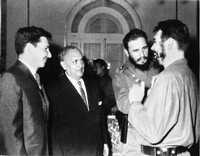
After the war, Bosques was appointed Mexican Minister to Portugal, Finland and Sweden. From 1953 to 1964, he served in Cuba. The photo shows Bosques with the Castro brothers (Raul and Fidel) and Ernesto Che Guevara.
Don Gilberto’s daughter, Laura Bosques, recalled her family’s experiences in Europe, which organizing tertuilias during their incarceration at Bad Godesburg which included reading from the poems of Rubén Darío at tertuilias.
“It was an era of intense drama. Along with everyone else, my parents and my brothers and I were aware of the suffering. The War was a tremendous thing that should never have happened, and the violence continues to this day.”
Laura Bosques spoke with us in the offices at the Centro Comunitario Nidjei Israel, where the Tuvie Maizel museum is also located. There, we also met press spokesman Enriqueta Loaeza Tovar and museum coordinator Leyla Malki, who summed up the man:
“Gilberto Bosques was a Mexican hero. With this exhibit the museum and the Jewish community in Mexico renders its homage, to one who did so much for us, and for his country.”
If you ever wondered how Ilsa and Victor Lazlo got to Casablanca, now you know… Gilberto Bosques arranged it.

Is gumbo Mexican? Are tacos Cajun?
Nezua, the Unapologetic Mexican, takes on Jefferson Parish (Louisiana) where
…there has been a rise of mobile taco vendors. And they have been thriving, their clientele apparently mostly “Hispanic” customers, according to this particular news report. Nevertheless, Jefferson Parish Councilman Louis Congemi has introduced a law (since passed) that will surely put the smackdown on that particular growing market.
After excoriating various Jefferson Parish officials for their not-so-subtle suggestions that it’s the CUSTOMERS of said taco stands that the Parish officials objects to (though not their low wage labor), he quotes New Orleans City Councilman Oliver Thomas who is of the same mindset:
‘How are we helping our restaurants that are trying to recover by having more food trucks from Texas open up?’ he asked. ‘How do tacos help gumbo?’
Lolis Eric Elie answers that question in this morning’s Times Picayune:
Gumbo and tacos, while emblematic dishes of Louisiana and Mexico, also serve as shorthand for broader cultural and economic references.
A detailed answer to the New Orleans council member’s question might surprise him. It seems the taco people helped the gumbo people during an especially desperate period.
Writing in the winter 2001-02 issue of Louisiana Cultural Vistas, Mary Gehman notes that in the 1850s, the American interlopers who moved here after the Louisiana Purchase increased their persecution and oppression of the native Creole-of-color population.
“Free blacks with young families and long futures ahead of them saw greater opportunity beyond the borders of Louisiana and prepared to leave,” Gehman wrote.
What happened to these people? Many found refuge in Veracruz, Mexico.
…
Considering the number of Louisiana chefs who have forgotten that okra is the key ingredient in gumbo, the Creole cooks of Veracruz might well be able to help reinvigorate the local version of the dish.
Anyone who had been to pre-Katrina New Orleans AND Veracruz is struck by the similarities. One travel writer describes the people of Veracruz this way:
The city’s 1.2 million inhabitants, known as jaroches (from Jara, the Spanish word for a type of arrow), once derogatory but now respectable, are fun-loving, lively and more ethnically mixed than other Mexican cities. Totonaca, Spanish, African and Caribbean blend into a warm and hospitable people. Giving color to this mixture are sailors from the four corners of the world, strolling the downtown streets and enjoying the city’s all-inclusive festive atmosphere.
Substitute “Cajan” for “Spanish” and that sounds like the “old” New Orleans. For that matter, Tampico and Galveston and New Orleans and Veracruz have more in common with each other than any of them do with Toluca or Tulsa.
 In the Gulf cities, regardless of what country they happen to fall in, you find a significant African influence, a multi-racial, multi-ethnic culture, and a tolerance for decadence. I’ve always said Veracruz is Mexico’s New Orleans (with a touch of San Francisco). Or New Orleans is the U.S. Veracruz… a good place to be bad.. or to grow old disgracefully.
Both are THE place to go for Carnival, even if the New Orleans version goes by the French name and was Disneyfied the last few years (even moved to a more convenient date than the Church calendar specifies). And great seafood.
So, Louisiana hot sauce ain’t quite the same as salsa… Creole, Cajun, Veracruzano, Tampaqueño… the great Gulf cuisines — and cultures — have been fertilizing and repopulating each other for centuries. They’ve survived each other’s pirate attacks (Jean Lafitte is remembered as a local businessman in all four cities), political intrigues (Benito Juarez did some of his best plotting against the conservatives in New Orleans and Veracruz cafes), bombardments, storms (the ONLY official Mexican military operation in the United States was disaster relief after Hurricane Katrina) and crooked politicos like Huey Long and Maximilio Avilla Camacho.
They’ll survive bureacratic attacks on taco vendors and maybe — with some luck — the unconscionable neglect of the Bush administration too.
The photo is Veracruz, but I cheated slightly. The dancers are from Veracruz’ sizable Cuban community
Bi-estupida y bi-intellegente
Texas State Senator Debbie Riddle, who thinks public education “comes straight out of the pit of hell” (or at least Moscow) is going soft. Now she just worries that a proposal to teach San Antonio school children in both Spanish and English (as opposed to just Spanish or just English, or taking one of the two Texas languages as the “foreign” one) will limit a child’s chance to perform surgery while flying a plane… and suing someone. Or something like that:
Riddle said she fears the project will dilute the need for students to master English, which is the international language of aviation and a requirement if children want to become lawyers or physicians.
“I think we are worshipping at the feet of diversity,” Riddle said. “There’s nothing wrong with diversity, but to minimize English as the primary language of this nation is a mistake, and I think it’s a mistake for our kids. Kids need to master the English language, period.
At least she doesn’t claim its a plot to rob children of their precious bodily fluids. Anyway, Debbie…learning to speak two languages is going to keep them from speaking English how?
Senator Riddle (R-etro early 1950s) was one of the two State Senators to vote against House Bill 2814, which creates a six-year pilot program that will test a dual-language program in up to 10 Texas public school districts and 30 campuses. The bill is designed to help Anglo kids learn a second language, according to sponsor Leticia Van de Putte, D-San Antonio. “They will learn Spanish or some other language, becoming bilingual and bi-literate. When they are little, you can do that.”
Dammit! We are NOT a war zone!
A few cohetes are going off (to the delight of my 3-year old neighbor Tristan) in a post-fourth of July frenzy, but thank you very much, we are not taking up arms against a sea of “insurgents” down this way.
A sombrero-tip to “Couldbetrue” at South Texas Chisme for finding Jeremy Roebuck’s article in the McAllen Monitor:
The U.S. Border Patrol could dramatically increase its presence on the nation’s southern frontier by adding hundreds of private contractors to its ranks, according to a proposal presented to Congress last month.
DynCorp International, a Virginia-based military security firm, said it could train and deploy 1,000 private agents to the U.S.-Mexico border within 13 months, offering a quick surge of law enforcement officers to a region struggling to clamp down on illegal immigration.
Currently, the company manages an army of private security agents deployed across the world in support of U.S. missions, including several former Border Patrol agents hired to help secure the Iraqi border.
While of course there are problems along the border, the “Statement of Robert B. Rosenkranz President, Government Services Division, DynCorp International before the Subcommittee on Management, Investigation, and Oversight Committee on Homeland Security House of Representatives Hearing on ‘Increasing the Number of U.S. Border Patrol Agents’ (June 19, 2007)” — pdf file here — says that his company’s border control experience is of a different sort than what is normal between two countries with close diplomatic, economic and social ties:
We currently have approximately 14,000 employees, more than $2 billion in annual sales, and employees deployed in some 35 countries. Some 4,000 personnel support our contracts in Iraq and Afghanistan and 142 have paid the ultimate sacrifice, including 23 Americans. We have broad and deep experience in our core competencies of law enforcement services, contingency support, logistics, base operations, field construction, aircraft and ground equipment maintenance, maritime services, and program management. We also support the government’s counter-drug efforts in Latin America and South Asia and provide selected security services to customers in various locations around the world.
…
In Iraq, Afghanistan, Sudan, Liberia, and Iraq, we have built and operated forward operating bases, military bases, training camps, and police facilities. Should these types of facilities be necessary to sustain forces in remote areas along the U.S. border, DynCorp International can build them, maintain them, and provide personnel to work from them.
In other words, the company is selling their experience in unfriendly countries — and war zones — IN THE UNITED STATES OF AMERICA.
Local policing here is done by the Brewster County Sheriff’s Department, the Alpine Police Department, the National Park Service rangers and the Border Patrol. While the latter are arguably a paramilitary outfit (and DynCorp also wants to subcontract our tax-payer trained agents to work in Iraq!!) all these are civilian police forces — what are usually called “Peace Officers”. Yeah, a few of them are jerks and throw their weight around, but more than a few of these guys carry an extra lunch with them to share with any “illegal” they have to turn in. And, they won’t admit it, but I’ve know a few who look the other way. If we’ve got hard-asses, they’re more the Joe Friday type than Rambo.
Our locals probably have less training than other police agents around Texas, but that’s more a matter of low salaries and the difficulty of recruiting officers to live in a rural area (if there’s a retired State Trooper or Border Patrol agent who likes horses and hunting… the Sheriff may have a deal for you! If you are were tops in your class at the Police Academy and have a MA in sociology, I don’t think we can afford you). Still, they are trained as civilian officers… and usually learn (or are native speakers of) Spanish. Most are locals who want to stay in the area. Even the new Border Patrol agents receive 10 months of training, and some immersion in border culture before coming here. Robert Rozencrantz trains his guys too:
Before deploying overseas on a training mission, our police officers typically undergo three weeks of training and orientation. … Obviously, this would also ensure a faster augmentation of the Border Patrol and—perhaps most importantly—provide a level of professional experience that may not be available when recruiting from the general population.
Half of the 10 months of current Border Patrol training is on-the-job and in-service training, and might be waived or reduced if prior law enforcement experience is accepted. Similarly, some of the academy training might be redundant, or perhaps could be revised to gain greater efficiencies.
What exactly is “redundant” about the training? And who is being trained. While the only news source I can find about this is from 2005 article on the World Socialist Web Site, the United Nations Commission on Human Rights has been very concerned about companies, including DynCorp, hiring Peruvian (and other) mercenaries for duty in Iraq. I don’t see where DynCorp. is proposing to train people on the local culture… or where these rent-an-agents would have any ties to the local community.
Lower-paid rent-an-agents in an unfamiliar place with no local ties should worry even the die-hard “close the border” folks. Besides our real concerns about the inevitable growth of police corruption with more and more policing along the border there’s a model for what we can expect in Los Zetas.
I can’t find many reliable links about them, the Wikipedia.org piece at noting that they don’t have sufficient information, and most links being a few years old. I don’t buy the story that Los Zetas are an army of rouge Mexican special forces soldiers (there aren’t more than about 200 special forces soldiers in the entire Mexican military), but the hired killers do include guys with military and police training who’ve gone over to the dark side.
What will keep mercenaries (especially if they are from a third country) from going to work for the narcotics traffickers in the U.S. who have a heck of a lot more access to weapons and money than their counterparts in Mexico? What loyalty to … well anything, let alone the Constitution of the United States do mercenaries have?
I wish this was just some bad political idea that was killed off when “cooler heads prevail”… but I’m very concerned that this is already in the works, and the financial benefits to the company (and politicians?) are making this a likely prospect. War is the health of the state, as Benito Mussolini put it. I wish they’d remember what his namesake, Benito Juarez said: “Peace is respect for the rights of others.” Like those of us who live here.
Nancy Conroy caught on to another “rent-an-army” — Blackwater — operating on the border. CorpWatch has several links to news about what they call “world’s premier rent-a-cop business”.
Around the (cyber) hood…
Tbogg, “a somewhat popular blogger,” writes that the “Minutemen” are equal opportunity dickheads… they dislike everyone, even each other…
Several former Minuteman leaders, angry over the organization’s failure to account for hundreds of thousands, perhaps millions, of dollars in donations, have formed their own border-vigil operation.
The Patriots’ Border Alliance, led by Minuteman Civil Defense Corps leaders fired in May for raising questions about the group’s finances, says it will carry on the mission of fighting illegal entry into the U.S. with volunteers who have “chosen to stand down” from MCDC.
And to be honest, the “Patriots’ Border Alliance” doesn’t quite have the headline-friendly snap and brevity of the Minutemen or say, the MexiKlan™, which was first runner-up.
I’m shocked! Bigots are supposed to be more honest than this.
The Low-rent correspondent credits Andres Manuel Lopez Obradór for the banner month in Mercedes Benz sales…
German automaker Mercedes Benz reported an 83-percent increase in Mexican sales during June 2007 when compared to the same month last year – which just happened to precede the July 2 vote.
…
Anyway, this Mercendes Benz news comes during the same week as Mexico’s “legitimate president” Andres Manuel Lopez Obrador held a rally in the Zocalo to mark the one-year anniversary of the July 2 election he says was fraudulent.
I think “low rent” is a little too eager to take the “official” spin that AMLO is toast… he mistakes a poll indicating that only 30% of voters would vote for AMLO today for a 15% drop in support when the 2006 election was a 5-way affair and AMLO received (officially, anyway) about 35.5% of the total vote. Holding on to 30% sounds impressive to me.
Mark in Mexico must be drinking the toxic sludge he talks about.
Sources inside the Puebla state government have told Mark in Mexico that more than 200 million cubic meters of toxic sludge lie at the bottom of the Valsequillo reservoir.
How “secret and exclusive” is it when the next paragraph says the same information was in the conservative daily, Reforma?
This would indicate that the explosive reports in Reforma did not take state officials by surprise. Well, maybe Reforma’s reports did, but the information contained therein did not.
Mark is full of shit (or toxic waste) as usual, but it’s nice to see that a website mostly organized about right-wing U.S. politics is supporting “nanny state” investments like sewage treatment.
Speaking of toxic wastes, Surreal Oaxaca takes a break from attacking vegan lesbian foreign APPOistas and Canadians to bash hapless gringos:
One genius decided the first dish he should wash was a pan coated with oil. Then he proceeded on to the water glasses. Even if the dishes hadn’t looked like they’d all been sprayed with Pam, there were chunks of food on the rims of bowls, red wine deposits in the glasses… Oh it was sad, fucking sad.
I wish I could find it again, but a couple of years ago one of the message boards for the well-heeled retirees in Mexico had a query from a woman wanting to know the specific model and color of dishwashers available in Mexico. The only one I ever had a short, fat and brown… her name was Soccoro, and was a very nice lady.
Quade Hermann (a recovering Canadian) is learning to love the weirdness of Mexico City — caught the Gay Pride Parade... and their encounter with the striking naked campesinos of Veracruz…

If you missed the gay pride/nekked campesino rally, mark your calendar now for the Second Encounter of the Zapatista Peoples with the Peoples of the World . There might even be a few Zapatistas there, but the Peoples of the world might have a little problem…
Taking into account the difficulties that the rainy season provokes at this time in the state of Chiapas, the locations of the Encounter will not be the 5 caracoles (as was previously announced), but rather 3 caracoles (Oventik, Morelia, and La Realidad.
Rain, or just not enough reservations for five squatter camps?
Eddie Willers finds a monument to Mexican sacrifices in World War II:
At the beginning of the causeway, by its junction with Blvd. Costero, is a monument to the men of the Mexican Merchant Marine who lost their lives in the 1942 U-Boat campaign in the Gulf of Mexico. Between May and September of that year, six ships of the Pemex fleet were sunk by Nazi torpedoes. The monument, an hexagonal obelisk surrounded by benches inscribed with the name of each ship, is, sadly, missing five of the bronze plaques that gave the names of the individuals to whom the monument is dedicated. It forms part of a larger story of those brave men who gave their lives, voluntarily, to fight alongside the Americans in World War Two or support them in their cause. There are few references, in either official histories or in literature, to Mexican citizens joining the US military.
Relax don’t do it When you want to go to it
(Edited and revised from the original)
I always had a problem with Gary Jenning’s “Aztec” (though the series is worth reading, if just to enjoy quibbling with the author’s interpretations of events, and to see how he manages to fit in everybody and everything into one person’s life). The “cuinlotín,” are a modern “gay” couple — artists, of course.
Jenning’s treatment of the two artists is a 20th century projection of his thinking and culture (Jennings was an Englishman) based on something alien to Aztec thinking — and that of modern Mexico.
Artists were not considered rarified creatures in Aztec culture, nor are they seen as some exotic species by the Mexicans today is beside the point. Artsy = faggy to us, so if you’re going to have a gay couple, they have to be artists. Not farmers, not warriors, but … something queer.
Not that romantic friendships or even sodomy are anything new… or that there weren’t effeminate men (even among the Aztecs) before the 19th century. But until the Germans, and then the English, got on their catagorizing kick, no one thought of making a clear distinction between gender preference and behavior… or that certain types of behavior said anything about one’s sexual orientation.
Consider these two photos of homeless people… the Mexicans on the right are comfortable with each other’s bodies and don’t read anything into it. The gringos (even the probably Hispanic guy) space themselves, preserving their autonomy.
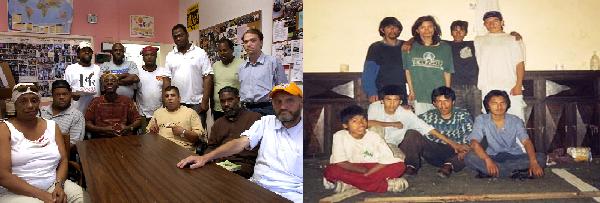
I hadn’t really thought about it, but I have noticed before that Mexicans – and Latins in general – are much more comfortable around each other than we gringos. I’ve been amused before by the clueless (by choice) gringos who assumed every man they saw with his arm around another man’s shoulders was a gay couple (or, when they’d see what was probably a padrino and ahijido, assumed the younger man was a prostitute). And, I got a perverse pleasure out of hearing a tableful of very nasty old queens on the Zona Rosa trying to figure out my relationship with a Mexican friend I properly greeted with an abrazo… we just don’t do that.
According to a California scholar named John Ibson, we did at one time. Ibson put together photos of U.S. men in groups from the 1880s to the 1950s – which sounds interesting – and wrote a semi-interesting (but also, semi-academic, i.e., pretentious) essay about his own research. His theory is that “homosexual,” a word that didn’t exist in English until about 1900 has changed the way we relate to each other, and we’re so conscious of how men are supposed to relate to each other, that we unconsciously adopt a “manly” pose.
Take a look at these two soccer teams… on the left, a college team from the U.S., on the right, the 2006 Mexican national team…

Mexicans – and Latins – don’t play by those rules, though maybe the Catalans do. This next photo is from a website for latina girls. How many male rock bands (this happens to be “La Lay” from Chile) in the U.S. pose like this?

When I first looked at the “issue” in 2004, I only looked at half the equation:
“gay” means effeminate men or masculine women. Behaviors we consider gay (good manners, cultural interests like the opera or women’s fashion, concern or body image and appearance) are neutral or positive values here.
But… Pancho Villa openly cried like a girl at Madero’s funeral. Obregón wrote morose poetry and had a biting wit. Zapata was a snappy dresser and very, very polite. And, if you’ve ever heard a tape of Francisco Franco, or read anything about the old dictator, he sounded “nelly” and was a fussy old queen… and hardly gay.
Citius64, who is hip and trendy, but not pretentious, wrote recently about Catalan scholar Oscar Guasch, who recently published a study called “La crisis de la heterosexualidad”. Citius, citing Vin Diesel and “World of Warcraft” has it over Prof. Ibson in the readablity department. Guasch, whose work I don’t know (I can’t read Catalan, and can’t afford the book anyway, even if it is in Spanish), makes the point that the late 19th century also saw the birth of “heterosexuality” as a concept
But, both Gausch and Prof. Ibson make the same point… we’ve got outselves into a situation where we act… consciously or unconsciously… according to some arbitrary set of rules. We assume the rules are universal, or at least the same throughout the Americas… they’re not.
Is it that Latin America is Catholic and communal and the North is Protestant and individualistic? Is it the Napoleonic Code (which never said a word about consensual sex)? Is it just that the Latin Americans just don’t give a shit what people think? Or is it something different about us? Friends of mine criticize us gringos for psychologizing everything… but we seem to be trapped in the psychology of 1900, and it’s where — or rather HOW — we stand.
Second stupid smuggler post of the day…
KPHO-TV (Phoenix):
HERMOSILLO, Mexico — An Arizona man is in jail in northern Mexico after the body of his girlfriend was found in the trunk of his car, police say.
Police said Ryan Chronis, 24, drove from an apartment complex in Cave Creek to Rocky Point where he was stopped for speeding.
Officers said they found his girlfriend’s body wrapped in a white blood-stained blanket.
MORAL FOR GRINGOS: obey Mexican traffic laws.
MORAL FOR MEXICANS: Red light/green light customs inspections may not be as thorough as one would like.


