Coming never? OR “The Producers” and the pols
With Televisa, TV Azteca, Netflicks, ClaroVision, and even the theater chain Cinemex, having all given a pass to the chance to air “Populismo en América Latina” the advertising that has been seen in recent days on the sides of Mexico City buses may have been a tad premature.

Assumed to have been financed by Carlos Salinas and Claudio X. Gonzales, allegedly with a 100 million peso budget ($US 5.4 million), the would-be documentary (meant, apparently, to show Andres Manuel Lopez Obrador in the “tradition” of Juan Domingo Peron, Hugo Chavez and Lula da Silva … and is that bad?) was entrusted to producer Javier García, García had a minor acting career, mostly in his filmsn he also produced: the most recent being “Cazador de narcos”. If you don’t remember that 2003 release, you’re not alone. Low budget, even by Mexican standards, cop thrillers would seem to have been more up García’s alley than documentaries. Spanish director Enelio Farina maybe has a little more experience with the genre… he’s apparently well-known for producing television commercials.

Where did we go right?
Admittedly, Mexfiles knows nothing about the movie biz, but somehow, one doubts smart guys like Salinas and Gonzales would have dropped this much money on what appears to have been a start-up production company (La Division) run by people with this particular “skill set” behind them. Either the budget is highly inflated or — with Salinas and Gonzales reflexively seen as the villains behind any anti-AMLO project of any magnitude — the project was never intended to actually be shown. Both seem reasonable. An inflated production budget for a dog of a show ( a la “The Producers“) could be profitable not only for the producers themselves, but for anyone looking to make money disappear. And, assuming the costs were more reasonable, the attempt to create an image of AMLO as an intolerant, wannabe censor and tyrant, would be a relatively inexpensive way to get around pesky election laws about negative advertising and outright slander for the “any neoliberal will do, but above all stop AMLO” political class.
Neither Televisa nor TV Azteca (our two major television networks), neither of which has ever shown any indication of giving AMLO even the benefit of the doubt in their news coverage, having turned the “documentary series” down, one is dubious that, as AMLO claims, it shows the networks have some ethical standards hitherto unknown. Maybe they do, but maybe the thing is a dog, and the networks aren’t about to turn off even more audience than they have already lost to Clarovision and Netflicks. Which didn’t want it either. If Salinas and Gonzales (or whoever the wizards behind the curtain might be) really want to get this into the public, they might take a cue from the Mexican political thriller “Ingobernable” in which the protagonists turn to Tepito’s thriving pirate CD industry to get their message to the public. But in that story, the plan was to force the mainstream media to report what people have seen. Here, the plan is to create a news event over what is unseen. Perhaps because it doesn’t show anything worth seeing?
Sources:
Regeneracíon, “Salinas pagó 100 mpd por serie de ‘populismo’ y televisoras no la quieren: AMLO” 22 April 2018.
“Javier García”, IMDB.com.
El Finanaciero, “Ésta es la productora detrás de la serie ‘Populismo en América Latina”“, 27 April 2018.
Sin Embargo, “Una élite lanzó el “todos contra AMLO”, dicen analistas políticos; tienen sus dudas que funcione“, 26 April 2018.
SDPNoticias, “AMLO presiona para que no se transmita nuestro trabajo: Productores de serie sobre “populismo“, 26 April 2018.
Dirs-n-Dops, the Filmmakers Industry, “Enelio Farina“
Apples and oranges: LGBT equality here and there
A study by two political scientists, published today by the London School of Economics, “reveals the puzzling finding that Mexico has offered greater legal equality for LGBT people for a longer period of time than the United States. ” I am not a political scientist, but wonder why the authors find it puzzling.

Photo: José Miguel Rosas, CC BY-SA 2.0
We haven’t had laws against sodomy since 1871, which is not surprising. U.S. law was largely an heir to the British legal system, while Mexico, in common with other Latin American nations… largely adopted the Civil Code (“Napoleonic Code”) that had been the standard in European nations for decades before Benito Juarez got around to pushing through a standard legal system. Our Constitution has “prohibits discrimination based on “sexual preferences” [while T]here is no explicit constitutional protection for sexual orientation in the United States.” Thst, perhaps is surprising, until one realizes that changes to the Mexican Constitution are relatively simple, and the addition of “sexual preference” to the wording of the first article was included (with some controversy) along with several other enumerated classes of non-discrimination to conform with the then standard South African Constitution of 1996 and other then more modern legal thinking. And, yes, we did have nation-wide recognition of same-gender marriage before the United States… by a few months, anyway.
What is puzzling isn’t that Mexico was more forward in these matters, but that the United States was so retro. The authors, Caroline Beer – a professor of Political Science at the University of Vermont – and Victor D. Cruz-Aceves – a doctoral candidate in Political Science at Christian-AlbrechtsUniversität zu Kiel (Germany), focus on two areas to account for what puzzles them: politics and religion. They seem to be making assumptions about both based on superficial similarities, rather than focusing on the profound differences that separate the two North American national cultures.
Of course the political systems are different. The United States has had for the last 175 years only two political parties of any significance, both relatively capitalist and centerist. The “left” in the United States has no comparison to the “left” in a country that went through a major revolution only a century ago, and in which Socialist and Fascist parties have both been major forces over the years, and U.S. style “liberalism” is centerist or center-right in our politics. Beers and Cruz-Aceves, to their credit, do note that as a “new democracy” (under the assumption that multi-party electoral politics is the definition of democracy) we probably are more proactive in demanding rights, and perhaps are more vocal about it, what they miss is the long history of Mexico’s obsession with “modernity”.
Going back to the first republic, and the fights between the Yorkista and Escosia masonic lodges, Mexican politics has pivoted around a pole of modernity and conservativism. And, even when conservatives were in power (as during most of Santa Anna’s era), the conservatives were always preoccupied with emulating the Europeans. , while attempting to preserve traditional privileges. Extending rights to LGBT persons was no threat to the elites, and was “modern” as well. That we followed European examples in extending basic rights to LGBT persons then, was hardly a radical move.
There were some religious objections, especially from the Church hierarchy, but — as the authors of Religion, the state, and the states explain why Mexico has stronger LGBT rights than the US note, for historical reasons, the “wall of separation” between Church and State is much higher here, and we like it that way. What I thought was a weakness in their comparison though, was an assumption that “Religion” (as a political factor) would have about the same meaning in the two societies. The conservative religion in the United States is Evangelical Protestantism, while in Mexico it is Roman Catholicism. Beers and Cruz-Aceves are absolutely spot-on in noting that, in the United States, religious belief is more likely to be given as a reason for a political posture (although, on the issue of same-gender marriage, it is popping up in the Mexican presidential campaign as well), but that is not entirely due to the just the historic taboos on using religion here to justify policy. Puritans have always been more concerned about the moral standing of the community than the Catholics, for whom private “sins” that don’t affect the community as a whole are generally overlooked (or at least, can be confessed and forgiven). And, in Latin America, we have always had a much more relaxed view of religion, seeing it as a culture, rather than as a personal statement.
Where I think the authors go wrong is in their thesis statement: “Common stereotypes about Mexico’s macho culture might lead us to expect that the legal landscape for gay rights in Mexico would be far less egalitarian than in the United States,” What “macho culture”? This is a culture of extended families, under the watchful eye of matriarchs. Yes, sexism is rampant here, but within the family, women rule. Within extended families, of course there are LGBT members, and the family (and the family matriarch), even if otherwise a conservative Catholic, carves out an exception for Her family. Add too, “compradizo”… “buddy.ship” if you will, or even “bro-mance”. Close, life-long friendships between unrelated persons of the same gender are the rule, not the exception. That these are sometimes sexual is a given, and no one thinks otherwise.
(As an aside, WTF is “macho” anyway? I’ve never seen anything defined that distinguishes this supposedly Mexican trait from sexist assumptions anywhere else on the planet, and … as the word was only used to describe bulls or other male farm animals until the late 1960s, the pseudo-Spanish coinage of Robert McAlmon and Ernest Hemingway back in the 1920s … to reference the attitudes of SPANIARDS, not Mexicans… I wonder if using the word “macho” — even if to say it is a stereotype — doesn’t suggest that the authors’ puzzlement isn’t just that they themselves are biased in their assumptions to begin with).
These notes may seem critical or nit-picky, but my intention is not to denigrate the fine work the pair has done. If anything, it’s the best I’ve ever seen on this particular topic.. not so much the specific question of why LGBT equality was obtained (at least legally) in Mexico sooner than in the United States, but why the Mexican policy can, and does, change with less political and cultural upheaval than that of our larger, supposedly tolerant and pluralistic, northern neighbor.
Dumb and dumber: Trump on NAFTA
Translated from “Trump pide a México actuar como agente migratorio a cambio de acuerdo sobre el TLCAN“, J. Jesús Esquivel , April 23, 2018, Proceso.
WASHINGTON (AP) – The president of the United States, Donald Trump, has once again called for new conditions for the restructuring of NAFTA, insisting the Mexican government act as a US immigration agent, preventing the entry of undocumented immigrants in his country.
“Mexico, whose immigration laws are very strict, must prevent people from reaching the United States through Mexico. We could make this a condition for the new NAFTA. Our country cannot accept what is happening, we must also have the funds to finance the construction of the wall soon, “Trump wrote Monday morning on his personal Twitter account.
Trump’s conditions come just as what may be the last stage of renegotiation of the North American Free Trade Agreement (NAFTA) between his government, Canada and Mexico is about to begin.
On Monday the Mexican Foreign Minister, Luis Videgaray, and the Secretary of Economy, Idelfonso Guajardo, will arrive in the US capital to participate in the plenary session that will take place on Tuesday the 24th with their Canadian and US counterparts.
Why would anyone think it wa sthe job of one nation to enforce the administrative procedures of another nation?
Is Mexico expected to determine the reason any citizen or visitor is leaving the country? Maybe this is “doable” in North Korea, but here… nah!
Will the United States reciprocate, and keep its own citizens from traveling?
How does one determine who is leaving the country not to return, and who is going for an extended vacation, or for some other reason?
Does Trump even know what a Free Trade Agreement is?
Derailing the election… by design?
Under the assumption that this candidate, Jaime Ramírez, El Bronco, will be able to cut into the margin of López Obrador, the group in power preferred to extinguish all legitimacy of the electoral authorities in order to inflict a wound on the opposition leader. For the time being, it has become clear that most of the [Electoral] Tribunal’s ministers are party hacks in power. We knew that [PRI had an edge in the Tribuna], we did not know that they were employees willing to commit any ignominy when so ordered.
Jorge Zapada Patterson in El País.
Qualifying “El Bronco” for the presidential ballot has been, so far, the most desperate (and obvious) attempt to … if not stop the AMLO campaign (or at least cut enough into his eventual vote count to cover any “irregularities” that would give some legitimacy to claims that it was “too close to call” and another candidate is declared the winner (a la 2006), then to blow the system up, delegitimizing the whole idea of contested elections.
Death is no excuse
Maria Felix would have been 104 today. It’s also the anniversary of her death in 2002. A diva to the end… and beyond.
 I was caught in traffic during her final curtain call.. having been exhumed at the behest of distant relatives who figured her death on her 88th birthday … had to have been a plot by her sexagenarian toy-boy to gain control of her estate, the petitioned the local prosecutor to have her dug up for a second autopsy. Of course, her fans all showed up to cheer the hearse leaving the French Cemetery. Rest in Peace? The woman never took a rest… not when she could still milk out a little more drama!
Ask, and you may not receive
Translated from ¿Tiene razón Trump?, J. Jésus Lema, Reporte Indigo
United States President Donald Trump celebrated yesterday the dilution of the “Viacrucis Migrante” caravan crossing through Mexican territory thanks, according to his Twitter account, to Mexico’s “strong” immigration policy.
Even though the Mexican government officially denied intervening in the movement’s dissolution, similiarity between the two country’s immigration policies are once again at the center of a debate.
Official statistics confirm Trump’s contention that Mexico has a “strong immigration policy”. Deportation rates in Mexico are up 80 percent this past year.
Just in the months of January and February of 2018, according to figures from the National Institute of Migration (INM for its initials in Spanish), the US government deported 32,017 Mexicans. In the same period, the INM detained 20,928 illegal entrants into Mexico, deporting 77 percent (16,278) of them.
During 2017, per IMN statistics, the United States ordered the repatriation of 166,986 Mexicans, while in the same year, Mexico deported 80,353 foreigners, mostly Central Americans, for illegal entry.
What these numbers demonstrate is that the immigration policy the U.S. government pursues against Mexicans who enter their country without documentation, is in practice the same as that pursued by Mexico against migrants who come mainly from the countries of Central America.
In 2017, of the 95,497 migrants who were detained by the Mexican immigration authorities, 84 percent were returned to their countries.
The numbers reveal that the majority of migrants in Mexico are Central Americans looking to find better opportunities. Of the 80,353 migrants who were expelled from the country, 35,133 were from Guatemala, 29,000 from Honduras and 11,542 from El Salvador.
Of the 166,986 Mexicans who were expelled from the United States in 2017, the greatest number were from eight states: 6,059 from Guerrero; 14,937 from Michoacan; 14,722 from Oaxaca; 11,087 from Guanajuato; 9,236 from Veracruz; 8,355 from Puebla; 8,221 from Jalisco; and 7,680 from the State of Mexico.
MANY DEPORTEES, FEW REFUGEES
Compared with high deportation figures from Mexico are comparatively low number of people who remain on national soil, mainly under refugee status.
According to data from the Mexican Commission for Refugee Aid (COMAR for its initials in Spanish), from 2013 to December 2017, the Mexican government has only granted refugee statutes to 23 percent of the 29,552 foreign applicants who have applied for political asylum, mainly Hondurans, Salvadorans and Guatemalans.
COMAR figures show that of the14,596 foreigners who entered illegally into our country and requested refugee status, the Mexican government denied that possibility to a total of 1,650 people. Another 2,233 never completed the bureaucratic procedure, 167 voluntarily gave up their petition, and 7,719 are still waiting for a response.
In sum, of all the applicants for political asylum registered in 2017, a total of 4,475 foreigners completed the administrative process, of which 1,907 were recognized as refugees, and 908 received complementary protection for their safety from the Mexican government. By gender, 5,876 were women, and 8,720 were men.
Central American migrants have fared poorly in their request for asylum. Of those 1,907 persons granted asylum as refugees, 907 were Venezuelans. Only 378 of the 4,272 Hondurans who requested asylum received it, and of the 3,708 Salvadorians, only 525 were given permission to stay.
On the migrant trail…
Neta is supported by individual donors who believe in our vision to amplify progressive voices from the Texas-Mexico border. In the one year since we launched, Neta has become one of the fastest-growing progressive online platforms in Texas reaching millions of people online. (contributions here).
Their loss is our gain
Great report by Franc Contreras, of CGTV… not all is gloom and doom for “dreamers” thwarted in their efforts to stay in the United States.
Read the fine print
Via Otto at Inca Kola News (“Annoyingly independent commentary on mining stocks and other things”) . TOREX, the Canadian mining firm has an “interesting” way of describing the on-going problems with their El Limon open pit gold mine… the murders, the strikes, the clash with autodefensas (people’s militias)…
“… the AIF’s [2017 Annual Information Form] ‘Risk Factors’ section, is just about the most wonderful I’ve ever read:
The ELG Mine Complex has brought new wealth to the area, and for some, the land leases, jobs, and business opportunities have created a distinctly improved set of economic outcomes. However, not everyone has been able to take advantage of these opportunities and for those who have not seen a dramatic change in their lifestyle, they now see others in their community with wealth that they do not have. This has been perceived as unfair by some members of the community, and most of the blockades to date have been an expression of that perceived unfairness. The Company has been working with the government to mitigate this risk of blockades, and it is expected that the economic benefits of the ELG Mine Complex will reach more local citizens once the government’s mining fund, which is supported by royalties from the ELG Mine Complex, starts to invest in the region. There is no assurance that the Company’s efforts will be able to effectively mitigate such risks.
Ottotrans: “It’s not our fault that we’re so wonderful and nobody told us that Guerrero is a difficult place, those small brown people should be happy and it’s just not jolly well fair.”
Paint the town purple
We don’t exactly have four season in Mexico City, but if there is a “Spring”, it is when the jacarandas bloom in late March and early April. We tend to think of them as the iconic tree of the capital, their omnipresence here is only about a century old, and due … not to some force of nature, but to an Japanese immigrant.
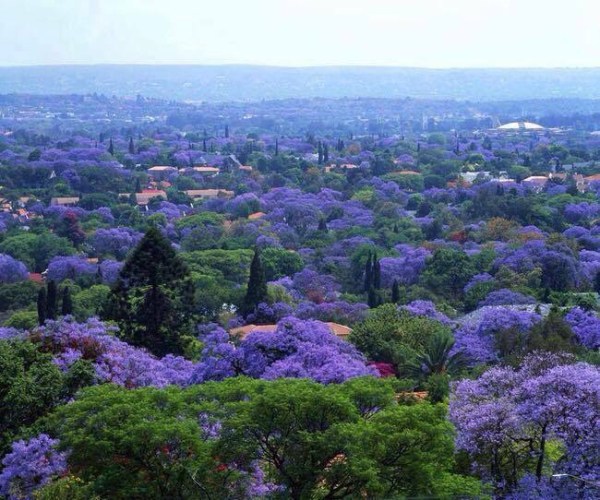 Sanshiro Matsumoto wasn’t looking to change the landscape of Mexico City when he arrived here in 1910. He was looking for his dad, Tatsugoro, who been hired to create a Japanese garden in Peru and was last heard of when he’d taken a job as a landscapper for the Mexican mining baron, José Landero y Coss in 1897. Sanshiro had lost touch with his father, but figured that it wouldn’t be too difficult to track down a Japanese landscapper in Mexico. He was right. Dad, Tatsugoro Matsumoto, indeed had landed a plum landscapping contract. But at the wrong time. Don Porfirio Díaz had hired Tatsugoro to oversee the gardens at Chapultepec Castle, something not exactly one of Don Porfirio’s priorities in 1910. And, considering he was being driven out of the country, he wasn’t looking to augment the landscapping staff. With the Revolution, Sanshiro and Tatsugoro were both out of work.
Down, but not out. If mentioned at all, at the time of the Revolution, Mexico’s political elites were looking to Japan as a potential ally agains the Western powers (especially the United States). The United States was deeply concerned over Japanese interest in establishing a naval coal station in Baja California, even before the Revolution. Pancho Villa, who was virulently anti-Chinese, welcomed Japanese immigrants into his ranks, and famously, the Zimmerman Note of First World War infamy, suggested that the Germans would try to convince Japan to change sides (it was on the Allied side in that war) to benefit Mexico.
Outside politics, there had been something of a European craze for Japanes art and culture before World War, one that was a bit late in reaching Mexico, but in time to keep the Matsumotos employed, if only running a nursery and small garden store during the Revolution. By 1920, with the Revolution more or less over, the nation looking to rebuild, and rapid population growth in the Capital, the Matsumotos were being approached by the resident of Chapultepec Castle once more. Alvaro Obregón, having firmly taken control of the Revolution, was as anxious to make the capital the nation’s showcase “modern” city as was Don Porfirio. If Mexico City was to be a 20th century city, it naturally would include that then faddish idea of middle class residential in-town suburbs. Like the recently annexed Roma district.
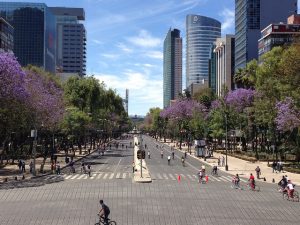 Washington, DC had had cherry trees since 1912, but the climate wasn’t quite right for them in Washington, or in Mexico City. Jacaranda mimosifolia, native to Paraguay and Brazil, however, is absolutely perfect for this area. It can withstand short frosts (and we get a few now and again), drought and flooding, is long lived, and can be propagated from cuttings. So… while considered a pest in a few places where it has been introduced… since the 1920s, jacarandas have spread from Roma throughout Mexico City, throughout the country and even into the United States.
(Oh, and an infusion of the flowers is known to kill E. coli virus. The bark and roots are used to treat syphillis)

Sergio Hernández Galindo, “Tatsugoro Matsumoto and the Magic of Jacaranda Trees in Mexico” (Discover Nikkei, 6 May 2016).
Josué Huerta, “La historia de los japoneses que nos trajeron los jacarandas a México” (México disconocido)
Jacaranda mimosifolia, Useful Tropical Plants Database
Passing acquaintances…

Problem visitors (left); passing guests (rights)
Mexico is facing an invasion of foreigners crossing its borders this week… at least 20,000 have descended on Rosarita, BC, and our police and immigration services are overwhelmed. So… what’s the big deal with the Hondurans and Guatemalans who are simply passing though, paying their own way and … unlike the drunken hoardes of gringo students … well behaved and conscious of their own security needs?
Ah… but ever since Buzzfeed reported on the “Refugee Caravan 2018” guided by Pueblas S
in Fronteras, the U.S. media (especially the more rightward leaning of the pack) and the U.S. President* have acted as if their 325 million people are somehow about to be i

nundated with a thousand or so refugees from countries the United States has turned into places too dangerous to stay. While I read on right-wing sites all kinds of attacks on Mexico for simply allowing these peaceful travelers to pass through unhindered as if it was our responsiblity for what happened in those US client states. If anything, they should be blaming the previous … to them odious… Obama Administration (and their favorite whipping-girl, Hillary Clinton) for justifying the 2009 coup, propping up the illegitimate government, and the subsequent flawed elections in Honduras that have created the conditions under which people are forced to flee their homes for the dubious protection of their persecutor. Throw into the mix the U.S. out of control narcotics import problem and … yeah… some people are gonna decide living with the bully of the north is safer than being bullied (or taking a bullet) at home.
 As Buzzfeed reported from the Caravan today:
“If this caravan bothers [the U.S. President], then it also bothers me that he supported people like Juan Orlando who oppresses the people, destroys the economy of the country, and creates a humanitarian crisis,” Irineo Mujica, director of Pueblos Sin Fronteras, told BuzzFeed News. “We didn’t create that humanitarian crisis. They want to stop the humanitarian crisis how? Stopping these people? The crisis is in Honduras, and he was part of the chaos that occurred in the country.”
Surprisingly, the usually odious Daily Mail (U.K.), despite describing these refugees as an “army”, has some very good coverage of the Caravan.
BTW… and this is the whole point… although the refugees are paying their own freight, they could use some help: Contributions to Pueblas Sin Fronteras here.
* I managed to keep my vow to give up all mention of the fellow during Lent, and now it’s Easter … but I detest … well, everything about him… and hope to avoid the near occasion of any mention, because his mere existence offends me… and thee. Amen.
Bee-deviled be-Jesus
While the best know Viacrusis in Mexico is the one in Itzapalapa (about 2 million spectators yesterday, the novelty being that… in a bow to gender equality… a few women were carrying crosses were added to the script, along with the usual Jesus and two thieves and miscellaneous condemned criminals) the annual “passion plays” have a long tradition throughout the country. They all follow the same basic script, of course… by Matthew, Mark, Luke, and John… but the 184 year old El Marqués, Queretero, with a cast of 135, introduced a suprise ending… getting cross-wise with local inhabitants.
The perfectly named Jésus Ramiréz Gutiérrez had fulfilled his role, carrying his 80 kilo (175 Lbs) cross to the crucifixion site, and was ready for the finale when… he was attacked by bees. It appears the little used chapel which is the site of the annual viacrusis was hosting eight hives, ready for a stining rebuke to the unwanted visitors. 44 people, including Jésus, and two Civil Protection workers, were treated for multiple bee stings.


 mexfiles.net