Surprised?
As Mexico battles to keep a lid on raging drug murders, American companies are vying for millions of dollars worth of contracts for military equipment and training under a long-promised U.S aid package.
Private U.S. security firms will get the bulk of a $1.4 billion package pledged by the United States in 2007 to help its southern neighbor crush rampant drug gang violence. Only a fraction of the aid has been delivered so far.
Almost all of an initial $400 million tranche approved by the U.S. Congress in 2008 and being released bit by bit to buy helicopters and inspection gear and train Mexican police will be doled out to 30 or 40 U.S. companies, said an official at the U.S. embassy in Mexico City, asking not to be named…
… A growing trend toward military outsourcing by the U.S. government has come under scrutiny in Iraq after Blackwater security guards were accused of killing civilians and a former Halliburton subsidiary allegedly overcharged by millions.
Some of the largest private security firms like Dyncorp, Northrop Grumman Corp and Blackwater, which has changed its name to Xe Services, declined to say if they were bidding on Merida contracts for equipment or training.
The Mexican government is being picky about contractors, carefully checking their reputations. “There is a sensitivity on (their) part about Merida looking like Iraq, Afghanistan, or Colombia,” the U.S. embassy official said.
U.S. Democratic congresswoman Jan Schakowsky has raised concerns about using private contractors in the drug war abroad, saying monitoring their activities can be difficult.
“When they wear the badge of the United States there is a very clear chain of command and very clear rules,” she told Reuters. “These contractors tend to be very much independent operators.”
Friday Night Video — for Hillary Clinton
By now, it’s evident that the categorical condemnation of the coup [in Honduras], formulated by the Secretary General of the OAS, José Miguel Insulza, was a break with this organization’s deplorable tradition and, just as surely, provoked Washington to quickly remove him from the scene, substituting the docile Costa Rican president in his place.
[Organization of American States Secretary-General José Miguel] Insulza, a former Chilean Interior Minister, apparently rubbed the US the wrong way following his leadership role in the OAS’s decision to readmit Cuba to the organization. Cuba was removed from the OAS in 1962 last June.
The US wanted stricter regulations to be imposed on Cuba to assure greater democracy in the country. Clinton was reportedly unhappy with Insulza’s personal attempts to get Cuba unconditionally reinstated.
Insulza’s position was further undermined by Clinton’s naming Costa Rican President and Nobel Prize winner Óscar Arias as the sole negotiator in the Honduran crisis, (July 9), ignoring Insulza’s efforts, reported Chile’s conservative media this weekend.
It seems like just yesterday that Lanny Davis was making the rounds of every news outlet that would have him, talking up Hillary Clinton’s bid for the White House
…
And now the hardest working conservative Democrat in show business has a new gig: lobbying against the Honduran leader recently deposed in a military coup.
The Hill reports that Davis has been hired by the Honduran branch of CEAL, the Latin American equivalent of the U.S. Chamber of Commerce, to urge US lawmakers to support, rather than oppose, the military removal of President Manuel Zelaya, Honduras’s democratically elected president.
Of course, thanks to his close ties to the current Secretary of State — who met with Zelaya yesterday — Davis could be particularly well placed for the job.
The Secretary-General — and many others throughout the Americas — have only one thing to say about the U.S. Secretary of State, Hillary Clinton. The same thing these old Canadian guys were saying at the 2007 Pan American Games:
Sea monsters!
As if the economic situation wasn’t enough, shootouts in Acapulco and the swine flu scare have put a dent into any hope for a quick recovery in the Pacific coastal tourism industry. Now comes an even scarier proposition… sea monster attacks!
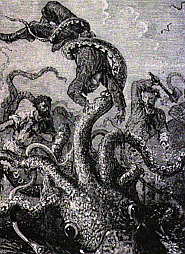 The Royal Norwegian Naval tanker, Brunswick, was attacked by a squid in the 1930s and during World War II, a sailor in a lifeboat was said to have been pulled out and eaten by a squid (that was the survivor’s story, and they stuck to it). There are reliable reports of sperm whales and squid fights, with the whales not always winning. However, the whales were probably fighting the really, really big squid, Mesonychoteuthis hamiltoni.
What are appearing now — unusually late in the season (normally they’re only close to shore in the spring), and further north than usual (around San Diego right now) are Diablos Rojas or Humboldt squid (Dosidicus gigas) have been moving into shallow waters.
They’re predatory, to be sure, but these guys are “only” about one and a half to two meters meters long, and “only” weigh around 50 kilos… it’s not like they’re going to eat too many tourists.
Besides, they make good eatin’ and one is more than enough for a family sized helping of calamar. They tend to run in schools, and are harvested by our local shrimpers during the closed season. Diablos Rojas normally run along the coast in the late Spring. One expected culprit in their sudden rise in numbers and expansion in range may be overfishing of their predators — shark, marlin and whales. Global warming, el Niño and a series of recent small earthquakes off the coast may also have played a role in the unusually late — and unusually large number of sighting — of Diablo Rojas.
Ah well, so far the squid scare has been only around San Diego (itself somewhat unusual, normally being found further south). And they’re only mollusks… scarier stuff comes out of the sea.
New VW plant to build who knows what
While most automakers are trying to fight off the red ink during one of the worst economic downturns in recent history, Volkswagen is blazing ahead and not only building a new, $1-billion plant in Tennessee but investing another $1 billion in its Mexico plant and adding an unspecified to model to the mix.
(Scott Evans, Motortrend)
This is extremely good news for Puebla, where production is down by half of that last year, and the company was forced VW to lay off 800 temporary workers in June alone.
Though the Puebla plant is best known for having produced the old Beetle until 2003 (long after production ended elsewhere), VW de Mexico presently turns out “New Beetle” and Jettas for the U.S., Canadian and Mexican market. It’s reported that the new Tennessee plant wil be building a new version of the Passant which has the automotive press speculating on what exactly will be built at the expanded Mexican plant. Guesses are the Polo or Up! which aren’t sold in the United States, suggesting that VW is looking at the Mexican and Latin American market to rebuild Mexico’s oldest (and presently #2 behind Ford in number of units manufactured) auto company.
Another naked Mexican guy in Hollywood
Nude Gay Mexican! is still the all-time champeen in he Mex Files “hits parade” (followed a poor second by a post on gerbils and donkey shows). By popular demand… here’s another nekked Mexican guy from the early days of Hollywood.
 Yup… “Oscar” is Emilio Fernández Romo, “el Indio”, who was learning his craft from the ground up in the 1920s, largely through an accident of history. Born in northern Coahuila (his mother was Kickapoo), in 1903, he’d unwisely joined ex-President Adolfo de la Huerta’s 1924 uprising. Like the ex-President, he fled to Hollywood (De la Huerta ran a dance school) and Emilio began learning his craft from the ground up, as an extra and go-fer.
Besides being Native American, well-toned bodies weren’t particularly stylish in 1920s Hollywood, and Ramon Novarro had the small market for hunky Mexicans pretty well covered all by himself … seriously limiting any future for “el Indio” as an actor in the United States. But there were other ways to get before the public.
His friend, Delores del Rio (who later posed for lesser-known American sculpture of note) , was married to set designer Cedric Gibbons who had been commissioned to design for the American Academy of Motion Pictures Arts and Sciences. “Indio”, was a bit shy about the idea of posing naked, but he needed the money. And… as they say… a legend was born.
As a screenwriter, actor, director and producer, from the early 1930s into the mid 1980s, el Indio influenced the “look and feel” of Mexican films (as well as Hollywood westerns, through his work with John Ford). He’s often credited with inventing the Mexican Revolution film, which made Maria Feliz and Pedro Armendáriz stars, and gave Del Rio a new career long after her Hollywood fame had faded. But he never won an Oscar.
If he limps like a lame duck…
The [Mexico City] News still has the crappiest retrieval system I know of (and no copyright information appears on the on-line edition that I can find), so — while I’m including a link — I’ve also pasted Ricardo Castillo’s article on the election and its effect on the parties at the end of this post.
While noting that both the PRD and PAN (both of which did poorly in the 5 July elections) are seriously discussing reorganization, two startling facts come out.
First, though less important for the immediate future, is that the PRD meeting this weekend is looking at healing the rift between the various “tribes” within the leftist party, as well as rebuilding the coalition with the two smaller parties of the left. While neither Cuauhtemoc Cardenas (whose 1988 run for the presidency — and is probable victory in that race, though Carlos Salinas de Goutari “won” — on a coalition of leftist and reformist tickets led to the party’s founding) nor Andres Manuel Lopez Obrador (whose coattails gave the party it’s greatest strength when he also may have won the presidency in 2006) attended, neither did the present party chair, Jesus Ortega.
Ortega — whose “chuco” faction, won in a bitter intra-party squabble, is seen by many to have been a divisive figure in what is an already fragmented coalition of interests. Carlos Narvatte, the PRD Senate leader, is calling for unity, and opening the party to all factions.
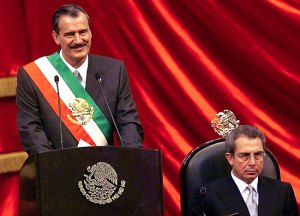
More important were the PAN meetings, also this previous weekend. Party Chair German Martinez — a personal choice of Felipe Calderon — was unceremoniously sacked even before the last votes were counted. Calderon himself is in trouble. PAN”s Senate leader, Gustavo Madero, told the press that — within the Party — “President Calderón has only one vote, he is just like everyone else here. We can no longer speak about the president’s candidate.
Calderon, remember, was not President Vicente Fox’s choice for his successor, forcing a bruising primary on the party, and in some ways, forcing the “pragmatic wing” (the pro-business wing of Fox) to the sidelines in party control. Which the party faithful now see as a strategic error.
Quacks in the system
With Calderon being pushed aside by his own party, he will be the first “lame duck” president we’ve had. Fox and Zedillo both had to deal with opposition legislatures, but Zedillo, who had been pushing to separate his party (PRI) from the government, faced a divided opposition in the legislature — split between the left and the right — which meant he could find middle ground from either side for any given administration proposal. And, while Fox’s PAN was in a slight minority the last three years of his “sexenial” (six-year term), he could count on support from the “dinasauro” wing of PRI which was hungry for the trappings of relevance. Fox could also count on the support of Esther Elba Gordilla, who — after the party stripped her of her central committee seat, and then purged her — still maintained some pull through the small Nueva Alliaza party.
Nueva Allianza will have a few seats within the new legislature, but, their short history is that of surviving by allying themselves to the “powers that be”. There may be no upside for them in working with PAN in the next legislature, and they’ll be more likely to try to swing PRI legislation to the right. PRD is likely to work with its two “junior partners” and regain its role as a leftist bloc that can swing legislation. But — with PRI in a majority by itself (and a plurality with the Greens), this will be the first time in Mexican history that the President cannot command the legislature since Madero’s short 1911-1913 Presidency.
Madero’s Presidency ended with a coup (U.S. sponsored, as everyone should know), but there was support for replacing him even before the coup, in part because he lost control of the legislature. I don’t see anything quite that dramatic in the next few years (despite those who claim that because the War of Indepence started in 1810, and the Revolution in 1910, there has to be a violent upheaval in 2010. A series of two does not mean a series of three).
 Calderon’s programs are probably dead however. The “War on Drugs” is losing more support every day, and — bolstered by the Human Rights Watch Report on military abuses in that “war” the PRI (and PRD) both have sufficient political rationale for drastically reducing the military operations, and — being nationalist parties — are less likely to be swayed by U.S. interests. Besides which, revenge is sweet, and many in both parties were incensed at the accusations that they were more “corrupted” than the presidential party.
The economy has not gotten better, and the leftist proposals look better all the time. Kiss selling off PEMEX good-bye, and say hello to more domestic spending programs at the expense of “free-trade” orthodoxies. PRI chair, Beatriz Paredes, has been trying to pull the party back to its left-wing traditions, though there is some concern that Carlos Salinas (and his “neo-liberal” backers) still have too much power in the party. While some of the PRI may back Calderon on economic issues, that isn’t a sure bet.
It would be a logistics nightmare if Calderon were to resign because of the need for a interim president to serve until the 2010 Elections, at which time an “Internal President” would be elected to a two year term, and there is no guarantee that any president appointed by the legislature would be from the same party as the sitting president. The only time there has been an internal and interim presidency (and it got messy, when the internal president then quit before the end of his short term, forcing the legislature to select another interim president), the legislature and the presidency were firmly in the control of Plutarcho Elias Calles, with a single party dominating the country.
And, of course, anyone serving as president — even for a day — would be ineligible to ever hold the office again.
The chances of a Lopez Obrador presidency — even for a couple of months? Nil. The chance for massive policy change? Very, very high.
(The News article after the “jump”)
Does Sarah Palin know AMLO?
One advantage of not watching U.S. television is I get my U.S. news from internet broadcasts, and can skip the clips that really don’t interest me at all. My interest in the Sarah Palin saga… the Governor of Alaska who — having shot up from nowhere to national prominence — then suddenly quit hasn’t been all that overwhelming. Everyone assumes Palin’s political career is toast, though she keeps hinting that something else is going on. Maybe if she was a Mexican politico I’d kind of believe that.
The PRD, which runs the Federal District the way the bigger parties run their respective strong-holds (crushing all opposition, internal and external) broke after the close 2006 election over whether to continue support for Andres Manuel Lopez Obrador’s campaign to overturn the dubious Calderon victory, or whether to compromise and accept the PANista’s narrow win as legitimate.
The party only managed to hold together by working out a compromise whereby Lopez Obrador backers ran on two smaller parties (PT, the Workers’ Party [theoreticaly Maoist and Che-guevarist] and Convergenica [social democratic]) in the Federal District.
Clara Brugata, a Lopez Obradorista, was forced off the PRD ballot in Itzapalapa, despite overwhelming support in the party primary. So, Lopez Obrador, and his backers, supported the PT candidate, who suprised the experts, and won the seat, big-time. El Debate de Sinaloa (my translation) wrote an editorial that explains what happened next… and what might be the result down the road.
With an informed, vigilant citizenship demanding transparency that by the political parties and the electoral authorities, it will no longer be easy to make deals behind closed doors, nor to treat the people capriously, after what happened in Iztapalapa, following the election of “Juanito”.
The triumph of Rafael Acosta Ángeles, (Juanito), the Workers’ Party candidate in Delegación Iztapalapa, over the PRD, PAN and PRI, began when the Federal Electoral Tribunal forced Clara Burgada off the ballot, touching off a citizen’s revolt. It ends with Acosta’s election, and his resignation in favor of Burada, to fulfill a political commitment to Andres Manuel Lopez Obrador.
“Juanito” was the instrument of the citizen’s rebellion, having run with the intention of resigning in favor of Brugada… and obtaining fame and popularity no one could have predicted in the process.
“Juanito” already gained fame and political glory, not only from those who cast their ballots for him, but from citizens generally, as a result of special circumstances that will allow him to consider being a candidate for Jefe de Gobierno of the Federal District three years hence, and – perhaps – for President of Mexico in another nine.
The strangest part of this political phenomenon in the Federal District, is that Clara Brugada, who was replaced as the candidate for Iztapalapa by Silvia Olivas Fregoso, will win her seat as Jefa de Delegación without having participated in the elections.
Finally, Andres Manuel Lopez Obrador, who pushed Brugada’s candidacy, and – when she was removed from the PRD ticket by the Electoral Tribunal – denounced the party, is the biggest winner of all in Iztapalapa, assuming “Juanito” fulfills the political pact that he has so far honored, and said will not be broken.
I’ve always said you can’t count the guy out, and — while I don’t think he’ll be a candidate for President in 2012, I don’t think AMLO, nor his 30-35 percent of the voter’s support, ever really disappeared. It may be significant that the editorial was not from a Mexico City newspaper, but a provincial one. Being out of the media spotlight may have worked to AMLO’s advantage, letting him rebuild his organization without drawing attacks from his avowed enemies, the television networks and corporate media, while working with grassroots organizations in rural areas, and in working class communities like Iztapalapa.
I don’t see a Lopez-obradorista being able to capture a third of the vote in the near future, but — given the poor showing by PRD nationally, PRD may be more amiable to a coalition with the smaller leftist parties, and — given the leftward slant of PRI chair Beatriz Paredes, whose party will have enough seats to not need a coalition with PAN, the left may be driving more of the legislative agenda for the next three years.
Beat the press
Sombrero tip to Maggie’s Madness for finding this in the Tijuana “El Mexicano” (my translation):
TIJUANA — The daily violence witnessed by municipal police have caused some to get testy*, cumulating in attempts to interfere with the work of various mass media journalists.
The result have been verbal, written and electronic threats by municipal police officers, directed especially at photographers and writers.
There were at least two new incidents over the weekend, one in Colonia Tecolote, where an armed gang had attacked three civilians.
There, Municipal Police officers, besides seizing photographs from journalists, told them “the mass media is responsible for this violent situation
Yesterday evening, after a municipal officer was murdered and another wounded, the police again interfered with journalists.
Specifically, the police sought to block the “right to information” and came to blows with cameramen and photographers seeking to record the violence that continues in Tijuana.
As a result, media representatives have released their own press statement, seeking a meeting with Secretary of Security Julian Leyzaola Perez and Tijuana’s mayor, Jorge Ramos Hernandez, to address the situation at the highest level.
At the same time, this morning the representatives of the national and international media requested a meeting later this evening with General Alfonso Duarte Mújica of the Federal Coordinating Group for Baja California to address their concerns.
Journalists, like police, have a job to do, and each sees their job from their own perspective. However, this is not a reason for disturbances, nor should it be a rationale for interference with the work of the journalists.
* The original word was the noun “la crispación” — a noun form of frazzled, fried, pissed-off… crispy — and a word we really could use in English.
Trivial pursuit
The Bastille Day trivia question was:
Besides Mexican diplomat Gilberto Bosques, who arranged for European refugees to flee the Nazis via Casablanca, another Latin American political figure has an important connection to the film, Casablanca. Who was he, and what was his connection to the movie.
Trivia answer: The Latin American political figure connected with “Casablanca” was Dominican dictator Rafael Trujillo, who was an extra in the final scene, He is one of the people at the airport (he’s watching a propeller go round) as Rick says his good-byes to Ilsa (and then plugs Major Strassner).
While it’s true that Trujillo welcomed Jews and other European refugees into the Dominican Republic he might have better played one of the Nazis. His stated purpose in welcoming European refugees was to “whiten” the population, after the slaughtering Haitians during a bloody pogram in 1937. Trujillo had set himself up as the undisputed leader of a party based on a cult of personality, and modeled his regime on both Francisco Franco and Josef Stalin. U.S. Secretary of State Cordell Hull said of Trujillo, “He’s a son of a bitch, but he’s our son of a bitch”.
Following the Second World War, Trujillo was supported by the United States as a bulkward against Communism. However, his attempts to assasinate the “Father of Venezuelan Democracy”, Romulo Bettencourt, followed by persecution against Bishops who had turned against the regime, cost him the support of both the U.S. and the Vatican. When anti-Trujillo forces turned to Cuba for asistance (and Cuba sent a small invasion force), it became clear that Trujillo and Trujilloismo had to go… it was only a question of whether a Cuban-backed or U.S. backed coup would overthrow him. The CIA and the Papal Nucio both provided clandestine support to the officers and others who finally assassinated “the Goat” in 1961.
Honduras: please hold
Nicholas Kozloff argues that one possible behind-the-scenes reason for the Honduran coup was a fight over telecommunication deregulation… Zelaya being opposed to it, and the coup-monger, for.
Be that as it may, any attempt to restore the legitimate government is on hold. Bloggings by Boz noted this morning that:
…we can be 95% certain there will be a democratically elected leader in six months. Whether or not Zelaya returns, it’s almost certain that elections will be held in November (if not sooner) and a new president inaugurated in January.
That was true before the coup, and would have been true even if the referendum (which was unofficial at any rate) was held … even if ballots printed in another country (the latest spin on why the coup was justified) there STILL would have been a new President in January.
The only reason at this point for a coup is to destroy any opposition to the status quo before an election can be held, and the longer the coup holds on, the less likely there will be any change or real democratic options on the November ballot.
Which was probably the whole point in the first place. I expect some kind of “settlement” acceptable to the United States that allows the elections to be held– with the guys who bent the law (and that’s being generous) being able to set the ground rules to assure they remain in power. In other words, rewarding the coup for staying on the line.
In the meantime, expect even more opposition figures to come to untimely ends as Hillary Clinton dithers.


 mexfiles.net