“N” with a mustache…
A nice beat, but can you blow stuff upto it?
I always figure its a measure of how relatively safe Mexico City is what kind of crimes are reported:
Officers of the Federal District Secretariat of Public Security* seized a firecracker from a group of youths identified as “reggaetoneros”** which they had allegedly attempted to hide in a trash can outside Pantitlán Metro Station.
The youths apparently had intended to use the firecracker in an attack on a rival group that had previously beaten one of them.

Not the real Task Force Zorro
According to the police report, officers of the Task Force Zorro shadowed the group as they left the station. Sensing the police presence, the youths became nervous and one of them approached the trash can in a suspicious manner.
While inspecting the scene, officers discovered the firecracker, preventing its detonation. It was removed under tight security to a place where it could not harm anyone.
Due to the risk of the operation, an intensive search for the perpetrator followed, but there was no capture.
On the other hand, officers dissuaded a group of rockeros, who those who presumably inflicted the beating the attempted firecracker assault, from searching for the other gang.
Finding nothing to prosecute, officers convinced the 20 or so rockeros to go their separate ways.
* Police-beat reporters are usually paid by the word. Why say ” Police” when you can use five or six words?
** Youth gangs here aren’t fighting over turf so much as they are over musical style. Reggaetoneros — aficionados of the Puerto Rican musical style — have been duking it out with Rockeros this season. It’s probably not all that serious, but these kids tend to get into fights on the subway, which is a headache for the police…
My translation from: David Fuentes, “Decomision petardo a ‘reguatoneros’ en Metro Pantitlán” El Universal, 23 March 2014
Mexican(?) Thais and Mexican ties
(Thanks to Chris Simms, for noting a misunderstanding of mine that required a revision. I moved two paragraphs and rewrote part of one. Revisions in italics)
This video from Coconuts TV (“The weird and wonderful of south Asia”) was posted on Borderlands Beat under the headline “Young Thai men emulate Mexican cholos”.
The headline confirms my sense that “Borderlands Beat” is less a Mexican site than a U.S. one, where “Mexican” and “Mexican-American” are assumed to be the same thing. “Cholo” is not a word usually found in Mexico (although according to the 1571 “Vocabulario en Lengua Castellana y Mexicana” of Fray Alonso de Molina, there is the Nahuatl word “Xolo” … slave or kitchen-servant). Where it is found used regularly is in South America (especially in the Andean countries) as a sometimes derogatory term for those of indigenous descent (or, in parts of Bolivia, for those of Afro-Indigenous descent).
Somehow, in the United States, the term was applied to “Latino” gangs in California and later in other U.S. urban areas with a Latin American immigrant and descendant underclass. Often poorly educated and underemployed (like most gang-bangers), the “Cholo” style is described as one adopted by:
A person, typically young, associated with gangs and apparel such as loose pants, a white tee-shirt worn under a well-ironed shirt buttoned only at the neck, and sneakers.
“Cholo” would be seems to be more “Hispanic” phenomenon than a Mexican one in the strictest sense. Although there are “Cholos” in some Mexican cities, they are seen as a foreign import, rather than another autochthonous. I will say that the only Cholos I’ve seen in Mexico have been returned migrants who were raised in the United States, or U.S. citizens of Mexican descent visiting relations here.
At least in the United States, Cholos are often also heavily tattood. While tattoos were never uncommon in Mexico, the “body ink” gave them a sinister image when the practice was also taken up by Salvadorian gangs in U.S. prisons. Deported from the U.S. those gangsters … and their style … reached El Salvador (and other Central American states) and has given Cholos style (whether the actual person is a criminal or not) a much more sinister image in Mexico and Central America beyond that of a simple ethnic marker.
The native Cholos are — in the snarky view of one commentary — also found in Tepito and other Mexican “ghetto” areas, either involved in petty mischief (like grafitti painting) or as gunmen for criminal gangs, have a taste for cumbia, hip-hop and rap, and tacky girlfriends.
While perhaps a rather picayune quibble — and I know many Mexican-Americans reject the idea that Mexican-Americans and Mexicans are culturally different, it doesn’t strike me as all that strange that some Mexicans, and some Thais have taken up a foreign style. Coca-cola and blue jeans are not the only U.S. cultural exports, nor are Mexican influences in Asia limited to chiles. But whether the Thais have taken up a U.S. style, a Mexican one, a Mexican-American one, simply created a Thai version of what they see as a Mexican variation of a Mexican-American style is something I can’t answer.
Young Thai men emulate Mexican cholos Borderlands Beat 20 March 2014
“Tribus Urbanas: Los Cholos“ Formacion Cultural 6 June 2012)
Antonio, Giovanna, and Norma. Cholos Tribus Ubanas (Blogspot) November 2010
A country for old men
Regresa a mí/ Return to Me … Recorded in 2012, by then 85 year old Tony Bennett and 72 year old Vicente Fernandez.
Sombrero tip to Porter Corn.
Dogs and cats together. Argentines and Brits agree!
Sombrero tip to Inca Kola News:
Argentine President Cristina Fernandez and British Prime Minister David Cameron have both strongly condemned the Crimean referendum as an illegitimate exercise, held as it was while there were Russian troops on the ground.
 I’ll accept that, but if 21,000 Russian soldiers at the time of the referendum, or one per ever 100 citizens is the rationale for disregarding the vote, then what can one say about last year’s poll of the residents of the Malvinas conducted under the gaze of 1200- 1500 British military personnel stationed on the islands… which, with a population of just under 3000 people, works out to one soldier per every two to two and a half inhabitants?
The thrill that will getcha, when you get your picture
… on the cover of Proceso.
Several thousands of copies of the latest edition of Proceso, feature a photo of a rather sad-faced Eruviel Ávila, governor of the State of Mexico were bought out in both the Federal District and Guadalajara, either by fans of the governor, or… more likely… by those who wanted to keep the public from reading the cover story, headlined “Blood Feud in the State of Mexico: In the administration of Eruviel Ávila, like in the previous Enrique Peña Neito administration, narco-gangs kill for the loot.”
 A few years ago, when Proceso had a cover story about poltical times to the gangsters by some of our Sinaloa politicians, the distributor was forced to sell the entire Sinaloan allotment to masked gunmen… that’s right, I said sell. They paid cash, by the way.
I suppose this is another of those “no news is good news” when the news is going to be bad, but this seems a rather inefficient way to censor the press. Whatever happened to just bribing the reporters?
How sweet it is!
No, an extra margarita or four will not help you lose weight, but you can’t blame the media for drinking up the story that agavins — the form of frutose found in agave, which is distilled into tequila — may help reduce blood sugar and reduce weight in humans.
At the annual meeting of the American Chemical Society, Dr. Mercedes López Pérez presented an abstract of a yet-to-be peer-reviewed research conducted at the Iraputo campus of Centro de Investigacion y de Estudios Avanzados, Biotechnology and Biochemistry (Cinvesav), which compared weight loss and blood sugar levels among groups of lab mice.
One group received a diet of plain water, while the other groups received water supplemented with either aspartame, glucose, fructose, sucrose, agave syrup or agavins.
The mice that consumed agavins showed a reduction in food intake and weight and a decrease in blood glucose levels. These findings were similar to the control group that received standard water.
While less sweet tasting than other artificial sweeteners or other sugars, López has suggested that there are ways to overcome the problem (and she has already applied for a patent on the process) and, besides,
“People must somehow understand that we cannot have the best of both worlds,” in terms of finding an alternative sweetener that is still very sweet, she commented.
It’s been known for some time that agavins reduce glucose levels and increase the level of hormones that slow down digestion and stimulate insulin production.
While of course there are commercial interests involved (not only agave  producers, but also Mondelēz International — the makers of Oreos and Chips Ahoy! — helped underwrite the research) and the idea of losing weight through tequila consumption has a certain twisted logic to it, if the Dra. is on the right track, this is major news not so much to the snack food industry and drunks, as it is to public health officials here in Mexico.
Diabetes is the leading cause of death among women, and second leading cause among men, in Mexico. And, we recently passed the United States as the most obese nation on the planet. According to many, both ailments are in due largely to a post-NAFTA abandonment of the native diet and a national addiction to sweetened drinks and snacks. The latter is the rationale behind a recent additional tax on high calorie food products. The former — a return to traditional food products (like agave) — has received much less attention from the outside world, and has not attracted much support within the general public in Mexico (outside of foodies and diet faddists). A traditional product, that seems to help diabetics cope with their condition, AND… as a sweetener would lower caloric content enough to avoid the tax bite, is a win-win for us all.
I’ll drink to that!
Sources:
New tequila plant-based sweetener could be a healthier option for diabetics (first quotation in post) Yahoo News (18 March 2014)
Plant Sugar May Prove to be Healthy Sweetener, Elizabeth DeVita Raeburn, MedNews Today (16 March 2014) (second quotation)
Sugars found in tequila may protect against obesity, diabetes, FoxNews.com (17 March 2014)
World Health Organization, Country Cooperation Strategy at a glance: Mexico
Oil in Mexico is much more than a symbol of national pride. For the past 75 years it has been an enormous source of income for developing Mexico’s infrastructure and improving social welfare. When, on this day in 1938, President Lázaro Cárdenas expropriated U.S.- and U.K.-owned oil companies, he allowed Mexico to achieve relative independence and modest prosperity. The nationalization of oil saved Mexico from becoming a paralyzed, essentially colonized country like Guatemala, which has a major mining industry that is almost entirely foreign-owned.
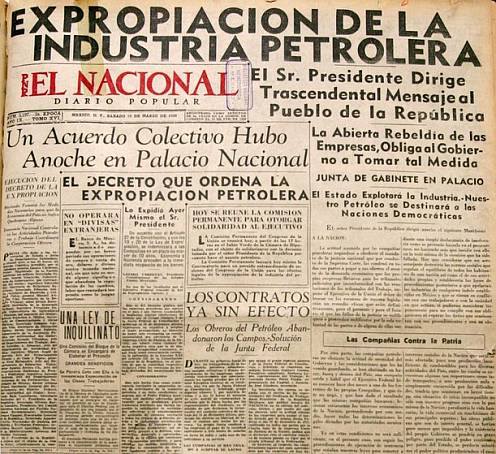
“Mexico’s Oil Belongs To Its Citizens, Not the Global One Percent“

Check grandma’s attic
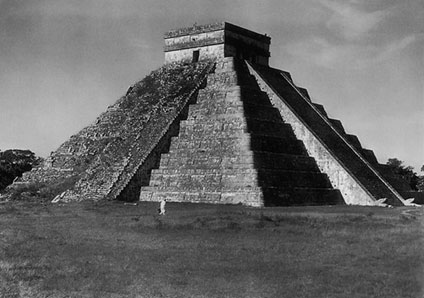 If you had relatives visiting Mexico City between September 1954 and November 1955, you might want to look through the old family albums. Maybe they bought some photos from a street photographer of some fame.
… while in Mexico following his motorcycle journey through Latin America, he got a contract with Agencia Latina (photographing the Pan-American Games of 1955, for which he was ultimately never paid) and also earned some of his living as an itinerant photographer in the parks and squares of Mexico City. He then continued taking pictures during the armed revolt in Cuba and through the course of the Cuban revolution; and even as he was traveling around the world as a member of the Cuban government. A very unusual experience as a photographer.
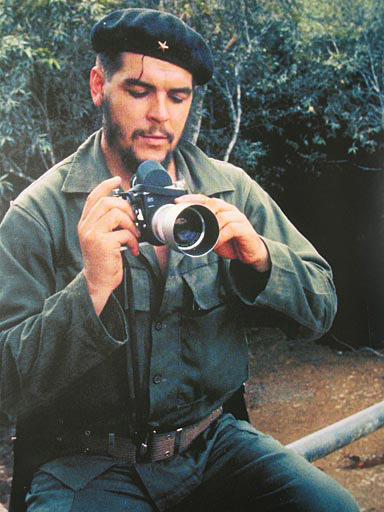
Elie Ivanova, “Che Guevara the photographer” Parasol Photography (19 April 2012)
ACK!
Had to have system repaired… all my bookmarks are gone!
Will have something up later today or over the holiday … Benito Juarez Birthday observed on Monday.
By a nose???
What are the chances that the right — at the last minute — has pulled out a victory in El Salvador…. sort of like what happened in Mexico in 2006 (where at least there were more than two parities on the ballot that could siphon off some votes from the left)?
As of right now, there’s only a 0.2 percent difference between the expected winner and front runner, FLMN’s Salvador Sánchez Cerén and ARENA’s Norman Quijano. Media sources are claiming sitting vice president Sánchez Cerén has won while Quijano, last I heard was claiming foul. And calling for military intervention… or a coup. This sounds less like the Mexican option (a crooked election that would keep the left from gaining the presidency) and more like Venezuela’s 2013 special presidential election, in which a right wing candidate came relatively close to unseating a left-wing administration (although in Venezuela, the difference was much greater, 1.5 percent) and the right used it’s “close but no cigar” to call for violence. At least in Mexico, the protests were non-violent (and, ultimately unproductive… which makes one question the whole non-violent change bit. Unfortunately.
Apple appeal

The wonders of “free trade”…
Arturo Rivas, an orchardman in Guerrero, Chihuahua cannot sell his apples to local supermarkets because they’re buying U.S. apples (usually picked by Mexican workers). Rivas’ apples are 70 pesos a box… picked by Mexican workers… in Mexico.
If you want fresh Mexican apples, Arturo’s cell phone number is 656-332- 4353.


 mexfiles.net