The war (profiteers) on the border
A terribly misleading heading in the New York Times yesterday on the militarization of the U.S. borderlands as “War on the border”… there is no war, unless its a war on the residents of the United States by its own government for the benefit of what was once quaintly called the “military-industrial complex”:
>In 2012, the Migration Policy Institute reported that immigration and border enforcement spending totaled almost $18 billion. That is 24 percent more than the $14.4 billion combined budgets in the last fiscal year of the F.B.I., the Secret Service, the Drug Enforcement Agency, the Marshals Service and the Bureau of Alcohol, Tobacco, Firearms and Explosives. Add the billions anticipated in the Senate bill, and you have what the trade publication Homeland Security Today calls a “treasure trove” for contractors in the border security industry.
Projected as an approximately $19 billion industry in 2013, defense contractors seem, in the words of one representative from a small surveillance technology company hoping to jump into the border security market, to be “bringing the battlefield to the border.”
In 1999, the anthropologist Josiah Heyman wrote that the Southwest was becoming a “militarized border society, where more and more people either work for the watchers, or are watched by the state.”
There is nowhere else in the country with such extensive and concentrated surveillance technology; nor is there any part of the United States in which people are as clearly divided between the police and the policed.
And the militarized security zone has begun to creep beyond the southern border and to affect those who live near the northern border in places like Spokane, Wash., Detroit and Erie, Pa., where the Border Patrol has significantly increased its ranks.
As true now as it ever was…
Eyes wide open

We’re a modern country… with state legislators as stupid as anyone else’s.
While the competition for stupidest state legislator of the year is usually a close race between representatives from Texas, Oklahoma, Arizona and Florida… perhaps this year, the competition can be open to the other NAFTA countries… in which case, PAN deputy Ana María Jiménez Ortiz, in the Puebla State legislature could be a strong contender.
Based on her own “scientific” research Ms. Jiménez has concluding that only people who can possibly marry each other are those who look at each other while having sex.
La diputada explicó que el impedimento para que los gays se miren a los ojos es la permanente posición del doggie style, la cual, “por más esfuerzos que realice el homosexual pasivo para tener contacto sexual con su pareja, le causará tortícolis, y encima ¡quién pretende amar dignamente usando la posición favorita de los perros”.
The deputy explained that the impediment to gays looking into the eyes of their partner is they always do it doggie style, which means “any further efforts by the passive partner to have sexual contact with their significant other causes torticolis [wry-neck], and … besides, how can they claim their love is dignified, when they’re using a dog’s favorite position?”
Uh…. well, I suppose someone could explain something about anatomy to Deputy Jiménez … and why so many gay guys have great abs from … ahem… thrusting their legs upwards [I’d provide NSFW links, but one can do their own research easily enough]- And while the Deputy is free to think all gay guys are twisted, that stereotype usually refers to their sense of humor, not their necks.
And, one wonders is she really means that blind people, near-sighted people, and people who do it in the dark, can’t get married, or if she plans to check that when you have sex in the state of Puebla, you don’t just don’t just lay back, close your eyes and think of Mexico.
Oh… and this is the favorite position of every dog I’ve ever known:

Cry to Heaven
From a closing scene in the 1993 French documentary Latcho Drom (Safe Journey), the story of the Romany (Gypsy) diaspora, from India to Spain, where the Gypsies have become an integral part of the culture, despite being the eternal alien. The singer is La Caita (María Ángeles Salazar Saavedra).
You are a stork, grazing on the land. I am a black bird, fallen in the mud.
Why do you spit it my face? Because I am what I am? … a brown gypsy?
What value do you put on your companion, the brown gypsy? What value?
From Isabella the Catholic, to Hitler and Franco, you have warred against us, a constantly war against the gypsy.
But one night, a night like any other night, the envy will die, as we watch you comb your hair.
TIME MAGAZINE’s Ugly Americanism
Fuckin’ idiot!
The unethical and legally questionable statement made by TIME magazine’s senior national correspondent has been met with a barrage of criticism. Although Michael Grunwald deleted the comment and apologized, WikiLeaks is still pushing for his resignation.
The scandal was sparked by a Twitter post on Grunwald’s account which stated that he is eager to write an article on Julian Assange’s execution by a drone.
WikiLeaks tweeted that they have sent a letter to the publication demanding Grunwald’s resignation. They have said that the magazine must show that journalists calling for the murder of other journalists is “never acceptable.”
…
Although Grunwald responded to the criticism by saying that the original post was a “dumb tweet” and deleting it, TIME has so far not offered any comment on the employee’s statement.
Nor, has Grunwald, or his employer, said anything about his non-apology: “my main problem with this is it gives Assange supporters a nice safe persecution complex to hide in.”
Persecution my ass…!!!! Given where Julian Assange happens to be (the building with the Ecuadorian flag on it) any “execution” by drone would presuppose killing a bunch of British people (who, last I heard were U.S. allies) in that building next door and — obviously — an attack on the Ecuadorian Embassy.
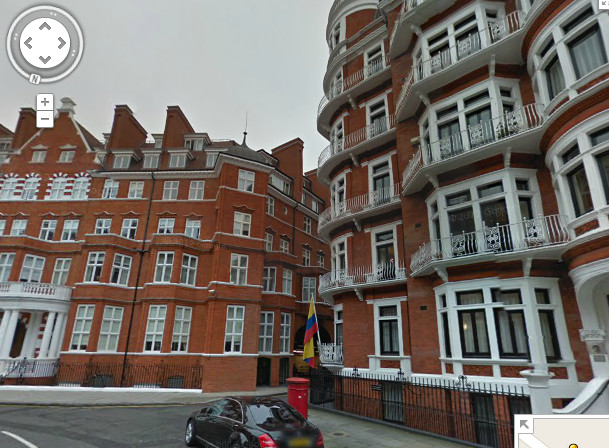
Ecuadorian Embassy, London… Google Street View
Grunwald is being the ugliest of Ugly Americas… basically cheerleading for death squads (or, in this case, a robotic death squad) sent against Latin Americans, as “punishment” for making the U.S. government uncomfortable.
Given the recent attempts to violate Bolivian immunity when — on behalf of the United States — President Morales’ plane was first denied a refueling stop, then overflight rights, then nearly boarded — all on an impossible story taken as probable that the Presidential plane was carrying somebody who was at one airport in Moscow had somehow boarded the Bolivian plane that was about 25 Km. away, I suppose bone-headed stupidity — and a concerted effort to destroy good relations — is SOP when the United States deals with Latin America.
Considering that a U.S. Customs and Border Protection surveillance camera reportedly recorded the Rodriguez Elena shooting, it seems like an especially good opportunity for the feds to step up and say, “The agent was justified in using lethal force, and here’s a video to prove it.” Instead, the video and other evidence that the feds control have been tightly sealed from public view.
 There are more questions than answers about the shooting death last October of Jose Antonio Elena Rodriguez. Neither the U.S. nor Mexican governments seem to be anxious to publicize what certainly appears to have been an intentional armed incursion into Mexico by a U.S. Federal paramilitary unit. The Border Patrol seems to expect people to take their word for it that it was a “justified” action… although how one justifies shooting someone in another country seven times in the back is a little more difficult to explain.
From the Nogales Internayional (via Green Valley (AZ) Sun):
The cross-border fatal shooting of 16-year-old Mexican citizen Jose Antonio Elena Rodriguez in October in Nogales remains in the public eye, despite and because of the shroud of secrecy that continues to surround it.
The incident in which a Border Patrol agent or agents shot Rodriguez 11 times – seven times in the back – during an alleged rock-throwing incident near West International Street, was featured prominently in a June 10 story by Fernanda Santos of The New York Times titled “Shootings by agents increase border tensions.” The story cites increased concerns by lawmakers, civil rights advocates and victims’ families over the Border Patrol’s use of lethal force, and notes that while the lengthy immigration bill now in the Senate addresses use of force on only one page, it still “provides the most decisive response to concerns so far.”
A story published two days later by KJZZ’s Fronteras: The Changing Americas Desk and titled “Immigration bill offers few changes to border patrol use of force,” also put the Elena Rodriguez shooting at the center of a discussion of the Border Patrol’s use-of-force policy and the Senate bill. Within that discussion were two observations that were especially noteworthy.
In the first, retired U.S. Customs special agent Terry Kirkpatrick, a Tubac resident and author of the book “Sixty Miles of Border,” described the chaos and fear of border shooting incidents. But he also wondered why the agents involved in the Elena Rodriguez shooting fired through the bars of the border fence instead of retreating.
“I would be questioning, if it was one of my agents, as to why that happened,” Kirkpatrick told reporter Michel Marizco.
This is a question we’ve been asking as well. After all, two Nogales Police Department officers were also at the scene and, while also being targeted by rock throwers, took cover instead of pointing a gun through the fence and firing into Mexico. The fact that so many shots were apparently fired into Elena Rodriguez’s back also needs further explanation….
Unless there were seven or eight “magic bullets” fired the night of 10 October 2012, those unseen videos would elucidate what really happened… the laws of physics (and common sense) make the Border Patrol story highly improbable:
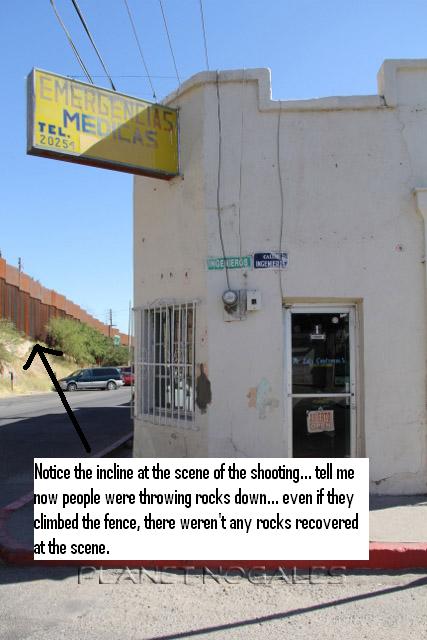
Photo: Planet Nogales
In published reports, the event occurred as the Border Patrol observed two youths wearing backpacks who were scaling the border wall. This was allegedly followed by a barrage of rocks thrown by youths standing on the Nogales, Mexico side of the fence. The agent then discharged his or her weapon on the group of rock throwers.
There are some factors that complicate this matter, however.
The shooting occurred at a location where the border fence sits atop a rocky crag with a sharp incline of more than 20 feet above the street below. Therefore, the shooter must have been standing at the border wall, with the muzzle of the pistol in the 4″ space between the iron bars of the fence, a location that would seemingly provide adequate protection from rocks thrown from below. If any rocks were actually thrown.
The claims of a “barrage of rocks” have come into question. it would not only take a great deal of effort to throw rocks over the fence from the street below (at an altitude between 30 to 40 feet), and it is apparent that there is no way that rock throwers could have seen their targets based on the difference in elevation, the border fence and vegetation blocking their view. In addition, the trajectory would have carried any projectiles far from the border fence. And there are no loose rocks to be found in the area.
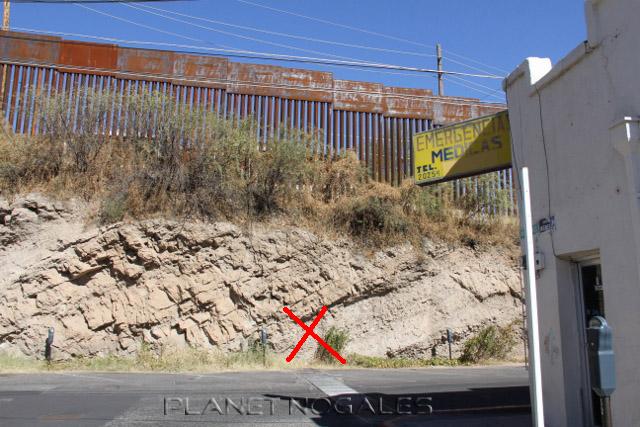
The kid was shot in the back about where the “X” is… which makes it impossible for him to have been on the fence, or in any way in U.S: territory.
Less than full disclosure: Pemex
At the beginning, Peña Nieto said that privatization is justified by the organization’s situation. But, surprise, surprise, this is also doublespeak, given that to the outside world, the Government is offering an unrealistic image of the current state of Pemex “in Mexico and globally”, as well as “the return on investment in Pemex.”
Adolfo Sánchez Rebolledo in La Jornada on the intellectual dishonesty of the marketing (and  there is no other word for it) of Pemex “reforms”. A translation, by Stuart Taylor, was posted on the Mexico Voices blog.
Some friends sent me a document from Pemex that has been broadcast on social networks aimed at potential investors in Mexico and abroad (ExpoForo Pemex). Written in July 2012, the text is the opposite of the pessimistic attitude of the current government, which uses the disarray in which Pemex finds itself as justification for privatization. It uses that self-prophecy, woven over the years, to convince Mexicans that there is no better path than re-opening the doors to private capital in the energy industry. In order to achieve this, initially they unsuccessfully fought “constitutional taboos”, unfairly ridiculing them as relics incompatible with modern times.
Given that this had no effect, they now put forth rejected slogans, repeating word for word, from Peña Nieto on down, that the presidential initiative is nothing more than a repetition of the original 1940 vision of President Lázaro Cárdenas.
Make no mistake about it, the “reforms” are intellectually dishonest. On the one hand, we’re told Pemex is broke, and won’t survive without foreign capital. On the other, foreign investors are being told Pemex is a sure fire money-maker.
We’re told Pemex is going broke because it allocates too much money to the government. How we’d be better served if the profits are shelled out to foreigners isn’t said.
And, of course, Pemex isn’t broke, and the only reason it needs to expand capacity is to serve foreign oil (i.e. U.S.) demand. Given that Pemex is a natural resource management company, in reality, it doesn’t have to export oil at all… we were promised six new refineries in the last administration, none of which is yet on line, and as far as I can tell, only one of which even saw the start of construction.
… Pemex is the 13th most successful company in the Americas and 34th in the world. Furthermore, it has been the fourth largest world producer of crude oil since 2008, the third largest exporter of crude oil to the U.S. and has the 13th largest total reserve of crude oil – “a strong position considering the company’s organic growth.” And for the record, Pemex ranks 14th in total profits, “with over 100 billion dollars made in sales.” Additionally, the text indicated, “Pemex’s profits are comparable to the five most profitable companies on the consumer price index… demonstrating a good cost structure and operational efficiency.”
Mexico is still way ahead of the U.S.
Not that I follow pro wrestling all that much, but there is a lot of talk about Darren Young, the first openly gay WWE wrestler. OK, the first in that circuit, but not the first out professional wrestler by any means. Back when I was teaching myself to translate Spanish, I posted in December 2004 about two out professionals on the AAA Luche Libre circuit “Mis Flores” and “Polvo de Estrellas”,

My Flowers does not have a favorite wrestling hold. But for Polvo, “I grab the first thing I can, but what pisses off an opponent is when I grab them by their testicles. They get angry and yell.
“HELP! A homosexual has me by the balls!” My Flowers mimicked.
He added, more seriously that there are always going to be homosexual fighters. Polvo knowingly adds that “time is the only thing that will stop us. We’re doing what we want to do, and I’ll keep going as long as the public lasts.”
For My Flowers “Luche libre is my life. I don’t know what I’ll do in the future. My only fear is old age,” says My Flowers. “And death,” adds Polvo.
Says Polvo: “I am neither proud nor ashamed of being a homosexual. Accept it.”
Ah, youth
Young Mexicans may not read the newspapers, and they may get most of their information from our conservative television broadcasts, but they are hardly falling for the “official line” presented by the government and are much further to the left than the perceived mainstream.
(via Regeneración… my translation)
A national survey of young adults (18 to 29 years old), Cultura Política de los Jóvenes 2012 — prepared by Colegio de México in collaboration with Berumen y Asociados — was based on interviews with 3250 young adults in 76 cities.
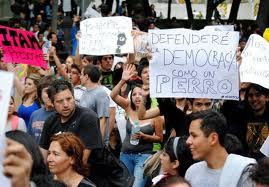 Among the more surprising findings was that 49 percent of young Mexicans do not read newspapers. Of those who do read newspapers, a third are most interested in the sports section, 25.6% in the police section, and only 0.7% of young newspaper readers turn to the political columns.
Only 8 percent read nationally distributed newspapers: El Universal, 8 percent; La Prensa, 1.5 percent; La Jornada, 1.1 percent; and Reforma and Milenio, both 0.8 percent. The study reveals that 95% of Mexican youth reported through television.
Although about a third (32 percent) of young adults claim no political affiliation, over 90 percent “lean to the left” when asked about specific issues. 90 percent rejecting a sales tax on food and medication; 70 percent opposed to opening Pemex to private capital; 72 percent against religious instruction in public schools; 87 percent against privatizing public services like water distribution; and 78 percent categorically rejecting the use of military force to maintain public order.
As it was in the beginning…
Lázaro Cárdenas’ address to the people on his decision to expropriate the oil industry lasts about fifteen minutes, covering the ethical, legal and financial issues and risks. Enrique Peña Nieto’s just over two minute address on de-nationalization is a slick campaign ad, offering… nothing specific.
… is now…
Sorry to hear it
Joel Ortega Cuevas, General Director of the General Director Mexico City’s Metro System, said police are beefing up plans to systematically prevent street vendors, known as vagoneros from entering metro stations.
(full story, in Spanish, at 24 Horas)

The painful birth
“Neither a triumph nor a tragedy, but the painful birth of the mestizo people of today’s Mexico”
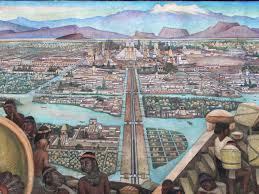
Cuauhtémoc, tlatoani of Tenochtitlan, surrendered the Aztec forces making their last stand at Tlatelolco to Hernan Cortés 13 August 1521.

Stand by, we are experiencing political difficulties
Steve Cotton — a U.S. “Mexpatriate” living in one of the resort towns along the Pacific (well, so do I) posted a succint, US-centric overview of the history of oil expropriation here (Fill’er up) back on the first of August.
During his presidential campaign, Peña Nieto promised to open Mexico’s oil industry to the private sector — including foreign investors. He won on that platform.
To American and Canadian ears the proposal simply made sense. Liberal economics recognizes that government-controlled monopolies are inherently inefficient. A more competitive market and an infusion of new investment and technology would be a no-brainer up north.
But this is not Canada or The States. This is Mexico. What candidate Peña Nieto proposed was as radical as President Obama proposing to repeal the Second Amendment.
This is the position taken by all the U.S./Canadian/British business publications that have weighed in on the issue, so rather than bury you in links to Reuters, The Economist, Globe and Mail, Wall Street Journal, etc., I’ll riff off Steve (besides, it’s one of the better “my life in Mexico” sites, managing to get beyond the merely personal and various gringo crotchets).
To say Peña Nieto was elected on a platform of opening the oil industry to the “private sector” is a vast overstatement. I honestly can’t find any analyst in Mexico (or outside Mexico) who has said that. Certainly, it was somewhere in his umteen promises, but was used mostly by opponents (like AMLO) as a reason NOT to vote for him. Even among those who are in denial about the fraud and dirty tricks that marred the last Presidential election (and the one before that), the sense is that PRI had the better political machinery, and that PAN had a lousy candidate, running to replace an extremely disliked, and disgraced, PAN administration. That the PRD candidate was targeted for defeat by both of the two neo-liberal parties — with a probable assist from the United States — it was inevitable that Peña Nieto gained the Presidency.
Certainly, I think that the noises being made about “privatizing PEMEX” helped his candidacy (at least with foreign parties and possibly with foreign money), but it was hardly the key to his “victory”, nor is it at all a popular position in this country. Even before Steve posted his piece, Forbes had reported on a poll by CIDE (Centro de Investigación y Docencia Económicas), a respected pro-business “think tank” showing about two-thirds of Mexicans rejected any privatization of the oil industry. A month before Steve posted (26 June 2013), Forbes was reporting:
Peña Nieto is counting on the Pact for Mexico, an alliance of the country’s top three political parties, to try to get the reform passed. The proposal, which is expected to involve reforming the Constitution, will need two-thirds support from Mexico’s Congress; the PRI, his party, does not hold a simple majority in either house. Peña Nieto reported that he’s negotiating to get the political support he needs to break the state monopoly. However, some analysts believe that the Pacto, which succeeded in getting through a monopoly-busting telecom reform in May, will not hold up this time.
In other words, this wasn’t a populist move (one that might get a guy elected), but one that depended on a political pact … among the leaders of the three main parties. PRD and the smaller left-wing parties have already signaled their opposition, and so have a number of PRI office holders… who can read polls as
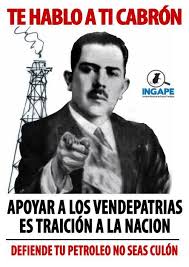
And, despite what U.S. based Jorge Castañeda says, history matters here.
well as anyone else. Even PAN is “iffy” on the “Pact for Mexico”, although PAN — which has never seen a privatization opportunity at least someone in the party doesn’t back, has been, as Steve noted, giving cover to a “don’t call it privatization” privatization (sort of in line with the “don’t call it the War on Drugs” War on Drugs we’d been subject to in the last — and this — administration) with its introduction of a proposal to
open the oil industry to private interests by amending article 27 to end the prohibition on oil and gas concessions and risk-sharing contracts, and to “guarantee the maximum benefit of oil profits for the nation from the work of the operators who conduct exploration and production activities.”
After putting off introduction of the proposed changes… first by a day, then by a week… and supposed to be presented tomorrow (12 August), which are said to include some (undefined) changes to Article 27 (dealing with the ownership of natural resources) of the Constitution. But… care is being taken to call any foreign participation “strategic alliances” and not foreign investment.
While PEMEX probably does need a cash infusion, the left (and some on the right) have been quick to note the poor management of the national company (possibly by design?) and the state’s over-reliance on PEMEX revenue for operating funds. That doesn’t require foreign resources, which — if they do come into the company — are more likely to be from other state oil companies, like Brazil’s Petrobras, Venezuela’s PDVSA or Norway’s Statoil than from any of the “seven sisters” (which when you come down to it, are smaller companies than PEMEX).
And, last time this came up it went down to defeat, in the streets and in the halls of Congress, which is more than likely to happen again.
More when I see what the actual proposals are. The only prediction I feel comfortable in making is that the U.S./Canadian/British business press aren’t going to be reporting what their readers want to hear.


 mexfiles.net